


In the world of software architecture and system design, visual modeling is no longer a luxury — it’s a necessity. UML (Unified Modeling Language) diagrams serve as the blueprint for development, enabling teams to communicate complex system behaviors, structures, and interactions clearly and consistently. Yet, creating these diagrams has long been a time-intensive, manual process — often bogged down by the mechanics of layout, syntax, and iterative refinement.
Enter Visual Paradigm’s AI Diagram Generation — a game-changing feature that transforms how developers, architects, and designers approach visual modeling. By leveraging advanced artificial intelligence, this tool turns abstract ideas into professional, accurate, and instantly usable UML diagrams — not through code or templates, but through natural language and intelligent conversation.
From Blank Canvas to Professional Diagram in Seconds
One of the biggest hurdles in visual modeling is the dreaded “blank canvas” syndrome. Starting from scratch means manually dragging elements, connecting them with lines, aligning components, and adjusting layouts — a process that distracts from the real goal: design thinking.
Visual Paradigm’s AI Diagram Generator eliminates this friction entirely. Instead of wrestling with tools and grids, users simply describe their system in plain English. For example:
“Create a state machine diagram for a toll booth system where a car arrives, the license plate is scanned, if valid it pays and leaves, otherwise it’s flagged for manual review.”
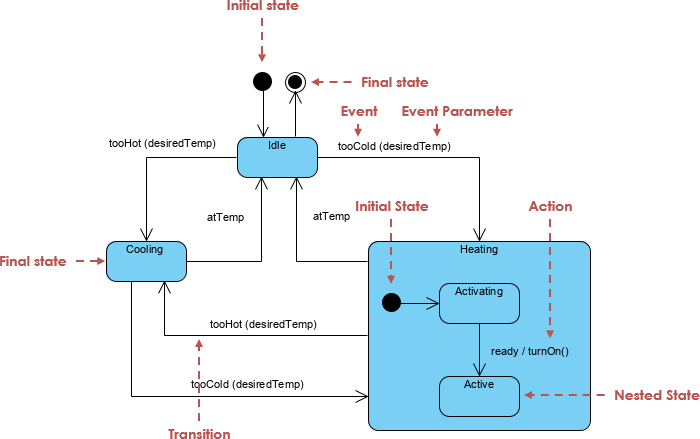
Within seconds, the AI generates a fully formed, correctly structured State Machine Diagram with:
-
Properly defined states (e.g., Approaching, Scanning Plate, Valid, Invalid, Pay, Leave)
-
Accurate transitions with triggers and guards
-
Correct entry/exit actions and internal transitions
-
A clean, readable layout following UML best practices
No more guesswork. No more trial-and-error. Just design intent translated into visual clarity — instantly.
Intelligent Interpretation: Understanding Intent, Not Just Syntax
What sets Visual Paradigm’s AI apart is its ability to understand context and logic, not just parse keywords. Unlike traditional diagramming tools that require users to learn specific syntax (like PlantUML or Mermaid), the AI interprets natural language with precision.
For instance, when you say:
“Add a sequence diagram showing a user logging in, where the system checks credentials and sends a confirmation email if successful.”
The AI:
-
Identifies actors (
User,System) -
Detects sequence of messages (
Login Request,Validate Credentials,Send Email) -
Understands conditional logic (
if valid) and applies proper alt or if fragments -
Ensures proper lifelines, activation bars, and message ordering
This level of semantic understanding means you don’t need to be a UML expert to create industry-standard diagrams — just a clear idea of how your system behaves.
Smart Automation for Complex Systems
Complex systems — such as banking transactions, e-commerce workflows, or IoT control systems — often involve intricate logic with nested states, error handling, and asynchronous behaviors. Manually modeling these can be overwhelming.
Visual Paradigm’s AI handles this complexity automatically:
-
Sub-states and regions are inferred from descriptions like “When the user is logged in, they can access dashboard, profile, or logout.”
-
Error paths are automatically generated: “If authentication fails, show error message and allow retry.”
-
Guards and triggers are added where needed: “Only proceed if the balance is sufficient.”
-
Notation compliance: All elements follow UML 2.5+ standards, ensuring consistency across teams and documentation.
This automation means you spend less time on mechanics and more time on meaningful design decisions — like whether a state should be composite, or whether an error should be retried or escalated.
Conversational Refinement: Design with Dialogue, Not Just Drag-and-Drop
Great design isn’t created in one go — it evolves. Visual Paradigm’s AI supports iterative refinement through natural conversation, making it easy to adjust, expand, and validate your models.
You can now:
-
Rename elements: “Change ‘Customer’ to ‘Buyer’ in the sequence diagram.”
-
Add missing steps: “Insert a step where the system logs the login attempt.”
-
Reorganize transitions: “Swap the order of the payment and confirmation steps.”
-
Analyze logic: “Find any unreachable states in the current state machine.”
The AI doesn’t just execute commands — it validates the logic behind them. It flags:
-
Unreachable states (e.g., a state that can never be entered)
-
Conflicting transitions (e.g., two transitions that can’t both fire)
-
Missing guards or incomplete entry/exit actions
This real-time feedback loop enables rapid prototyping and validation, helping teams catch design flaws early — before they become costly bugs.
Seamless Integration into the Development Workflow
Visual Paradigm’s AI Diagram Generation isn’t a standalone tool. It’s fully integrated into the Visual Paradigm IDE and modeling environment, allowing for a smooth workflow:
-
Describe your idea in natural language.
-
Generate a high-fidelity UML diagram instantly.
-
Refine it through conversation.
-
Import the diagram into your project for further development.
-
Use it for documentation, code generation, or stakeholder communication.
This integration means:
-
No file exports/imports
-
No learning curve for syntax
-
No context switching
Designers can now focus on what the system should do, not how to draw it.
Empowering Teams Across Roles
The benefits of AI-powered diagram generation extend across the software lifecycle:
-
Architects can quickly prototype system behavior and explore alternatives.
-
Developers can generate accurate diagrams to guide implementation and ensure alignment with requirements.
-
Product Managers can visualize workflows and validate user stories with minimal technical effort.
-
QA Engineers can use generated diagrams to map test scenarios and coverage.
By lowering the barrier to entry, Visual Paradigm’s AI makes collaborative design accessible to non-technical stakeholders, fostering better communication and reducing misunderstandings.
Conclusion: The Future of Visual Modeling is Conversational
Visual Paradigm’s AI Diagram Generation is more than a productivity tool — it’s a paradigm shift in how we model systems. It replaces the manual, error-prone process of drawing diagrams with an intelligent, conversational approach that focuses on design thinking, clarity, and accuracy.
By transforming natural language into professional UML diagrams, automating complex logic, and enabling iterative refinement through dialogue, the AI empowers teams to:
-
Accelerate design cycles
-
Improve model quality
-
Collaborate more effectively
-
Focus on innovation, not mechanics
In a world where speed and clarity are critical, Visual Paradigm’s AI Diagram Generation isn’t just helpful — it’s essential.
Turn your idea into a diagram. Talk to your system. Let AI do the rest.
Related posts:
 Modularize, Reuse, and Scale: The Role of Introduction: Why I Switched to AI-Assisted UML Modeling
Mastering UML Class Diagrams: A Review of Visual Paradigm’s Learning Resources
Modularize, Reuse, and Scale: The Role of Introduction: Why I Switched to AI-Assisted UML Modeling
Mastering UML Class Diagrams: A Review of Visual Paradigm’s Learning Resources