


1. Executive Summary
Visual Paradigm (VP) has established itself as a certified, comprehensive environment for enterprise architecture modeling. Recently, it has undergone a significant transformation with deep AI integration, enabling the automation of diagram creation, semantic analysis, and impact assessment. As a certified tool by The Open Group, Visual Paradigm is the premier choice for organizations adhering to ArchiMate 3.1 and the latest ArchiMate 4 standards.
This guide reviews the tool’s capabilities across three domains: Core Compliance, ArchiMate 4 Enhancements, and AI-Driven Intelligence, providing workflows, key concepts, and actionable strategies for modern Enterprise Architects.
2. Core ArchiMate Compliance & Standards Support
Visual Paradigm is the first modeling tool to offer full certification for ArchiMate specifications, ensuring syntactic and semantic correctness for enterprise models.
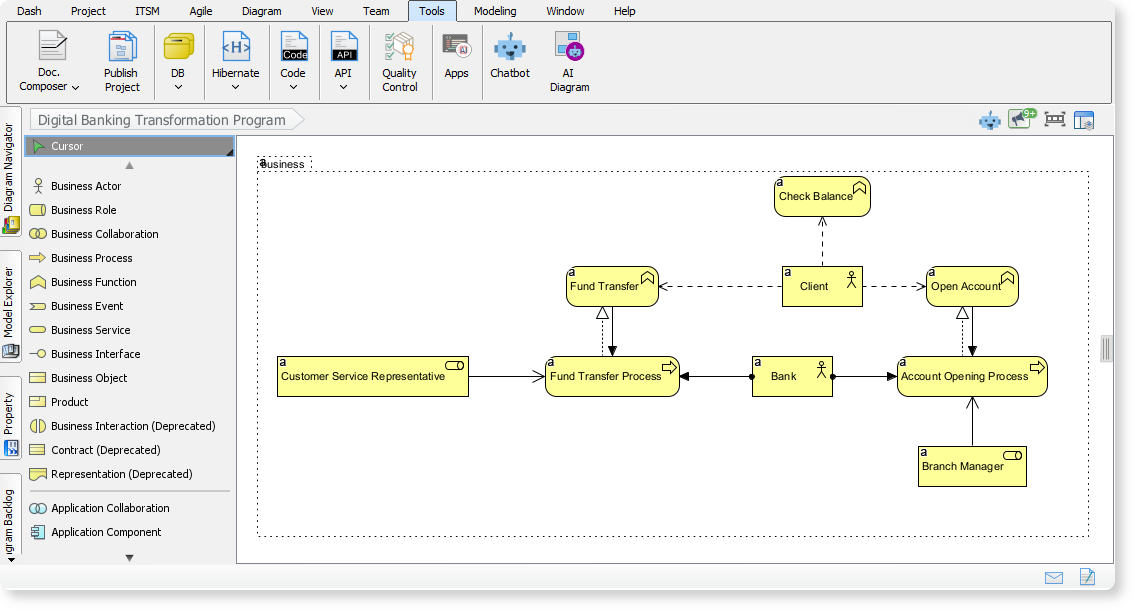
2.1 Full Specification Coverage
- Standards Supported: ArchiMate 3.1 and ArchiMate 4.
- Vocabulary & Notation: The tool supports the entire lexical inventory, including:
- Business Layer: Business Roles, Personnel, Courses, Jobs.
- Application Layer: Services, Business Functions, Interactions.
- Technology Layer: Software Architectural Elements, Hardware Nodes, Data Stores.
- Extensions: Strategy, Motivation (Goals, Drivers), Implementation & Migration.
- Model Validation: Built-in validators automatically check models against standard rules (e.g., verifying that a Business Service correctly contains Application Services), alerting users to broken dependencies or missing elements before publication.
2.2 Interoperability
- Native Multiplicity: Users can define precise cardinality constraints (e.g.,
1..1,0..n) directly on connectors and annotations to express rigorous structural relationships. - Traceability: The tool maintains end-to-end traceability, allowing linkages between ArchiMate models, BPMN diagrams, and UML models. Changes in one domain automatically propagate to connected diagrams.
- Exchange Formats: Supports the Model Exchange File Format (MXF) and XMI for seamless import/export between different tools or furniture libraries.
3. ArchiMate 4: Unified Domain & Hexagonion Framework
Visual Paradigm 18.0 introduces next-generation support for ArchiMate 4, moving away from rigid layering toward a more flexible, requirement-driven approach.
3.1 The Unified Domain Approach
- Concept: Transition from the traditional three discrete layers (Business, Application, Technology) plus strategy, to a flexible “Common Domain” where elements are defined once and used across multiple views based on context, not just technological stack.
- Workflow Example:
- Define a Goal in the Strategy layer.
- Define a Business Process in the Business layer that realizes that goal.
- Define a Service in the Common Domain that links the process to a technical implementation.
- The model is valid because the Common Domain aggregates these views dynamically, preventing the siloing of “motivation” from “implementation.”
3.2 The Hexagonion Framework
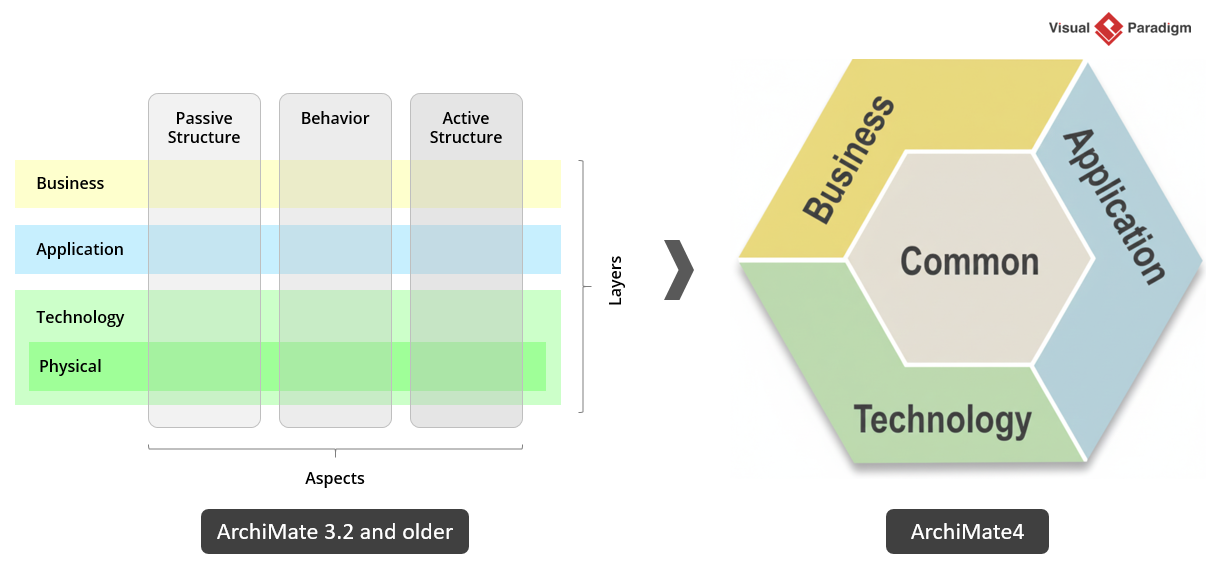
- Purpose: A visualization framework focused on outcomes rather than just structures. It visualizes how architectural decisions lead to specific business results.
- Implementation: Users can map elements into hexagonal views to show the flow from Strategic Goals Business Capabilities, Applications IT Systems. This aids stakeholders in seeing the “big picture” integration.
3.3 Advanced Viewpoint Management
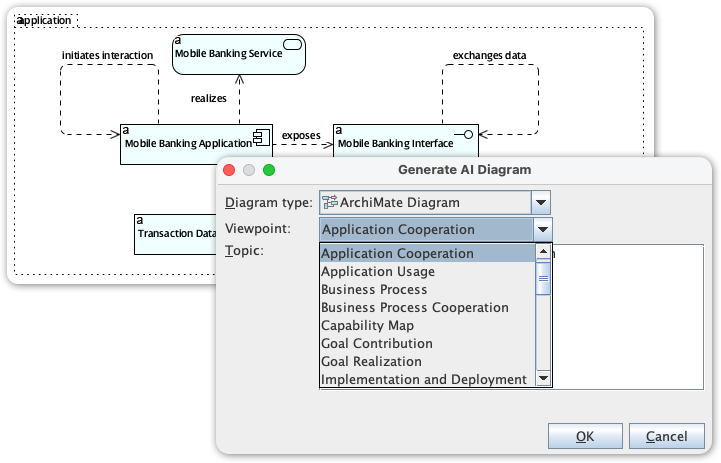
- Official Viewpoints: 100% support for all standard viewpoints (e.g., Layered, Physical, Application Usage, Technology Usage).
- Custom Viewpoint Creation:
- Users can create user-defined viewpoints by selecting specific subsets of elements (e.g., “Security View” limited only to Security Risks and Access Control features).
- Constraint Palettes: Ensure modelers only drop allowed elements (e.g., preventing a Business Analyst from dragging Technical Servers onto a high-level Strategy canvas).
4. AI Integration: Automating Enterprise Architecture
Visual Paradigm’s AI engine is trained specifically on ArchiMate and UML standards, distinguishing it from generic LLMs. It focuses on transforming natural language into structured, compliant artifacts.
4.1 AI ArchiMate Generator
- Function: Converts high-level requirement descriptions or topic texts into full-fledged modeled diagrams.
- Example Input: “Design a view of our payment processing system including the bank gateway, fraud detection service, and the cloud backend.”
- Output: The AI automatically generates the relevant elements (Application Services, Hardware, Data Stores) and draws the correct relationship connectors (Realization, Usage, Association).
- Unique Selling Point: It enforces semantic rules; it won’t generate an invalid connection type for unrelated elements.
4.2 Automated Viewpoint Generation
- Function: Users can describe a desired perspective in a conversational interface, and the tool generates the appropriate diagram.
- Workflow:
- Prompt: “Generate a Technology Usage view of the customer login module.”
- Result: The tool filters the massive model, extracting only the relevant technology nodes and their usage instances, displaying them in the correct notation.
4.3 Conversational Editing (AI Chatbot)
- Natural Language Refinement: Users can interact with their diagram directly via chat commands rather than clicking complex menus.
- Capabilities:
- “Add an actor named ‘Customer Support Agent’ to the main process.”
- “Rename Service A to ‘Payment Gateway v2’.”
- “Decompose the ‘Order Processing’ into three sub-processes based on standard design patterns.”
4.4 Architectural Critique & Impact Analysis
- Logic Gap Detection: The AI scans diagrams for flaws, such as missing multiplicities (e.g., not specifying if a process runs once or many times) or “single points of failure” in high-availability designs.
- Pattern Suggestions: If a loop is detected without governance, the AI suggests design patterns like MVC or Hexagon Architecture.
- Intelligent Impact Analysis: Query results in plain English.
- Query: “What happens if we decommission the Billing System?”
- Answer: The engine highlights 4 affected Business Processes, 2 breached Service interfaces, and 1 Strategy Goal at risk, calculating the ripple effect instantly.
5. Strategic Workflows & TOGAF Integration
Visual Paradigm is designed to accelerate the TOGAF ADM (Architecture Development Method).
5.1 Linking to TOGAF
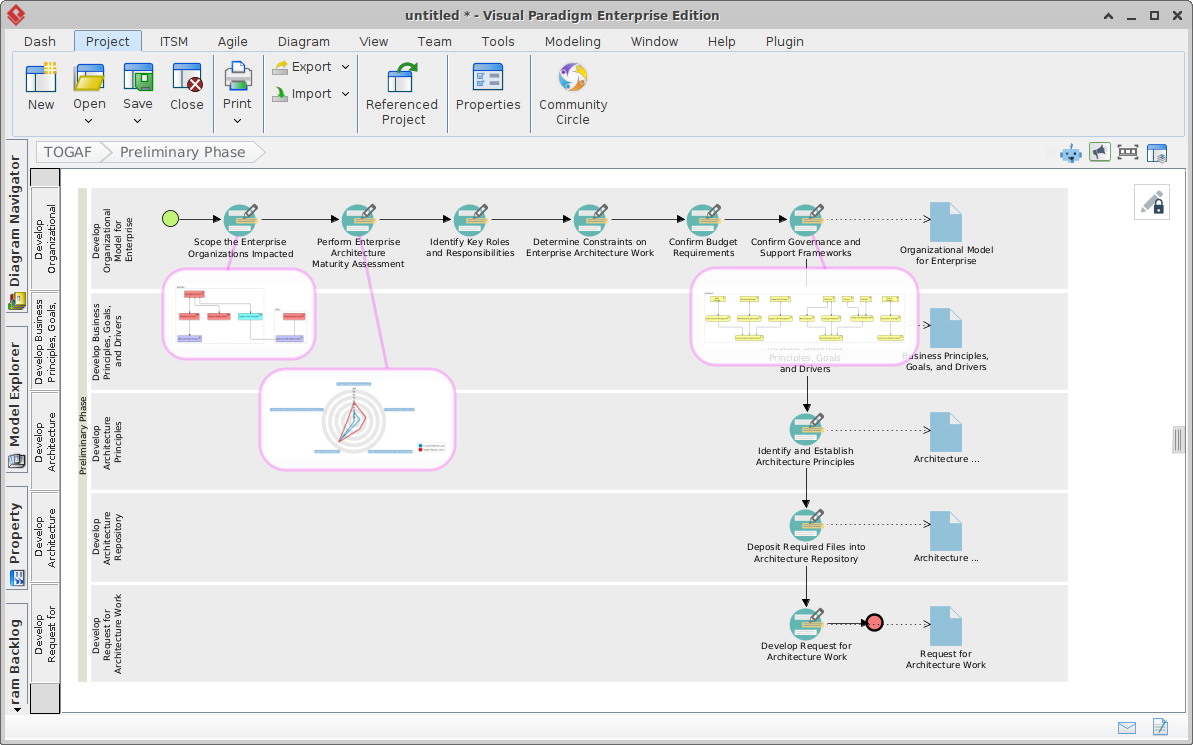
- Requirements Gathering: Use AI to generate requirements from stakeholder inputs, automatically creating the Architecture Vision and Business Architecture models.
- Migration Planning: Use the Implementation & Migration viewpoints to create step-by-step transformation diagrams, leveraging AI to generate the sequence of changes required to move from the Baseline to the Target state.
- Stakeholder Concerns: Map specific stakeholders (e.g., CIO vs. CTO) to specific customized viewpoints using the constraint palette feature.
5.2 Cross-Model Traceability
Ensure that the Strategy does not contradict the Implementation. The tool creates a “Golden Thread,” allowing architects to click a Strategy Goal and see exactly which Applications and Data Stores are proposed to achieve it, and conversely, trace back any existing IT Debt that prevents the goal.
6. Key Concepts Summary Table
| Feature Category | Key Concept | Practical Benefit |
|---|---|---|
| Certification | Open Group Certified | Guarantees compliance with ArchiMate 3.1 & 4 syntax/semantics. |
| Modeling | Unified Domain | Removes silos between Strategy, Business, App, and Tech. |
| Visualization | Hexagonion | Visualizes outcomes and decision rationales clearly. |
| AI Generation | Text-to-Model | Reduces modeling time from days to minutes for prototyping. |
| Validation | Smart Compliance | Auto-checks for missing links, invalid multiplicities, and broken views. |
| Interaction | Conversational AI | Allows non-modelers to refine diagrams using natural language. |
| Analysis | Impact Analysis | Predicts consequences of change before implementation. |
7. Implementation Roadmap
- Deployment: Install Visual Paradigm Enterprise Modeling Tool.
- Standardization: Review organizational standards against Open Group certifications.
- Model Migration: Import legacy UML/BPMN models and trace them to ArchiMate 3/4 standards.
- AI Training (Optional): Fine-tune the AI on specific organization vocabulary if desired.
- Pilot Workflow: Use the AI Generator to create a new High-Level Architecture from a requirements document.
- Validation: Run the Built-in Validator to ensure all connections are valid ArchiMate 4 relationships.
8. Conclusion
Visual Paradigm represents the current pinnacle of Enterprise Architecture modeling. By combining Open Group certification with cutting-edge AI, it solves the perennial problem of “garbage in, garbage out” in architecture modeling. The shift to the ArchiMate 4 Unified Domain allows for more flexible, outcome-based modeling, while the AI-driven critique and generation features significantly reduce the time-to-value for architectural initiatives.
For organizations looking to modernize their EA practices, adopt a unified domain approach, or simply speed up their diagram creation, Visual Paradigm is the recommended tool.
Are you ready to explore specific workflows? Check the official Tool Guide or dive deeper into the AI Documentation.
Reference List
- Updates Visual Paradigm AI ArchiMate Viewpoints Generator: Documentation detailing the new AI capabilities for generating ArchiMate viewpoints from natural language prompts.
- Visual Paradigm Main Website: Official homepage for Visual Paradigm, serving as the primary hub for product information, features, and community resources.
- Visual Paradigm ArchiMate 4 Support Release: Official release notes describing the implementation of ArchiMate 4 features, including the Common Domain and Hexagonion Framework.
- Mastering ArchiMate: A Comprehensive Guide: A thorough guide covering the evolution of the ArchiMate framework and best practices for modeling using Visual Paradigm.
- Visual Paradigm ArchiMate Tools Page: Dedicated section outlining specific features, workflows, and capabilities of the ArchiMate modeling tool within the suite.
- Visual Paradigm ArchiMate 3 Update: Technical details on ArchiMate 3 support, including updates to the model exchange file format and standard vocabulary.
- What is ArchiMate: Educational resource explaining the core concepts, layers, and extensions of the ArchiMate framework.
- Maximizing Enterprise Architecture with Visual Paradigm 18.0: Third-party analysis of Visual Paradigm 18.0’s support for ArchiMate 4, focusing on efficiency and compliance.
- Visual Paradigm 18.0 Release Highlights: Video walkthrough highlighting the new features in Visual Paradigm 18.0, including unified behavior elements, the Common Domain, and Hexagonion.
- Comprehensive Guide to ArchiMate 4 Support in Visual Paradigm: Detailed article on the architecture of the 18.0 release and its specific enhancements for ArchiMate modeling.
- Visual Paradigm as Premier ArchiMate Tool: Review positioning Visual Paradigm against other tools in the enterprise architecture space.
- Visual Paradigm Enterprise Modeling Tool: Overview of the broader enterprise modeling capabilities beyond just ArchiMate.
- Enhanced AI Activity Diagram Support: Updates regarding the AI chatbot’s capabilities in generating and editing activity diagrams.
- Archimate Explained: AI-Powered EA: Documentation specifically explaining how to use AI to create and manage ArchiMate models.
- Visual Paradigm 18.0 General Updates: General release notes and feature list for Visual Paradigm version 18.0.
- Enhancing TOGAF ADM with Archimate: Guide on integrating Visual Paradigm with TOGAF methodologies for agile modeling.
Related posts:
 Comprehensive Guide to Integrating TOGAF with ArchiMate, UML, and BPMN in Visual Paradigm
 Comprehensive Guide to Using Visual Paradigm for ArchiMate Modeling
 Comprehensive Guide to Using Visual Paradigm for TOGAF ADM with ArchiMate Integration
 Comprehensive Guide to Gap Analysis in TOGAF Using Visual Paradigm