
Project management is often viewed through the lens of timelines and deliverables. However, financial stewardship is the backbone that supports every successful initiative. For early career managers, the transition from executing tasks to managing resources requires a shift in mindset. Budget estimation is not just about adding numbers; it is about predicting future states, managing risk, and building trust with stakeholders.
When you underestimate costs, you jeopardize project viability. When you overestimate, you risk losing resources to other departments. Finding the balance requires a disciplined approach and a toolkit of proven techniques. This guide outlines the essential methods to create reliable budgets without relying on guesswork.
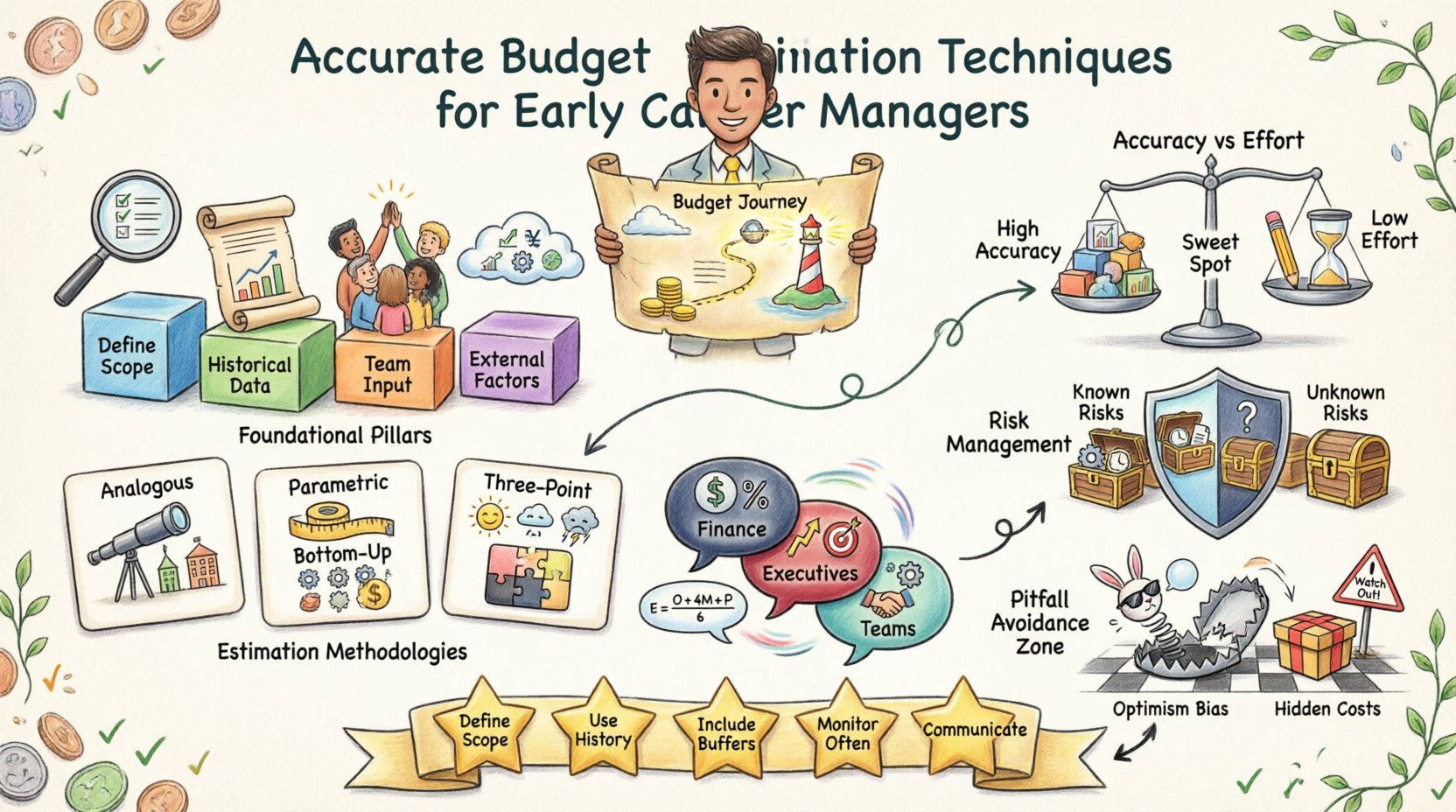
Why Precision Matters in Financial Planning 💰
Accurate budgeting serves multiple critical functions within an organization. It is not merely a record-keeping exercise but a strategic planning tool.
- Resource Allocation: It determines what talent, tools, and materials are available.
- Performance Measurement: It provides a baseline to measure success or identify variances.
- Stakeholder Confidence: Consistent adherence to budget builds credibility with leadership.
- Risk Mitigation: It highlights potential financial shortfalls before they become crises.
For new managers, establishing a reputation for financial reliability is as important as delivering on time. A budget that is consistently accurate allows you to focus on execution rather than explaining variances.
Foundational Principles of Cost Estimation 🏗️
Before selecting a specific technique, you must understand the core principles that govern cost estimation. These principles ensure your numbers are grounded in reality rather than optimism.
1. Define the Scope Clearly
You cannot estimate what you cannot define. A vague scope leads to vague costs. Ensure that every deliverable is documented and understood by the team. Ambiguity is the primary enemy of accurate estimation.
2. Gather Historical Data
Look at past projects. What were the actual costs? How did they compare to estimates? Historical data provides the most reliable indicator of future performance. If historical data is unavailable, benchmark against industry standards.
3. Involve the Team
Those doing the work know the effort required best. Excluding team members from the estimation process often leads to unrealistic targets. Their input adds technical depth to the financial plan.
4. Account for External Factors
Market conditions, inflation, and supply chain delays impact costs. A static number rarely survives a dynamic environment. Your estimate must acknowledge that variables exist.
Primary Estimation Methodologies 🔍
Different projects require different approaches. There is no single “best” method. The choice depends on the amount of detail available and the phase of the project lifecycle.
1. Analogous Estimating
Also known as top-down estimating, this method uses data from similar past projects to determine the cost of the current one. It is quick and relies on high-level comparisons.
- Best Used For: Early phases where details are scarce.
- Pros: Fast, requires minimal data.
- Cons: Less accurate, relies heavily on the similarity of past projects.
Example: If a previous software rollout cost $50,000 and the new project is 90% similar, you might start with a baseline of $45,000.
2. Parametric Estimating
This technique uses statistical relationships between historical data and other variables. It scales costs based on specific units of work.
- Best Used For: Repetitive processes with known unit costs.
- Pros: More accurate than analogous if data is robust.
- Cons: Requires detailed historical data and reliable unit rates.
Example: If laying carpet costs $5 per square foot, and the office is 10,000 square feet, the estimate is $50,000. This can be applied to coding hours per feature or construction square footage.
3. Bottom-Up Estimating
This is the most detailed method. You estimate the cost of individual work items and aggregate them to form the total project budget.
- Best Used For: Later phases with a detailed work breakdown structure (WBS).
- Pros: Highest level of accuracy.
- Cons: Time-consuming, requires significant planning.
Example: Break down a marketing campaign into ads, copywriting, design, and distribution. Estimate each line item, then sum them up.
4. Three-Point Estimating
This technique accounts for uncertainty by calculating three distinct values for every task.
- Optimistic (O): Best-case scenario.
- Pessimistic (P): Worst-case scenario.
- Most Likely (M): Realistic expectation.
The weighted average is often calculated as: (O + 4M + P) / 6. This smooths out extreme outliers and provides a more realistic figure.
Comparing Estimation Techniques 📋
Choosing the right tool requires understanding the trade-offs. The table below summarizes the key differences.
| Technique | Accuracy | Effort Required | Best Phase |
|---|---|---|---|
| Analogous | Low | Low | Initiation |
| Parametric | Medium | Medium | Planning |
| Bottom-Up | High | High | Execution |
| Three-Point | High | Medium | Risk Analysis |
Managing Contingency and Reserves 🛡️
No estimate is perfect. Unknowns exist. To protect the project, you must include buffers. However, these buffers must be managed transparently.
1. Cost Contingency Reserve
This is money set aside for known risks. These are risks you have identified during planning. If the risk occurs, you use the reserve. If it does not, the funds may be reallocated.
2. Management Reserve
This is money set aside for unknown risks. These are “unknown unknowns”. Accessing this reserve usually requires approval from senior leadership or the steering committee.
3. Calculating the Buffer
There is no universal percentage for reserves. Common practices range from 5% to 20% depending on project complexity. Consider the following factors:
- Project Complexity: More complex systems require higher buffers.
- Team Experience: Newer teams may need more contingency for learning curves.
- External Dependencies: Projects relying on vendors or third parties need higher reserves.
- Historical Variance: If your organization typically overspends by 10%, factor that in.
Common Pitfalls for New Leaders 🚫
Even with the right techniques, human error can derail a budget. Awareness of common mistakes helps you avoid them.
1. Optimism Bias
It is natural to want to present a positive outlook. However, assuming everything will go perfectly leads to shortfalls. Challenge your assumptions. Ask “What could go wrong?”
2. Ignoring Hidden Costs
Direct costs are obvious. Indirect costs are often missed. These include:
- Training time for new tools.
- Overhead and administrative fees.
- Cost of meetings and collaboration time.
- Software licenses and subscriptions.
3. Failing to Update Estimates
Estimates are not static documents. As the project evolves, so should the budget. If scope changes, the budget must change. Updating estimates regularly keeps the plan relevant.
4. Underestimating Change Requests
Change is inevitable. Each request for change should have a cost impact assessment attached. Do not approve changes without understanding the financial implication.
Risk Response Strategies 📉
Financial risks need specific responses. Here is how to categorize and address them.
| Risk Type | Description | Response Strategy |
|---|---|---|
| Cost Overrun | Expenses exceed budget | Reduce scope or increase budget approval. |
| Resource Shortage | Key staff unavailable | Train backups or hire contractors. |
| Price Fluctuation | Vendor prices rise | Lock in contracts early. |
| Delays | Timeline slips impact costs | Add buffer time to schedule. |
Maintaining Budget Integrity 📝
Once the budget is approved, the work of monitoring begins. You must track actual spend against the planned spend.
1. Track Variances Regularly
Review financial reports weekly or monthly. Identify variances immediately. A small variance is easier to fix than a large one.
2. Understand the Variance
When a variance occurs, investigate the root cause. Was it a price increase? Did the team take longer than expected? Understanding the “why” prevents recurrence.
3. Document Decisions
Keep a log of all financial decisions. If you approve an extra expense, document why. This protects you during audits and reviews.
4. Use Earned Value Management (EVM)
This is a robust method for measuring project performance. It integrates scope, schedule, and cost.
- Planned Value (PV): What should have been spent?
- Actual Cost (AC): What was spent?
- Earned Value (EV): What is the value of work completed?
Using these metrics helps you forecast the final cost at completion (EAC). This provides a forward-looking view rather than a backward-looking one.
Stakeholder Alignment and Communication 🗣️
A budget is useless if stakeholders do not understand it. Communication is key to financial success.
1. Set Expectations Early
Discuss the budget with sponsors before work begins. Ensure they understand what is included and what is excluded. Define the process for requesting additional funds.
2. Avoid Financial Surprises
Never present a budget overrun as a surprise. If you see a trend developing, communicate it immediately. Leaders prefer bad news early so they can help solve it.
3. Speak Their Language
Finance teams care about ROI and cash flow. Executives care about risk and strategic alignment. Tailor your reporting to their priorities.
- For Finance: Focus on cash flow timing and compliance.
- For Executives: Focus on value delivered and risk exposure.
- For Teams: Focus on resource availability and constraints.
4. Justify Variances
If you go over budget, explain the justification clearly. Did it result in higher value? Was it an unavoidable external factor? Context matters.
Building a Culture of Accountability 💪
Budget estimation is not just a manager’s job. It is a team effort. When team members understand the financial impact of their work, they make better decisions.
- Train the Team: Educate members on cost centers and resource usage.
- Empower Decisions: Allow team members to make choices that save money.
- Review Together: Hold budget review meetings where the whole team sees the financial status.
Final Thoughts on Financial Stewardship 🌟
Becoming proficient in budget estimation takes time and practice. You will make mistakes. You will encounter unforeseen costs. The goal is not perfection, but improvement.
By using a combination of techniques, managing risks proactively, and maintaining open communication, you build a foundation for sustainable project success. Your ability to manage money is a direct reflection of your ability to manage projects.
Start small. Apply these techniques to your next initiative. Gather the data. Involve the team. Review the results. Over time, your estimates will become more accurate, and your leadership will become more effective. Financial discipline is a skill that compounds over a career, leading to greater trust and more significant opportunities.
Key Takeaways for Quick Reference ✅
- Define Scope: Clear scope equals clear costs.
- Use History: Past data predicts future performance.
- Include Buffers: Plan for known risks with contingency.
- Monitor Often: Track actuals against plan weekly.
- Communicate: Share variances before they become crises.