
The landscape of technology entrepreneurship is shifting at an unprecedented pace. For founders and strategists, the traditional Business Model Canvas (BMC) remains a foundational tool. However, the integration of Artificial Intelligence (AI) and the complexities of Software as a Service (SaaS) delivery require a reimagining of how these frameworks operate. This guide explores how modern startups are adapting the nine building blocks to navigate data-driven economies, automated value delivery, and ethical considerations.
🧐 Why Standard Models Lag Behind Modern Tech Needs
The original Business Model Canvas was designed for physical goods and early digital services. It assumed linear value chains and predictable customer acquisition. AI and SaaS disrupt these assumptions. Value is often dynamic, derived from data loops rather than static features. Revenue models have shifted from one-time transactions to recurring subscriptions or usage-based pricing. Key resources now include proprietary datasets and compute power, not just office space or inventory.
When applying the traditional canvas to these sectors, founders often miss critical nuances. For instance, the “Customer Relationships” block usually implies human support or marketing funnels. In AI-driven SaaS, this relationship is increasingly automated, personalized, and continuous. The “Value Proposition” is no longer just a feature list; it is a promise of outcome optimization enabled by machine learning.
Without adapting the canvas, startups risk:
- Overestimating initial infrastructure costs without accounting for compute scaling.
- Underestimating the cost of data acquisition and cleaning.
- Misaligning revenue models with actual usage patterns.
- Ignoring the regulatory overhead associated with AI ethics and data privacy.
🔮 Emerging Trends Reshaping the Canvas
Several distinct trends are emerging as AI and SaaS companies mature. These trends influence how each of the nine blocks is filled out and prioritized during strategic planning.
1. Dynamic Value Propositions
Static value propositions fail in AI contexts. A platform that learns from user behavior offers a different value at every interaction. The canvas must reflect this fluidity. Instead of listing a single “Key Activity” as “Developing Software,” it should encompass “Continuous Model Training” and “Real-time Personalization Engines.” This shift acknowledges that the product evolves alongside the customer.
2. Data as a Primary Revenue Stream
Historically, data was a byproduct. Now, it is a product. SaaS companies are increasingly monetizing insights derived from their aggregated data. This trend impacts the “Revenue Streams” block significantly. Companies may charge for API access, for the insights generated, or for the underlying infrastructure that processes the data. The canvas needs to distinguish between the software service and the data asset.
3. Platform Ecosystems and APIs
Isolation is becoming less viable. The “Key Partnerships” block is expanding to include integration partners and API consumers. A SaaS tool that connects with hundreds of other services creates a network effect. This changes the “Customer Segments” definition from end-users to developers and ecosystem partners who build on top of the core product.
4. Ethical AI and Trust as a Feature
Trust is the new currency. In the “Customer Relationships” and “Value Proposition” blocks, transparency regarding data usage and algorithmic bias is becoming a competitive advantage. Startups must explicitly plan for compliance, auditability, and ethical governance. Ignoring this creates significant long-term liability.
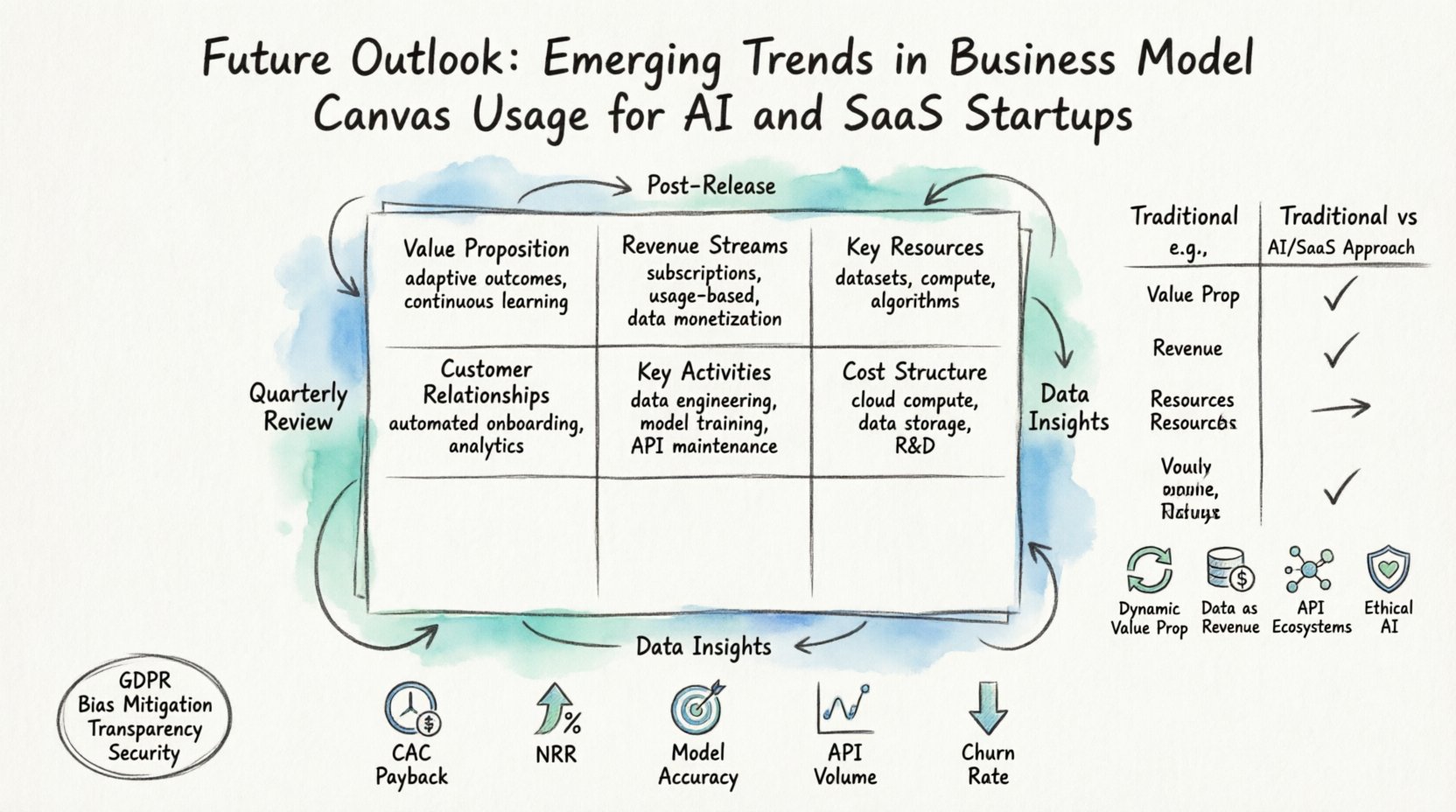
📊 Comparative Analysis: Traditional vs. AI/SaaS Canvas
To visualize the differences, consider the following breakdown of how specific blocks evolve.
| Canvas Block | Traditional Approach | AI & SaaS Modern Approach |
|---|---|---|
| Value Proposition | Fixed features, one-time solution. | Adaptive outcomes, continuous learning, personalized results. |
| Revenue Streams | Product sales, fixed licensing. | Subscription tiers, usage-based billing, data monetization. |
| Key Resources | Physical assets, human talent. | Datasets, compute infrastructure, algorithms, domain expertise. |
| Customer Relationships | Support tickets, sales calls. | Automated onboarding, usage analytics, community-driven support. |
| Key Activities | Manufacturing, marketing campaigns. | Data engineering, model training, API maintenance. |
| Cost Structure | Inventory, labor, rent. | Cloud compute, data storage, talent acquisition, R&D. |
🛠️ Deep Dive: Modifying Specific Blocks
Implementing these trends requires specific adjustments to the canvas structure. Below is a detailed look at how to populate these sections effectively.
Refining Customer Segments
In SaaS, segmentation is rarely static. It is often behavioral. A startup might segment users based on usage intensity rather than industry. For AI products, segmentation includes the “quality of data” the customer can provide. The canvas should reflect:
- Early Adopters: Users willing to tolerate beta instability for cutting-edge features.
- Enterprise: Clients requiring compliance, security, and SLAs.
- Developers: Users who integrate the tool into their own workflows.
Optimizing Key Activities
The “Key Activities” block is the engine of the business. For AI and SaaS, this is rarely just “coding.” It involves:
- Data Ingestion: Building pipelines to collect and normalize data.
- Model Iteration: Regularly retraining algorithms on new data.
- Infrastructure Management: Ensuring uptime and latency optimization.
- Feedback Loops: Capturing user interactions to improve the system.
Calculating Cost Structure
Cost structures in this sector are variable and scale-dependent. Unlike traditional manufacturing where marginal costs are physical, here they are computational. Founders must account for:
- Cloud Compute Costs: GPU usage can spike significantly during training phases.
- Third-Party API Costs: Relying on external data providers adds variable expenses.
- Talent Density: Specialized AI engineers command higher compensation.
- Compliance Audits: Regular security and privacy assessments require budget allocation.
📈 Metrics and Validation Beyond ARR
Financial metrics like Annual Recurring Revenue (ARR) are standard, but they do not capture the health of an AI or SaaS business fully. The canvas should guide founders toward leading indicators of success.
- Customer Acquisition Cost (CAC) Payback Period: How long until the customer pays for their own acquisition?
- Net Revenue Retention (NRR): Does the existing customer base grow over time?
- Model Accuracy/Performance: For AI products, does the product get better with use?
- API Call Volume: A proxy for product utility and engagement.
- Churn Rate by Segment: Identifying which customer types are leaving and why.
🤝 The Role of Partnerships in the API Economy
Partnerships have shifted from simple reseller agreements to technical integrations. A “Key Partnership” is now often a platform on which the startup builds, or a platform that distributes the startup’s product. This includes:
- Cloud Providers: Infrastructure partners that offer credits or co-marketing.
- Data Providers: Entities that supply the training data necessary for the AI model.
- Channel Partners: Agencies that implement the software for end clients.
- Complementary Tools: Other SaaS products that integrate via API to add value.
⚖️ Ethical Considerations as a Strategic Block
While not a standard block in the original canvas, ethics is becoming critical. Startups must consider:
- Data Privacy: Compliance with GDPR, CCPA, and emerging AI regulations.
- Bias Mitigation: Processes to ensure algorithms do not discriminate.
- Transparency: Explaining how decisions are made to users.
- Security: Protecting data from breaches and adversarial attacks.
Integrating these considerations prevents future roadblocks. It builds trust with customers and investors who are increasingly scrutinizing the ethical footprint of technology companies.
🔄 Iteration and Validation Loops
The Business Model Canvas is not a static document. It is a living hypothesis. For AI and SaaS startups, the speed of iteration is paramount. The canvas should be reviewed:
- Quarterly: To assess financial health and strategic alignment.
- Post-Feature Release: To see if the value proposition held true.
- After Data Insights: To adjust the product based on actual user behavior.
This iterative process ensures the business model evolves with the market. It prevents the common pitfall of falling in love with a solution that no longer solves the customer problem.
🌐 Scaling Key Resources
Scaling in this sector requires careful management of resources. You cannot simply hire more people to solve technical debt. You must invest in automation and architecture. The “Key Resources” section should highlight:
- Tech Stack: Is the infrastructure scalable and cost-effective?
- Knowledge Base: Is institutional memory captured and accessible?
- Brand Equity: Does the market trust the brand with their data?
📉 Navigating Cost Structures
As startups grow, costs can spiral if not managed. The “Cost Structure” block helps identify fixed versus variable costs. In SaaS, the goal is to increase the ratio of fixed costs (development) to variable costs (support, hosting). This improves margins as revenue scales. However, AI compute costs are often variable and can grow linearly with usage. Founders must model this carefully to ensure profitability.
🔍 Final Considerations
The Business Model Canvas remains a powerful tool, but its application requires nuance in the age of AI and SaaS. By understanding how value is created, delivered, and captured in a data-driven environment, founders can build resilient organizations. The trends outlined here—from dynamic value propositions to ethical governance—represent the new standard for strategic planning.
Success depends on the ability to adapt the framework continuously. It is about asking the right questions regarding data, trust, and scalability. By treating the canvas as a dynamic map rather than a static form, startups can navigate the complexities of the modern tech landscape with clarity and purpose.
Remember that the goal is not to fit the business into the canvas, but to use the canvas to illuminate the business. As the technology evolves, so must the strategy. This ongoing dialogue between the model and the market is the key to sustainable growth.