
Starting a company is an act of faith. You and your co-founder believe in a future that doesn’t exist yet. You share a dream, a late-night energy, and a sense of urgency. But months into the journey, that shared energy often fractures. One founder sees a massive, global platform. The other sees a niche product for a specific demographic. One wants to burn cash for growth. The other wants profitability from day one. These tensions are not signs of failure; they are natural stress tests of a partnership.
Without a shared framework, these differences become arguments. Without a shared framework, strategy becomes a guessing game. This is where the Business Model Canvas stops being just a strategic tool and becomes a communication protocol. It provides a single source of truth. It forces founders to articulate assumptions. It transforms abstract debates into concrete discussions about value, costs, and channels.
This guide explores how to leverage the nine building blocks of the Business Model Canvas to bridge the gap between vision and execution. We will look at how to structure your alignment sessions, identify where friction typically occurs, and build a roadmap that keeps both co-founders moving in the same direction. 🚀
Why Co-Founder Alignment Fails 🛑
Most startup conflicts do not stem from a lack of trust. They stem from a lack of clarity. When founders rely on verbal agreements or vague mental models, they inevitably drift. Here are the primary reasons alignment breaks down:
- Different Risk Appetites: One founder may view the business as a lifestyle vehicle, while the other views it as a high-growth exit. The Business Model Canvas makes financial assumptions explicit.
- Undefined Customer Value: Founders often disagree on who the customer actually is. Is it the end user, or the paying entity? The canvas forces a specific definition.
- Execution vs. Ideation Imbalance: One founder lives in the vision (Value Propositions), while the other lives in the details (Key Activities). The canvas connects these two worlds.
- Resource Allocation Disputes: Without a cost structure visible, founders argue over budget. The canvas highlights fixed vs. variable costs clearly.
Addressing these issues requires a structured approach. The Business Model Canvas offers that structure.
Understanding the Nine Building Blocks 🏗️
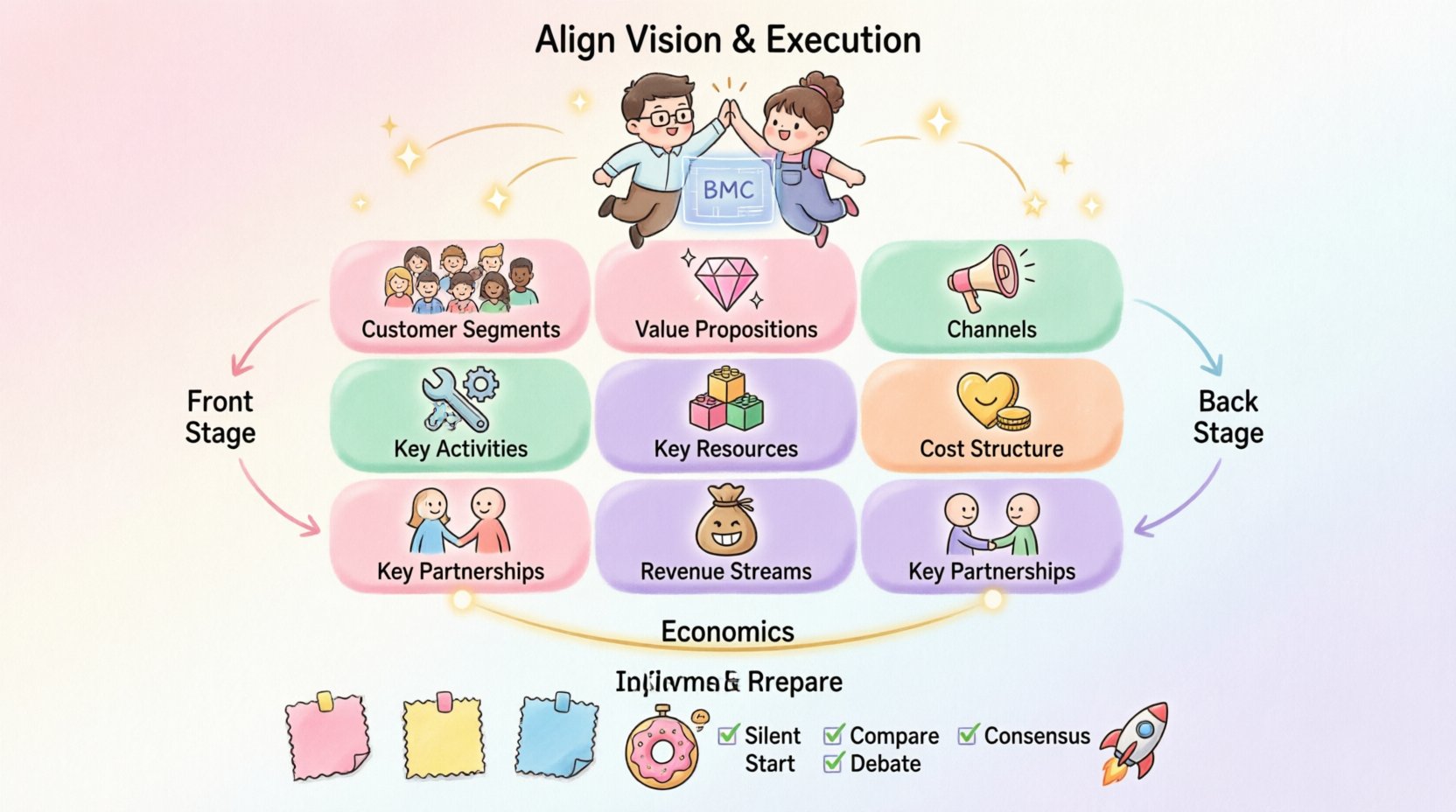
The Business Model Canvas is not a traditional business plan. It is a visual chart with elements describing a firm’s value proposition, infrastructure, customers, and finances. It consists of nine strategic building blocks. When co-founders fill these out together, they create a shared narrative.
Think of the canvas as three distinct zones:
- The Front Stage (Value & Customers): Who are we serving and why do they care? (Right side focus)
- The Back Stage (Infrastructure): What do we need to build and deliver? (Left side focus)
- The Economics (Viability): Does the math work? (Bottom focus)
When co-founders disagree, it is usually because one is staring at the Front Stage and the other is staring at the Back Stage. The Canvas brings them to the center.
Aligning Vision: The Left and Top Blocks 👁️
The first step in alignment is ensuring both founders agree on what value is being created. This section of the canvas addresses the “Why” and the “Who”.
1. Customer Segments 👥
Disagreement here is common. Founder A might target enterprise clients. Founder B might target individual consumers. The canvas requires you to write this down. It forces a decision.
- Discussion Point: Can we serve both segments, or must we choose one?
- Alignment Goal: Define the primary persona. If you serve two, prioritize which one drives the core revenue.
2. Value Propositions 💎
This block defines the bundle of products and services that create value for a specific Customer Segment. This is often where the “Vision” lives.
- Discussion Point: Are we solving a high-priority problem or a nice-to-have?
- Alignment Goal: Ensure both founders agree on the primary pain point being solved. Is it speed, cost, quality, or design?
3. Channels 📢
How do you reach your customers? Direct sales, online ads, partnerships? This block bridges vision and execution.
- Discussion Point: Do we have the resources to build our own channel, or do we need to rely on third parties?
- Alignment Goal: Agree on the primary acquisition path. This dictates the marketing budget and hiring needs.
Aligning Execution: The Right and Bottom Blocks ⚙️
Once vision is set, execution takes over. This is where founders often clash regarding resources, timelines, and financial sustainability.
4. Key Activities 🛠️
What are the most important things the company must do to make its business model work? Is it software development? Manufacturing? Customer support?
- Discussion Point: What activity consumes 80% of our time?
- Alignment Goal: Prioritize activities. If you say you are a product company, but your Key Activities are sales, you have a misalignment.
5. Key Resources 🏢
What assets are required to offer and deliver the previously described value? Physical, intellectual, human, or financial.
- Discussion Point: Do we own our tech stack, or do we rent it? Do we hire full-time or outsource?
- Alignment Goal: Clarify ownership and control. This impacts risk tolerance and cash burn.
6. Cost Structure 💸
The Business Model Canvas forces you to identify the most important costs inherent to operating a business model. Is it cost-driven (lowest possible cost) or value-driven (premium pricing)?
- Discussion Point: Where will the majority of our cash go?
- Alignment Goal: Agree on the burn rate. Is the business model focused on high fixed costs (infrastructure) or high variable costs (marketing)?
The Bridge: Partnerships and Revenue 🤝
Two blocks often hold the key to resolving the hardest conflicts: Key Partnerships and Revenue Streams.
7. Key Partnerships 🤝
The network of suppliers and partners that make the business model work. Founders often disagree on who they should trust or rely on.
- Discussion Point: Are we building everything, or collaborating?
- Alignment Goal: Define the ecosystem. This reduces the burden on co-founders to do everything alone.
8. Revenue Streams 💰
The cash a company generates from each Customer Segment. This is the most critical block for financial alignment.
- Discussion Point: Subscription, one-time purchase, freemium, or licensing?
- Alignment Goal: Agree on the monetization model. This dictates the sales cycle and the financial runway.
Comparing Vision vs. Execution Focus 📊
To help visualize how the Canvas splits the workload between two founders, consider the following comparison table. This helps identify if one founder is dominating a specific area.
| Block | Typical Vision Focus | Typical Execution Focus | Alignment Check |
|---|---|---|---|
| Customer Segments | Market potential, growth | Specific user personas, data | Do we agree on who pays? |
| Value Proposition | Disruption, innovation | Features, reliability | Do we agree on the core benefit? |
| Key Activities | Product roadmap | Development sprints, ops | Do we agree on what to build first? |
| Revenue Streams | Market share, valuation | Cash flow, profitability | Do we agree on pricing strategy? |
| Cost Structure | Investment for scale | Efficiency, lean operations | Do we agree on spending limits? |
When founders review this table, they can spot where they are out of sync. If one founder focuses heavily on “Market Potential” while the other focuses on “Efficiency”, the Canvas highlights the friction point immediately.
Running a Co-Founder Alignment Workshop 📝
Filling out the canvas is not a one-time event. It requires a structured workshop. Here is a step-by-step process to facilitate this session effectively.
Step 1: Preparation 📋
- Gather physical sticky notes and markers. Digital tools work, but physical interaction sparks better debate.
- Set a time limit. 90 minutes to 2 hours is optimal.
- Ensure no external distractions. Turn off phones.
Step 2: The Silent Start 🤫
- Do not start talking immediately. Give each founder 15 minutes to fill out the canvas individually.
- This reveals individual assumptions before they are influenced by the other person’s opinion.
Step 3: The Comparison 🔍
- Place the two canvases side by side.
- Go block by block. Start with Customer Segments and Value Propositions.
- Highlight where the sticky notes differ. Do not argue yet. Just mark the differences.
Step 4: The Debate 💬
- For each difference, ask “Why?” three times.
- Example: “Why do we target enterprise?” -> “Because they have money.” -> “Why do we need their money?” -> “To fund growth.” -> “Why do we need growth now?”
- This drill-down often reveals the root cause of the disagreement.
Step 5: Consensus Building ✍️
- Move the sticky notes to a single, unified canvas.
- If consensus cannot be reached on a specific block, agree to disagree and note the assumption. Do not block progress.
- Sign off on the final version together.
Common Pitfalls to Avoid ⚠️
Even with a solid framework, co-founders can misapply the Business Model Canvas. Avoid these common mistakes.
- Ignoring the Economics: Many founders focus only on the Value Proposition and ignore the Cost Structure. This leads to a beautiful product that cannot sustain itself.
- Static Planning: The canvas is a living document. If the market shifts, the canvas must change. Do not treat it as a one-time filing document.
- Blindly Following Trends: Do not copy a competitor’s canvas. Your Key Activities and Partnerships must be unique to your team’s capabilities.
- Over-Complicating: Keep it simple. If a block requires a paragraph of text, you have missed the point. Use bullet points.
Measuring Alignment Over Time 📈
How do you know if the Canvas successfully aligned your partnership? Look for these indicators:
- Decisions are Faster: When a new opportunity arises, you can check the Canvas. Does it fit the Value Proposition? Does it fit the Cost Structure? If yes, move forward. If no, reject it. This speeds up decision-making.
- Reduced Conflict: Arguments shift from “I want this” to “Does this fit the model?”. The model becomes the third party in the discussion.
- Clear Hiring: When Key Resources are defined, hiring becomes easier. You know exactly what skills are missing from the current team.
- Investor Readiness: Investors ask about the business model. Having a completed Canvas means you have already answered the most critical strategic questions.
The Human Element of Strategy 🧠
It is important to remember that the Business Model Canvas is a tool for people, not just data. The goal is not to create a perfect document. The goal is to create a shared understanding.
During the workshop, emotions may run high. This is normal. You are discussing the future of your livelihoods. Acknowledge the tension. Validate the partner’s perspective. The Canvas provides a neutral ground where ideas can be tested without attacking the person.
Remember that execution requires adaptation. The vision may remain constant, but the execution strategy will evolve. Regularly revisit the canvas every quarter. Ask the co-founders: “Does this still reflect reality?” If the answer is no, update it together.
Final Thoughts on Strategic Unity 🏁
Alignment is not a destination; it is a continuous practice. Co-founders who align their vision and execution through structured frameworks like the Business Model Canvas build more resilient organizations. They reduce the risk of divergence. They create a culture of clarity.
By dedicating time to map out the nine blocks, you are investing in the partnership itself. You are building a language that allows you to discuss difficult topics without destroying the relationship. Whether you are in the early stages of ideation or scaling an existing operation, the Canvas remains a vital tool for maintaining strategic cohesion.
Start the workshop today. Put the sticky notes on the wall. Draw the lines. The path forward becomes clearer when both founders are looking at the same picture. 🗺️