
In the landscape of software architecture, clarity is not merely an aesthetic choice; it is a functional necessity. When developers and architects communicate through diagrams, they rely on a standardized language. However, the standard notation often falls short when dealing with complex domain-specific requirements. This is where the concept of a stereotype becomes vital. A stereotype acts as an extension to the base modeling language, allowing you to define new concepts without breaking the underlying syntax.
Understanding the anatomy of a stereotype and its associated tagged values is crucial for maintaining high-fidelity models. This guide explores the semantic weight behind these tags, how they influence implementation, and how to structure them for maximum readability. We will dissect the notation, examine common patterns, and discuss the implications of using these constructs in enterprise-level modeling.
Defining the Stereotype Concept 🧠
A stereotype is a mechanism that allows you to extend the UML (Unified Modeling Language) metamodel. While the base language provides elements like Class, Interface, and Package, real-world systems often require more specific categorization. A stereotype sits outside the base type and applies a specific context or behavior to the element it marks.
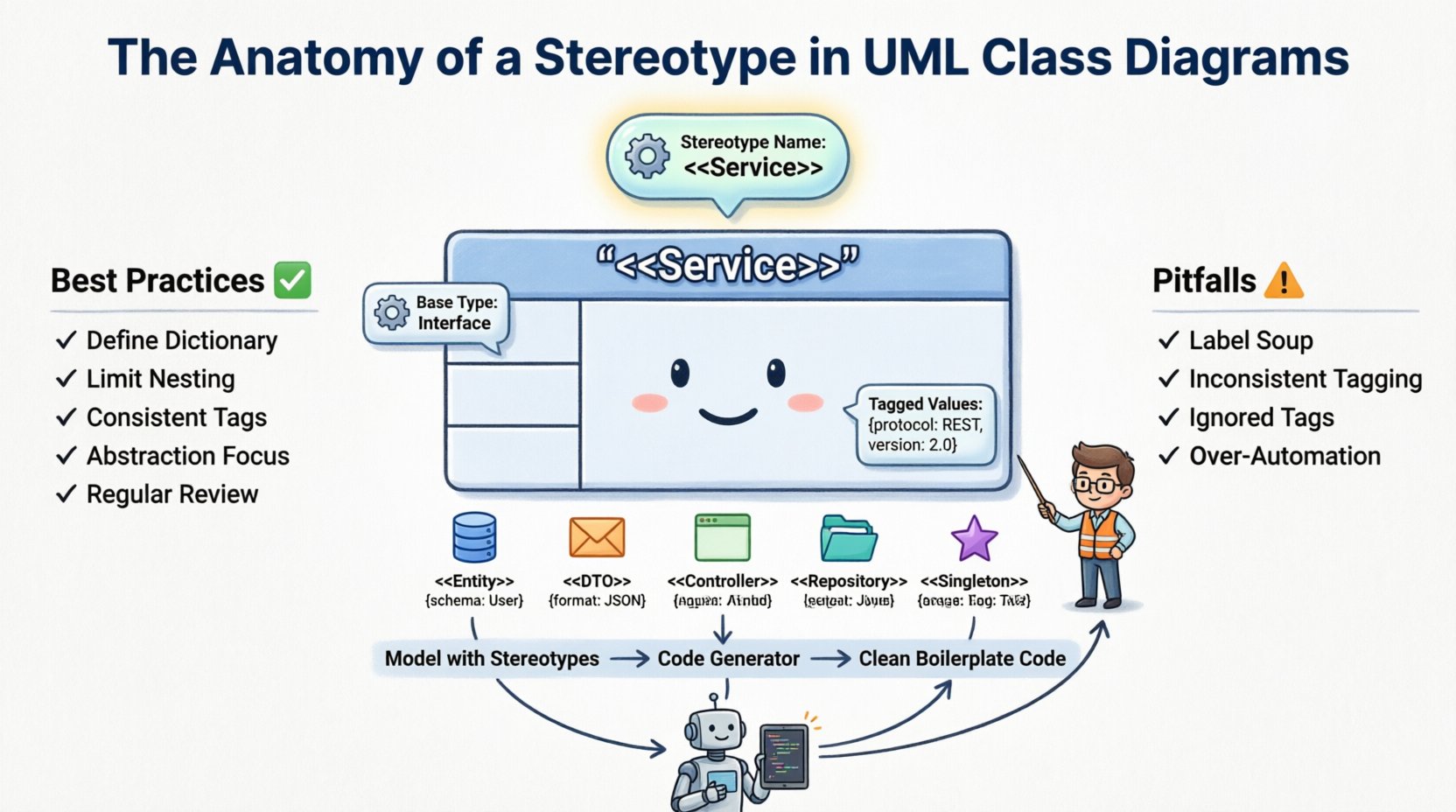
Visually, a stereotype is denoted by guillemets (double angle brackets) surrounding the stereotype name. For example, <<Entity>> or <<Service>>. This notation signals to the reader that the element is not just a generic class, but carries specific semantic meaning within the project’s domain.
The power of a stereotype lies in its ability to:
- Clarify Intent: It removes ambiguity regarding the role of a class within the system architecture.
- Guide Implementation: Code generators often interpret stereotypes to create specific boilerplate or base classes.
- Enforce Standards: They help maintain consistency across a large codebase by defining expected properties.
- Facilitate Communication: They provide a shorthand for complex architectural patterns.
The Structure of a Stereotype 🏗️
To fully understand the anatomy, one must look at the components that make up a stereotype definition. It is not simply a label; it is a structured definition that can include properties and constraints.
1. The Base Type
Every stereotype is applied to a specific base type. You typically apply a stereotype to a Class, Component, Interface, or Actor. The base type determines the fundamental capabilities of the element.
- Class: The most common target. Used for data structures and logic containers.
- Interface: Defines contracts without implementation details.
- Component: Represents a deployable unit of software.
- Package: Groups related elements together.
2. The Stereotype Name
This is the identifier placed between the angle brackets. It should be descriptive and consistent with the domain vocabulary. Ambiguity here leads to confusion later in the development lifecycle.
3. Tagged Values (The Tags)
This is the most critical part of the anatomy. Tagged values allow you to attach specific data to the stereotype. They are essentially key-value pairs associated with the element.
For example, a class might be marked as <<Repository>> and carry a tagged value for the database type. This information is often invisible in the visual diagram unless explicitly rendered, but it is crucial for tooling and documentation.
Tagged Values: The Hidden Depth 🔍
Tagged values are the mechanism by which stereotypes gain their functional utility. Without them, a stereotype is just a label. With them, it becomes a configuration object. These values can define constraints, metadata, or implementation hints.
Why Use Tagged Values?
Tagged values bridge the gap between abstract design and concrete implementation. They allow the model to hold information that is not strictly structural. Consider the following scenarios where tagged values are essential:
- Database Mapping: Specifying which table a class maps to.
- API Versioning: Defining the version of an API endpoint.
- Access Control: Indicating the security level required (e.g., Public, Private, Protected).
- Lifecycle Management: Defining whether an instance is transient, persistent, or singleton.
Common Tagged Value Types
While the specific values depend on the project, the types generally fall into a few categories:
- String: Textual identifiers, names, or descriptions.
- Integer: Counts, limits, or version numbers.
- Boolean: Flags for enabling or disabling features.
- Enumeration: A predefined set of allowed values.
Common Stereotypes and Their Meanings 📋
Different domains adopt different conventions. However, there are several stereotypes that appear frequently in professional software architecture. Understanding these standard patterns can speed up onboarding and reduce modeling errors.
The following table outlines common stereotypes, their base types, and typical tagged values used in enterprise modeling.
| Stereotype | Base Type | Typical Tagged Values | Purpose |
|---|---|---|---|
| <<Entity>> | Class | tableName, primaryKey | Represents a persistent domain object. |
| <<DTO>> | Class | source, target | Data Transfer Object for API responses. |
| <<Service>> | Interface | protocol, version | Defines business logic contracts. |
| <<Controller>> | Class | route, method | Handles incoming requests. |
| <<Repository>> | Interface | dbType, cache | Manages data access logic. |
| <<Abstract>> | Class | extendable | Indicates the class cannot be instantiated directly. |
| <<Singleton>> | Class | scope, threadSafe | Ensures only one instance exists. |
Detailed Breakdown of Key Stereotypes
The Entity Stereotype
The <<Entity>> stereotype is foundational in object-relational mapping. It signifies that the class maps directly to a row in a database table. When you see this tag, you expect persistence operations like save, update, and delete.
Tagged values here often specify the database table name if it differs from the class name. They may also indicate which field serves as the primary key. This separation allows the model to remain independent of the database schema while still providing necessary mapping information.
The Service Stereotype
Services represent the business logic layer. They are typically interfaces that hide implementation details. The <<Service>> stereotype helps distinguish between data models and the logic that manipulates them.
Tagged values for services often include the communication protocol (e.g., REST, gRPC) and the API version. This is critical for microservices architectures where versioning is a constant concern.
The Repository Stereotype
Repositories abstract the data access layer. They provide a collection-like interface for accessing domain objects. The <<Repository>> stereotype indicates that the class is responsible for fetching, saving, or deleting data.
Tagged values here might specify the type of database being accessed (SQL vs. NoSQL) or whether caching is enabled. This allows the architecture to adapt to different data stores without changing the domain model.
Best Practices for Modeling Stereotypes ✅
Using stereotypes effectively requires discipline. Overuse or inconsistent application can lead to a diagram that is harder to read than one without stereotypes. The following guidelines ensure your modeling remains effective.
1. Define a Standard Dictionary
Before drawing a single line, establish a dictionary of allowed stereotypes. Every team member should agree on what <<Service>> means versus <<Handler>>. Consistency prevents ambiguity. Document these definitions in a central location accessible to all developers.
2. Limit Depth of Nesting
Avoid applying multiple stereotypes to the same element. While technically possible, it creates visual clutter and semantic confusion. If a class needs multiple roles, consider using composition or interfaces to separate concerns rather than stacking tags.
3. Keep Tagged Values Consistent
If you use a tagged value for a database name, use it consistently across all entities. Do not switch between camelCase and snake_case for the same property type. This consistency aids in automated tooling and code generation.
4. Use Stereotypes for Abstraction, Not Implementation
Stereotypes should describe what something is, not how it is implemented. Avoid using tags that expose specific technology choices unless necessary for the architecture. For example, using <<JavaBean>> ties the model to a specific language, whereas <<Entity>> is language-agnostic.
5. Review and Refactor
Stereotypes should evolve with the system. Periodically review your diagrams to ensure the tags still reflect the current architecture. If a pattern changes, update the stereotype usage immediately to prevent drift between the model and the code.
Common Pitfalls and How to Avoid Them ⚠️
Even experienced architects make mistakes when incorporating stereotypes into class diagrams. Being aware of common traps helps you maintain a clean and useful model.
Pitfall 1: The Label Soup
This occurs when too many tags are applied to a single element. A class might be marked as <<Service>> <<Singleton>> <<ThreadSafe>>. While technically descriptive, it overwhelms the reader. Break these concerns down. Use interfaces for contracts and classes for implementation details.
Pitfall 2: Inconsistent Tagging
One developer uses <<Controller>> while another uses <<API>> for the same concept. This inconsistency makes searching and filtering diagrams difficult. Enforce strict naming conventions through code reviews of the diagrams.
Pitfall 3: Ignoring Tagged Values
Defining a stereotype without utilizing its tagged values renders the stereotype useless. If you mark a class as <<Entity>>, you should also specify the table mapping. Otherwise, the tag is purely decorative.
Pitfall 4: Over-Reliance on Automation
Do not assume that tools will automatically interpret your stereotypes. While many modern modeling environments support tagged values, older tools or manual documentation may ignore them. Always ensure the diagram is readable even without the tooling.
Impact on Code Generation 🚀
One of the primary reasons for using stereotypes and tagged values is to drive code generation. When a model is converted into code, the tooling reads the stereotypes to determine the structure of the generated files.
Mapping Logic
A code generator typically follows a set of rules:
- If the stereotype is <<Entity>>, generate a class with getter and setter methods.
- If the stereotype is <<Service>>, generate an interface with method signatures.
- If a tagged value specifies a database type, generate the corresponding ORM configuration.
This automation reduces boilerplate code and ensures that the implementation adheres to the architectural intent. However, it requires the model to be accurate. If the stereotypes are missing or incorrect, the generated code will be flawed.
Reverse Engineering
The process also works in reverse. When importing existing code into a diagram, the tool reads the annotations in the code and applies the appropriate stereotypes. This synchronization ensures that the documentation remains in sync with the source code.
Visual Presentation and Readability 🎨
While the content of the stereotype is logical, its visual presentation matters. A cluttered diagram is a failing diagram. How you display the stereotype affects how quickly a reader can grasp the system’s structure.
Placement
Place the stereotype name at the top of the class box, immediately above the class name. This hierarchy guides the eye from the specific role to the general type.
Visibility
Decide whether tagged values should be visible in the diagram. In large systems, showing every tag can obscure the relationships between classes. Consider using a “show details” feature in your modeling tool to toggle tagged values on demand.
Grouping
Group classes by their stereotype. If you have many <<Entity>> classes, place them in a separate package or section from <<Service>> classes. This visual separation reinforces the architectural layers.
Maintaining Model Integrity 🛡️
A model is a living artifact. It requires maintenance to remain relevant. Stereotypes and tags are part of this lifecycle. Regular audits ensure that the tags reflect the current state of the system.
Version Control
Just like source code, model files should be version controlled. This allows you to track changes in stereotypes over time. If a team decides to remove the <<Singleton>> stereotype, the version history will show when and why that decision was made.
Documentation Links
Link your diagrams to external documentation. If a tagged value refers to a specific API contract, provide a link to the OpenAPI specification or similar documentation. This keeps the diagram concise while maintaining access to detailed information.
The Role of Stereotypes in Complex Systems 🌐
As systems grow in complexity, the need for precise notation increases. Microservices, event-driven architectures, and distributed systems introduce layers of abstraction that standard UML cannot capture alone.
Stereotypes provide the necessary granularity. They allow you to denote concepts like “Event Producer” or “Event Consumer” without inventing new base types. This flexibility is what makes the modeling language robust enough for modern software engineering challenges.
Event-Driven Context
In event-driven architectures, classes often act as publishers or subscribers. You can use a stereotype like <<Producer>> with a tagged value for the event type. This clarifies the flow of data without drawing complex sequence diagrams for every interaction.
Distributed Context
For distributed systems, stereotypes can indicate locality. A class might be marked as <<Local>> or <<Remote>>. This helps in understanding network latency and fault tolerance requirements at a glance.
Conclusion on Notation and Semantics
The use of stereotypes and tagged values transforms a class diagram from a static drawing into a dynamic specification. It encodes intent, constraints, and implementation details into a visual format that is both human-readable and machine-processable.
By adhering to consistent naming conventions, limiting the scope of usage, and ensuring tagged values are meaningful, you create a model that serves as a reliable blueprint for development. The effort invested in defining these elements pays dividends in reduced ambiguity and clearer communication across the team.
Remember that the goal of modeling is understanding, not just documentation. If a stereotype does not aid in understanding the system, reconsider its necessity. Simplicity and clarity remain the highest virtues in software architecture.
Summary of Key Takeaways 📝
- Stereotypes extend UML: They allow custom concepts beyond the base language.
- Tagged values add detail: They provide specific data like table names or versions.
- Consistency is key: Define a dictionary and stick to it.
- Visual clarity matters: Avoid clutter and group related elements.
- Automation support: Proper tagging enables code generation and reverse engineering.
- Maintain the model: Treat the diagram as a living document that evolves with the code.
Mastering the anatomy of a stereotype is a step toward professional-grade modeling. It requires attention to detail and a commitment to standards, but the result is a system design that is robust, clear, and maintainable.