
Building a business is an exercise in hypothesis and validation. Too often, founders fall in love with a solution before verifying the problem exists. The Business Model Canvas (BMC) serves as a strategic blueprint, yet even the most detailed canvas can crumble if built on shaky foundations. Identifying structural weaknesses early saves time, capital, and emotional energy.
This guide focuses on the five most critical areas where business models fail. By understanding these pitfalls, you can troubleshoot your strategy before significant resources are committed. The goal is not perfection on day one, but a framework that is resilient enough to adapt.
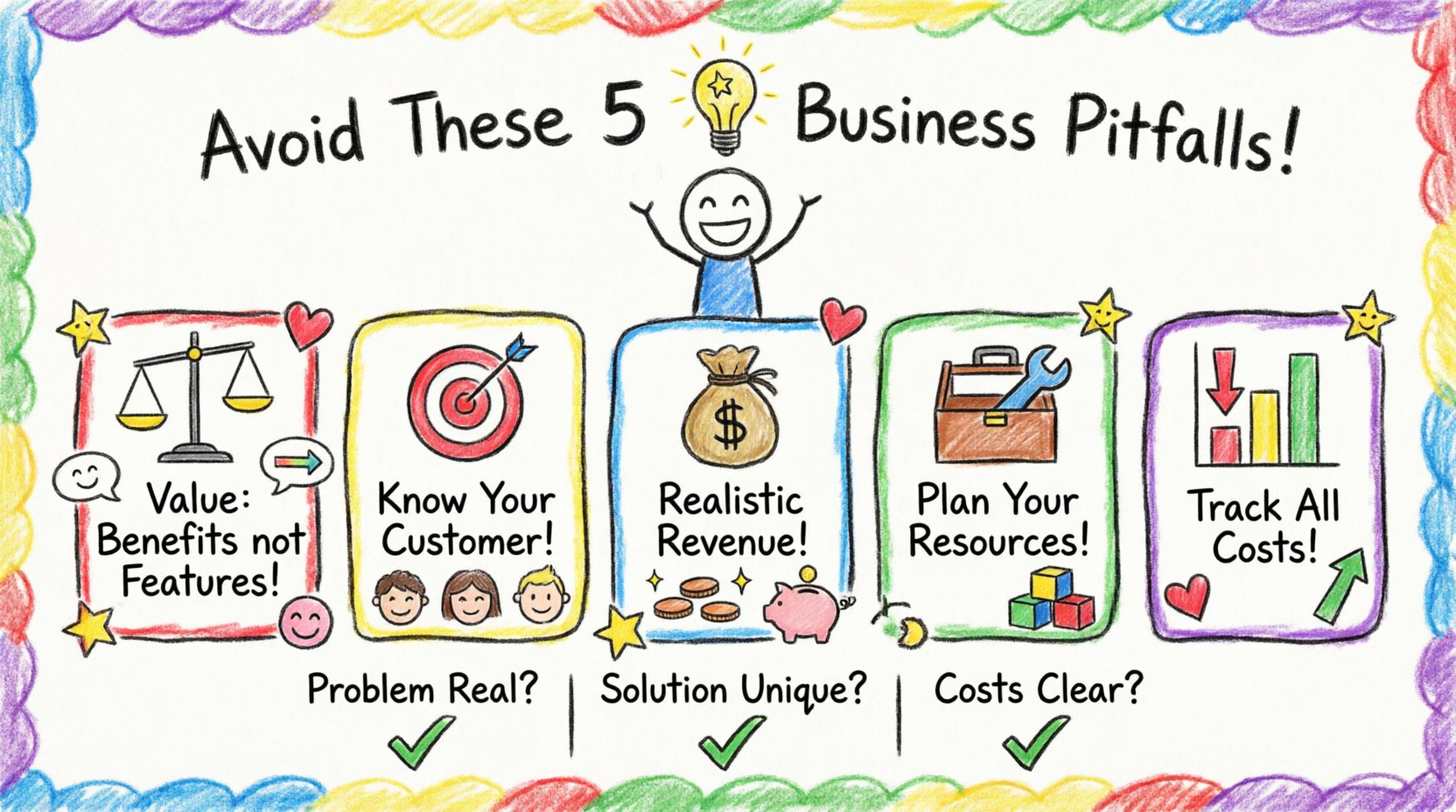
1. The Value Proposition Mismatch ⚖️
The value proposition is the core of your model. It explains why a customer should choose your offering over alternatives. A common error is describing features instead of benefits. Features tell customers what the product does; benefits tell them what it solves in their lives.
Signs of a Weak Value Proposition
- Vague Language: Using terms like “innovative,” “game-changing,” or “world-class” without concrete backing.
- Feature Focus: Listing specifications rather than outcomes.
- Assumed Need: Building a product because you think it is needed, rather than because customers explicitly asked for it.
To troubleshoot this area, shift your language from technical to human. Ask yourself: What pain does this remove? What joy does this add?
Reframing the Proposition
Instead of stating “We offer a 24/7 chat support bot”, consider “Get instant answers to your billing questions at any time of day.” The second statement addresses a specific need: immediacy and clarity.
2. Ignoring Customer Segments 🎯
A fundamental mistake is assuming that “everyone” is your customer. When a business model targets no one specifically, it usually reaches no one effectively. Broad segmentation leads to diluted marketing messages and inefficient resource allocation.
Why Broad Segmentation Fails
- Message Dilution: You cannot speak to teenagers, retirees, and corporate executives in the same voice.
- Channel Inefficiency: Advertising on platforms where your ideal customer does not spend time.
- Product Complexity: Trying to add features for too many groups, resulting in a bloated offering.
Defining Your Segment
Use demographic, psychographic, and behavioral data to carve out a specific niche. Early on, it is better to dominate a small segment than to barely serve a large one.
- Demographics: Age, location, income level.
- Psychographics: Values, interests, lifestyle.
- Behavioral: Purchase history, brand loyalty, usage rate.
3. Unrealistic Revenue Models 💰
Revenue streams are the lifeblood of the operation. Many beginners confuse pricing with revenue models. A pricing strategy dictates how much you charge, but the revenue model dictates how you capture value.
Common Revenue Mistakes
- The “Free” Trap: Relying solely on ad revenue or freemium models without a clear path to monetization.
- One-Time Sales Only: Ignoring recurring revenue opportunities like subscriptions or maintenance fees.
- Pricing Without Context: Setting prices based on costs rather than perceived value.
A sustainable model accounts for Customer Acquisition Cost (CAC) and Lifetime Value (LTV). If the cost to get a customer exceeds the value they bring, the model is mathematically unsound.
4. Overlooking Key Resources and Activities 🛠️
The building blocks of your business are the resources you need to make the model work. These include physical assets, intellectual property, human capital, and financial resources. Equally important are the activities: manufacturing, problem-solving, platform maintenance, etc.
The Resource Gap
Founders often underestimate the resources required to deliver on their promises. They may assume they can build the software alone or manage the supply chain without partners.
Key Questions to Ask
- What is the most important asset? Is it the technology, the brand, or the data?
- What activities drive the most value? Focus your energy here.
- Can we outsource? Non-core activities should often be delegated to experts.
If you cannot identify the specific resources and activities needed to operate, you cannot plan for scale. Ambiguity here leads to operational bottlenecks later.
5. Neglecting Cost Structure 📊
Cost structure defines the most important costs incurred to operate a business model. Ignoring this section is akin to driving a car without checking the fuel gauge. You need to understand fixed and variable costs.
Fixed vs. Variable Costs
- Fixed Costs: Rent, salaries, software licenses. These remain relatively constant regardless of sales volume.
- Variable Costs: Raw materials, shipping, transaction fees. These fluctuate directly with production or sales.
Why This Matters
High fixed costs require high volume to break even. High variable costs reduce margins per unit. Understanding the ratio helps in decision-making regarding pricing and expansion.
Beginners often overlook hidden costs such as customer support, returns, and legal compliance. A robust model accounts for these overheads before calculating profit.
Comparing Strong vs. Weak Business Models 🔍
Visualizing the difference between a healthy model and a flawed one can clarify the pitfalls discussed above. The following table outlines key distinctions.
| Dimension | Weak Business Model | Strong Business Model |
|---|---|---|
| Value Proposition | Feature-focused, vague benefits. | Problem-focused, clear outcomes. |
| Customer Segment | “Everyone” or undefined. | Specific persona with clear needs. |
| Revenue Streams | Single source, low margin. | Diversified, recurring options. |
| Key Resources | Assumed availability. | Identified and secured. |
| Cost Structure | Hidden or underestimated. | Transparent, fixed/variable tracked. |
Troubleshooting Framework for Early Validation ✅
Once you have identified potential pitfalls, how do you test them? Validation is not a one-time event; it is an ongoing process. Use the following steps to stress-test your canvas.
Step 1: Hypothesis Testing
Write down your assumptions. For example, “Customers will pay $50/month for this service.” Treat this as a bet, not a fact.
Step 2: Customer Interviews
Speak to potential users. Do not ask if they like your idea; ask about their current process and pain points. Listen for patterns, not just compliments.
Step 3: Minimum Viable Product (MVP)
Build the smallest version of your solution that delivers value. This could be a landing page, a manual service, or a prototype. Measure engagement.
Step 4: Financial Projections
Create a conservative cash flow model. What happens if sales are 50% of your forecast? Can you survive the shortfall?
Checklist for Business Model Health 📝
Before scaling operations, run through this checklist to ensure your model is robust.
- Is the problem real? Have customers confirmed they feel this pain?
- Is the solution unique? Does it offer a distinct advantage over existing solutions?
- Is the segment reachable? Do you know where your customers hang out?
- Is the unit economics positive? Does one customer bring more money than it costs to acquire them?
- Are the costs transparent? Do you know your break-even point?
- Is there a barrier to entry? Can competitors easily copy what you do?
- Is the team capable? Do you have the skills to execute the model?
Adapting When Things Change 🔄
Business models are rarely static. Markets shift, technologies evolve, and customer preferences change. A weak model breaks when it cannot adapt. A strong model is flexible.
Regularly review your canvas. Quarterly reviews are recommended. Look for:
- Churn Rates: Are customers leaving faster than expected?
- Support Tickets: Are there recurring complaints about the product?
- Market Trends: Are new competitors entering the space?
- Cost Increases: Are supplier prices rising unexpectedly?
When you spot these signals, adjust the relevant blocks of your model. You might need to change your pricing, pivot your target audience, or alter your delivery method.
The Cost of Ignoring Weaknesses ⚠️
Ignoring these pitfalls leads to tangible consequences. Cash burn accelerates, team morale drops, and investor confidence wanes. Early detection allows for small adjustments. Late detection often requires a complete pivot, which is costly and risky.
It is better to know a model is flawed at the sketch stage than after launching a full product. Use the canvas as a living document, not a static poster.
Final Thoughts on Strategic Clarity 🧭
Building a business requires clarity of thought. The Business Model Canvas provides the structure, but your analysis provides the strength. By avoiding these five common pitfalls, you position yourself to build a venture that can withstand market pressures.
Focus on the value you create, understand who you serve, and keep a close eye on your numbers. These principles form the bedrock of sustainable growth. Regularly revisit your assumptions and be willing to change course based on evidence.
Success in business is not about guessing right every time; it is about learning fast and correcting course before the damage is done. Use these guidelines to troubleshoot your model and build with confidence.