
In software architecture, few patterns are as detrimental to long-term maintainability as the God Class. This anti-pattern occurs when a single class becomes responsible for a vast array of responsibilities, often leading to bloated codebases that are difficult to test, extend, or debug. When your class diagram shows a central node connecting to almost every other entity, it is time to intervene.
This guide provides a technical roadmap for identifying, understanding, and refactoring large diagrams into cohesive, manageable modules. We will explore the symptoms of high coupling, the principles of modular design, and concrete steps to decompose monolithic structures without breaking existing functionality.
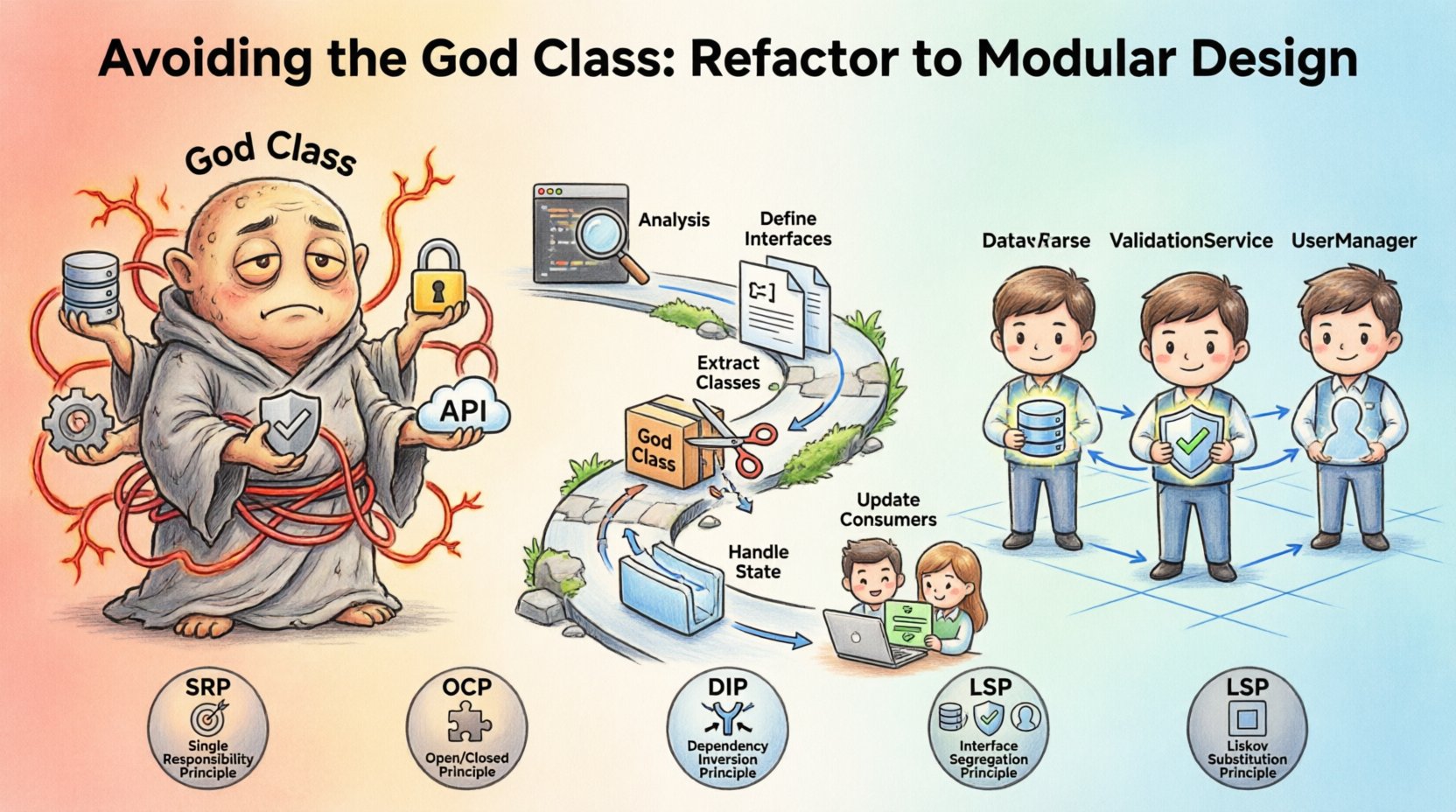
🤔 What Is a God Class?
A God Class is a single module that knows too much and does too much. It typically accumulates methods from various domains within the application. Instead of distributing logic across specialized components, the system routes all requests to this central hub.
Common characteristics include:
- High Cohesion Failure: Methods within the class perform unrelated tasks.
- Massive Line Count: The file contains hundreds or thousands of lines of code.
- Global State: The class often holds static data or global references that are accessed throughout the application.
- Dependency Hub: Other classes depend on this class for almost all functionality, creating a single point of failure.
While some legacy systems may have evolved this way organically, modern development standards prioritize separation of concerns. Breaking this pattern is essential for scalability.
🚨 Signs You Have a God Class
Before refactoring, you must confirm the diagnosis. Review your class diagrams and code metrics for the following indicators.
Table: Symptoms vs. Technical Impact
| Symptom | Technical Impact |
|---|---|
| Class size exceeds 1,000 lines | Compilation times increase; version control conflicts become frequent. |
| Many public methods (20+) | Interface becomes complex; consumers are unsure which methods to call. |
| Accesses nearly all other classes | High coupling; changing one area risks breaking unrelated features. |
| Multiple responsibilities mixed | Testing becomes difficult; unit tests must mock complex state. |
| Static method usage for logic | Hard to mock in tests; prevents dependency injection. |
If you see three or more of these symptoms, your architecture requires immediate attention.
💡 Why Refactoring Matters
Leaving a God Class in place creates technical debt that compounds over time. Developers hesitate to make changes because the impact is unpredictable. Here is why decomposition is necessary.
- Improved Testability: Smaller classes with single responsibilities are easier to isolate. You can write unit tests that cover specific behaviors without initializing a massive environment.
- Faster Onboarding: New team members can understand a module without reading the entire codebase. Context switching is reduced.
- Parallel Development: Teams can work on different modules simultaneously without merging conflicts in a single massive file.
- Performance Optimization: You can optimize or replace specific modules without recompiling the entire application.
🧱 Core Principles for Decomposition
To successfully refactor, you must apply established design principles. These rules guide how you split logic and define boundaries.
1. Single Responsibility Principle (SRP)
A class should have one, and only one, reason to change. If a class handles data retrieval, business logic, and formatting, it violates SRP. Split these concerns into three distinct classes.
2. Open/Closed Principle (OCP)
Entities should be open for extension but closed for modification. Instead of adding new if statements to the God Class to handle new features, introduce new modules that extend existing interfaces.
3. Dependency Inversion Principle (DIP)
High-level modules should not depend on low-level modules. Both should depend on abstractions. This allows you to swap implementations without touching the core logic.
4. Interface Segregation
Clients should not be forced to depend on interfaces they do not use. Instead of one large interface, create smaller, client-specific interfaces.
🛠️ Step-by-Step Refactoring Process
Refactoring is a surgical procedure. You must plan carefully to avoid breaking production code. Follow this workflow.
Step 1: Analysis and Mapping
Start by auditing the God Class. List every method and property. Categorize them by domain.
- Group by Function: Identify which methods handle user authentication, which handle data persistence, and which handle business rules.
- Identify Dependencies: Note which external classes the God Class calls. This helps define the boundaries of the new modules.
- Document Relationships: Draw a new diagram showing how these groups should interact.
Step 2: Define New Interfaces
Before moving code, define the contracts. Create interfaces or abstract base classes that describe the behavior of the new modules.
- Create a
DataServiceinterface for all data-related methods. - Create a
ValidationServiceinterface for logic related to input checks. - Ensure these interfaces are minimal and specific to the consumers.
Step 3: Extract Classes
Begin moving logic. Use the Extract Class pattern.
- Create a new class for the first domain (e.g.,
UserManager). - Move relevant methods from the God Class to the new class.
- Update the God Class to delegate calls to the new instance.
- Run tests to ensure behavior remains identical.
Step 4: Handle State and Data
One of the hardest parts of refactoring is managing shared state. The God Class likely holds global variables.
- Encapsulate State: Move state variables into the specific module that uses them.
- Pass Data Explicitly: Instead of accessing a global store, pass data through method arguments.
- Use Dependency Injection: Inject the required dependencies into the constructors of the new classes.
Step 5: Update Consumers
Once the modules exist, update the code that calls the God Class.
- Replace direct instantiation with factory patterns or dependency injection containers.
- Ensure that the calling code does not need to know about the internal structure of the modules.
- Use adapters if necessary to maintain backward compatibility during the transition.
🔗 Managing Dependencies and Coupling
Refactoring often reveals hidden dependencies. When you split a large class, you may find that two new modules rely on each other. This can create circular dependencies.
Strategies to Reduce Coupling
- Event Bus: For decoupled communication, use an event mechanism. Module A publishes an event, and Module B listens. Neither knows about the other.
- Message Queues: In asynchronous architectures, use queues to buffer requests between modules.
- Facade Pattern: Create a facade class that simplifies the interface of a subsystem. Clients interact with the facade, not the individual modules.
Avoiding Circular Dependencies
A circular dependency occurs when Class A depends on Class B, and Class B depends on Class A. To fix this:
- Extract an Interface: Move the dependency to an interface located in a shared package.
- Reorganize Layers: Ensure that lower-level modules do not import higher-level modules.
- Introduce a Mediator: Use a central coordinator to handle communication without direct references.
🧪 Testing Strategies for Refactored Code
Refactoring without tests is gambling. You must verify that the behavior remains consistent.
Unit Testing
Write tests for the new modules immediately. Focus on:
- Edge Cases: Ensure the new logic handles nulls, empty lists, and invalid inputs.
- Boundary Conditions: Verify performance under load.
- Contract Compliance: Ensure the implementation matches the interface definitions.
Integration Testing
Test how the new modules interact with each other.
- End-to-End Scenarios: Run through a full user journey to ensure the flow is intact.
- Mock External Systems: Isolate external API calls to ensure internal logic is tested correctly.
Regression Testing
Run the existing test suite. If the God Class was previously tested, ensure those tests pass with the new structure. If the tests fail, you may have introduced a bug or changed the contract.
📈 Maintaining Clean Architecture Over Time
Preventing the return of the God Class requires ongoing discipline.
Code Reviews
Make architectural hygiene a part of your code review checklist.
- Check for class size metrics.
- Verify that new methods fit the existing domain logic.
- Ensure no new dependencies are added without justification.
Static Analysis
Use tools to enforce metrics automatically.
- Cyclomatic Complexity: Monitor the complexity of methods. High complexity suggests a need for refactoring.
- Coupling Metrics: Track the number of classes a module depends on.
- Cohesion Metrics: Measure how closely related the methods in a class are.
Documentation
Keep your class diagrams up to date. If the code changes, the diagram should reflect the new structure. This helps new developers understand the boundaries of responsibility.
🔄 Common Pitfalls to Avoid
During the refactoring process, watch out for these common mistakes.
- Refactoring Too Quickly: Do not try to fix everything in one sprint. Break it down into smaller, deliverable chunks.
- Ignoring Tests: Do not skip testing. Assume the code is broken until proven otherwise.
- Over-Engineering: Do not create too many small classes. Aim for balance. A class with 20 methods might still be appropriate if they all relate to one specific task.
- Leaving Dead Code: Remove unused methods from the original God Class. Do not leave them as placeholders.
- Ignoring Communication: Keep stakeholders informed. Changes to the core architecture can affect timelines and dependencies.
🚀 Moving Forward
Refactoring a God Class is a significant undertaking, but it pays dividends in maintainability and team velocity. By adhering to SOLID principles, managing dependencies carefully, and maintaining rigorous testing standards, you can transform a monolithic structure into a robust, modular system.
Start small. Pick one module to refactor first. Learn from the process. Then apply the same logic to the rest of the system. This approach minimizes risk and builds confidence in the new architecture.
📝 Summary of Key Actions
- Identify: Look for classes with high complexity and broad responsibility.
- Plan: Define new interfaces and boundaries before moving code.
- Extract: Move logic to new classes while keeping the original class as a delegate.
- Test: Ensure behavior remains unchanged through comprehensive testing.
- Monitor: Use static analysis tools to prevent the pattern from returning.
By taking these steps, you ensure your system remains adaptable to future requirements and easier to navigate for all developers involved.