
Starting a business is hard enough without adding layers of unnecessary complexity. Many founders get stuck trying to write 50-page business plans that gather dust on a shelf. The reality is that you need a clear picture of how your business works, not a novel. This is where the Business Model Canvas comes in. It strips away the fluff and focuses on the core mechanics of your venture. Whether you are selling coffee, offering consulting, or launching a service, this tool provides a structured way to visualize your strategy.
This guide is designed for non-tech entrepreneurs who want clarity without the jargon. We will break down the nine building blocks, explain how they fit together, and show you how to use them to test and refine your ideas. No software subscriptions, no complicated diagrams, just a clear path forward. Let’s build something sustainable.
What Is the Business Model Canvas? 🧩
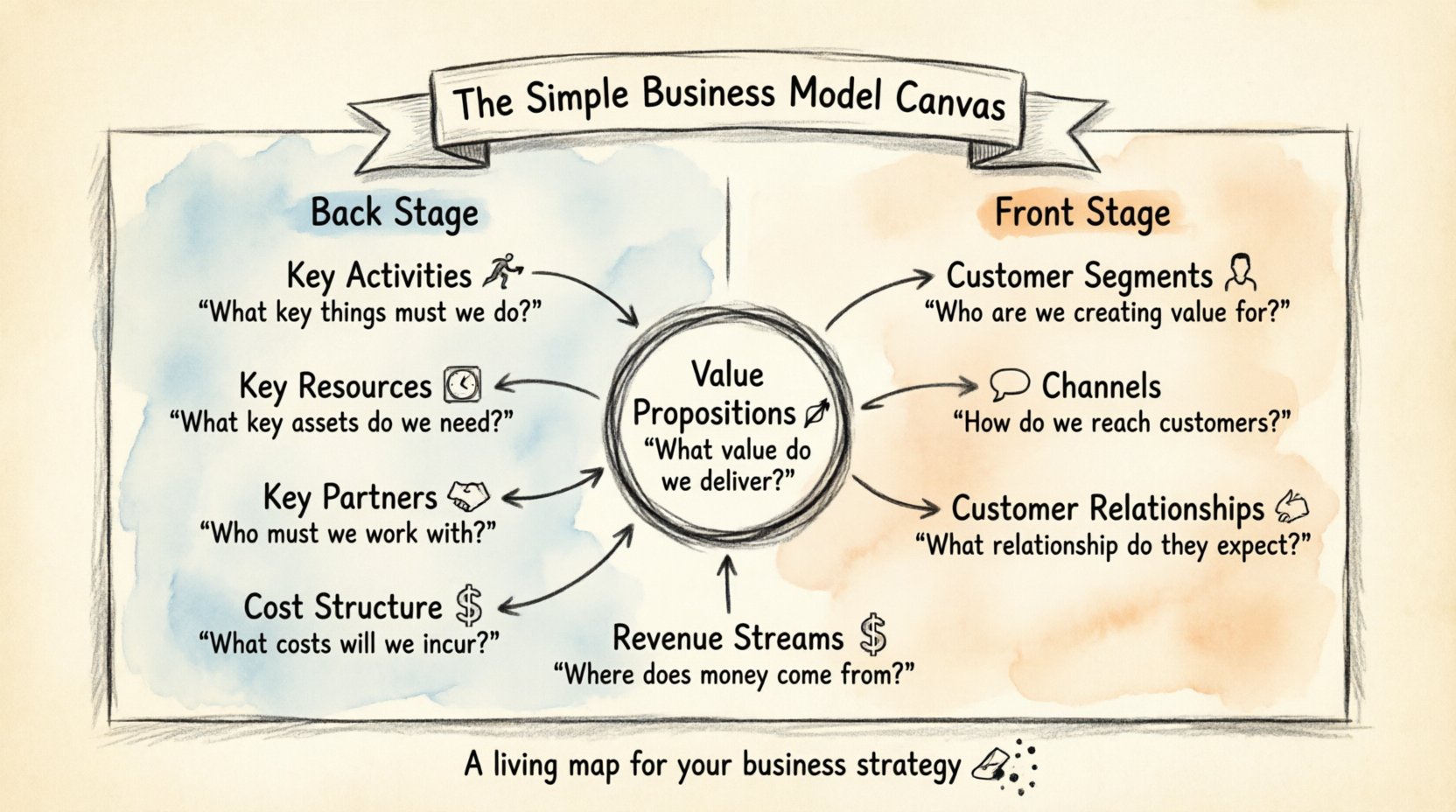
The Business Model Canvas (BMC) is a strategic management template. It is a visual chart with elements describing a company’s value proposition, infrastructure, customers, and finances. Unlike traditional business plans, which are often linear and text-heavy, the Canvas is visual and modular. It fits on a single page, forcing you to prioritize what actually matters.
Here is why this approach works for non-technical founders:
- Visual Clarity: You can see the whole business at a glance.
- Flexibility: It is easy to change one block without rewriting the whole document.
- Focus: It forces you to answer specific questions about each part of the business.
- Collaboration: It works well in workshops with teams or advisors.
The goal is not to create a static document for investors. The goal is to create a living map that guides your decisions. You fill it out on a whiteboard, a large sheet of paper, or a digital document. The medium does not matter; the thinking process does.
The 9 Building Blocks Explained 📦
To understand the canvas, you need to understand its components. The model is divided into nine building blocks. These are not random; they are grouped into four main areas: Customers, Offerings, Infrastructure, and Finances. Below is a summary table to help you locate each block quickly.
| Building Block | Category | Primary Question |
|---|---|---|
| Customer Segments | Front Stage | Who are we creating value for? |
| Value Propositions | Front Stage | What value do we deliver to the customer? |
| Channels | Front Stage | How do we reach our customers? |
| Customer Relationships | Front Stage | What type of relationship does each segment expect? |
| Key Activities | Back Stage | What key activities do our value propositions require? |
| Key Resources | Back Stage | What key resources do our value propositions require? |
| Key Partners | Back Stage | Who are our key suppliers and partners? |
| Cost Structure | Back Stage | What are the most important costs inherent in our business model? |
| Revenue Streams | Back Stage | For what value are our customers really willing to pay? |
Now, let’s dive deep into each block to understand what goes inside.
1. Customer Segments 👥
Every business exists to serve someone. You cannot be everything to everyone. Identifying your specific customer segments is the foundation of your strategy. This is not just about demographics like age or location; it is about behaviors and needs.
Consider these types of segments:
- Mass Market: You serve a broad range of people with no specific niche.
- Niche Market: You focus on a specific group with specialized needs.
- Segmented: You have different groups with slightly different needs.
- Multi-sided Platforms: You serve two or more interdependent customer groups.
For a non-tech entrepreneur, think about who pays the bills. Is it the end user, or is it a third party? For example, a free app might serve users, but an advertiser is the actual customer. Be precise. Vague answers here lead to vague products.
2. Value Propositions 🎯
This is the heart of your business. The value proposition describes the bundle of products and services that create value for a specific customer segment. It solves a problem or satisfies a need.
Ask yourself: Why should a customer choose you over a competitor? Common value drivers include:
- Performance: Does it work better than alternatives?
- Customization: Can it be tailored to their needs?
- Price: Is it cheaper than the competition?
- Design: Is it aesthetically pleasing?
- Brand Status: Does it signal a certain identity?
- Cost Reduction: Does it save the customer money or time?
- Risk Reduction: Does it make the process safer or more reliable?
Avoid saying your value proposition is “high quality.” That is subjective. Instead, say “we deliver 24-hour turnaround time for urgent repairs.” Specificity builds trust.
3. Channels 📢
How does your value proposition reach your customer? Channels are touchpoints where customers interact with your company. They are a critical part of the customer experience.
Channels serve five phases of the customer journey:
- Awareness: How do customers learn about you?
- Evaluation: How do they assess your value proposition?
- Purchase: How do they buy your product?
- Delivery: How do they get the product or service?
- After Sales: How do you support them after the purchase?
You can use owned channels (your website, your store) or partner channels (retailers, social media influencers). Mixing direct and indirect channels often provides the best coverage. Consider the cost and reach of each channel.
4. Customer Relationships 🤝
This block defines the types of relationships you establish with specific customer segments. Relationships can range from personal assistance to automated services.
Common relationship types include:
- Personal Assistance: Direct interaction via phone or email.
- Dedicated Personal Assistance: A dedicated account manager for high-value clients.
- Self-Service: No direct human interaction.
- Automated Services: Using technology to serve customers without human help.
- Communities: Creating a space for users to interact with each other.
- Co-creation: Involving customers in creating the value proposition.
The right relationship type depends on your value proposition. Luxury goods often require personal assistance, while utility apps often use automated services.
5. Key Activities 🏃
These are the most important actions a company must take to make its business model work. They differ by business model type. For example, a software company focuses on product development, while a manufacturing company focuses on production.
Key activities generally fall into three categories:
- Production: Designing, making, and delivering a product in significant quantities and/or of superior quality.
- Problem Solving: Creating new solutions to individual customer problems (e.g., consulting, hospitals).
- Platform/Network: Maintaining the platform and the network (e.g., social media, credit card networks).
Identify the activities that are indispensable to your value proposition. If you stop doing these, the business stops working.
6. Key Resources 🏗️
These are the assets required to offer and deliver the previously described elements. Without these resources, the business model cannot function.
Resources can be categorized as:
- Physical: Buildings, vehicles, machines.
- Intellectual: Brands, patents, copyrights, data.
- Human: Staff, specialized talent.
- Financial: Cash, lines of credit, stock options.
For a non-tech entrepreneur, human resources are often the most critical. Knowing who you need to hire or partner with is vital. Do not underestimate the cost of acquiring and maintaining these resources.
7. Key Partners 🤝
Businesses do not operate in a vacuum. They rely on suppliers and partners to optimize their business models, reduce risk, and acquire resources.
Motivations for partnering include:
- Optimization and Efficiency: Outsourcing non-core activities.
- Reduction of Risk and Uncertainty: Sharing the burden of market changes.
- Acquisition of Specific Resources: Accessing technology or distribution channels you do not own.
Types of partnerships include strategic alliances between non-competitors, coopetition between competitors, and joint ventures to create new businesses. Be careful to align incentives.
8. Cost Structure 💸
Every business model incurs costs to operate. The cost structure describes all costs incurred to operate a business model. It is not just about expenses; it is about how you structure your spending relative to your value.
Cost structures can be:
- Cost-Driven: Focus on minimizing costs wherever possible (e.g., low-cost airlines).
- Value-Driven: Focus on creating value, where cost is secondary (e.g., luxury goods).
Identify your most important fixed and variable costs. Fixed costs remain constant regardless of sales volume (rent, salaries). Variable costs change with production (materials, shipping). Understanding this helps you price correctly.
9. Revenue Streams 💰
Revenue streams represent the cash a company generates from each customer segment. It is the money that keeps the lights on. If you do not have a clear way to make money, you do not have a business.
Revenue can come from various sources:
- Asset Sale: Selling the ownership of a product.
- Usage Fee: Charging for the use of a service.
- Subscription Fees: Charging recurring fees for continuous service.
- Lending/Renting/Leasing: Giving temporary right to use an asset.
- Licensing: Charging for the right to use intellectual property.
- Brokerage Fees: Charging for the transaction between two parties.
- Advertising: Charging for advertising space.
Ensure your revenue streams match your customer’s willingness to pay. A B2B software company might charge per user, while a B2C app might use a freemium model.
How to Start Your Canvas 📝
Once you understand the blocks, the next step is to fill them out. Do not try to do this alone in a quiet room for days. It is better to work iteratively.
Step 1: Start with Value and Customers
Begin with the right side of the canvas. Focus on Customer Segments and Value Propositions. If you do not know who you are helping or what you are giving them, the rest of the business does not matter. Write these down first. Use sticky notes so you can move them around.
Step 2: Define the Infrastructure
Now look at the left side. How will you deliver the value? Define Key Activities, Resources, and Partners. This ensures you have the means to execute your promise. If you promise fast delivery but have no logistics partners, your model is broken.
Step 3: Connect the Channels and Relationships
Fill in Channels and Customer Relationships. How will people find you? How will you keep them? This bridges the gap between your offer and the customer.
Step 4: Calculate the Economics
Finally, complete the financial side. Determine Cost Structure and Revenue Streams. Does the revenue cover the costs? Is there a margin? If the math does not work, go back to the value proposition or the cost structure and adjust.
Common Mistakes to Avoid 🚫
Even with a clear guide, founders make predictable errors. Being aware of these pitfalls can save you months of wasted effort.
- Too Many Customer Segments: Trying to serve everyone dilutes your value. Pick one segment and dominate it.
- Vague Value Propositions: Avoid generic terms like “best” or “innovative.” Be specific about the problem you solve.
- Ignoring Costs: Many entrepreneurs focus on revenue but forget the hidden costs of acquisition and support.
- Static Thinking: The canvas is not a one-time task. Markets change, and your model must change with them.
- Confusing Features with Value: Customers do not want a drill; they want a hole. Do not focus on the tool; focus on the result.
Another common error is creating the canvas in isolation. Get feedback from people outside your company. If a stranger cannot understand your canvas in two minutes, it is too complex.
Iterating and Updating 🔄
Your first draft of the Business Model Canvas will likely be wrong. That is okay. The purpose of the canvas is to help you test hypotheses. Treat every block as an assumption that needs validation.
When you receive feedback or data that contradicts your assumptions, update the canvas immediately. For example, if customers say they do not care about the price but care about speed, move the Value Proposition to highlight speed and adjust the Cost Structure to support it.
Make updates visible. If you use a physical board, move the sticky notes. If you use a document, change the text clearly. This visual change reinforces the shift in strategy.
Signs It Is Time to Pivot
You know it is time to change your model when:
- Customer Acquisition Costs (CAC) are too high: You are spending more to get a customer than they are worth.
- Churn is high: Customers leave shortly after signing up.
- Revenue is stagnant: You have reached a plateau despite effort.
- Competitors offer better value: The market has shifted, and your original proposition is no longer unique.
Pivoting does not mean failure. It means you learned something valuable about the market. The canvas allows you to pivot quickly without rewriting a 100-page document.
Making It Work for Non-Tech Ventures
Tech startups often have complex user acquisition models. Non-tech ventures often rely on local presence and personal relationships. The Canvas works for both, but the emphasis shifts.
For a brick-and-mortar store, the Channels block is heavily weighted toward physical location and local marketing. The Key Resources block focuses on real estate and inventory. For a service business, the Key Activities block focuses on time and expertise.
Do not let the “tech” label scare you. The logic remains the same: Value flows from your capabilities to your customers, and money flows back from the customers to sustain your capabilities.
Final Thoughts on Strategic Clarity 🧠
Success in business is rarely about having the most complex strategy. It is about having the clearest understanding of how you create value. The Business Model Canvas is a tool to achieve that clarity. It forces you to confront the hard questions before you spend money.
By keeping the model simple, you can iterate faster. You can test ideas without the burden of a massive plan. You can focus on execution rather than paperwork. Remember that the canvas is a living document. It should evolve as your business grows.
Start with a blank page. Fill in the blocks. Test your assumptions. Refine your approach. This process builds a foundation that is resilient to market changes. You do not need to overcomplicate the journey. You just need a map.
Take the time to understand each of the nine blocks deeply. Do not rush through them. The effort you put into this now will save you significant time and resources later. Your business is a system. Understand the parts, understand the whole, and move forward with confidence.