
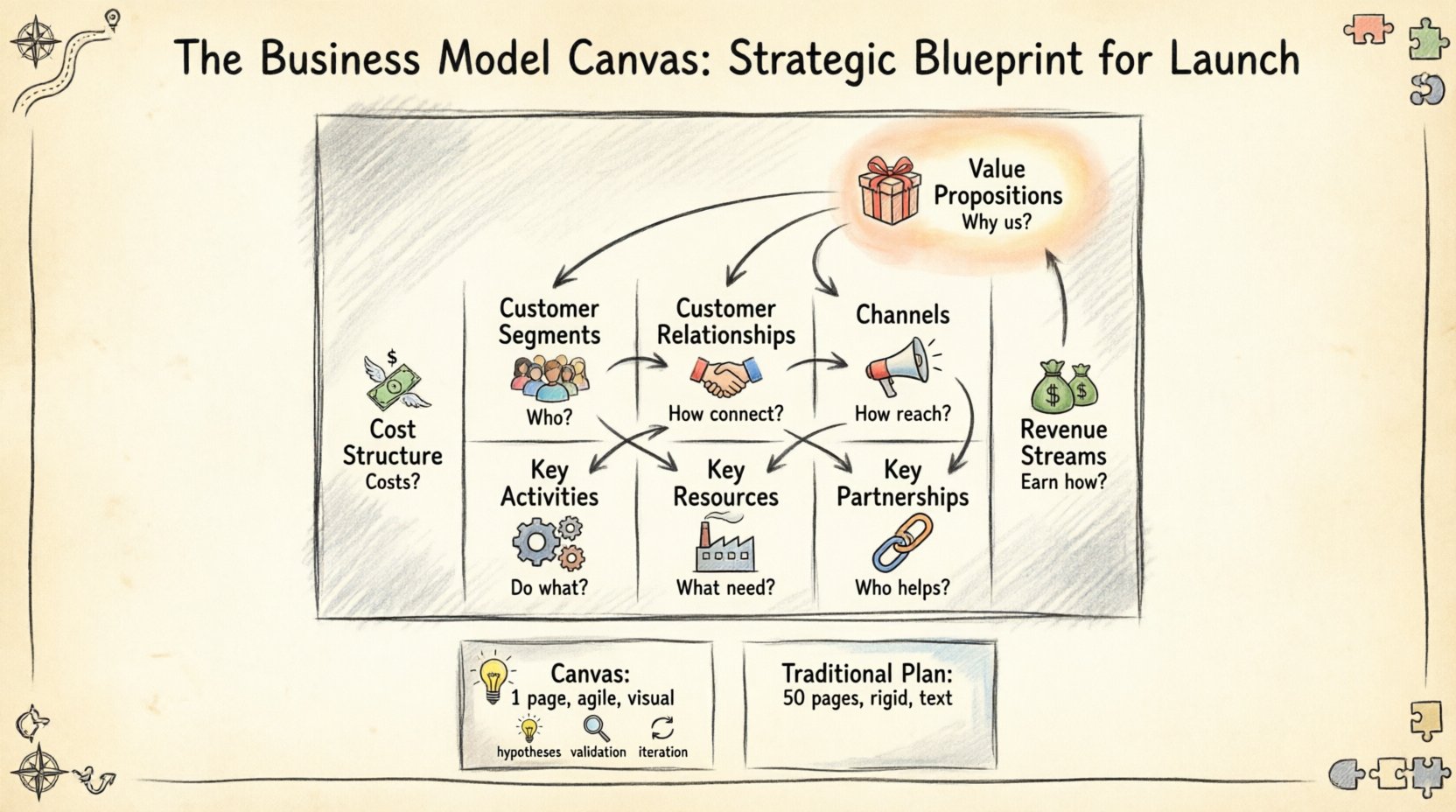
The foundation of any sustainable enterprise lies in clarity. Before a single product is built or a service is marketed, the underlying logic of how value flows must be understood. The Business Model Canvas serves as a strategic blueprint that maps out the critical components of an organization. It is a visual chart with elements describing a firm’s or product’s value proposition, infrastructure, customers, and finances.
Unlike traditional business plans that often span fifty pages and gather dust on a shelf, the Canvas condenses complex strategies into a single page. This allows for agility. Teams can iterate quickly. It shifts the focus from documentation to execution. This guide explores every dimension of this framework, providing a comprehensive look at how to leverage it for strategic planning.
🧩 The Origin and Purpose
Developed by Alexander Osterwalder and Yves Pigneur, the Business Model Canvas (BMC) emerged from the need to standardize the language of business design. It is rooted in the Lean Startup methodology, emphasizing hypothesis testing over rigid planning. The goal is not to predict the future with certainty, but to understand the current assumptions about how the business functions.
When teams sit down to define their model, they are answering fundamental questions:
- Who is the target audience?
- Why would they choose this solution?
- How does the organization sustain itself financially?
By visualizing these elements, stakeholders can identify gaps, redundancies, and opportunities for optimization. It is a tool for alignment, ensuring everyone from engineering to sales is working from the same map.
🏛️ The Nine Building Blocks
The Canvas is divided into nine distinct sections. These sections cover the four main areas of a business: customers, offer, infrastructure, and financial viability. Each block is interconnected; a change in one area ripples through the others. Understanding these relationships is key to effective strategy.
1. Customer Segments 👥
This block defines the different groups of people or organizations an enterprise aims to reach and serve. A business model can be either mass market or niche market. Identifying the right segment is the first step in value creation.
Key questions to consider include:
- Who are our most important customers?
- Which customer needs are we satisfying?
- Which customer segments are we serving?
Common segmentation strategies include:
- Mass Market: No significant differentiation in customer groups.
- Niche Market: Tailored for a specific group of customers.
- Segmented: Distinctly different groups with different needs.
- Diversified: Two or more distinct groups that are not significantly different.
2. Value Propositions 🎁
This block describes the bundle of products and services that create value for a specific Customer Segment. It is the reason why customers turn to one company over another. A value proposition must address a customer need or problem.
Typical value drivers include:
- Newness: Offering something novel.
- Performance: Improving product performance.
- Customization: Tailoring to specific client needs.
- Design: Aesthetic or functional appeal.
- Price: Competitive pricing strategies.
It is crucial to distinguish between a feature and a value. A feature is a characteristic of the product; value is the benefit the customer receives. For example, a GPS feature is a feature; “saving time by avoiding traffic” is the value.
3. Channels 📢
Companies must create a set of touchpoints that allow customers to interact with the business. Channels play a role in raising awareness, enabling purchase, and delivering value. They are critical for customer experience.
Channel phases include:
- Awareness: How do customers know about us?
- Evaluation: How do they assess our value proposition?
- Purchase: How do they buy the product?
- Delivery: How is the product received?
- After Sales: How is support provided?
Channels can be direct or indirect. Direct channels provide full control over the experience but require more resources. Indirect channels leverage existing networks but offer less control. The choice depends on the customer segment and the value proposition.
4. Customer Relationships 🤝
This block specifies the types of relationships a company establishes with specific customer segments. Relationships can range from personal assistance to automated services. They can be a key source of differentiation.
Types of relationships include:
- Personal Assistance: Direct human interaction.
- Dedicated Personal Assistance: A specific account manager.
- Self-Service: Customers help themselves.
- Automated Services: Technology-based interactions.
- Communities: Building a user base that interacts with each other.
- Co-creation: Working with the customer to create value.
The relationship strategy must align with the channel strategy. For example, a high-touch sales model requires a different relationship approach than a self-service software platform.
5. Revenue Streams 💰
This block represents the cash a company generates from each Customer Segment. It is the lifeblood of the business. Revenue can come from various sources, and it is often a mix of pricing mechanisms.
Revenue sources include:
- Asset Sale: Selling ownership of goods.
- Usage Fee: Charging for the use of a service.
- Subscription Fees: Recurring revenue for access.
- Lending/Renting: Temporary access to assets.
- Advertising: Charging for space or attention.
Pricing mechanisms must be determined here. Strategies include fixed pricing, dynamic pricing, or yield management. The price must cover costs and provide a margin while remaining attractive to the customer.
6. Key Resources 🏭
This block describes the most important assets required to make a business model work. Without these resources, the value proposition cannot be delivered.
Categories of resources include:
- Physical: Buildings, vehicles, machines.
- Intellectual: Brands, patents, copyrights, data.
- Human: Talent, specialized skills, leadership.
- Financial: Cash, lines of credit, stock options.
Identifying key resources helps prioritize investment. If intellectual property is the key resource, budget should reflect R&D and legal protection. If human talent is key, recruitment and retention become the primary focus.
7. Key Activities ⚙️
This block describes the most important things a company must do to make its business model work. These activities ensure that the value proposition is delivered to the customer.
Types of activities include:
- Production: Designing, making, and delivering a product.
- Problem Solving: Creating new solutions for individual customers.
- Platform/Network: Maintaining a platform or network.
For a manufacturing firm, production is the key activity. For a consultancy, problem solving is central. For a social media company, maintaining the platform is the priority. Aligning activities with the value proposition is essential.
8. Key Partnerships 🤝
This block describes the network of suppliers and partners that make the business model work. Companies form partnerships to optimize their business models, reduce risk, or acquire resources.
Types of partnerships include:
- Strategic Alliances: Between non-competitors.
- Co-opetition: Strategic partnerships between competitors.
- Joint Ventures: Partners develop new businesses together.
- Buyer-Supplier Relationships: Ensuring reliable supply.
Partnerships allow a company to focus on its core competencies while outsourcing non-core activities. This can reduce costs and improve speed to market.
9. Cost Structure 💸
This block describes all costs incurred to operate a business model. It is the flip side of the Revenue Streams. Understanding costs is vital for profitability.
Cost drivers include:
- Fixed Costs: Remain constant regardless of output.
- Variable Costs: Vary with the level of output.
- Economies of Scale: Costs decrease as volume increases.
- Economies of Scope: Costs decrease as product variety increases.
Businesses are often either cost-driven or value-driven. A cost-driven model focuses on minimizing costs wherever possible. A value-driven model focuses on creating premium value, accepting higher costs to justify higher prices.
📊 Comparison: Canvas vs. Traditional Plans
Many organizations struggle with the transition from traditional documentation to the Canvas. The following table highlights the differences in structure and utility.
| Feature | Business Model Canvas | Traditional Business Plan |
|---|---|---|
| Format | Visual, single page | Document, 20-50 pages |
| Focus | Execution and hypotheses | Planning and prediction |
| Flexibility | High, easy to update | Low, difficult to revise |
| Clarity | High, concise | Variable, often verbose |
| Stakeholder Alignment | Collaborative workshop | Top-down approval |
🛠️ The Process of Implementation
Filling out the Canvas is not a one-time event. It is a process of discovery and iteration. The following steps outline a practical approach to developing the model.
Step 1: Gather the Team
Strategy is a collective effort. Bring together individuals from different departments. Include perspectives from sales, product, marketing, and operations. Diverse input prevents blind spots and ensures the model reflects reality.
Step 2: Define the Hypothesis
Start with a hypothesis for each of the nine blocks. Do not assume you know the answer. Write down your best guess. This frames the work as an experiment rather than a fact.
Step 3: Validate with Data
Move out of the building. Talk to potential customers. Run small tests. Gather data to support or refute your hypotheses. If the data contradicts the assumption, update the Canvas immediately.
Step 4: Iterate
The model is living. As the market changes, the model must change. Regularly review the Canvas. Look for misalignments between value and cost, or between channels and customer relationships.
⚠️ Common Pitfalls
Even with a powerful tool, teams can make mistakes. Awareness of common errors helps avoid strategic drift.
- Confusing Channels with Relationships: A channel is a way to reach a customer. A relationship is the nature of the interaction. Do not mix them up.
- Focusing on the Product, Not the Customer: Start with Customer Segments and Value Propositions. If you start with Key Resources, you may build something nobody wants.
- Ignoring the Cost Structure: Revenue is vanity; profit is sanity. A great value proposition that costs too much to deliver will fail.
- One Size Fits All: Different segments may require different value propositions. Do not try to serve everyone with the exact same model.
- Static Thinking: Treating the Canvas as a finished document rather than a working hypothesis leads to stagnation.
🔄 Validation and Iteration
The true power of the Business Model Canvas lies in its ability to facilitate iteration. Once the initial draft is complete, the focus shifts to validation. This involves testing the riskiest assumptions.
For example, if the assumption is that customers will pay a subscription fee, the validation step is to try to sell the subscription before building the full platform. This is known as a minimum viable product (MVP) approach.
If the data shows low conversion, the team must revisit the Canvas. Perhaps the Price is too high, or the Value Proposition is unclear. The Canvas provides the structure to make these adjustments systematically.
🔍 Strategic Alignment
Once the model is defined, it must align with the broader organizational strategy. The resources and activities must support the value proposition. If the value proposition is “speed,” the Key Activities must prioritize rapid development and logistics.
Alignment ensures that the company moves in one direction. It prevents resource dilution. When every department understands the nine blocks, they can make decisions that reinforce the core business model.
📝 Final Thoughts on Strategic Planning
Building a business is complex. The Business Model Canvas simplifies this complexity without oversimplifying the reality. It forces discipline. It requires teams to be explicit about their choices.
By mapping the nine building blocks, organizations gain a holistic view. They can see how a change in pricing affects the cost structure, or how a change in partners affects the key activities. This interconnected view is where strategic insight is found.
Use the Canvas as a starting point. Let it guide your conversations. Let it frame your experiments. As the business grows and evolves, so too will the Canvas. It is a dynamic tool for a dynamic market. Embrace the process of continuous improvement. This is how sustainable value is created.