
Starting a new venture or refining an existing one requires more than just a good idea. It demands a clear understanding of how value is created, delivered, and captured. The Business Model Canvas (BMC) serves as a strategic management tool that provides a holistic view of your organization. Unlike traditional business plans that fill dozens of pages, the BMC condenses complex strategies into a single visual chart.
This guide explores the mechanics of the framework, offering a structured approach to mapping your business logic. We will navigate the nine building blocks, examine how they interconnect, and discuss how to use this tool for validation and iteration. By the end of this process, you will have a tangible artifact that represents your current strategy and highlights areas requiring attention.
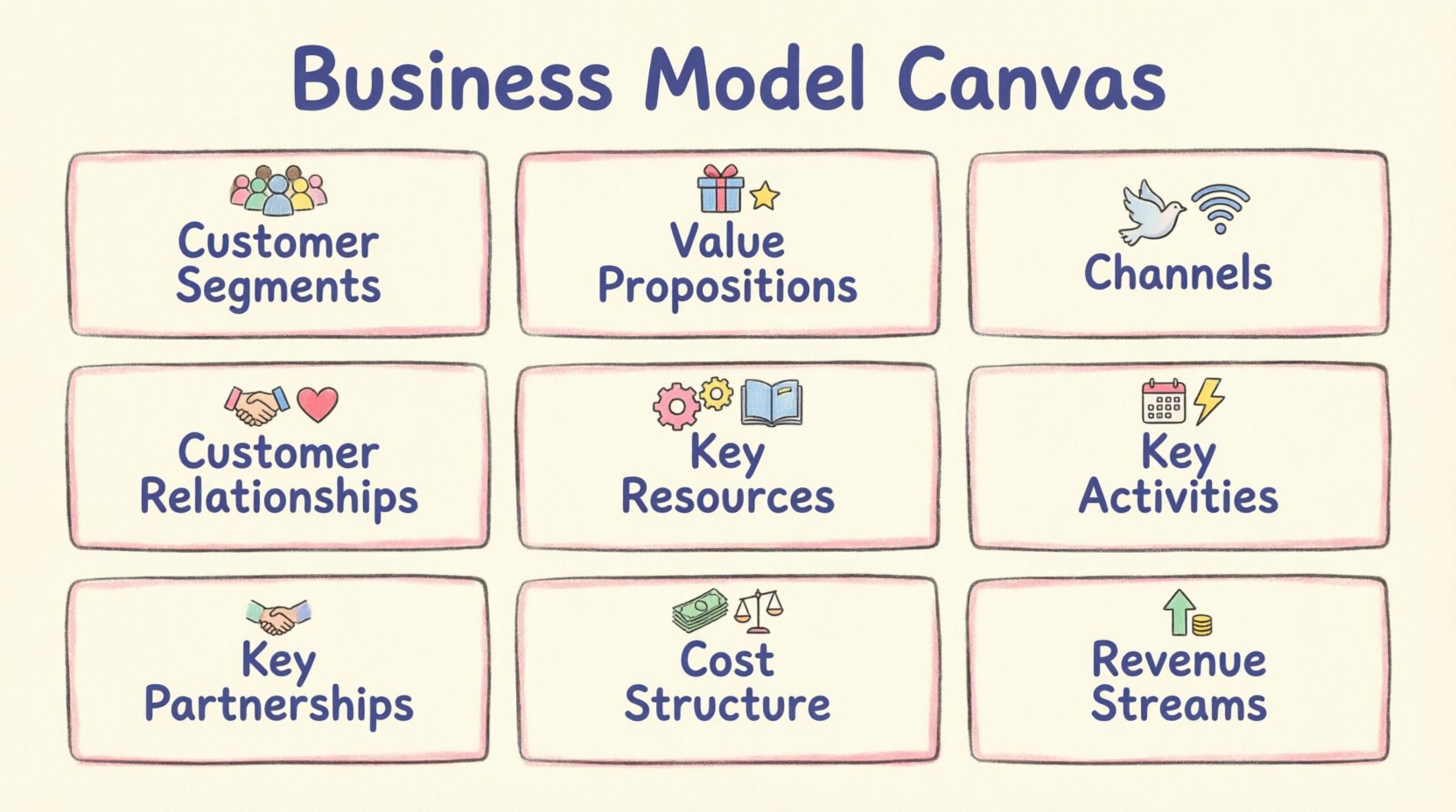
What is the Business Model Canvas? 📊
Developed by Alexander Osterwalder and Yves Pigneur, the Business Model Canvas is a framework that describes the rationale of how an organization creates, delivers, and captures value. It is not a business plan in the traditional sense; rather, it is a dynamic map of your operations.
Traditional plans often focus heavily on financial projections and marketing strategies in isolation. The BMC forces you to look at the interdependencies between your customers, your infrastructure, and your financial viability simultaneously. This holistic approach helps identify gaps in logic before resources are committed.
Why Use This Framework?
- Clarity: It simplifies complex strategies into manageable components.
- Alignment: It helps teams agree on the direction and logic of the business.
- Agility: It allows for rapid iteration as assumptions change.
- Focus: It highlights the most critical aspects of the business model.
The 9 Building Blocks Explained 🧱
The canvas is divided into nine sections. These sections cover four main areas: customers, offer, infrastructure, and financial viability. Understanding each block is essential for constructing a coherent model.
| Building Block | Category | Core Question |
|---|---|---|
| Customer Segments | Front Stage | Who are we serving? |
| Value Propositions | Front Stage | What value do we deliver? |
| Channels | Front Stage | How do we reach them? |
| Customer Relationships | Front Stage | How do we interact? |
| Revenue Streams | Financial Viability | How do we earn money? |
| Key Resources | Back Stage | What assets do we need? |
| Key Activities | Back Stage | What must we do? |
| Key Partnerships | Back Stage | Who helps us? |
| Cost Structure | Financial Viability | What are the costs? |
1. Customer Segments 👥
This block defines the different groups of people or organizations you aim to reach and serve. A business model can be divided into multiple segments, such as mass market, niche market, segmented, diversified, or multi-sided platforms.
- Mass Market: No significant segmentation. Everyone is a potential customer.
- Niche Market: Focus on a specific group with unique needs.
- Segmented: Distinct groups based on differences in needs or behaviors.
- Multisided: You must serve two or more interdependent customer groups (e.g., credit card companies and merchants).
When defining this section, avoid saying “everyone.” Identify specific personas. What are their pain points? What is their income level? What is their location? Precise definitions here ensure your value proposition resonates.
2. Value Propositions 🎁
The value proposition is the reason why customers turn to your offering over a competitor. It solves a customer problem or satisfies a customer need. It bundles a set of products and services that create value for a specific customer segment.
Key elements of a value proposition include:
- Innovation: Newness or a performance improvement.
- Customization: Tailoring to specific needs.
- Getting the Job Done: Helping customers accomplish a task.
- Design: Aesthetic or ergonomic qualities.
- Price: Cost reduction or premium pricing strategies.
- Convenience: Ease of use or accessibility.
Your value proposition must align with the specific needs of your customer segments. If you target price-sensitive customers, a luxury value proposition will fail. If you target efficiency seekers, a slow, bespoke service is not a fit.
3. Channels 📣
Channels are how a company communicates with and reaches its customer segments to deliver a value proposition. This includes customer touchpoints across the entire journey.
There are five phases in the customer journey where channels play a role:
- Awareness: How do customers become aware of your offering?
- Evaluation: How do they assess your value proposition?
- Purchase: How do they buy the product?
- Delivery: How is the product delivered to them?
- After Sales: How is support provided?
Channels can be direct (e.g., own website, sales team) or indirect (e.g., retailers, partners). Choosing the right mix affects cost, reach, and customer experience. Consistency across channels is vital for brand integrity.
4. Customer Relationships 🤝
This block describes the types of relationships a company establishes with specific customer segments. Relationships can range from personal assistance to automated services.
Common types of relationships include:
- Personal Assistance: Human interaction at key points.
- Self-Service: No direct human interaction.
- Automated Services: Personalized self-service based on data.
- Communities: Creating a space for users to interact.
- Co-creation: Active collaboration with customers.
These relationships drive customer acquisition, retention, and upselling. Understanding the emotional connection or the functional necessity of the relationship helps in designing the customer experience.
5. Revenue Streams 💰
Revenue streams represent the cash a company generates from each customer segment. It is the sum of money paid to the company for the value proposition delivered.
Revenue can come from various sources:
- Asset Sale: Selling the ownership of a physical or digital asset.
- Usage Fee: Charging for the use of a service.
- Subscription Fee: Recurring revenue for access to a service.
- Lending/Renting/Leasing: Charging for temporary access.
- Advertising: Charging for space to display messages.
- Auction: Dynamic pricing based on demand.
Identifying the right pricing mechanism is crucial. It should reflect the value perceived by the customer and cover the costs of the business. Diversifying revenue streams can reduce risk.
6. Key Resources 🏗️
Key resources are the assets required to offer and deliver the previously described elements. Without these resources, the business model cannot function.
Resources are generally categorized into:
- Physical: Buildings, vehicles, machines, systems.
- Intellectual: Brands, patents, copyrights, data, algorithms.
- Human: Staff, talent, expertise.
- Financial: Cash, lines of credit, equity.
Identifying which resources are critical helps in prioritizing investment. For a tech startup, intellectual and human resources often take precedence over physical assets. For a manufacturing firm, physical resources are paramount.
7. Key Activities 🔨
Key activities are the most important things a company must do to make its business model work. These are the actions taken to execute the strategy.
Types of activities include:
- Production: Designing, making, and delivering a product.
- Problem Solving: Creating new solutions for individual customer problems.
- Platform/Network: Maintaining and improving a platform.
Activities must align with the value proposition. If the value is speed, key activities must focus on logistics and rapid deployment. If the value is reliability, activities focus on quality control and testing.
8. Key Partnerships 🤝
Key partners are the network of suppliers and partners that make the business model work. Companies form partnerships to optimize efficiency, reduce risk, or acquire resources.
Types of partnerships include:
- Strategic Alliances: Between non-competitors.
- Coopetition: Strategic partnerships between competitors.
- Joint Ventures: Partners developing a new business together.
- Buyer-Supplier Relationships: Ensuring reliable supply.
Outsourcing non-core activities allows the company to focus on its key competencies. Partnerships can provide access to new markets or technologies without internal investment.
9. Cost Structure 💸
The cost structure describes all costs incurred to operate a business model. It is the flip side of the revenue streams. Understanding costs is vital for profitability.
Cost structures can be categorized by their behavior:
- Fixed Costs: Remain constant regardless of output (e.g., rent, salaries).
- Variable Costs: Change with the volume of output (e.g., raw materials, shipping).
Some models are cost-driven (focusing on minimum costs), while others are value-driven (focusing on value creation even if costs are higher). Identifying the major cost drivers helps in optimizing the model.
How to Fill Out the Canvas 📝
Filling out the canvas is a collaborative process. It is rarely a solitary task. Here is a step-by-step approach to generating the content.
Step 1: Preparation
- Print a large canvas or use a digital whiteboard.
- Gather a diverse group of stakeholders.
- Prepare sticky notes and markers.
- Ensure everyone understands the definitions of the nine blocks.
Step 2: Brainstorming
Start with the Customer Segments and Value Propositions. These are the core of the business. Write down ideas on sticky notes and place them in the respective blocks. Do not worry about perfection at this stage.
Step 3: Connecting the Dots
Once the blocks are populated, draw lines connecting related elements. For example, draw a line from a Customer Segment to the Value Proposition that serves them. Draw a line from Key Activities to the Value Proposition they enable. This visualizes the flow of logic.
Step 4: Review and Refine
Step back and review the connections. Are there gaps? Is the cost structure aligned with the revenue streams? Does the infrastructure support the customer experience? Iterate on the content based on these observations.
Validation and Iteration 🔄
A canvas is a hypothesis, not a fact. It represents your best guess at how the business works. Validation is the process of testing these assumptions in the real world.
- Customer Interviews: Ask potential customers if they recognize the problem and value.
- Prototyping: Build a minimum viable product to test the value proposition.
- A/B Testing: Test different channels or pricing models.
- Pilot Programs: Launch a small-scale version of the service.
As you gather data, update the canvas. If a customer segment is not responding, move on to another. If costs are higher than expected, adjust the key activities or partnerships. The canvas is a living document.
Common Pitfalls to Avoid ⚠️
Many teams struggle with the canvas due to common mistakes. Being aware of these can save time and effort.
1. Confusing Internal Processes with Value
Writing down internal processes in the Value Proposition block is a mistake. The value proposition must be about the benefit to the customer, not how you build the product internally.
2. Ignoring the Cost Structure
Focusing only on revenue and ignoring costs leads to unsustainable models. Ensure the cost structure is realistic and reflects the resources and activities defined.
3. Too Many Customer Segments
Trying to serve everyone often leads to serving no one well. Focus on a primary segment first. You can expand later, but a clear focus is better for starting.
4. Static Thinking
Creating the canvas and filing it away is a waste of time. Treat it as a dynamic tool that evolves with the market. Review it regularly, perhaps monthly or quarterly.
Integrating with Other Strategies 🧩
The Business Model Canvas works well alongside other strategic frameworks. It can be used to refine a SWOT analysis or support a Lean Startup methodology.
When using the Lean Startup approach, the canvas serves as the initial hypothesis. The build-measure-learn loop updates the canvas based on validated learning. This integration ensures that strategy remains grounded in evidence.
Strategic Alignment
Ensure that the front stage (customers) aligns with the back stage (infrastructure). A premium value proposition requires high-quality resources and activities. A low-cost model requires efficient activities and lean resources. Mismatches here create friction and inefficiency.
Final Thoughts on Strategic Clarity 🎯
Building a business model is an act of translation. You are translating a vision into a concrete plan. The Business Model Canvas provides the structure for this translation. It forces you to confront the realities of your market, your costs, and your customers.
By systematically working through the nine blocks, you create a shared language for your team. It reduces ambiguity and focuses energy on the areas that drive growth. Remember, the goal is not to fill the boxes perfectly on the first try. The goal is to start the conversation, test your assumptions, and refine your approach based on reality.
Use this tool to map your current state and to design your future state. Whether you are a startup founder or an executive in a large corporation, the principles of value creation remain the same. Keep the canvas visible, keep it updated, and let it guide your strategic decisions.