
In the fast-paced environment of modern software development, the value of visual documentation often gets questioned. Agile methodologies prioritize working software over comprehensive documentation. However, this principle is frequently misinterpreted as a mandate to eliminate all design artifacts. A class diagram remains a critical tool for understanding complex systems, even within iterative frameworks. It provides a static snapshot of the structure, relationships, and constraints of a system. This guide explores why these diagrams are not relics of the past but essential components of a robust engineering practice.
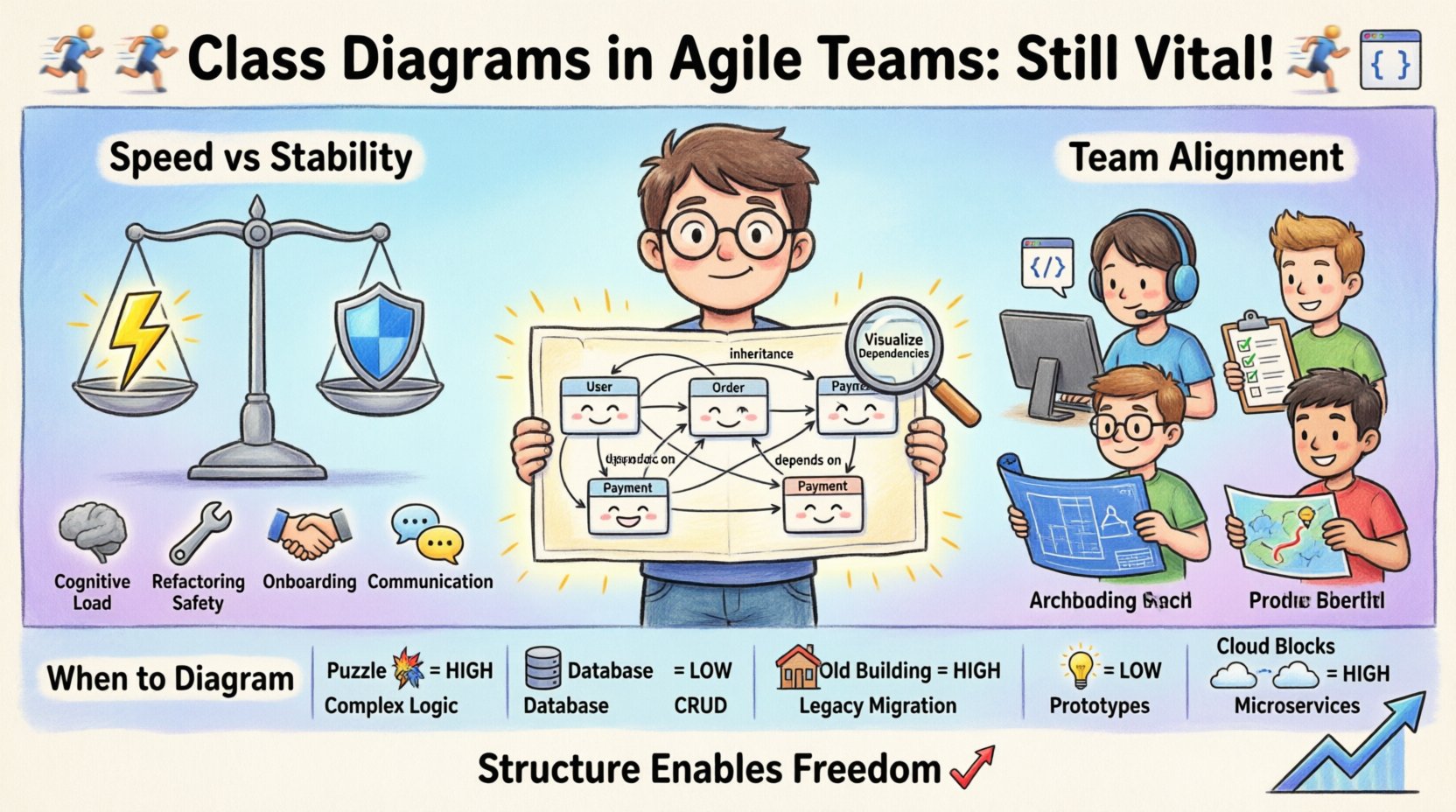
The Misconception of Speed vs. Stability 🏃♂️💨
Agile teams often face pressure to deliver features quickly. The perception is that drawing diagrams slows down the sprint. This view overlooks the cost of ambiguity. When a developer encounters a complex class hierarchy without a map, the time spent deciphering dependencies often exceeds the time spent creating the diagram. Understanding the boundaries of responsibility is crucial. A class diagram clarifies these boundaries.
Consider the following points regarding speed and stability:
- Cognitive Load: Visual representations reduce the mental effort required to understand relationships between modules.
- Refactoring Safety: Knowing how classes interact prevents breaking changes during updates.
- Onboarding Efficiency: New team members grasp the architecture faster with visual aids.
- Communication: Diagrams serve as a universal language between different roles.
Skipping this step might save minutes today but can cost hours next week during maintenance. The goal is not to create exhaustive blueprints for every micro-feature but to maintain a high-level view of the system’s anatomy.
Visualizing Dependencies for Safer Refactoring 🔧
Refactoring is a core practice in maintaining code health. As code evolves, classes grow, merge, or split. Without a visual guide, it is easy to introduce hidden coupling. A class diagram exposes these connections explicitly. It highlights inheritance trees, interface implementations, and association lines.
When planning a structural change, the diagram acts as a checklist. It answers critical questions before a single line of code is written:
- Which classes depend on this module?
- Is this dependency bidirectional or cyclic?
- Does changing this class signature impact downstream consumers?
- Are there circular references that could cause runtime errors?
Identifying a cyclic dependency visually is often faster than tracing it through the codebase. Cycles complicate testing and increase deployment risk. By mapping the classes, architects can enforce design patterns that prevent these issues. This proactive approach reduces the likelihood of introducing regressions.
Bridging the Communication Gap Across Roles 🗣️
Software development involves multiple stakeholders. Developers, testers, product owners, and system architects all need to align on how the system functions. While developers read code, other roles may not have the same level of technical fluency. A class diagram acts as a translation layer.
Different roles benefit from specific views:
- Developers: Focus on implementation details, attributes, and methods.
- Testers: Focus on inputs, outputs, and state transitions implied by class structures.
- Architects: Focus on high-level organization, boundaries, and scalability.
- Product Owners: Focus on domain concepts and entity relationships.
A well-documented diagram ensures everyone is discussing the same system. It prevents the scenario where a developer builds a feature based on a misunderstanding of the domain model. This alignment reduces the rework rate and improves overall delivery quality.
Onboarding New Talent Faster 🚀
Turnover is a reality in the tech industry. When a new engineer joins a team, they must ramp up quickly. Reading the codebase is the primary method, but it can be overwhelming. A large system with thousands of classes is difficult to navigate solely through text.
Class diagrams provide a roadmap. They show the entry points and the major components. This context helps new hires understand where their specific task fits into the larger puzzle. It reduces the time spent asking senior team members for basic architectural context.
Key benefits for onboarding include:
- Reduced Context Switching: New hires understand the big picture before diving into details.
- Faster Issue Resolution: Knowing where code resides helps in locating bugs.
- Confidence Building: Visual confirmation of structure helps new members feel secure in their changes.
- Knowledge Retention: Diagrams preserve institutional memory even if key developers leave.
Managing Technical Debt with Structure 📉
Technical debt accumulates when shortcuts are taken in design. Over time, the codebase becomes a tangled web of dependencies. This state makes new features difficult to implement. Class diagrams help identify this debt early.
By reviewing the current state of the diagrams, teams can spot:
- God Classes: Classes that do too many things and hold too much state.
- High Coupling: Modules that rely too heavily on each other.
- Low Cohesion: Groups of classes that do not share a common purpose.
- Legacy Bottlenecks: Areas of the system that are difficult to modify.
Addressing these issues requires a plan. The diagram serves as the baseline for that plan. It allows the team to visualize the target state and measure progress. This structured approach to debt reduction prevents the system from becoming unmaintainable.
When to Diagram vs When to Code First ⚖️
Not every component requires a detailed diagram. Agile teams must balance documentation effort with value. The following table outlines scenarios where class diagrams add significant value versus where they might be less critical.
| Scenario | Diagram Value | Reasoning |
|---|---|---|
| Complex Domain Logic | High | Business rules are often intricate and need clear modeling to avoid errors. |
| Simple CRUD Operations | Low | Standard patterns are well understood; code is self-explanatory. |
| Legacy System Migration | High | Understanding existing structure is crucial before moving to a new architecture. |
| Experimental Prototypes | Low | Speed is key; the structure will change rapidly anyway. |
| Microservices Boundary Design | High | Defining service boundaries prevents tight coupling between services. |
| Public API Contracts | Medium | Class structures define the data models exposed to external consumers. |
This matrix helps teams decide where to invest their design time. The goal is to provide clarity where it matters most.
Dynamic Evolution of Diagrams 🔄
A common concern is that diagrams become outdated as soon as the code changes. In a rapidly evolving agile environment, maintaining a static document is indeed difficult. The solution is to treat diagrams as living artifacts that evolve alongside the code.
Several strategies ensure diagrams remain relevant:
- Automated Generation: Tools can generate diagrams directly from the source code to ensure accuracy.
- Just-in-Time Updates: Update diagrams when refactoring or adding major features.
- High-Level Focus: Focus on the architecture rather than every single attribute.
- Version Control: Store diagrams alongside code in the repository to track changes.
This approach ensures that the documentation reflects the reality of the system. It avoids the “documentation debt” where the written word no longer matches the executable code.
The Impact on Testing Strategies 🧪
Test coverage is often measured by code metrics, but structural coverage is equally important. Class diagrams help testers understand the state of the system. They reveal the public interfaces and the internal states that might need mocking.
For unit testing, knowing the dependencies allows for proper isolation. If a class relies on a database connection, the diagram highlights that dependency. This informs the decision to mock the database rather than connecting to a real one during the test run.
For integration testing, the diagram shows how different modules connect. It helps define the scope of the integration. Testers can identify the critical paths that must be verified when multiple classes interact. This structural awareness leads to more robust test suites.
Code Generation and Reverse Engineering 🛠️
Some workflows utilize class diagrams to generate code skeletons. This is less common now but still applicable in certain enterprise contexts. It ensures that the structure follows a strict standard.
Conversely, reverse engineering allows teams to create diagrams from existing code. This is useful when dealing with legacy systems where documentation is missing. It helps in understanding the current state before planning any migration or overhaul.
These processes highlight the bidirectional relationship between design and implementation. They reinforce the idea that structure and code are two sides of the same coin.
Integrating with Microservices Architecture 🏛️
In modern distributed systems, defining boundaries is critical. Class diagrams help define the domain boundaries within microservices. They clarify which entities belong to which service.
Clear boundaries prevent the “distributed monolith” anti-pattern. If classes in one service depend heavily on classes in another, it suggests the services are too tightly coupled. The diagram makes this visible, allowing architects to redesign the service boundaries before deployment.
Key considerations include:
- Data Ownership: Which service owns the data for a specific entity?
- Interface Contracts: How do services communicate structurally?
- Shared Kernels: Avoiding shared code bases that create tight coupling.
By visualizing these relationships, teams can ensure a truly modular architecture that scales effectively.
Maintaining a Culture of Documentation 📚
Finally, the existence of class diagrams fosters a culture of thoughtful design. It signals that the team values long-term maintainability over short-term speed. This mindset attracts high-quality engineers who care about the craft.
When documentation is part of the workflow, it becomes a habit rather than a chore. It encourages developers to think before they code. This discipline leads to cleaner, more logical code structures. It reduces the need for constant rework and patching.
The presence of diagrams also aids in code reviews. Reviewers can check if the implementation matches the design. If the code diverges from the diagram, it flags a potential issue. This consistency check is a powerful quality assurance mechanism.
Conclusion: Structure Enables Freedom 🎯
The debate often centers on whether design documents hinder agility. The reality is that structure enables agility. When the foundation is clear, changes can be made with confidence. Class diagrams provide this clarity.
They are not about creating barriers but about removing ambiguity. In a complex system, ambiguity is the enemy of speed. By investing in visualizing the class structure, teams save time on communication, debugging, and maintenance.
Modern development does not require abandoning diagrams. It requires using them wisely. Focus on the aspects that add value to your specific context. Use them to clarify dependencies, guide refactoring, and onboard talent. When used correctly, they remain a vital asset for any serious software engineering team.