
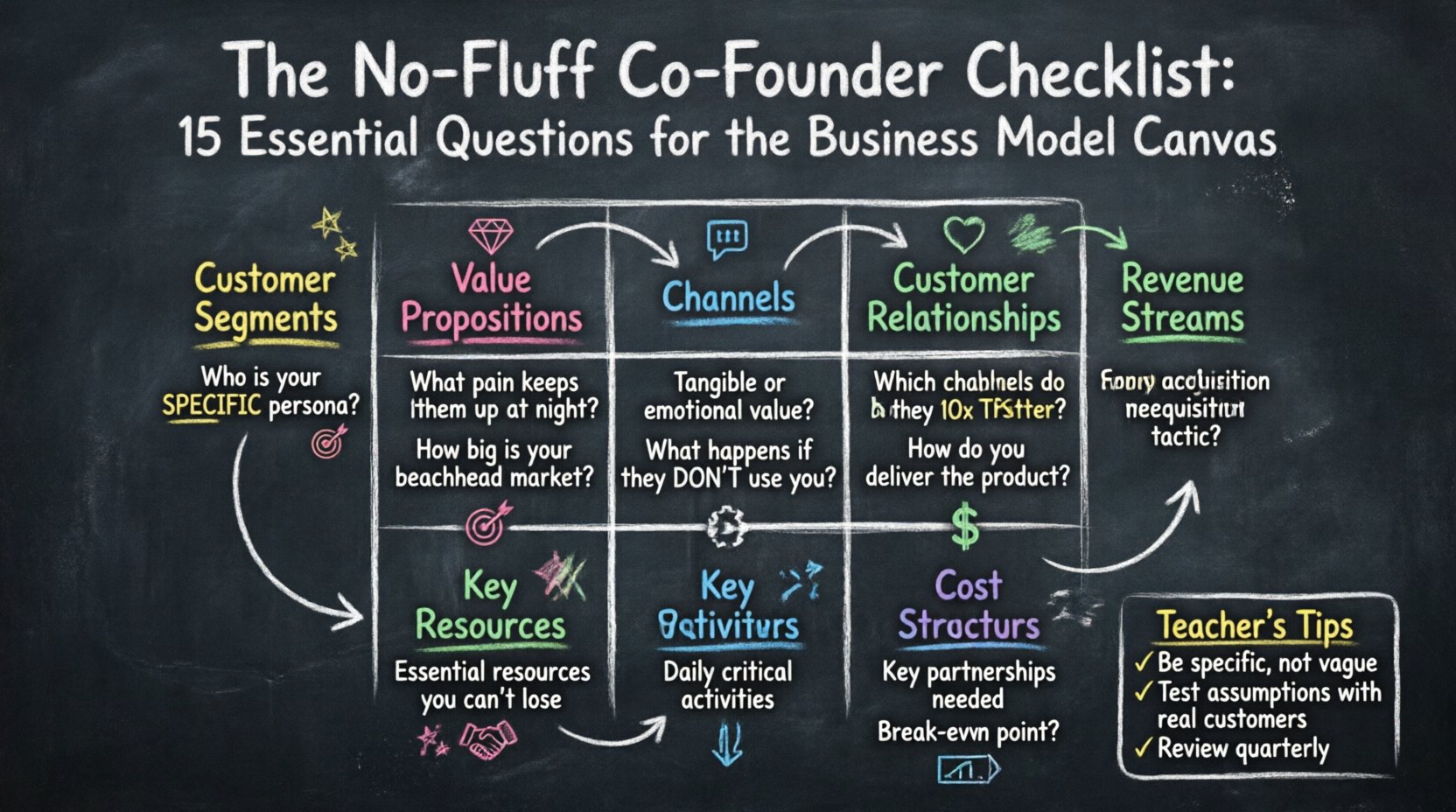
Building a startup is an exercise in managing uncertainty. Co-founders often dive into product development or sales before validating the underlying mechanics of how the business actually functions. This leads to fragile models that crumble under market pressure. The Business Model Canvas (BMC) offers a structured way to map out these mechanics without getting lost in a 50-page business plan. However, having the canvas is not enough. You need the right questions to fill it correctly.
Many founders treat the BMC as a static document. In reality, it is a living framework that requires rigorous interrogation. The following checklist contains 15 critical questions designed to expose gaps in your logic before you burn capital. This guide breaks down each section of the canvas, providing deep insights into what each answer implies for your company’s trajectory.
1. Understanding Customer Segments 🎯
The foundation of any business is who buys from you. If you cannot define your customer clearly, your marketing budget will vanish, and your product features will lack focus. Co-founders often assume everyone is their customer, which means they are targeting no one.
Question 1: Who is the specific persona driving the core value?
Do not answer with “everyone” or “small businesses.” You need a specific profile. Is it a CTO at a fintech startup? Is it a stay-at-home parent looking for meal solutions? Define the demographic, psychographic, and behavioral traits. If you cannot name the person, you cannot sell to them effectively. A clear persona allows you to tailor your messaging to their specific language and pain points.
Question 2: What is the single biggest pain point this segment faces today?
Identify the specific problem that keeps this persona up at night. It must be acute. If the problem is mild, they will not pay to solve it. Look for existing workarounds they currently use. If they are using spreadsheets, pen and paper, or a competitor, there is a problem worth solving. The goal is to find a problem that causes them enough friction to seek a solution immediately.
Question 3: How large is the addressable market for this specific segment?
There is a difference between a niche problem and a viable business. You need to estimate the Total Addressable Market (TAM) for your specific persona. Is this a group of 10,000 people or 10 million? If the market is too small, the business may not sustain itself. If it is too broad, you will struggle to gain traction. Aim for a beachhead market that is reachable but substantial enough to support growth.
Question 4: Who is the secondary customer segment that could expand the model?
Startups rarely start with a massive market. They start with a wedge. Identify a secondary segment that might adopt the product later. Perhaps your primary segment is developers, and your secondary segment is their managers. Understanding this expansion path helps in designing the product architecture for scalability. It prevents you from building a tool that only serves the initial user base.
2. Defining Value Propositions 💎
Once you know who you are serving, you must define what you offer. The value proposition is the reason customers choose you over alternatives. It is the core promise of value you deliver.
Question 5: What specific problem does your product solve better than any alternative?
Competitors always exist, even if they are not direct. They might be manual processes or free tools. You need a clear differentiator. Is it speed? Cost? Reliability? Or a unique feature? If you are just “better,” it is not enough. You need to be distinct. Explain exactly why your solution is superior. Is it 10x faster? Is it 50% cheaper? Quantify the advantage where possible.
Question 6: Is the value tangible (functional) or intangible (emotional)?
Some products save time (tangible). Others provide peace of mind (intangible). You must know which category you are in. A productivity tool saves hours. A security tool provides safety. Understanding this distinction helps in pricing and marketing. Tangible value is easier to measure. Intangible value requires building trust. You may need to address both, but one should be the primary driver.
Question 7: What would happen if the customer did not use your solution?
This highlights the cost of inaction. If they don’t use your product, do they lose money? Do they lose time? Do they risk compliance? The higher the cost of inaction, the higher the perceived value. This question forces you to articulate the urgency. If the consequence of doing nothing is negligible, the customer will not prioritize your solution.
Can you sell the same value to different segments? If your value is too specific to one industry, scaling becomes difficult. For example, a tool that works for hospitals might not work for schools. If you plan to expand, ensure the core value remains relevant. If the value changes drastically for new segments, you may need a new product line.
3. Optimizing Channels and Relationships 📢
How you reach customers and how you keep them are operational realities. A great product fails if no one knows about it or if they leave after the first month.
Question 9: Which channels does your customer trust the most?
Different segments trust different sources. B2B buyers might trust whitepapers and industry events. B2C buyers might trust social media influencers or reviews. You must allocate resources to the channels where your audience spends their attention. Do not spread yourself thin across every platform. Pick the one or two where you can get the highest conversion rate.
Question 10: How do you distribute the product or service to the customer?
Is it a physical shipment? A digital download? A service delivered manually? The distribution method impacts your cost structure and speed. Digital distribution is fast and scalable. Physical distribution requires logistics and inventory. Manual delivery limits your growth. Choose a method that aligns with your growth goals and capital constraints.
Question 11: How do you acquire customers in the early stages?
Acquisition strategies change as you grow. Early on, it might be direct outreach or founder networks. Later, it might be paid ads or SEO. Define the specific mechanism for your current stage. Do you need a landing page? Do you need sales calls? Do you need a referral program? The acquisition channel dictates your initial cash flow requirements.
Question 12: What mechanisms are in place to retain customers long-term?
Acquisition is expensive. Retention is profitable. Why will they stay? Is it because of switching costs? Is it because of network effects? Is it because of a subscription model? If you have no retention strategy, you are building a leaky bucket. Define the specific actions you take to keep them engaged after the first purchase.
Customers need to know they can reach you. Do you offer 24/7 support? Do you have a community forum? Do you use tickets? The level of support you provide signals the quality of your brand. High-touch support increases costs but boosts loyalty. Low-touch support saves money but risks churn. Decide on the balance that fits your resources.
4. Analyzing Key Resources and Activities ⚙️
Behind the scenes, you need assets and actions to make the model work. These are the operational engines that drive the value proposition.
Question 14: What key resources are absolutely essential to deliver the value?
Identify the assets you cannot do without. Is it proprietary technology? A team of data scientists? A physical warehouse? Patents? If you lose these resources, the business stops. Prioritize these resources. If you do not own them, how do you secure them? This question helps you understand your dependency risks.
Question 15: What are the most critical activities you must perform daily?
Running a business requires focus. What tasks must happen every single day to keep the lights on? Is it coding? Is it sales calls? Is it manufacturing? If you stop these activities, the value proposition collapses. Align your hiring and budget around these activities. Do not waste time on low-impact tasks that do not drive the core model.
Additional Consideration: What are the strategic partnerships required?
Do you need suppliers? Do you need distribution partners? Do you need technology integrations? Partnerships can reduce your risk and cost. However, they also add complexity. Identify which partnerships are critical for launch and which can be added later. Be careful not to rely on a partner that could block your growth.
5. Financial Viability: Revenue and Costs 💰
The model must make financial sense. Revenue streams and cost structures determine survival.
Question 16: What is the primary revenue model?
How do you make money? Subscription? Transaction fee? Licensing? Freemium? Each model has different cash flow implications. Subscriptions provide predictable revenue. Transactions provide variable revenue. Choose the model that matches your customer’s payment habits and your financial runway.
Question 17: What is the pricing strategy relative to value?
Price is not just a number; it is a signal. Does your price reflect the value delivered? If you underprice, you devalue your product. If you overprice, you limit adoption. Consider the willingness to pay of your specific segment. Test different price points to find the sweet spot where volume and margin balance.
Question 18: What are the major fixed and variable costs?
Fixed costs do not change with sales (rent, salaries). Variable costs do (server costs, transaction fees). Understanding this ratio helps you project profitability. High fixed costs mean you need high volume to break even. High variable costs mean you need high margins. Map out your cost structure to ensure you do not run out of cash before reaching scale.
Calculate how many units you need to sell to cover all costs. This number tells you how aggressive your growth strategy needs to be. If the break-even point is too high, the business model might be risky. If it is low, you have more room to experiment. Knowing this number helps you set realistic milestones.
Profit is an accounting concept; cash is a survival concept. Do you get paid before you incur costs? Or do you pay suppliers before customers pay you? This gap can kill a business. Plan for the cash flow cycle. Secure funding if your costs come before your revenue. Do not assume you can survive on future sales.
Summary Table: The 15-Point Co-Founder Audit 📋
Use this table to quickly assess where your team stands. It maps the 15 core questions to the relevant building blocks of the Business Model Canvas.
| Block | Focus Area | Key Question Summary |
|---|---|---|
| Customer Segments | Who | Who is the specific persona and their biggest pain point? |
| Value Propositions | What | What problem is solved better than alternatives? |
| Channels | How | Which channels do they trust and how do we distribute? |
| Customer Relationships | Retention | How do we acquire and retain them long-term? |
| Revenue Streams | Money In | How do we monetize and what is the pricing strategy? |
| Key Resources | Assets | What assets are essential to deliver the value? |
| Key Activities | Operations | What critical activities must happen daily? |
| Key Partners | Network | Who are the strategic suppliers needed? |
| Cost Structure | Money Out | What are the fixed and variable costs? |
Implementing the Checklist 🛠️
Answering these questions is not a one-time task. It requires a workshop environment where co-founders debate the answers. Write the answers on a whiteboard. Do not hide them in a document. The goal is alignment. If one founder thinks the customer is enterprise and the other thinks it is SMB, you have a fundamental disconnect.
Review these answers quarterly. Markets shift. Customer needs evolve. Your value proposition might need to pivot. If you find that your answers no longer match reality, update the canvas. Treat the canvas as a diagnostic tool, not a static report.
Common Pitfalls to Avoid
- Vague Personas: Avoid broad descriptions like “everyone.” Specificity is your friend.
- Ignoring Costs: Founders often focus on revenue and ignore the cost to acquire customers. Calculate CAC (Customer Acquisition Cost) early.
- Confusing Features with Value: A feature is not a value proposition. Focus on the outcome, not the tool.
- Over-reliance on Partners: Do not build your entire model on a single supplier or platform.
- Ignoring Cash Flow: Profit does not equal cash. Manage liquidity carefully.
Final Thoughts on Strategic Clarity 🧭
A clear business model reduces risk. It does not guarantee success, but it removes the fog of uncertainty. By answering these 15 questions, you create a shared understanding of the business logic. This clarity allows you to make faster decisions when opportunities or threats arise.
Focus on the questions that feel most uncomfortable. Those are usually the areas where the risk lies. Address them first. Validate your assumptions with real data as soon as possible. Do not rely on internal opinions alone. Go out and talk to the customers defined in your first question.
This checklist is a starting point. As your business matures, the complexity will increase. The principles remain the same: know your customer, define your value, and ensure the math works. Use this framework to build a foundation that can withstand the pressures of the market.