
Refinement sessions, often referred to as backlog grooming, serve as the backbone of a healthy agile workflow. They are not merely administrative checks but strategic discussions that determine the viability of future work. When executed correctly, these meetings clarify scope, align expectations, and prepare the team for upcoming iterations. However, when the process lacks discipline or focus, it becomes a source of friction rather than a driver of efficiency. Understanding the nuances of user story refinement is essential for maintaining velocity and ensuring high-quality delivery.
This guide explores the most frequent obstacles teams face during these sessions. It moves beyond surface-level advice to examine the underlying causes of failure. By identifying these patterns, teams can implement structural changes that foster clarity and reduce technical debt.
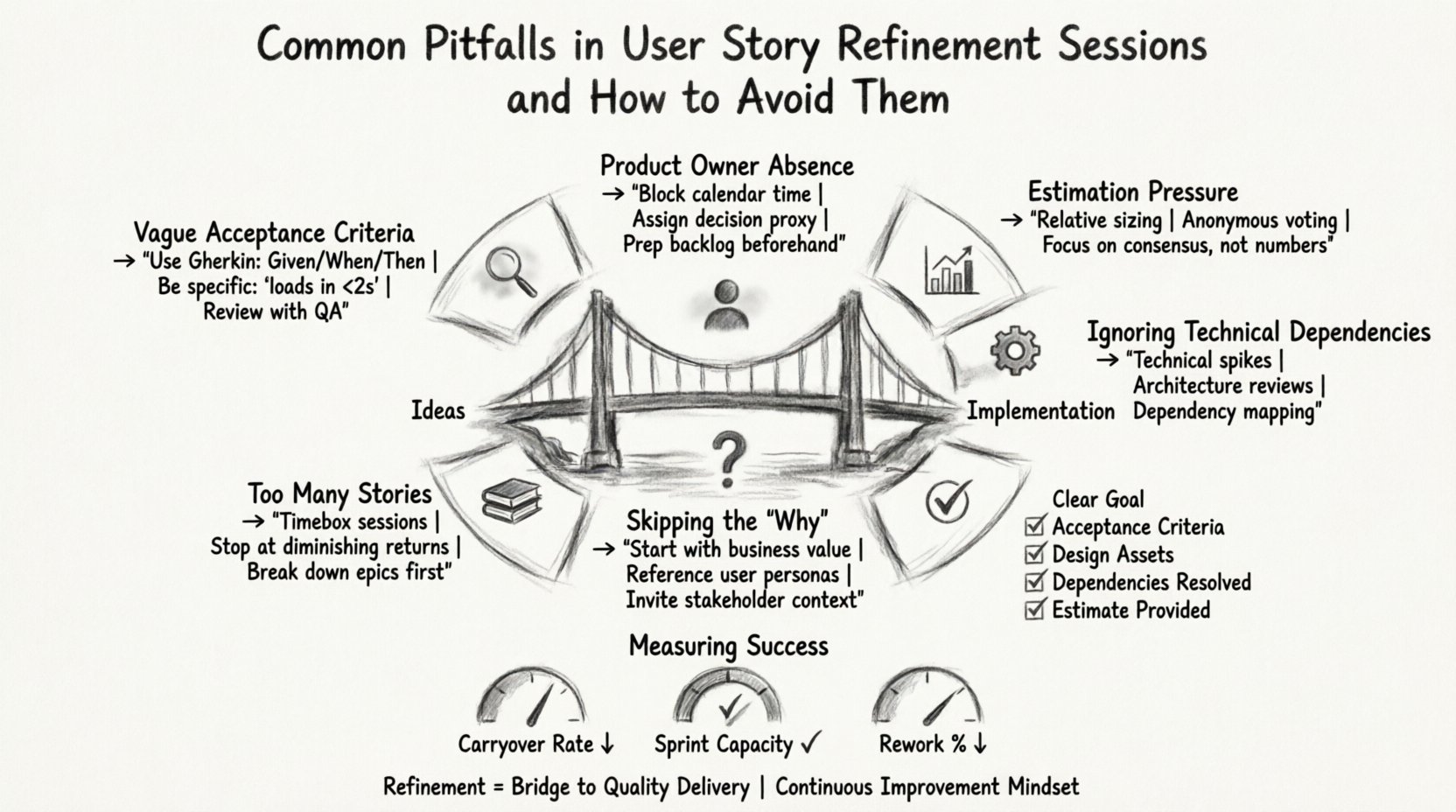
🧠 What Defines a Successful Refinement?
Before addressing what goes wrong, it is necessary to define what success looks like. A productive refinement session results in user stories that are ready to be pulled into a sprint. This readiness is typically characterized by the Definition of Ready (DoR). Stories must be small enough to be completed within a sprint, clear enough to be understood by the entire team, and valuable enough to justify the effort.
Key objectives include:
- Clarifying Requirements: Ensuring the acceptance criteria are testable and unambiguous.
- Estimating Complexity: Reaching a consensus on effort through collaborative discussion.
- Identifying Risks: Spotting technical or dependency blockers early.
- Prioritizing Value: Aligning the backlog with current business goals.
🚫 Pitfall 1: Vague Acceptance Criteria
The most damaging issue in refinement is the presence of stories with vague acceptance criteria. When a story states “The system shall be fast” or “The user interface should be intuitive,” it opens the door for interpretation. Different team members will build different versions of the same requirement, leading to rework.
Why This Happens
Product owners often write acceptance criteria from a user perspective without considering technical implementation details. They focus on the “what” rather than the “how.” Without specific conditions, the team cannot verify the work during testing.
How to Fix It
- Use the Gherkin Syntax: Adopt the Given/When/Then format to structure scenarios logically.
- Be Specific: Replace adjectives with numbers. Instead of “fast,” use “loads in under 2 seconds.”
- Review with QA: Involve quality assurance professionals during refinement to ensure testability.
🚫 Pitfall 2: Product Owner Absence or Distraction
Refinement sessions rely heavily on the availability of the product owner or a designated representative. If they are not present, or if they are distracted by emails and other tasks, the session loses its direction. The team cannot ask critical questions about business logic, and stories remain stuck in ambiguity.
The Impact of Absence
When the decision-maker is missing, the team is forced to make assumptions. These assumptions become technical debt. Later, when the story is developed, the team must stop to clarify the requirement, disrupting the flow of work.
Strategies for Consistency
- Block the Time: Treat refinement as a non-negotiable commitment in the calendar.
- Assign a Proxy: If the product owner cannot attend, a delegated stakeholder with decision-making authority must be present.
- Prepare Materials: The product owner should review the backlog before the meeting to have answers ready.
🚫 Pitfall 3: Estimation Pressure and Gaming
Estimation during refinement is often fraught with pressure. Teams may feel compelled to give lower numbers to look efficient or higher numbers to create a buffer. This behavior, known as gaming the system, skews velocity data and makes future planning inaccurate.
Understanding the Psychology
Estimates are not promises; they are predictions based on current knowledge. When management ties estimates directly to performance reviews, the team will optimize for the metric rather than the work. This creates a culture of fear where uncertainty is hidden.
Best Practices for Estimation
- Use Relative Sizing: Compare stories to one another rather than using absolute time (hours or days). This reduces the anxiety associated with precise deadlines.
- Keep it Anonymous: In some formats, using anonymous voting for story points can reduce the influence of seniority.
- Focus on Consensus: If the team disagrees significantly, discuss the reasons. The goal is shared understanding, not a specific number.
🚫 Pitfall 4: Ignoring Technical Dependencies
Teams often focus on the functional user story and overlook the underlying technical infrastructure required to support it. A feature might look simple on the surface, but it could require a database migration, an API update, or a change in security protocols. Missing these dependencies leads to bottlenecks later in the sprint.
The Cost of Overlooking Infrastructure
When technical debt is ignored, the team spends the sprint fixing issues rather than delivering value. This creates a cycle where the backlog grows faster than it can be processed.
Integration Strategy
- Technical Spikes: Allocate specific stories for research and investigation if a story is too complex to estimate immediately.
- Architecture Reviews: Involve senior developers to review stories for architectural impact before refinement is complete.
- Dependency Mapping: Maintain a visual map of external services or teams that the story relies on.
🚫 Pitfall 5: Lack of Definition of Ready (DoR)
Without a shared Definition of Ready, every story enters the sprint with different levels of preparation. Some stories might be fully detailed, while others are just ideas. This inconsistency makes sprint planning chaotic and leads to unfinished work.
Components of a Strong DoR
| Component | Description |
|---|---|
| Clear Goal | The story has a single, concise objective. |
| Acceptance Criteria | Conditions are defined and agreed upon. |
| Design Assets | UI/UX mockups or wireframes are available. |
| Dependencies Resolved | External blockers are identified and mitigated. |
| Estimate Provided | The team has agreed on a size for the work. |
Enforcing this checklist ensures that only viable work enters the sprint. If a story does not meet these criteria, it remains in the backlog for further refinement.
🚫 Pitfall 6: Too Many Stories in One Session
Teams often try to refine too much content in a single meeting. This leads to “refinement fatigue.” Participants lose focus, and the quality of discussion drops. It is better to refine a few stories deeply than many stories superficially.
The Optimal Ratio
A common rule of thumb is to refine enough stories to fill the next sprint and maybe one or two for the following one. This ensures that the pipeline is full but the team is not overwhelmed.
Managing the Flow
- Timeboxing: Set a strict time limit for the session, such as one hour or two hours.
- Stop When Ready: If the team reaches a point of diminishing returns, stop and move the remaining stories to a future session.
- Break Down Large Stories: If a story is too big to refine in one go, break it down into smaller pieces first.
🚫 Pitfall 7: Skipping the “Why”
Teams often rush into the “how” without understanding the “why.” The business value of a story is the compass that guides development decisions. Without this context, developers might optimize for the wrong thing, such as speed over security or performance over usability.
The Value Chain
Every story should answer the question: “What problem does this solve for the user?” If the team cannot answer this, the story is likely not valuable enough to proceed.
Aligning on Value
- Contextual Briefings: Start each story with a brief summary of the business problem.
- Stakeholder Feedback: Occasionally invite a stakeholder to explain the strategic goal behind a feature.
- User Personas: Reference specific user personas to keep the human element in focus.
📉 Measuring Refinement Health
To ensure these improvements are working, teams should track specific metrics. However, avoid vanity metrics that encourage bad behavior. Focus on indicators of stability and flow.
- Carryover Rate: How many stories move from one sprint to the next? A high rate suggests poor refinement.
- Sprint Capacity: Is the team consistently delivering what they planned? Consistent over-commitment is a sign of bad estimation.
- Rework Percentage: How often are stories returned for clarification? A high number indicates vague acceptance criteria.
🤝 Fostering Psychological Safety
Refinement is a collaborative effort. It requires open communication where team members feel safe to admit they do not understand something or that a story is too risky. If a junior developer feels intimidated by a senior engineer, they will not speak up about potential risks.
Creating a Safe Environment
- Rotate Facilitators: Change who leads the session to distribute authority.
- Encourage Questions: Explicitly invite questions from the quieter members of the group.
- Focus on the Work: Critique the story, not the person who wrote it. Keep the conversation objective.
🔄 Continuous Improvement
The refinement process itself is subject to change. What works for one team may not work for another. Teams should regularly review their refinement sessions during retrospectives. Ask questions such as:
- Did we finish the sprint because we refined well, or because we got lucky?
- Were there any surprises during development that should have been caught in refinement?
- Was the product owner available when we needed them?
By treating refinement as a product to be optimized, teams can continuously improve their delivery capabilities. It is not a one-time fix but a discipline that requires maintenance.
📝 Summary of Key Actions
To summarize the path forward, teams should focus on the following actionable steps:
- Define the DoR: Establish a clear checklist for story readiness.
- Enforce Criteria: Reject stories that lack specific acceptance criteria.
- Secure Attendance: Ensure the product owner is present and engaged.
- Manage Scope: Refine only what is needed for the next sprint.
- Value First: Always start with the business value and user problem.
- Track Metrics: Monitor carryover and rework rates to gauge effectiveness.
Implementing these changes requires patience and consistency. There will be resistance initially as old habits break. However, the long-term benefit is a predictable, high-quality delivery process that allows the team to focus on building value rather than fixing misunderstandings.
🚀 Moving Forward
Refinement is the bridge between idea and implementation. A weak bridge leads to collapse. A strong bridge allows for smooth traffic. By avoiding the common pitfalls outlined in this guide, teams can construct a robust foundation for their agile practices. The goal is not perfection, but continuous progress toward clarity and efficiency.
Start by selecting one pitfall from this list and addressing it in the next session. Small, consistent improvements compound over time to create a significant competitive advantage. The work is not just about writing better stories; it is about building a culture of clear communication and shared understanding.