
In the fast-paced world of Agile software development, the user story serves as the fundamental unit of work. It bridges the gap between business value and technical implementation. However, even experienced teams often stumble when crafting these narratives. When user stories are poorly defined, the ripple effect can be felt immediately during sprint planning, development, and testing phases. This often leads to wasted effort, rework, and a noticeable slowdown in velocity.
A well-constructed user story acts as a promise of value. It tells a developer exactly what to build and a tester exactly how to verify it. Conversely, a vague story creates ambiguity. Ambiguity breeds questions. Questions lead to delays. In this guide, we will explore the most frequent errors teams make when writing user stories and how to navigate around them to maintain a smooth workflow. We will focus on practical adjustments rather than theoretical frameworks.
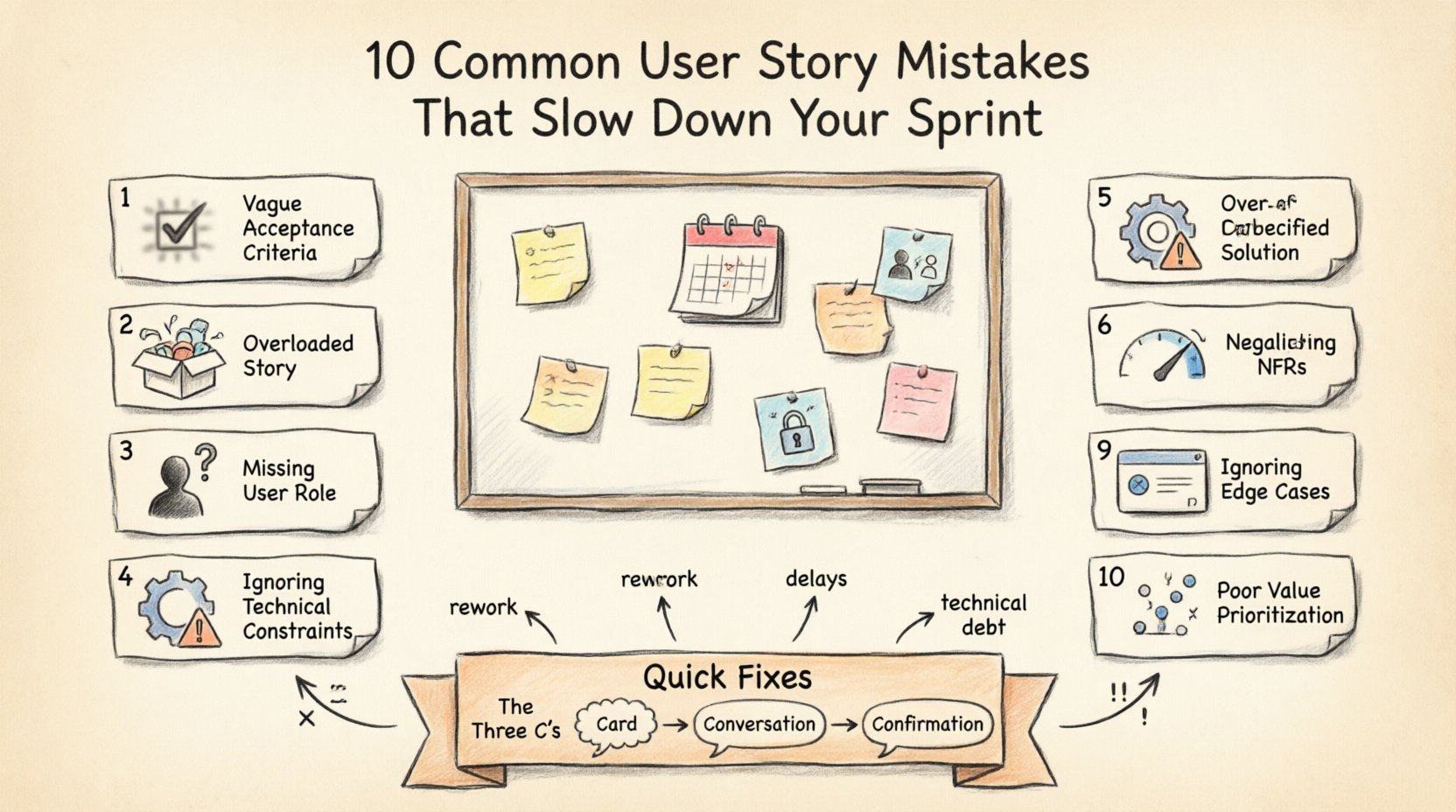
Understanding the Core Purpose of a User Story 📝
Before diving into the mistakes, it is essential to revisit the core definition. A user story is not merely a task list item. It is a description of a feature from an end-user perspective. The standard format follows the structure:
- As a [role]
- I want to [action]
- So that [benefit/value]
This format ensures the team remains focused on the user need rather than the technical solution. While this is a simple concept, execution often falters. The following sections detail specific areas where teams frequently deviate from this principle.
1. Vague Acceptance Criteria 🤔
One of the most common pitfalls is providing insufficient acceptance criteria. These criteria define the conditions that must be met for the story to be considered complete. Without them, developers must guess the boundaries of the functionality.
- The Mistake: Writing “Login button works” as the only criterion.
- The Reality: Does it handle invalid passwords? What about network timeouts? Does it lock the account after three attempts? Is there a “Forgot Password” flow?
- The Impact: Developers build a basic version. QA finds edge cases later. The team must return to the code to fix issues, breaking the flow of the sprint.
To fix this, acceptance criteria should be specific and testable. Use the Given-When-Then format to structure your expectations clearly. This removes the guesswork and allows developers to start coding with confidence.
2. Overloading a Single Story 📦
There is a tendency to bundle too much functionality into a single narrative. This often happens when a Product Owner wants to ensure a large feature is delivered quickly. They write one massive story instead of breaking it down.
- The Mistake: “As a user, I want to create an account, verify my email, set my profile picture, and receive a welcome notification all in one go.”
- The Reality: This story is too large to fit into a single sprint reliably. It introduces complex dependencies. If one part fails, the whole story is blocked.
- The Impact: Developers struggle to estimate time accurately. Testing becomes a nightmare due to the number of paths. The sprint goal is missed because the story is incomplete.
Adopt the INVEST model principle of being Independent and Small. Break large features into smaller, deliverable chunks. This allows for incremental delivery and faster feedback loops.
3. Missing the User Role 👤
Every feature serves a specific person or group. When the role is omitted, the context of the feature is lost. This often leads to generic solutions that do not fit the specific needs of the actual user.
- The Mistake: “I want to export data to CSV.”
- The Reality: Who is exporting? Is it an admin with access to sensitive data? Is it a regular user with limited permissions? The security and UI requirements change drastically based on the role.
- The Impact: Security vulnerabilities may be introduced. The UI might be cluttered with features the user does not need.
Always specify the persona. Knowing who is using the system helps the team prioritize features that matter most to that specific group. It also helps in defining appropriate error messages and permissions.
4. Ignoring Technical Constraints 🛠️
Business requirements often collide with technical realities. If a story does not acknowledge existing technical debt or system limitations, it sets the team up for failure.
- The Mistake: Requesting a feature that requires a database schema change without acknowledging the migration time required.
- The Reality: The development team spends the first half of the sprint refactoring code to make the new feature work, rather than building the feature itself.
- The Impact: Sprint velocity drops. Technical debt accumulates because the necessary refactoring was not planned.
Collaboration between Product Owners and Technical Leads is vital here. Stories should include notes about technical dependencies or necessary refactoring tasks to ensure realistic planning.
5. Lack of Collaboration During Refinement 🗣️
User stories are often written in isolation by a Product Owner and thrown over the wall to the development team. This “throw it over the wall” approach ignores the collective wisdom of the team.
- The Mistake: The story is finalized without the input of the developers or QA engineers.
- The Reality: The team discovers implementation hurdles during Sprint Planning instead of during refinement.
- The Impact: Re-prioritization of the backlog. Delays in the sprint start. Frustration among team members who feel their expertise is undervalued.
Refinement sessions should be collaborative. Developers should ask questions about feasibility, and QA should ask about edge cases. This shared ownership ensures the story is truly ready for development.
6. Over-Specifying the Solution 🚀
While clarity is good, dictating the exact implementation details stifles innovation and technical expertise. The user story should define the problem, not the solution.
- The Mistake: “As a user, I want a dropdown menu that lists the top 10 countries alphabetically.”
- The Reality: The developer might find a better way to present this data, such as a search field or a map interface, but feels restricted by the story.
- The Impact: Suboptimal user experience. Developers feel micromanaged. Technical solutions are not optimized for the current architecture.
Focus on the “What” and the “Why.” Let the developers figure out the “How.” This empowers the technical team to choose the best tools and patterns for the job.
7. Neglecting Non-Functional Requirements (NFRs) ⚙️
Functional requirements describe what the system does. Non-functional requirements describe how the system performs. Many stories focus solely on functionality and ignore performance, security, or scalability.
- The Mistake: “I want to upload a profile picture.” (No mention of file size limits or image format).
- The Reality: Users try to upload 50MB images. The server crashes. The application becomes slow.
- The Impact: Post-release hotfixes. Security patches needed later. User dissatisfaction due to poor performance.
Integrate NFRs into the story or link them to the Definition of Done. Specify constraints like response times, concurrent user limits, and encryption standards directly within the acceptance criteria.
8. Misalignment with Definition of Done (DoD) ✅
The Definition of Done is a shared agreement within the team about what it means for a piece of work to be complete. If a story ignores the DoD, it creates confusion about what “finished” actually looks like.
- The Mistake: A developer marks a story as complete after coding, but code review and unit tests are skipped because they were not part of the story checklist.
- The Reality: The code is deployed but unstable. Technical debt is introduced.
- The Impact: Bugs appear in production. The team loses trust in the delivery pipeline.
Ensure every story explicitly references the team’s Definition of Done. This includes documentation updates, code reviews, testing coverage, and deployment readiness.
9. Ignoring Edge Cases and Error Handling 🚨
Happy paths are easy to write. They describe what happens when everything goes right. However, software lives in the real world where things go wrong. Stories that ignore error states lead to fragile applications.
- The Mistake: Only describing the successful submission of a form.
- The Reality: What happens if the user loses internet connection during submission? What if the database is full?
- The Impact: Poor user experience. Data inconsistency. Support tickets from frustrated users.
Explicitly write acceptance criteria for error states. Define how the system should communicate errors to the user and whether it should attempt to recover automatically.
10. Poor Prioritization of Value 📊
Not all user stories are created equal. Teams often fill their backlog with nice-to-have features while ignoring critical value drivers. This dilutes the focus of the sprint.
- The Mistake: Prioritizing UI tweaks over core functionality that prevents users from completing tasks.
- The Reality: The team spends time polishing the surface while the foundation cracks.
- The Impact: Low ROI on development efforts. Missed business goals.
Use value-based prioritization techniques. Ask “What delivers the most value to the user right now?” Ensure the top items in the sprint backlog are the most critical for business success.
Impact Analysis: The Cost of Poor Stories 📉
To understand the gravity of these mistakes, consider how they directly affect the metrics of your development team. The table below outlines the correlation between specific story errors and their operational impact.
| Common Mistake | Direct Impact on Sprint | Long-Term Consequence |
|---|---|---|
| Vague Acceptance Criteria | Increased QA time, rework | Accumulation of technical debt |
| Overloaded Story | Sprint goal missed | Reduced predictability |
| Missing Role | Security/UX issues | Compliance risks |
| Lack of Collaboration | Planning delays | Team morale decline |
| Ignoring NFRs | Performance bottlenecks | Scalability failures |
Strategies for Improvement 🛠️
Correcting these mistakes requires a shift in culture and process. Here are actionable steps to refine your user story practice.
1. Implement Regular Backlog Refinement
Do not wait for Sprint Planning to discuss stories. Schedule dedicated refinement sessions weekly. This gives the team time to digest requirements and ask questions without the pressure of immediate delivery.
2. Enforce the Three C’s
Remember the Three C’s of User Stories: Card, Conversation, and Confirmation.
- Card: The written story.
- Conversation: The discussion between team members to clarify details.
- Confirmation: The acceptance criteria that validates the story.
Ensure all three are present before a story enters a sprint.
3. Create a Story Checklist
Develop a standard checklist for every story. This might include:
- Is the role clear?
- Are the acceptance criteria testable?
- Are edge cases covered?
- Does it align with the Definition of Done?
- Are there any dependencies?
Use this checklist during grooming to ensure quality before the story moves forward.
4. Foster Cross-Functional Feedback
Encourage developers and testers to write parts of the acceptance criteria. Their perspective on how things break is invaluable. This shared responsibility reduces the risk of missing critical details.
5. Review Completed Stories
After a sprint, look back at the stories that caused issues. Analyze why they were problematic. Was the criteria vague? Was the scope too big? Use these insights to update your refinement process for the next cycle.
Building a Sustainable Workflow 🔄
Improving user story quality is not a one-time fix. It is an ongoing process of calibration. As your product grows and your team evolves, the needs of your stories will change. What works for a startup MVP may not work for an enterprise system.
Consistency is key. When the team agrees on what a “ready” story looks like, the friction in the workflow decreases. Developers spend less time asking clarifying questions and more time writing code. Testers spend less time hunting for missing requirements and more time ensuring quality.
This stability creates a predictable environment. Stakeholders gain confidence in delivery dates. Team members feel less stressed and more engaged. The focus shifts from fire-fighting to value creation.
Final Thoughts on Agile Delivery 🚀
The quality of your user stories directly influences the quality of your software and the health of your team. By avoiding these common mistakes, you remove the friction that slows down development. You create an environment where work flows smoothly from idea to production.
Remember that the goal is not perfection, but continuous improvement. Start by identifying one or two of the mistakes discussed here that resonate most with your current challenges. Address those first. Measure the impact on your velocity and quality. Then move to the next area.
Investing time in the backlog is an investment in the sprint. It pays dividends in the form of completed work, satisfied users, and a resilient team. Keep refining, keep collaborating, and keep delivering value.