
Stepping into a project management role represents a significant shift in professional responsibility. You move from executing tasks to orchestrating the people and processes that drive those tasks to completion. This transition demands a specific set of competencies that go beyond technical expertise. Success in this position relies on balancing hard constraints with soft human dynamics.
Many new leaders enter this field with strong technical backgrounds but lack the framework to manage scope, time, and budget simultaneously. This guide outlines the essential capabilities required to lead projects effectively without relying on buzzwords or shortcuts. We will explore the foundational pillars of project leadership, focusing on practical application and strategic thinking.
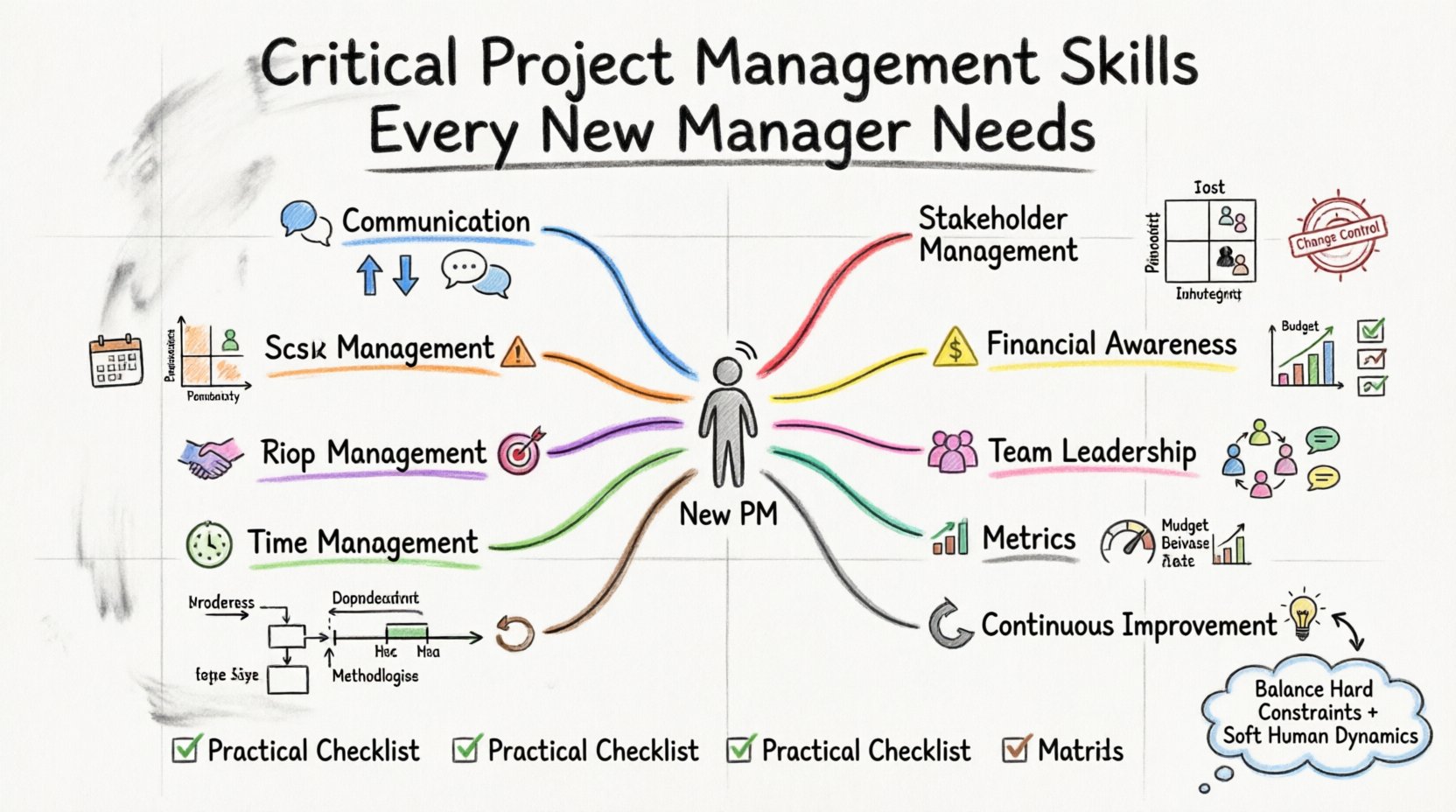
🗣️ Communication: The Backbone of Leadership
Communication is not merely about sending emails or holding meetings. It is the mechanism through which vision, expectations, and feedback travel within a team. A project manager acts as the central hub, ensuring information flows accurately between stakeholders, team members, and leadership.
- Upward Communication: Keeping sponsors informed about progress, risks, and resource needs. This builds trust and ensures alignment with organizational goals.
- Downward Communication: Clarifying tasks and expectations for the team. Ambiguity here leads to rework and frustration.
- Lateral Communication: Coordinating with other departments or external vendors. This prevents silos and ensures dependencies are managed.
Effective communicators adapt their style to the audience. A status report for a C-suite executive differs significantly from a daily stand-up with developers. The goal is clarity. You must learn to distill complex information into actionable insights. Listening is equally critical. Understanding the concerns behind a stakeholder’s question often reveals the root issue rather than the symptom.
🎯 Scope Management: Defining Boundaries
Scope creep is the silent killer of projects. It occurs when requirements expand without corresponding adjustments to time or budget. New managers often hesitate to say “no” to requests for fear of appearing uncooperative. However, protecting the project boundaries is a duty to the team and the organization.
Establishing the Baseline
Every project needs a defined scope document. This outlines deliverables, acceptance criteria, and exclusions. Without this baseline, there is no metric against which to measure success. When a new request arises, it must be evaluated against this document.
- Change Control: Implement a formal process for requesting changes. This ensures every addition is reviewed for impact on schedule and cost.
- Documentation: Record every decision and change. This creates an audit trail and prevents misunderstandings later.
- Expectation Setting: Clearly communicate what is not included in the project at the outset.
⚠️ Risk Management: Anticipating the Unknown
Projects rarely go exactly according to plan. Risk management is the practice of identifying potential obstacles before they become crises. It involves a proactive mindset rather than a reactive one. You must cultivate the habit of asking “What could go wrong?” at every stage of the lifecycle.
- Identification: Brainstorm potential issues with the team. Past project data can provide clues about recurring problems.
- Assessment: Determine the probability and impact of each risk. High-impact, high-probability risks require immediate attention.
- Mitigation: Develop strategies to reduce probability or impact. Create contingency plans for risks that cannot be eliminated.
Ignoring risks does not make them disappear. A manager who prepares for the worst creates a buffer that allows the team to recover quickly when issues arise. This builds resilience into the project structure.
🤝 Stakeholder Management: Navigating Interests
Different stakeholders have different priorities. Engineering might focus on code quality, while sales might focus on speed to market. Your role is to balance these competing interests without alienating any group. Understanding the influence and interest of each stakeholder helps you tailor your engagement strategy.
Map your stakeholders based on their power to affect the project and their interest in the outcome. High-power, high-interest stakeholders require close management and frequent engagement. Low-power, low-interest stakeholders require minimal effort but should be kept informed enough to prevent surprises.
⏱️ Time Management and Prioritization
Time is a finite resource. Unlike budget or scope, it cannot be recovered once lost. New managers often struggle with prioritization, trying to do everything at once. Learning to distinguish between urgent and important tasks is vital.
- Sequencing: Identify task dependencies. Some work cannot start until other work is finished. Understanding this flow prevents bottlenecks.
- Buffering: Add realistic time buffers to estimates. Humans underestimate how long tasks take. Buffers protect the schedule from minor delays.
- Focus: Encourage the team to work on one critical path item at a time. Context switching reduces efficiency.
💰 Financial Awareness and Budgeting
You do not need to be an accountant, but you must understand the financial implications of your decisions. A project is an investment, and you are responsible for the return. This means tracking costs against the budget and forecasting future spend accurately.
- Resource Costs: Understand the cost of labor, software, and external vendors. Hidden costs often appear in overtime or licensing fees.
- Forecasting: Review spending trends regularly. If you are ahead of schedule, you may have budget left. If you are behind, you need to cut costs elsewhere.
- Approval Authority: Know your spending limits. Never commit funds without proper authorization.
👥 Team Leadership and Motivation
People drive projects. Technical plans are useless if the team is disengaged or confused. Leadership in this context is less about authority and more about service. You remove obstacles so your team can do their best work.
Recognize that motivation varies by individual. Some thrive on public recognition, while others prefer private feedback. Understanding these differences helps you tailor your management approach. Conflict is inevitable in high-pressure environments. Addressing it early and constructively prevents toxicity from spreading.
- Delegation: Assign tasks based on strengths. Do not hoard work. Trust your team to execute.
- Feedback Loops: Provide regular, specific feedback. Avoid waiting for a final review to discuss performance issues.
- Psychological Safety: Create an environment where team members feel safe admitting mistakes. This allows for faster problem resolution.
🔄 Methodologies and Frameworks
Different projects require different approaches. Understanding the core principles of common methodologies allows you to select the right framework for the situation. It is not about rigid adherence to a rulebook, but about applying the right structure to the right problem.
Sequential vs. Iterative
- Sequential: Best for projects with fixed requirements and low uncertainty. Phases are completed one after another.
- Iterative: Best for projects where requirements evolve. Work is done in cycles, allowing for feedback and adjustment.
- Hybrid: Combines elements of both. Use sequential planning for high-level milestones and iterative execution for development.
The key is adaptability. If the project environment changes, your management style should shift to match. Rigid adherence to a methodology when it no longer fits the context leads to inefficiency.
📊 Metrics and Reporting
Data provides the evidence needed to make decisions. Reporting should not be a bureaucratic exercise but a tool for transparency. Select metrics that reflect project health rather than vanity metrics.
| Metric | What It Measures | Why It Matters |
|---|---|---|
| Schedule Variance | Planned vs. Actual Progress | Indicates if the project is on track to finish on time. |
| Budget Variance | Planned vs. Actual Spend | Shows financial health and potential overspending. |
| Risk Exposure | Probability x Impact | Highlights the most critical threats to success. |
| Team Velocity | Work Completed per Cycle | Helps forecast future capacity and delivery dates. |
When presenting these metrics, focus on the narrative. Numbers alone do not tell the story. Explain the “why” behind the variance. If the budget is over, explain the cause and the corrective action.
🌱 Continuous Improvement
The landscape of work changes constantly. What worked yesterday may not work tomorrow. Committing to continuous learning is essential for long-term success. Review projects after completion to identify lessons learned. Document what went well and what did not.
- Retrospectives: Hold sessions with the team to discuss process improvements. Focus on systems, not people.
- Professional Development: Stay updated on industry trends. Read literature, attend workshops, and seek mentorship.
- Feedback Seeking: Ask your team and stakeholders for feedback on your performance. You cannot see your own blind spots.
🛠️ Practical Application Checklist
To ensure you are applying these skills effectively, use this checklist as a reference during your planning and execution phases.
- ✅ Have I clearly defined the scope and got sign-off?
- ✅ Is there a risk register with mitigation plans?
- ✅ Are stakeholder expectations documented and understood?
- ✅ Is the budget realistic and approved?
- ✅ Does the team understand their roles and responsibilities?
- ✅ Is there a communication plan in place?
- ✅ Are there mechanisms to track progress and report variance?
- ✅ Have I built buffer time into the schedule?
Mastering these skills takes time and practice. There is no single moment of enlightenment. It is a cumulative process of making decisions, observing outcomes, and refining your approach. By focusing on these core areas, you build a foundation that supports sustainable project success.
🔍 Summary of Core Competencies
Project management is a discipline that blends analytical rigor with human empathy. It requires you to be a strategist, a diplomat, and a facilitator. The skills outlined above provide the structure needed to navigate complex environments. Focus on building these capabilities gradually. Start with communication and scope, then layer in risk and financial management as you gain experience.
Remember that your goal is not just to deliver a project, but to build a team that can deliver future projects better. Invest in your people and your processes. The results will follow naturally.