
In the fast-paced world of software development, the gap between an idea and a deployed feature often determines success. This journey begins with a single concept, often captured as a user story, and traverses through analysis, design, implementation, testing, and release. Understanding the complete user story lifecycle is essential for engineering teams aiming for efficiency and quality.
Agile methodologies have shifted focus from rigid documentation to iterative value delivery. However, without a structured process, even the best ideas can get lost in translation. This guide outlines the end-to-end flow of a user story, ensuring clarity at every stage from the initial spark of a requirement to the final line of code.
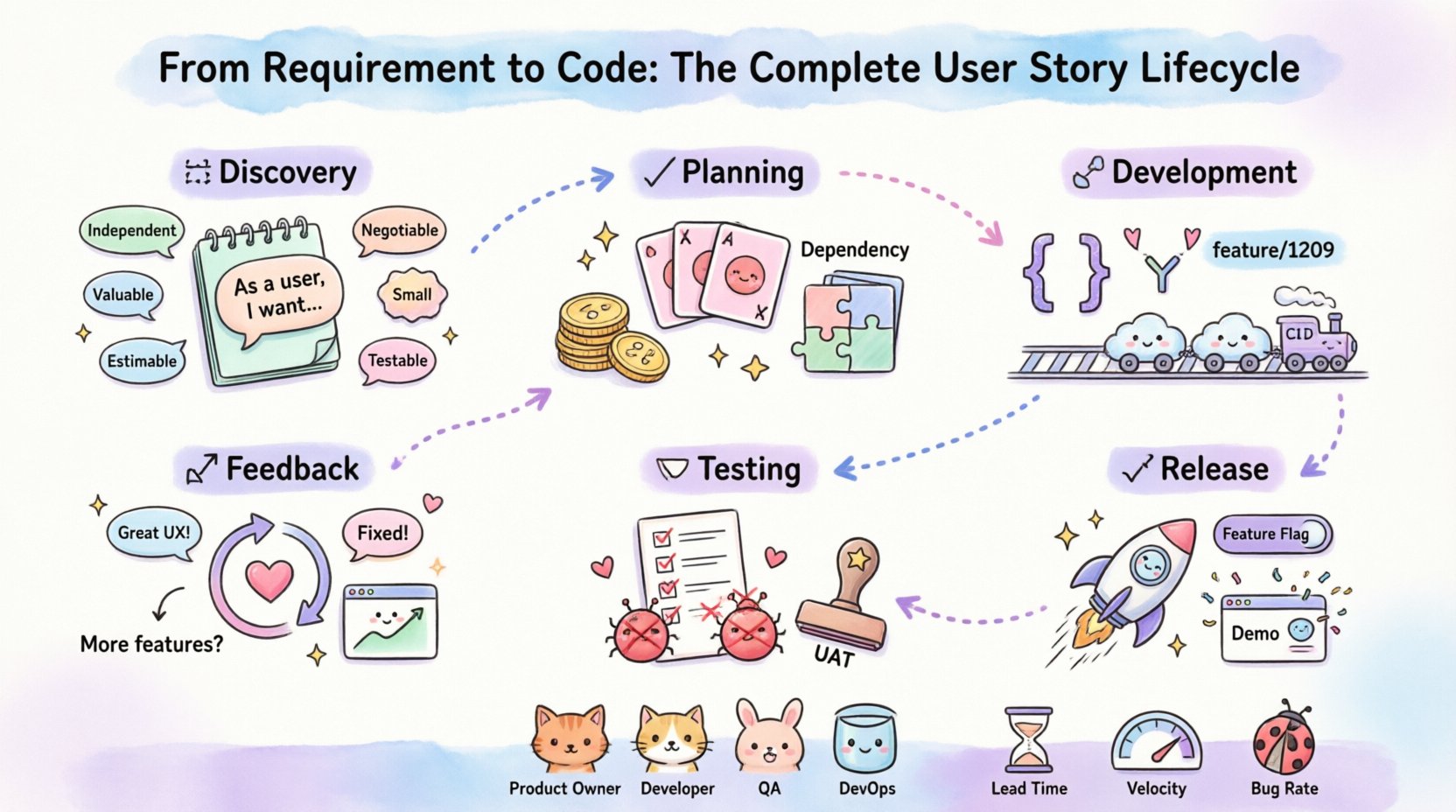
Understanding the User Story 📝
A user story is a short, simple description of a feature told from the perspective of the person who desires the new capability. It is not merely a task; it is a promise of value. The standard format usually follows the structure: “As a [type of user], I want [some goal] so that [some reason].”
For a lifecycle to function effectively, the story must be viable. It needs to pass the INVEST criteria:
- Independent: Stories should not rely on others to be developed.
- Negotiable: Details are discussed, not fixed in stone immediately.
- Valuable: It must deliver value to the end user or stakeholder.
- Estimable: The team must be able to size the effort.
- Small: It should fit within a single iteration or sprint.
- Testable: There must be clear criteria to verify completion.
When these conditions are met, the story is ready to enter the active workflow.
Phase 1: Discovery and Refinement 🧩
Before any code is written, the story must be understood. This phase is often called backlog refinement or grooming. It is where ambiguity is reduced.
1.1 Initial Capture
Requirements often start as rough notes, voice messages, or meeting minutes. The goal here is to convert these into a draft story. The Product Owner or stakeholder defines the core problem.
- Who is the primary user?
- What is the specific action?
- Why is this needed now?
1.2 Technical Feasibility
Developers review the draft to identify technical constraints. This is not about saying “no,” but about understanding the complexity early. Questions regarding database schema, API limits, or legacy system integration are raised here.
1.3 Defining Acceptance Criteria
This is the most critical part of the lifecycle. Acceptance criteria define the boundaries of the story. They are the conditions that must be met for the story to be considered complete.
Using a table to structure these criteria helps both developers and testers:
| Category | Example Criteria | Priority |
|---|---|---|
| Functional | User can reset password via email link | Must Have |
| Performance | Page loads in under 2 seconds | Should Have |
| Security | Passwords are hashed before storage | Must Have |
| Usability | Error message appears if input is invalid | Could Have |
Clear criteria prevent the common pitfall of “I thought it worked that way.” They serve as the contract between the business and the technical team.
Phase 2: Planning and Estimation 📊
Once the story is refined, it moves to the planning phase. The team decides when the work will happen based on capacity and priority.
2.1 Story Pointing
Rather than estimating time (hours), teams often use story points. This accounts for complexity, effort, and risk. Techniques like Planning Poker are used to reach a consensus without bias.
- Low Complexity: Simple changes, minimal risk.
- Medium Complexity: New features, some integration.
- High Complexity: Architecture changes, heavy data migration.
2.2 Dependency Mapping
No story exists in a vacuum. If Story B requires data from Story A, this dependency must be noted. Dependencies can block progress, so identifying them early allows for better scheduling.
2.3 Sprint Commitment
The team selects stories that fit their velocity. This is not a mandate from management but a commitment from the developers based on their understanding of the work.
Phase 3: Development and Implementation 🛠️
This is the core phase where requirements transform into software. It involves design, coding, and unit testing.
3.1 Design and Architecture
Before writing logic, the solution design is sketched. This might include flowcharts, database diagrams, or UI mockups. The goal is to ensure the technical approach aligns with the acceptance criteria.
3.2 Coding Standards
Consistency is key. Code should adhere to established style guides. Readability matters more than brevity. Comments should explain why something is done, not what is being done.
3.3 Version Control Strategy
Each story should ideally have its own branch. This isolates changes and allows for safe merging. The branch naming convention should reflect the story ID for easy tracking.
feature/1024-user-loginfix/1025-password-resetrefactor/1026-api-response
3.4 Continuous Integration
Code is merged frequently to prevent “integration hell.” Automated builds verify that the new code does not break existing functionality immediately.
Phase 4: Verification and Testing 🧪
A story is not done until it is verified. This phase ensures the product meets the acceptance criteria defined in Phase 1.
4.1 Unit Testing
Developers write tests for individual components. This ensures that the logic holds up under various inputs. High code coverage provides confidence in the stability of the code.
4.2 Integration Testing
How does this story interact with other parts of the system? Does the new API endpoint communicate correctly with the frontend? Does the new payment flow trigger the correct email?
4.3 User Acceptance Testing (UAT)
Often, the Product Owner or a designated tester verifies the story against the acceptance criteria. This is the “Definition of Done” check. If the story passes, it is ready for deployment.
4.4 Code Review
Before merging to the main branch, another developer reviews the changes. This is a knowledge-sharing opportunity and a quality gate. It catches logic errors, security vulnerabilities, and style violations.
- Check Logic: Does the code solve the problem?
- Check Security: Are inputs sanitized?
- Check Readability: Can someone else maintain this?
Phase 5: Review and Release 🚦
Once testing is complete, the story is prepared for the user.
5.1 Deployment
Deployment can be automated via CI/CD pipelines. The goal is to move code from a development environment to production with minimal manual intervention. This reduces the risk of human error during the release process.
5.2 Feature Flags
For large releases, feature flags allow the code to be deployed but disabled. This provides a safety net. If an issue arises, the feature can be turned off without rolling back the entire deployment.
5.3 The Demo
Stakeholders are shown the working software. This is not just a formality; it is the moment of truth. Feedback is gathered immediately. If the implementation deviates from the expectation, adjustments are made.
Phase 6: Maintenance and Feedback 🔄
The lifecycle does not end at release. It loops back to discovery.
6.1 Monitoring
Logs and metrics track how the feature performs in production. Are users hitting the feature? Are there errors in the logs? Is the performance meeting the targets set in Phase 1?
6.2 Feedback Loop
User feedback informs future iterations. A bug report or a feature request might spawn a new user story. This closes the loop, ensuring the product evolves with user needs.
Common Pitfalls in the Lifecycle 🐛
Even experienced teams face challenges. Recognizing these common issues helps avoid delays.
- Scope Creep: Adding requirements mid-sprint without adjusting the timeline.
- Vague Criteria: Ambiguous acceptance criteria lead to rework.
- Ignoring Tests: Skipping testing to save time results in bugs later.
- Siloed Communication: Developers and testers working in isolation.
- Over-Estimation: Padding estimates to be safe, which distorts velocity tracking.
Roles and Responsibilities 👥
Clarity on who does what prevents friction. A simplified breakdown of roles:
| Role | Primary Responsibility | Key Output |
|---|---|---|
| Product Owner | Defines value and prioritizes | Refined Backlog |
| Developer | Builds and implements | Working Code |
| QA Engineer | Verifies quality and criteria | Test Reports |
| DevOps | Manages infrastructure and deployment | Stable Environment |
Metrics for Measurement 📈
To improve the lifecycle, teams must measure performance. Avoid vanity metrics and focus on flow.
- Lead Time: Time from requirement to production.
- Cycle Time: Time spent actively working on the story.
- Velocity: The amount of work completed per sprint.
- Bug Rate: Number of defects found post-release.
Tracking these metrics helps identify bottlenecks. If lead time increases, the process needs review. If bug rates rise, testing rigor may need enhancement.
Best Practices for Success 🎯
Implementing these habits ensures a smoother lifecycle.
1. Collaborate Early
Involve testers and architects during the refinement phase. Catching issues early saves significant time later.
2. Keep Stories Small
A story that takes two weeks to build is too big. Break it down. Smaller stories provide faster feedback and lower risk.
3. Automate Where Possible
Automated testing, deployment, and monitoring reduce manual toil. This allows the team to focus on value creation rather than repetitive tasks.
4. Communicate Continuously
Status updates should be transparent. If a story is blocked, communicate it immediately. Silence often leads to surprise.
5. Respect the Definition of Done
A story is not “almost done.” It is either done or not. Compromising on the Definition of Done accum Technical Debt that slows the team down over time.
Final Thoughts on Workflow 🏗️
The journey from requirement to code is complex. It requires coordination, discipline, and clear communication. By adhering to a structured lifecycle, teams can deliver software that is reliable, valuable, and aligned with user needs.
Every stage of this process contributes to the quality of the final product. Neglecting refinement leads to confusion. Skipping testing leads to instability. Ignoring feedback leads to obsolescence.
Optimizing this workflow is an ongoing effort. Teams should regularly reflect on their process and adapt. The goal is not just to ship code, but to deliver solutions that solve real problems effectively.
With a clear lifecycle in place, the path from idea to implementation becomes predictable. This predictability builds trust with stakeholders and empowers the development team to focus on what they do best: building great software.