
Scaling a technology venture is often described as a journey from a startup to an enterprise. However, the mechanics behind this transition are rarely linear. Many organizations struggle not because of a lack of demand, but because their foundational structures cannot support increased velocity. The Business Model Canvas (BMC) serves as the strategic blueprint for this expansion. When companies adapt the nine building blocks of the BMC to meet the demands of hypergrowth, they create resilience. This guide explores how leading tech firms are evolving their models to sustain long-term performance without compromising agility.
The traditional BMC was designed for stability. In the modern digital economy, stability is a byproduct of adaptability. Companies are shifting from linear value chains to networked ecosystems. This shift requires a fundamental rethinking of how value is created, delivered, and captured. We will examine each component of the canvas through the lens of scaling, offering a framework for growth that prioritizes operational efficiency and customer retention.
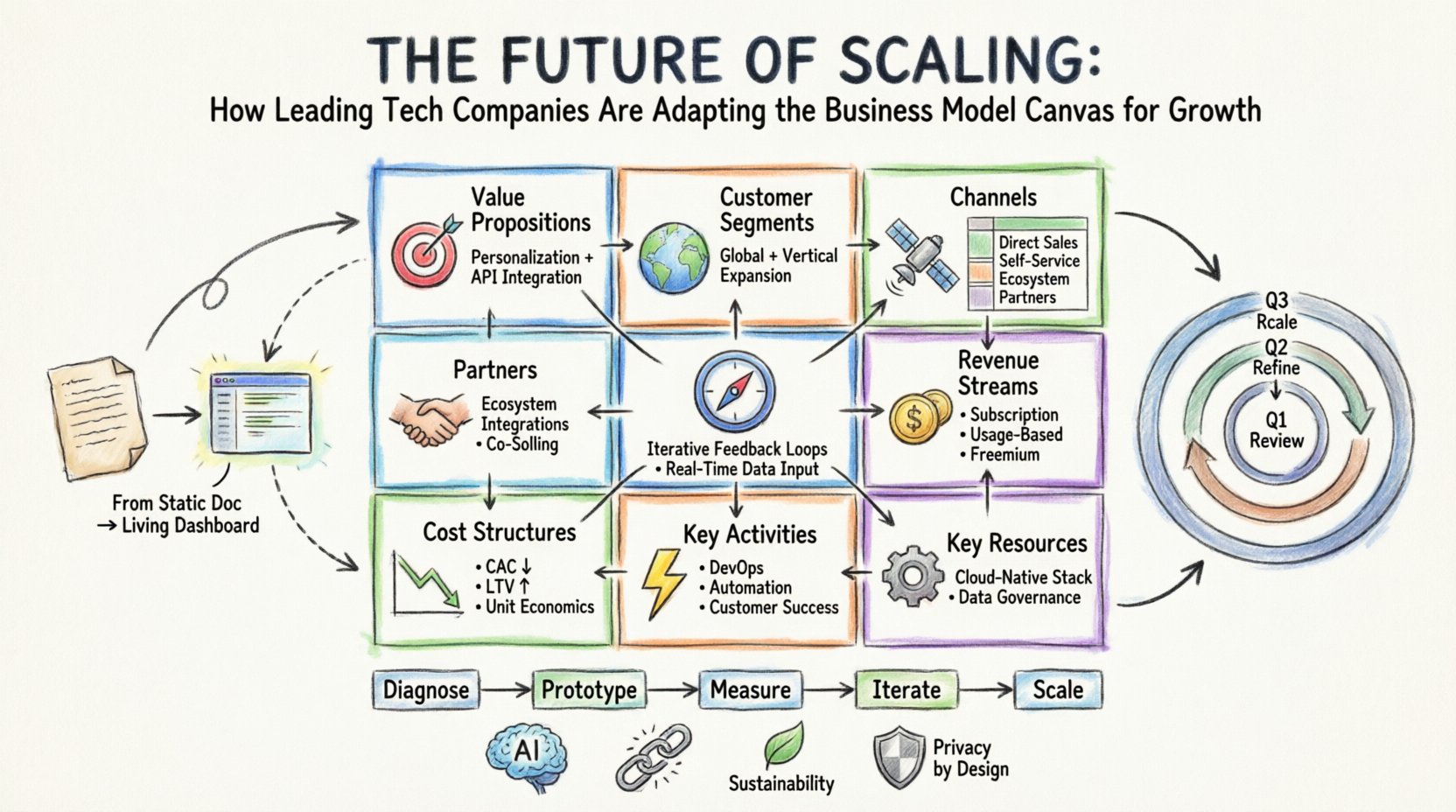
1. The Evolution of the Canvas: Static to Dynamic 🧭
Historically, the Business Model Canvas was treated as a static document. It was sketched once, approved, and then left on a shelf. For a startup seeking initial product-market fit, this approach works. As the organization grows, however, the canvas must become a living system. Leading tech companies now treat the BMC as a dynamic dashboard. It updates with market feedback, data analytics, and operational metrics.
This evolution is driven by the speed of technological change. What was a viable strategy six months ago may be obsolete today due to shifts in consumer behavior or regulatory environments. A dynamic canvas allows teams to pivot quickly. It encourages continuous iteration rather than annual planning cycles.
- Iterative Updates: Reviewing the model quarterly rather than annually.
- Data Integration: Feeding real-time usage data directly into the canvas assumptions.
- Stakeholder Alignment: Ensuring all departments understand the current strategic focus.
By moving away from a static document, companies reduce the risk of strategic drift. The canvas becomes a communication tool that aligns the engineering, sales, and operations teams around a shared vision for growth.
2. Value Propositions in Hypergrowth 🎯
The core of any business is the value it delivers. During the scaling phase, the value proposition often needs to broaden. Early-stage companies focus on solving a specific pain point for a niche audience. As they grow, they must address adjacent needs without diluting their brand identity.
Leading organizations expand their value proposition through modularity. Instead of building a monolithic product, they offer a suite of solutions that integrate seamlessly. This approach allows them to capture more wallet share from existing customers while reducing churn.
Key Considerations for Value Proposition Scaling
- Personalization: Leveraging data to tailor solutions to specific user segments.
- Integration: Ensuring new features work within existing workflows to minimize friction.
- Scalability: Designing features that perform well under high load and volume.
- Trust: Maintaining security and privacy standards as data volumes increase.
A strong value proposition at scale also involves simplifying the user experience. Complexity often increases with growth, but the user interface must remain intuitive. If the product becomes too difficult to use, the value proposition erodes regardless of feature richness.
3. Customer Segments and Market Expansion 🌍
Initial customer segments are often defined by the founders’ network or early adopter enthusiasm. Scaling requires identifying and targeting broader market segments. This process involves market segmentation, targeting, and positioning (STP) analysis.
Tech companies are increasingly moving from a product-led growth strategy to a market-led approach. They analyze verticals, geographies, and enterprise sizes to identify high-value opportunities. The goal is to diversify revenue streams so that the business is not reliant on a single customer type.
Strategies for Segment Expansion
- Geographic Diversification: Entering new regions with localized offerings.
- Vertical Specialization: Tailoring solutions for specific industries like healthcare or finance.
- Enterprise Upgrades: Creating tiers that serve large organizations with complex needs.
- Global Compliance: Adapting to regional data laws and regulations.
Expanding customer segments also requires changes in sales and marketing operations. The messaging that worked for early adopters will not resonate with enterprise buyers. Companies must develop distinct value narratives for each segment.
4. Channels and Distribution Networks 📡
Channels are the touchpoints through which a company delivers its value proposition. In the early stages, founders often handle sales personally. At scale, this is impossible. The focus shifts to building automated and scalable distribution channels.
Leading tech firms invest heavily in digital channels, partner networks, and self-service platforms. They reduce dependency on direct sales teams for lower-tier customers, allowing the sales force to focus on high-value enterprise deals.
| Channel Type | Traditional Approach | Scalable Tech Approach |
|---|---|---|
| Direct Sales | Founders close every deal. | Specialized teams for enterprise; self-service for SMB. |
| Marketing | Word of mouth and events. | Automated nurture streams and content hubs. |
| Support | Manual email responses. | Knowledge bases, AI chatbots, and ticketing systems. |
| Partnerships | Ad-hoc collaborations. | Formal API integrations and marketplace listings. |
The goal is to optimize the cost of acquisition relative to customer lifetime value. Efficient channels reduce the burn rate, allowing more capital to be reinvested into product development.
5. Revenue Streams and Pricing Models 💰
Pricing is a critical lever in scaling. Early pricing often covers immediate costs. At scale, pricing must reflect the value delivered and the elasticity of demand. Many tech companies transition from one-time licensing fees to recurring subscription models.
Recurring revenue provides predictability, which is essential for valuation and planning. However, the model must be flexible enough to accommodate different customer needs. Tiered pricing allows organizations to serve both budget-conscious users and those requiring premium features.
Pricing Models for Growth
- Usage-Based: Charging based on consumption (e.g., API calls, storage).
- Freemium: Offering a free tier to drive adoption and upsell premium features.
- Perpetual: Selling licenses with maintenance fees (less common for SaaS).
- Outcome-Based: Pricing tied to specific business results achieved.
Transparency in pricing builds trust. Hidden fees or complex contracts can hinder adoption. Leading companies ensure their pricing pages are clear and accessible to all potential customers.
6. Key Resources and Infrastructure ⚙️
Resources are the assets required to make a business model work. In the scaling phase, the focus shifts from human resources to technological infrastructure. Cloud computing allows companies to scale infrastructure up or down based on demand.
Intellectual property, data, and brand reputation become more valuable than physical assets. Protecting these resources is crucial. Security protocols must be robust to prevent data breaches that could destroy customer trust.
- Cloud Architecture: Using scalable servers and databases.
- Data Governance: Managing data quality and access rights.
- Talent Acquisition: Hiring specialists who can manage complex systems.
- Brand Equity: Investing in marketing to maintain market presence.
Investing in the right infrastructure prevents technical debt. Technical debt slows down development and increases maintenance costs. A clean architecture supports rapid innovation.
7. Key Activities and Operational Efficiency ⚡
Key activities are the most important things a company must do to make its model work. For scaling tech companies, these activities shift from development to optimization and support.
Automation becomes a priority. Repetitive tasks are handled by software, freeing humans to focus on strategic initiatives. This shift improves margins and allows the company to handle larger volumes of transactions without a linear increase in headcount.
Optimizing Operations
- DevOps Practices: Automating testing and deployment pipelines.
- Customer Success: Proactive support to reduce churn.
- Financial Management: Automated invoicing and revenue recognition.
- Quality Assurance: Continuous testing to maintain product stability.
Efficiency is not just about cutting costs. It is about maximizing output per input. When operations are streamlined, the company can react faster to market changes.
8. Cost Structures and Unit Economics 📉
Understanding costs is vital for sustainability. There are fixed costs (rent, salaries) and variable costs (hosting, transaction fees). Scaling requires managing the ratio between these two.
Unit economics measure the profitability of a single customer. If the cost to acquire a customer exceeds the profit they generate, the business cannot scale. Leading companies track metrics like Customer Acquisition Cost (CAC) and Lifetime Value (LTV) rigorously.
- Variable Costs: Must decrease as a percentage of revenue with scale.
- Fixed Costs: Can be absorbed by increased revenue.
- Break-Even Analysis: Knowing the volume needed to cover costs.
- Margin Improvement: Strategies to increase gross profit margins over time.
Financial discipline ensures longevity. Over-spending on growth without a path to profitability is a common pitfall. Companies must balance speed with financial health.
9. Partner Ecosystems and Strategic Alliances 🤝
No company scales entirely alone. Partnerships extend reach and capabilities. Integrating with other platforms allows a product to become part of a larger workflow.
API-first companies build ecosystems where third-party developers can build on top of their infrastructure. This creates network effects where the value of the platform increases as more users and developers join.
Building an Ecosystem
- Integration Partners: Connecting with complementary software.
- Resellers: Leveraging other sales channels.
- Technology Partners: Sharing infrastructure or data.
- Strategic Ventures: Joint investments in new markets.
Partnerships reduce the burden on internal resources. They allow the company to focus on its core competencies while leveraging external strengths.
10. Common Pitfalls to Avoid 🛑
Even with a solid plan, scaling introduces risks. Recognizing these pitfalls early can save a company from failure.
- Over-Hiring: Adding staff before revenue justifies it.
- Feature Bloat: Adding complexity that confuses users.
- Neglecting Culture: Losing the startup ethos as the team grows.
- Ignoring Feedback: Focusing on growth metrics over customer satisfaction.
- Complacency: Assuming past success guarantees future results.
Staying agile is key. Companies must remain willing to cut features or pivot strategies if the data suggests it is necessary. Rigidity leads to obsolescence.
11. Implementation Framework 🛠️
How do you begin adapting the Business Model Canvas? Start with a workshop involving key stakeholders. Review each of the nine building blocks against current reality.
- Diagnose: Identify where the current model is breaking down.
- Prototype: Test new assumptions in small markets.
- Measure: Collect data on the impact of changes.
- Iterate: Refine the model based on results.
- Scale: Roll out successful changes broadly.
This framework ensures that changes are data-driven rather than based on intuition. It minimizes risk while maximizing potential upside.
12. Future Trends in Business Modeling 🔮
The landscape continues to evolve. Several trends are shaping the next generation of scalable business models.
- Artificial Intelligence: Automating decision-making and personalization.
- Decentralization: Exploring blockchain and distributed networks.
- Sustainability: Integrating environmental and social goals into the core model.
- Privacy-First: Designing for data protection by default.
Companies that anticipate these shifts will be better positioned for the future. The Business Model Canvas provides the structure to integrate these trends effectively.
Final Thoughts on Sustainable Growth 🌱
Scaling is a continuous process of adaptation. The Business Model Canvas is not a one-time exercise but a compass for navigation. By focusing on the nine building blocks and understanding how they interact, companies can build structures that withstand market volatility.
Success depends on the ability to balance innovation with stability. Leaders must foster a culture that embraces change while maintaining operational discipline. The future belongs to organizations that view their business model as a dynamic asset, constantly refined to meet the needs of a changing world.
When the canvas is alive, the business is resilient. This resilience is the true foundation of long-term growth in the technology sector.