
Creating a schedule that matches reality is one of the most difficult challenges in project management. Too often, teams start with an ideal scenario and end up with a missed deadline. This gap between planned time and actual execution stems from a lack of psychological awareness, insufficient data, and poor risk management. When a timeline is unrealistic from day one, the team loses trust in the planning process. Consequently, they stop trying to adhere to dates that feel arbitrary. To fix this, you need a method that prioritizes accuracy over optimism.
This guide details the systematic approach to constructing schedules that respect the human element of work. We will move beyond simple date-setting and explore the mechanics of estimation, dependency mapping, and resource allocation. By the end of this text, you will understand how to build a timeline that is robust, credible, and actionable.
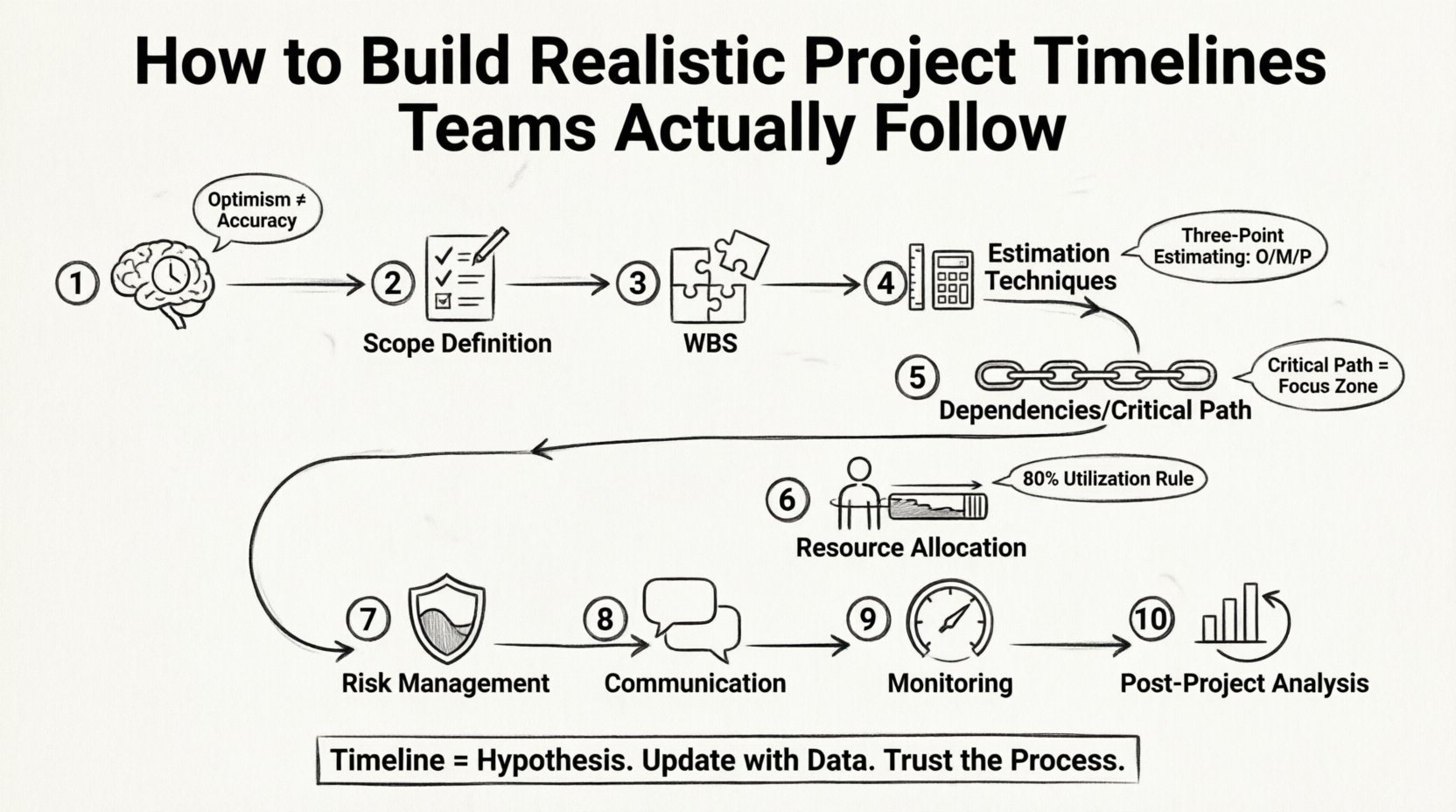
1. Understanding the Planning Fallacy 🧠
Before drawing a single line on a schedule, you must acknowledge a common cognitive bias known as the planning fallacy. This is the tendency to underestimate the time needed to complete a future task while overestimating the benefits. It is not a failure of intelligence; it is a failure of experience. When a team member says, “I can finish this in two days,” they are usually thinking about the best-case scenario where nothing goes wrong.
To counter this bias, you must shift the focus from optimistic estimates to historical data. This involves looking at what has happened in the past rather than what might happen in the future. Here are the core principles to keep in mind:
- Optimism is the enemy of accuracy: Always assume that things will take longer than they seem.
- Context matters: A task that took three days last quarter might take five days now due to staffing changes or technical debt.
- Individual variance: Different team members have different speeds and working styles. A single estimate for the whole team often fails.
- External dependencies: Work rarely happens in a vacuum. Waiting for approvals or data from other departments adds hidden time.
A realistic timeline is not a wish list. It is a projection based on evidence. If you cannot find evidence for an estimate, you must flag it as a high-risk assumption.
2. Defining Scope and Deliverables 📋
You cannot estimate time if you do not know what you are building. Scope creep is the primary killer of project schedules. When requirements shift without a corresponding change in the timeline, the plan becomes invalid immediately. To prevent this, you must define deliverables with extreme clarity before starting the scheduling process.
Start by listing every single output the project must produce. This includes documentation, code, physical prototypes, or reports. For each item, define what “done” looks like. Use the following checklist to ensure scope is locked:
- Acceptance Criteria: What specific conditions must be met for the stakeholder to sign off?
- Exclusions: Explicitly state what is not included in the current timeline to avoid ambiguity.
- Versioning: Are we building Version 1.0 or a full release candidate?
- Quality Standards: Does the timeline account for testing, review cycles, and bug fixing?
Without a clear scope, the timeline is a moving target. Once the scope is documented, get formal sign-off from key stakeholders. This agreement creates a baseline against which you can measure changes later.
3. Breaking Down the Work (WBS) 🧩
Large tasks are the source of estimation errors. A task labeled “Develop Backend” is too vague to estimate accurately. You must decompose this into smaller, manageable units of work. This process is often called a Work Breakdown Structure (WBS). The rule of thumb is that no single task should take longer than a few days. If a task takes a week, it is likely hiding sub-tasks that have not been identified.
Decomposing work offers three distinct benefits:
- Visibility: You can see the granular steps required to reach the goal.
- Ownership: Smaller tasks can be assigned to specific individuals, increasing accountability.
- Accuracy: It is easier to estimate a 4-hour coding session than a 4-day module development.
When breaking down tasks, ensure every component has a start date, an end date, and an owner. Avoid leaving any gap in the chain of work. If a task is missing, the timeline will have a hole that delays the entire project.
4. Selecting the Right Estimation Technique 🛠️
Different types of projects require different estimation methods. Relying on a single method for all tasks leads to inaccuracies. Below is a comparison of common techniques used to determine duration.
| Technique | Best Used For | Pros | Cons |
|---|---|---|---|
| Analogous Estimating | Early phases, similar past projects | Fast and simple | Less accurate if contexts differ |
| Three-Point Estimating | High-risk or complex tasks | Accounts for uncertainty | Requires more effort to calculate |
| Bottom-Up Estimating | Detailed execution phases | Highly accurate | Time-consuming to create |
For the most reliable results, use a combination of these methods. Start with analogous estimating to get a rough idea, then switch to bottom-up estimating as the scope becomes clearer. For tasks with high uncertainty, apply the three-point technique.
The Three-Point Technique Explained
This method asks the team for three specific numbers for each task:
- Optimistic (O): Everything goes perfectly.
- Pessimistic (P): Major obstacles occur.
- Most Likely (M): Normal conditions apply.
By calculating a weighted average of these three values, you create a buffer for risk without artificially inflating the schedule. This approach invites honesty from the team, as they feel safe expressing their concerns about potential delays.
5. Mapping Dependencies and Critical Path 🔗
Tasks do not exist in isolation. Most work is dependent on the completion of other work. If Task B cannot start until Task A is finished, you must link them. Failing to map these relationships creates a schedule that looks good on paper but collapses in practice.
Identify the following types of dependencies:
- Finish-to-Start (FS): Task B starts only after Task A finishes. (Most common)
- Start-to-Start (SS): Task B can start once Task A starts.
- Finish-to-Finish (FF): Task B must finish when Task A finishes.
- Start-to-Finish (SF): Rare, but Task B cannot finish until Task A starts.
Once dependencies are mapped, identify the Critical Path. This is the longest sequence of dependent tasks that determines the shortest possible time to complete the project. Any delay on the critical path directly delays the project finish date. Tasks not on the critical path have “float” or “slack,” meaning they can be delayed slightly without affecting the final deadline.
Focus your monitoring efforts on the critical path. Do not waste time micromanaging tasks with significant float unless they are about to become critical.
6. Resource Availability and Capacity 🧑💻
A timeline is only as good as the people who execute it. You must account for the actual availability of your team members. A common mistake is assigning 100% of an employee’s time to a project, ignoring meetings, administrative work, and sick days.
Apply the following rules for resource allocation:
- Utilization Rate: Cap individual availability at 80% to allow for focus time and unexpected interruptions.
- Skill Matching: Ensure the person assigned has the necessary skills. A senior developer can complete a task in half the time of a junior, but may cost more.
- Seasonality: Account for holidays, vacations, and end-of-quarter rushes where focus is low.
- Burnout Prevention: Sustained overwork leads to errors and turnover. A realistic timeline respects human limits.
Use a resource histogram to visualize workload over time. If you see spikes where a single person is booked for 120% capacity, you have found a bottleneck. You must either add resources, extend the timeline, or reduce scope.
7. Buffer Management and Risk Mitigation 🛡️
No plan survives contact with reality without adjustments. You need buffers to absorb shocks. There are two types of buffers you should consider: activity buffers and project buffers.
Activity Buffers: Add a small percentage of extra time to individual tasks. This is often called padding. However, be careful. If you add padding to every task, Parkinson’s Law kicks in: “Work expands to fill the time available.” Team members may stretch tasks to fill the padded time.
Project Buffers: Instead of padding individual tasks, add a single buffer at the end of the project or at major milestones. This protects the final delivery date without encouraging procrastination on specific tasks.
Here is a risk mitigation table to help you plan for common issues:
| Risk Factor | Impact | Mitigation Strategy |
|---|---|---|
| Key Personnel Illness | High | Ensure documentation exists; cross-train team members. |
| Scope Changes | High | Implement a formal change control process. |
| Technical Debt | Medium | Schedule dedicated refactoring sprints. |
| Vendor Delays | Medium | Build contingency time into external handoffs. |
When presenting the timeline to stakeholders, explain where the buffer is located. Transparency builds trust. If you hide the buffer, stakeholders will expect the date to be hard and will pressure the team to cut corners.
8. Communication and Buy-In 🗣️
A timeline that sits in a document is useless. It must be communicated and understood by everyone involved. The team needs to feel ownership over the schedule. If they feel the dates were imposed from above, they will not commit to them.
Involve the team in the creation process. Ask them for their estimates rather than assigning dates. This is known as participatory planning. When team members provide the numbers, they understand the constraints better.
Establish a rhythm for reviewing the timeline. Regular updates prevent surprises. Use the following communication cadence:
- Daily Stand-ups: Quick check on task progress and blockers.
- Weekly Reviews: Compare planned vs. actual progress.
- Milestone Gates: Formal sign-offs at major phases to decide if the project should proceed.
If the timeline starts to slip, communicate this early. Do not wait until the deadline is missed. Early warning allows stakeholders to make informed decisions about scope reduction or resource addition.
9. Monitoring and Adjusting the Schedule 🔄
Once the project begins, the timeline becomes a living document. You must track progress against the baseline. Use Earned Value Management (EVM) principles to measure performance objectively.
Key metrics to track include:
- Planned Value (PV): What was supposed to be done by now?
- Actual Cost (AC): What has been spent?
- Earned Value (EV): What was actually accomplished?
If the difference between EV and PV is negative, you are behind schedule. If the difference is positive, you are ahead. However, being ahead does not always mean success. Sometimes it means you cut quality to move faster.
When adjustments are needed, follow a structured process:
- Identify the variance.
- Analyze the root cause.
- Propose options (e.g., fast-tracking, crashing, reducing scope).
- Get stakeholder approval for the change.
- Update the timeline and communicate the new baseline.
Do not make changes silently. Every adjustment to the timeline affects the cost, quality, and risk profile of the project.
10. Post-Project Analysis for Future Accuracy 📊
The cycle of realistic planning continues after the project ends. Conduct a retrospective to compare estimated time with actual time. This data feeds into your historical database for future estimates.
Ask the following questions:
- Which tasks were underestimated?
- Which risks materialized that were not in the plan?
- How did the team feel about the workload?
- Was the buffer sufficient?
Store this data in a central repository. Over time, you will see patterns. You might discover that your testing phase consistently takes 20% longer than planned. You can then apply a correction factor to future estimates automatically.
Conclusion
Building a project timeline that teams actually follow requires discipline, data, and empathy. It is not about finding the fastest route; it is about finding the most reliable one. By breaking down work accurately, accounting for human limitations, and managing risk transparently, you create a schedule that serves as a tool for success rather than a source of stress.
Remember that a timeline is a hypothesis. It is a statement of what you expect to happen based on current information. Treat it with respect, update it when reality changes, and involve your team in every step. This approach builds a culture of trust and delivers results consistently.
Focus on the process. Focus on the people. Focus on the data. The dates will follow.