
Working as an independent consultant means you wear many hats. You are the strategist, the executor, the accountant, and often the salesperson. This autonomy brings freedom, but it also brings specific vulnerabilities. One of the most persistent threats to your profitability and sanity is scope creep. It starts small—a casual “while you’re at it” email, a vague requirement in a meeting—and slowly expands until your timeline is shattered and your margins evaporate.
Scope creep is not just an inconvenience; it is a silent killer of freelance businesses. It consumes billable hours without generating additional revenue. It leads to burnout. It damages client relationships when deadlines slip. As a consultant, your product is your time and expertise. When you give away time for free, you are devaluing your service.
This guide provides a comprehensive framework for identifying, preventing, and managing scope creep. It focuses on structural protections, communication strategies, and the psychological shift required to enforce boundaries without losing business.
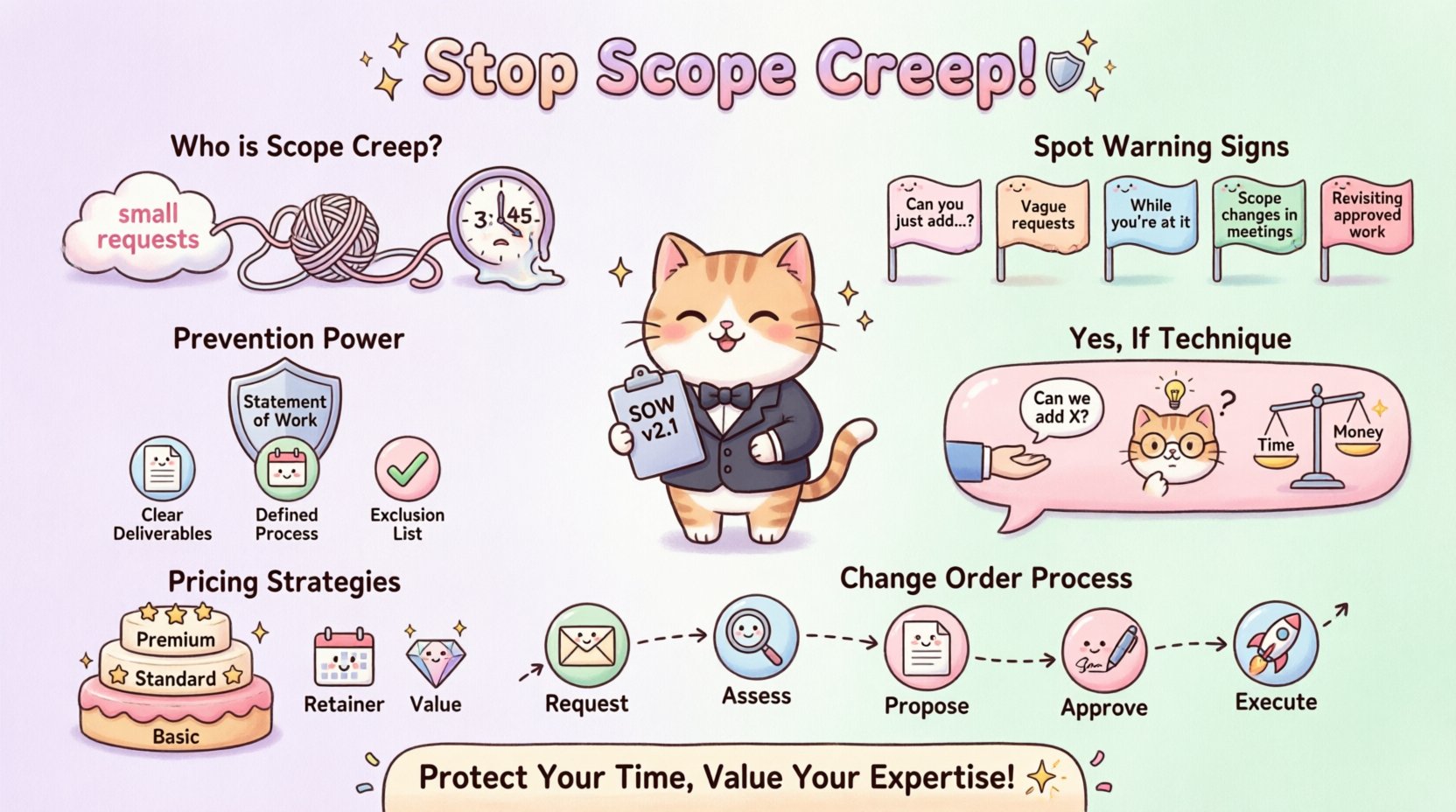
📉 Understanding the Impact of Scope Creep
Scope creep refers to uncontrolled changes or continuous growth in a project’s scope after the project has begun. Unlike formal change requests, these changes are often informal, undocumented, and assumed to be part of the original agreement. For a salaried employee, this might result in working late. For an independent consultant, it directly impacts the bottom line.
Consider the mechanics of your pricing model. If you charge a fixed fee, your hourly rate is theoretical. If the project takes longer than anticipated, your effective hourly rate drops. If you charge hourly, scope creep results in timeline overruns, which can lead to client dissatisfaction if the project is delayed.
Why Scope Creep Occurs
- Unclear Definitions: The initial agreement lacked specific deliverables.
- Client Misunderstanding: The client assumes “consulting” means “doing everything until it’s done” rather than “advising and executing specific tasks. “
- Politeness: Consultants often fear that saying “no” will damage the relationship or cause the client to leave.
- Feature Creep: Stakeholders want to add new features once the project is underway, believing they are minor adjustments.
🚩 Spotting the Warning Signs Early
Prevention is better than cure. The best way to stop scope creep is to catch it before it becomes a habit. You need to recognize the subtle signals that indicate a project is drifting beyond its agreed boundaries. Use the following table to audit your current client interactions.
| Signal | What It Means | Immediate Action |
|---|---|---|
| “Can you just add…” | Client views scope as fluid, not fixed. | Stop work. Refer to contract. |
| Vague Requests | Requirements are not documented. | Ask for written specification. |
| “While you’re at it” | Small tasks are accumulating. | Log them as separate line items. |
| Scope Changes in Meetings | Verbal agreements override written ones. | Send meeting minutes confirming scope. |
| Revisiting Approved Work | Client wants to redo what was signed off. | Treat as a new project or change order. |
📝 Prevention: The Power of the Statement of Work
The foundation of protecting your time is the documentation you create before the first dollar changes hands. A robust Statement of Work (SOW) or contract is your shield. It does not need to be complex, but it must be precise.
1. Define Deliverables Explicitly
Avoid vague language like “create a marketing strategy.” Instead, specify the output:
- A 10-page PDF document.
- A presentation deck with 15 slides.
- A written report with three specific sections.
When the deliverable is physical or digital, it is easier to measure completion. If the deliverable is a concept or feeling, it is harder to defend boundaries.
2. Outline the Process
Define how the work will happen. This manages expectations regarding communication and iterations.
- How many rounds of revisions are included? (e.g., Two rounds of revisions).
- What is the communication cadence? (e.g., Weekly status calls).
- What constitutes “approval”? (e.g., Written confirmation via email).
3. The Exclusion List
Just as important as what you are doing is what you are not doing. Explicitly state exclusions in your contract.
- Content Creation: “Copywriting is limited to the provided brief. Full article writing is not included. “
- Technical Support: “Post-launch support is limited to 30 days. Ongoing hosting is not included. “
- Training: “Training is limited to one session. Additional workshops are billed hourly. “
This forces the client to think about what they need before the project starts, rather than after you have already begun.
🤝 The Art of Negotiating Boundaries
Setting boundaries is not an act of aggression; it is an act of professionalism. Clients respect consultants who know their value. However, delivering these boundaries requires a specific tone. You must be firm but helpful.
1. The “Yes, If” Technique
Never start with a flat “No.” This triggers defensiveness. Instead, use the “Yes, If” structure. This acknowledges the request while maintaining the boundary.
- Client: “Can you also design the email banner for the launch? “
- Bad Response: “No, that’s not in the contract. “
- Good Response: “I can certainly design the email banner for you. If I add that to the current project, it will impact the launch date by three days. We can proceed, or we can schedule it as a separate phase. Which do you prefer? “
This shifts the decision to the client. It highlights the cost (time) of the change.
2. The Change Order Process
Implement a formal Change Order process. This is a document that details the additional work, the additional cost, and the impact on the timeline.
- Receive Request: Client asks for something outside the SOW.
- Assess Impact: Calculate hours and cost.
- Submit Proposal: Send a Change Order document.
- Approval: Client signs off before work begins.
- Execute: Only then do the work.
Make this process standard. If you make an exception once, you establish a precedent. If you follow the process every time, clients adapt to it.
📉 Handling Change Requests Professionally
Even with the best contracts, scope creep happens. It is part of the human element of business. When a change request comes in, your reaction determines how the client views your authority.
1. Pause the Work
If a request comes in that is clearly out of scope, do not start the work immediately. Stop. Ask for clarification. This pause gives you time to formulate a response that protects your interests.
2. Quantify the Impact
Translate the request into business terms. Clients care about budget and time.
- Time: “This will delay the final delivery by one week. “
- Money: “This requires an additional 10 hours of work. “
- Quality: “Adding this now will compromise the testing phase. “
3. Use Email for Everything
Verbal agreements are the enemy of scope management. If a client says something in a meeting that changes the scope, send an email immediately after.
“Hi [Client], following up on our call. We discussed adding [Task X]. As per our agreement, this is out of scope. I have attached a quote for this work. Please let me know how you would like to proceed. “
This creates a paper trail. It prevents the client from forgetting that this was a new request later on.
💰 Pricing Strategies That Protect Your Time
Your pricing model influences how scope creep affects you. Fixed-price projects are vulnerable to scope creep because the risk lies with the consultant. Hourly models protect time but can create client anxiety about the ticking clock.
1. Tiered Pricing
Offer different packages. This sets clear expectations.
- Basic: Core deliverables only.
- Standard: Core deliverables + one revision round.
- Premium: Core deliverables + multiple revisions + extra support.
When a client asks for something extra, you can simply say, “That feature is included in the Premium tier. We can upgrade your package. “
2. Retainer Models
Retainers are excellent for managing scope creep because they establish a predictable baseline. The client pays for a set amount of time or output per month.
- Define what is included in the monthly retainer.
- Anything beyond the retainer is billed at a premium hourly rate.
- Track time meticulously. If the client uses 80% of the retainer, alert them before they hit 100%.
3. Value-Based Pricing
Charge based on the value delivered, not the time spent. This is difficult to execute but offers the best protection against scope creep.
- If you are solving a critical problem, the price reflects the solution, not the hours.
- Scope creep does not change the value of the solution significantly.
- This makes it harder for clients to argue against paying for extra work because the primary value is already locked in.
🧠 Overcoming the Fear of Losing the Client
The biggest barrier to saying no is emotional. Many consultants fear that enforcing boundaries will make them seem difficult or uncooperative. They worry the client will walk away.
1. The Law of Attraction
Clear boundaries attract the right clients. Clients who respect your boundaries are clients who value your expertise. Clients who try to squeeze you for free work are often the ones who will pay the least and complain the most. By saying no to scope creep, you are filtering for high-quality partners.
2. The Cost of Burnout
Consider the alternative. If you say yes to everything, you will eventually burn out. If you burn out, you cannot work for that client or anyone else. Protecting your energy is essential for longevity.
3. Scripts for Difficult Conversations
Prepare responses for common scenarios so you do not have to think on your feet.
Scenario A: The “Just a Little Bit” Request
“I understand this is a small addition. However, every change requires review time, testing, and deployment. To keep the project on schedule, I need to log this as a change order. “
Scenario B: The “It Was Included” Claim
“I want to make sure we are on the same page. Looking at our Statement of Work, this task falls outside the agreed deliverables. I would be happy to include it, but we will need to adjust the budget and timeline. “
Scenario C: The Urgent Deadline
“I can prioritize this new request, but it means pushing the original deadline back by three days. I will need your approval to proceed with this shift. “
🛡️ Building a Culture of Clarity
Ultimately, managing scope creep is about building a culture of clarity within your business. It is about setting the tone from the very first interaction.
- Onboarding: Start every project with a kickoff meeting that reviews the SOW. Walk through the deliverables together.
- Milestones: Break the project into milestones. At each milestone, require sign-off before moving to the next phase.
- Transparency: Be transparent about your workflow. Show clients where their time is going.
When clients see the structure, they are less likely to try to bypass it. They understand that the process exists to ensure their success, not to hinder them.
🔄 Continuous Improvement
After every project, conduct a retrospective. Analyze where scope creep occurred.
- Was it in the initial SOW?
- Was it a communication breakdown?
- Did the client misunderstand the deliverables?
Use these insights to refine your contracts and communication templates. The more you refine your process, the less scope creep you will experience over time.
Independence is a privilege. It requires discipline. By mastering the art of saying no, you protect your income, your time, and your reputation. You transform from a vendor who says yes to everything into a partner who delivers exactly what was promised, on time, and on budget.
Start today. Review your current contracts. Identify your weak points. And prepare your scripts. The next client who asks for “just one more thing” will meet a professional who knows their worth.