
In the architecture of object-oriented systems, the structural integrity of software relies heavily on how classes relate to one another. Two of the most fundamental pillars supporting this structure are inheritance and polymorphism. These concepts are not merely syntax rules; they represent a philosophical approach to modeling real-world entities within a digital environment. When visualized through class diagrams, these relationships become clear, guiding developers in creating scalable and maintainable applications. This guide explores the mechanics of the “IS-A” relationship, offering a technical examination of how these principles shape design.
🏗️ Understanding Inheritance Fundamentals
Inheritance allows a new class to acquire the properties and behaviors of an existing class. This mechanism promotes code reusability and establishes a hierarchical relationship between entities. Instead of writing identical code for similar objects, developers define common attributes in a parent class and extend them in child classes.
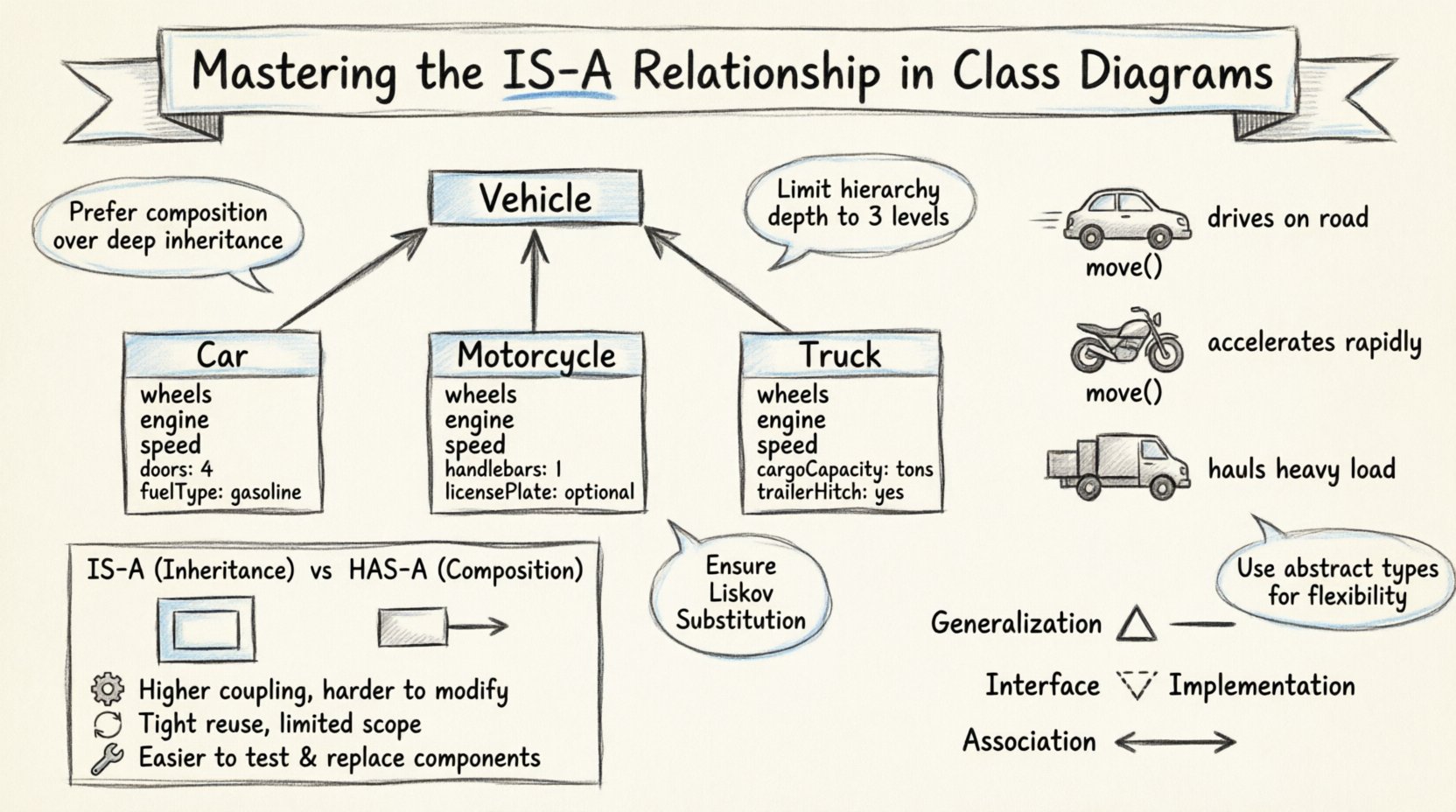
Consider a scenario involving various vehicle types. Rather than defining wheels, engines, and speed for every single vehicle type individually, a base structure can be created. This base structure serves as a blueprint. Derived classes then inherit these traits while adding specific details unique to their type.
- Parent Class: The existing class from which new classes are derived. Often referred to as the superclass.
- Child Class: The new class that inherits from the superclass. Also known as the subclass.
- Access Modifiers: Determine which members of the parent class are visible to the child class.
- Method Overriding: Allows a child class to provide a specific implementation of a method already defined in its parent.
The primary benefit of this approach is efficiency. Changes made to the parent class often propagate to all child classes, ensuring consistency. However, this tight coupling requires careful management to prevent unintended side effects.
🔗 The Core Concept: The “IS-A” Relationship
The essence of inheritance is the “IS-A” relationship. This phrase signifies that a specific instance of a child class is also an instance of the parent class. For example, if Car inherits from Vehicle, then a Car IS-A Vehicle.
This relationship is distinct from “HAS-A” relationships, which involve composition or aggregation. In a “HAS-A” relationship, a class contains an instance of another class as a member variable. In contrast, the “IS-A” relationship implies identity and substitution.
Key Characteristics of IS-A Relationships
- Substitutability: A child object can be used wherever a parent object is expected.
- Extensibility: New types can be added without modifying existing code that uses the parent type.
- Hierarchy: It creates a tree-like structure where general concepts branch into specific implementations.
- Single vs. Multiple: Depending on the language and design, a class may inherit from one parent or multiple parents (though multiple inheritance can complicate the hierarchy).
Visualizing this in a class diagram involves drawing a line with a hollow arrowhead pointing from the child class to the parent class. This notation is standard across modeling languages, ensuring clarity across different teams and tools.
🎭 Polymorphism in Action
Polymorphism is the ability of different classes to respond to the same message in different ways. It allows objects to be treated as instances of their parent class rather than their actual class. This flexibility is crucial for writing generic, reusable code.
There are generally two types of polymorphism relevant to class design:
- Compile-Time Polymorphism: Often achieved through method overloading. The same method name is used for different parameters within the same class.
- Runtime Polymorphism: Achieved through method overriding. The method to be executed is determined at runtime based on the actual object type.
When combined with inheritance, polymorphism enables dynamic behavior. A system can hold a list of parent class objects, yet each object can behave differently when a method is called. This decouples the client code from the specific implementation details of the objects.
📐 Visualizing Relationships in Class Diagrams
Class diagrams serve as the blueprint for software architecture. They map out the classes, attributes, methods, and relationships between them. Proper notation is essential for clear communication among stakeholders.
Here is how these concepts appear visually:
- Generalization (Inheritance): Represented by a solid line with a hollow triangular arrowhead pointing to the superclass.
- Realization: Used when a class implements an interface. Represented by a dashed line with a hollow triangular arrowhead.
- Association: Represents a “HAS-A” relationship. A solid line connecting two classes.
- Multiplicity: Indicated near the ends of lines to show cardinality (e.g., 1 to many).
When drawing these diagrams, it is vital to ensure that the hierarchy makes logical sense. If a class inherits from another, it must truly be a type of that parent. Violating this rule leads to fragile designs that are difficult to maintain.
Comparison: Inheritance vs. Composition
Choosing between inheritance and composition is a common design decision. While inheritance establishes an “IS-A” relationship, composition establishes a “HAS-A” relationship.
| Feature | Inheritance (IS-A) | Composition (HAS-A) |
|---|---|---|
| Relationship | Is a type of | Contains an instance of |
| Flexibility | Low (Static) | High (Dynamic) |
| Reusability | Strong code sharing | Encapsulated behavior |
| Maintenance | Fragile if hierarchy grows deep | Easier to modify components |
🛡️ Common Implementation Patterns
Design patterns often leverage inheritance and polymorphism to solve recurring problems. Understanding these patterns helps in recognizing when to apply specific structures.
- Abstract Classes: Classes that cannot be instantiated directly. They define a common interface for subclasses but leave some methods unimplemented.
- Interfaces: Contracts that define what a class must do, without specifying how. A class can implement multiple interfaces.
- Template Method: Defines the skeleton of an algorithm in a superclass, allowing subclasses to redefine specific steps without changing the structure.
- Strategy Pattern: Encapsulates interchangeable behavior. The context class uses a strategy interface, allowing different implementations to be swapped at runtime.
⚠️ Potential Pitfalls and Anti-Patterns
While powerful, these mechanisms can be misused. Overusing inheritance can lead to complex hierarchies that are hard to understand. This is often referred to as the “Fragile Base Class” problem.
Common Issues
- Deep Hierarchies: Inheritance chains that go too many levels deep make it difficult to track where a method is defined or overridden.
- Violation of Liskov Substitution: Occurs when a subclass replaces the parent in a way that breaks expected behavior.
- Unnecessary Coupling: Child classes becoming too dependent on parent implementation details.
- Mixing Responsibilities: Combining unrelated concepts into a single inheritance tree.
When a class has too many methods or attributes, it becomes bloated. This violates the Single Responsibility Principle. It is often better to extract common behaviors into separate interfaces or utility classes rather than forcing them into a parent class.
🚀 Strategies for Effective Design
To maintain a healthy codebase, developers should adopt specific strategies when working with these concepts. Clarity and simplicity should always be the priority.
- Use Abstract Types: Define contracts using abstract classes or interfaces. This allows for flexibility in implementation without forcing a specific structure.
- Limit Depth: Keep inheritance hierarchies shallow. If a hierarchy exceeds three levels, reconsider the design.
- Prefer Composition: When in doubt, choose composition over inheritance. It offers more flexibility and less coupling.
- Document Relationships: Clearly document why a relationship exists in class diagrams. This helps future maintainers understand the intent.
- Test Substitutability: Ensure that any subclass can replace the parent without breaking existing functionality.
UML Notation for Inheritance and Polymorphism
| Element | Visual Symbol | Description |
|---|---|---|
| Generalization | Line with Hollow Triangle | Indicates inheritance (Parent to Child) |
| Implementation | Dashed Line with Hollow Triangle | Indicates a class implements an interface |
| Association | Solid Line | Indicates a relationship between instances |
| Dependency | Dashed Line with Open Arrow | Indicates one class depends on another |
🧩 Building Robust Systems
The goal of using inheritance and polymorphism is to build systems that are robust, extensible, and easy to understand. By adhering to the principles of the “IS-A” relationship, developers can create architectures that stand the test of time.
When designing class diagrams, always ask if the relationship truly exists. Does the child class truly represent a specialized version of the parent? If the answer is unclear, consider alternative structures.
Furthermore, keep the hierarchy open for extension but closed for modification. This principle ensures that adding new features does not require altering existing, tested code. This is where polymorphism shines, allowing new behaviors to be introduced without breaking the core logic.
📝 Summary of Key Takeaways
- Inheritance creates an “IS-A” relationship, allowing code reuse and hierarchy.
- Polymorphism enables objects to be treated as their parent type, providing flexibility.
- Class Diagrams use specific notations like hollow triangles to visualize these relationships.
- Composition is often a better alternative to inheritance for complex relationships.
- Design Patterns leverage these concepts to solve common structural problems.
- Pitfalls such as deep hierarchies should be avoided to maintain code health.
By understanding the nuances of these concepts, developers can create software that is both powerful and maintainable. The “IS-A” relationship remains a cornerstone of object-oriented design, providing the structure needed to model complex domains effectively.
Continuing to refine these skills ensures that systems remain adaptable to changing requirements. As technology evolves, the core principles of how objects relate to one another remain constant. Mastering this foundation allows for the creation of solutions that are resilient and scalable.
Always prioritize clarity in your diagrams and code. A clear design is easier to debug, extend, and document. This approach leads to better outcomes for both the development team and the end users of the software.
Remember that design is an iterative process. Regularly review your class structures to ensure they still reflect the current needs of the application. Refactoring is a normal part of development, not a sign of failure. By keeping these principles in mind, you can navigate the complexities of object-oriented design with confidence.
Ultimately, the strength of a system lies in how well its components work together. Inheritance and polymorphism provide the tools to organize these components logically. Use them wisely, and they will serve as the backbone of your architectural strategy.