
In the modern landscape of project management, the traditional command-and-control hierarchy is rapidly dissolving. Organizations are shifting towards agile methodologies, matrix structures, and networked teams where resources are shared across departments. This evolution creates a specific challenge: how do you drive results when you are responsible for the outcome but hold no hiring or firing power over the contributors? This is the essence of leading cross-functional teams without direct authority. It requires a shift from positional power to relational influence. Success in this environment depends on your ability to build trust, align incentives, and facilitate clear communication among diverse stakeholders.
When you lead without authority, you are operating in a space defined by negotiation and collaboration. You are not managing people; you are managing a process that relies on people. This guide explores the practical mechanics of navigating this complex dynamic. We will examine the sources of informal power, strategies for stakeholder alignment, and methods for resolving friction without escalating to formal management channels. The goal is to build a sustainable approach to leadership that works within the constraints of a matrix organization.
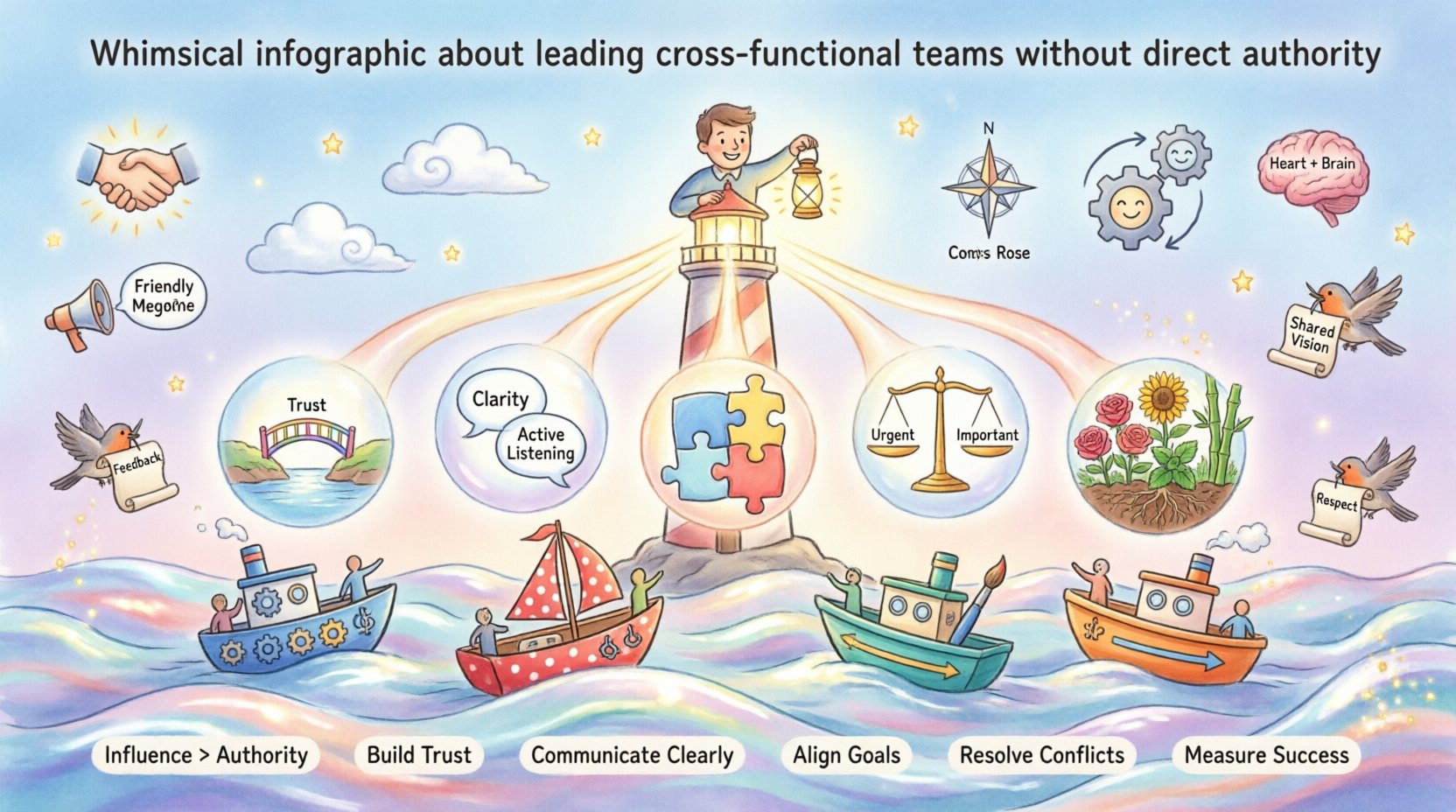
Understanding the Challenge of Matrix Leadership 🧩
A matrix organization is designed to optimize resource utilization by allowing employees to report to multiple managers. You might be a Project Manager tasked with delivering a product, while your team members report to functional managers like the Head of Engineering or the Director of Marketing. This structure offers flexibility but introduces ambiguity regarding priorities and accountability. The primary friction point is that your team members often have competing demands. They must balance project deadlines with functional development goals and career progression requests.
Without the leverage of personnel decisions, your influence relies entirely on the value you provide to the team. If you are seen as a blocker or a source of confusion, your ability to steer the project diminishes. Conversely, if you are viewed as a facilitator who removes obstacles and clarifies direction, your informal authority grows. This dynamic is not static; it fluctuates based on delivery speed, transparency, and the quality of relationships you maintain. Understanding this fluidity is the first step in effective leadership.
Key Characteristics of the Environment
- Shared Resources: Team members split their time between multiple projects or functional duties.
- Dual Reporting Lines: Individuals receive directives from both functional and project leadership.
- Competing Priorities: Functional goals may conflict with project milestones.
- Complex Stakeholder Map: Multiple decision-makers must be kept informed and aligned.
Understanding Power Dynamics and Influence ⚖️
In the absence of formal authority, you must cultivate influence. Influence is the ability to affect the behavior of others without coercion. There are several distinct sources of power that you can leverage in a cross-functional setting. These concepts are rooted in organizational behavior theory but apply directly to daily project execution.
Sources of Informal Power
- Expert Power: This stems from your knowledge and skills. If the team trusts your technical understanding or strategic insight, they are more likely to follow your guidance. You do not need to be the best coder, but you must understand the implications of the code.
- Referent Power: This is based on respect and admiration. If team members like you and want to please you, they will engage more deeply. This is built through empathy, consistency, and integrity.
- Information Power: Controlling the flow of information can be a double-edged sword. Using information to empower the team rather than gatekeep it builds trust. Being the source of clarity is a significant asset.
- Connection Power: Your network within the organization allows you to bypass bottlenecks. Knowing who to call to resolve a procurement issue or secure a server environment is crucial.
It is vital to recognize that these sources of power are not mutually exclusive. A leader who combines expert knowledge with high referent power is exceptionally effective. However, over-reliance on one type can lead to fragility. For instance, if your influence is purely based on expert power, you may lose credibility if the technology stack changes. Diversifying your influence ensures stability.
Building Influence Through Trust 🤝
Trust is the currency of leadership without authority. Without the ability to mandate compliance, you need voluntary cooperation. This cooperation is only granted when team members believe in your competence and your intentions. Building this trust requires a consistent track record of reliability. It is not built in a single meeting but accumulated over time through small, predictable actions.
Practical Steps to Establish Trust
- Deliver on Promises: If you say you will find a resource, find it. If you say you will clear a blocker, clear it. Consistency creates predictability.
- Admit Mistakes: When you get something wrong, own it immediately. Covering up errors destroys credibility faster than the error itself.
- Protect the Team: Shield your contributors from unnecessary administrative burdens or political noise. Be the buffer between the team and external chaos.
- Give Credit Publicly: When success happens, attribute it to the team. When failure happens, take the responsibility as the lead.
Trust also involves psychological safety. Team members must feel safe to voice concerns, admit errors, or suggest alternative approaches without fear of retribution. In a cross-functional team, this is particularly difficult because members are accountable to their functional managers as well. You must create a safe space within the project context where open dialogue is the norm.
Communication Protocols and Clarity 🗣️
Communication is the primary tool for managing distributed teams. In the absence of direct oversight, ambiguity is the enemy. If instructions are vague, individuals will interpret them based on their own functional biases, leading to misalignment. Your role is to act as the translator, converting high-level project goals into actionable tasks that make sense to each discipline.
Effective Communication Strategies
- Over-Communicate Context: Do not just assign tasks. Explain the “why” behind the work. When a developer understands how their feature impacts the customer, they are more engaged.
- Standardize Updates: Establish a rhythm for status reporting. Whether it is a daily stand-up or a weekly email, consistency reduces the cognitive load on the team.
- Document Decisions: Maintain a living record of key decisions and the rationale behind them. This prevents “re-litigation” of past choices in future meetings.
- Active Listening: Ensure you understand the constraints faced by other functions. A marketing lead may have deadlines you are unaware of. Listen to their constraints before setting yours.
Communication channels should be chosen based on the complexity of the message. Sensitive or complex issues should be handled in synchronous meetings. Simple status updates should be asynchronous. This distinction prevents meeting fatigue and ensures important information is not lost in chat logs.
Aligning Goals and Incentives 🎯
One of the most significant hurdles in cross-functional work is misaligned incentives. A developer might be rewarded for code stability, while a marketer is rewarded for speed to market. These goals can directly conflict. As the leader without authority, you must bridge this gap by connecting individual contributions to the shared project vision. You need to make the project goals visible and relevant to every function.
Strategies for Alignment
- Define Shared Success Metrics: Move beyond departmental KPIs. Establish project-level metrics that require collaboration to achieve.
- Visualize the Roadmap: Use visual planning tools to show how each function fits into the timeline. This helps everyone see the interdependencies.
- Involve Stakeholders Early: Invite functional managers to the planning phase. When they help set the plan, they are more invested in its success.
- Highlight Cross-Functional Wins: Publicly acknowledge instances where collaboration solved a problem that siloed work could not.
It is also important to negotiate priorities with functional managers. You cannot dictate their team’s capacity, but you can negotiate the time required for the project. This requires transparency about the impact of delays. If a feature is delayed, explain the business risk to the functional manager so they can advocate for resources if necessary.
Navigating Conflict Resolution 🛡️
Conflict is inevitable when multiple departments work on the same output. Resources are finite, and opinions differ on the best path forward. In a traditional hierarchy, a manager might simply decide. Without that power, you must facilitate a resolution that respects all parties. This requires moving from positions to interests. A position is what someone wants; an interest is why they want it.
Approaching Conflict Constructively
- Separate People from Problems: Focus on the issue at hand, not the personality of the stakeholder. Avoid personalizing disagreements.
- Seek Mutual Gains: Look for solutions that satisfy the core interests of all parties involved, rather than compromising in the middle.
- Escalate Only When Necessary: Use formal escalation as a last resort. It signals a breakdown in the process. Try to resolve issues at the working level first.
- Use Data: When opinions clash, objective data often provides the tie-breaker. Use metrics to validate the decision path.
When conflict arises between team members, you act as a mediator. You must ensure that the conversation remains productive. This might involve breaking a large group discussion into smaller, focused pairs to resolve specific technical disagreements before bringing them back to the whole.
Common Pitfalls to Avoid ⚠️
There are specific behaviors that can undermine your influence in a matrix environment. Recognizing these pitfalls early can save you from significant friction. Many leaders assume that their role is to assign work and check boxes. This approach fails in a collaborative environment where autonomy is key.
Behavioral Traps
| Pitfall | Impact | Alternative Approach |
|---|---|---|
| Micromanagement | Reduces ownership and creates dependency. | Outcome-Based Management: Define the “what” and let the team decide the “how”. |
| Assuming Compliance | Leads to missed deadlines when people are actually blocked. | Assumption Checking: Regularly verify that dependencies are met. |
| Hoarding Information | Creates bottlenecks and reduces team autonomy. | Radical Transparency: Share context and decisions broadly. |
| Ignoring Politics | Projects stall due to unseen organizational friction. | Political Awareness: Understand who holds sway and how decisions are made. |
Micromanagement is particularly damaging. When you tell a senior engineer exactly how to solve a problem, you signal a lack of trust. This causes them to disengage. Instead, focus on the outcome. Ask questions that prompt them to find the solution rather than giving the answer.
Measuring Success Beyond Deadlines 📊
Traditional project management focuses heavily on time and budget. While these are important, they do not capture the health of a cross-functional team. If you deliver on time but the team is burnt out and the quality is poor, the project is not a success. You need to measure the process and the people as well as the product.
Metrics for Informal Leadership
- Team Engagement: Monitor participation in meetings and the quality of contributions. Low engagement often signals misalignment.
- Blocker Resolution Time: How long does it take to remove obstacles? A high number indicates friction.
- Stakeholder Satisfaction: Regularly ask functional managers if they feel heard and supported.
- Retention of Talent: High turnover within the project team suggests leadership issues.
- Velocity Stability: Fluctuations in delivery speed often indicate communication breakdowns.
These metrics help you identify issues before they become crises. If engagement drops, you know to have one-on-one conversations. If blocker resolution time increases, you know to invest more time in stakeholder management. This proactive approach is essential when you cannot rely on authority to enforce changes.
The Role of Emotional Intelligence 🧠
Emotional intelligence (EQ) is the differentiator between a manager who functions and one who leads. In a matrix environment, you are constantly reading the room. You must detect stress, frustration, or enthusiasm in the team. This requires high levels of empathy and self-regulation.
Developing Emotional Intelligence
- Self-Awareness: Understand your own triggers. Do you get anxious when deadlines slip? If so, manage that anxiety so it does not become team anxiety.
- Empathy: Try to understand the perspective of a functional manager. They may be under pressure from their own leadership that you do not see.
- Social Skills: Build a network of peers. Having allies in other departments makes it easier to get things done.
- Self-Regulation: Remain calm during crises. If you panic, the team will panic.
High EQ allows you to navigate sensitive conversations. You can deliver difficult feedback without damaging the relationship. This is crucial for long-term collaboration. If you burn bridges with functional managers, your ability to lead cross-functional work diminishes over time.
Conclusion
Leading cross-functional teams without direct authority is a demanding but rewarding discipline. It requires a shift in mindset from command to service. By building trust, clarifying communication, and aligning incentives, you can drive high performance even without formal power. The organizations of the future rely on this type of leadership. As the structure of work becomes more fluid, the ability to influence without authority will become a core competency for project managers.
Focus on the value you bring to the table. Be the person who makes the work easier for everyone else. When you prioritize the success of the team over your own title, you create a foundation for sustainable leadership. This approach does not require special tools or resources. It requires patience, consistency, and a genuine commitment to the people you work with.
Remember that this is a continuous practice. You will face challenges, and you will need to adapt your strategies. The landscape of organizational structure will continue to evolve. By mastering the principles of informal leadership, you position yourself to navigate any structure with confidence and effectiveness.