
Every project manager knows the feeling. You are mid-sprint, the deliverables are clear, and the client approaches you with a new idea. It sounds good. It sounds better than the original plan. But it also means more work, more time, and potentially more cost. This is the change request. It is the most common friction point in project management. How you handle it defines the relationship. Do you say yes to everything and burn out your team? Do you say no and lose the client? The path between these extremes is a structured, transparent process.
Effective change request management is not about blocking progress. It is about ensuring that every modification is intentional, valued, and understood by all parties. When done correctly, a change request can strengthen trust. It shows that you care about the budget, the timeline, and the quality of the final product. This guide outlines the strategy for navigating scope changes while maintaining a healthy partnership.
Understanding the Psychology of Change 🧠
Before implementing a process, you must understand why change requests happen. They rarely stem from malice. Often, they come from evolving market conditions, new insights gained during the project, or a better understanding of the end-user needs. The client is not trying to make your life difficult. They are trying to make the product successful.
However, from the project manager’s perspective, change often feels like a threat. It threatens the baseline plan. It threatens the estimated budget. It threatens the delivery date. This fear drives defensive behaviors. To manage relationships, you must separate the emotion from the procedure.
- Client Motivation: They want value. They see an opportunity to improve the outcome.
- PM Motivation: They want stability. They want to protect the agreed-upon constraints.
- The Goal: Align these motivations. Show that stability is the foundation for value.
When a client proposes a change, they are often looking for validation. They want to know if their idea is viable. If you immediately dismiss it, they feel unheard. If you immediately accept it, you lose control. The middle ground is the formal review process.
Establishing a Clear Change Protocol 📋
Chaos occurs when change happens informally. A quick email saying “Hey, can we add this?” followed by “Sure, I’ll do it” creates a shadow project that is impossible to manage. This is where scope creep lives. To prevent this, you need a protocol that is established early. Ideally, this is part of the initial project charter or statement of work.
Define what constitutes a change request. Is it a new feature? A change in design? A shift in priority? Once defined, the rules of engagement become clear.
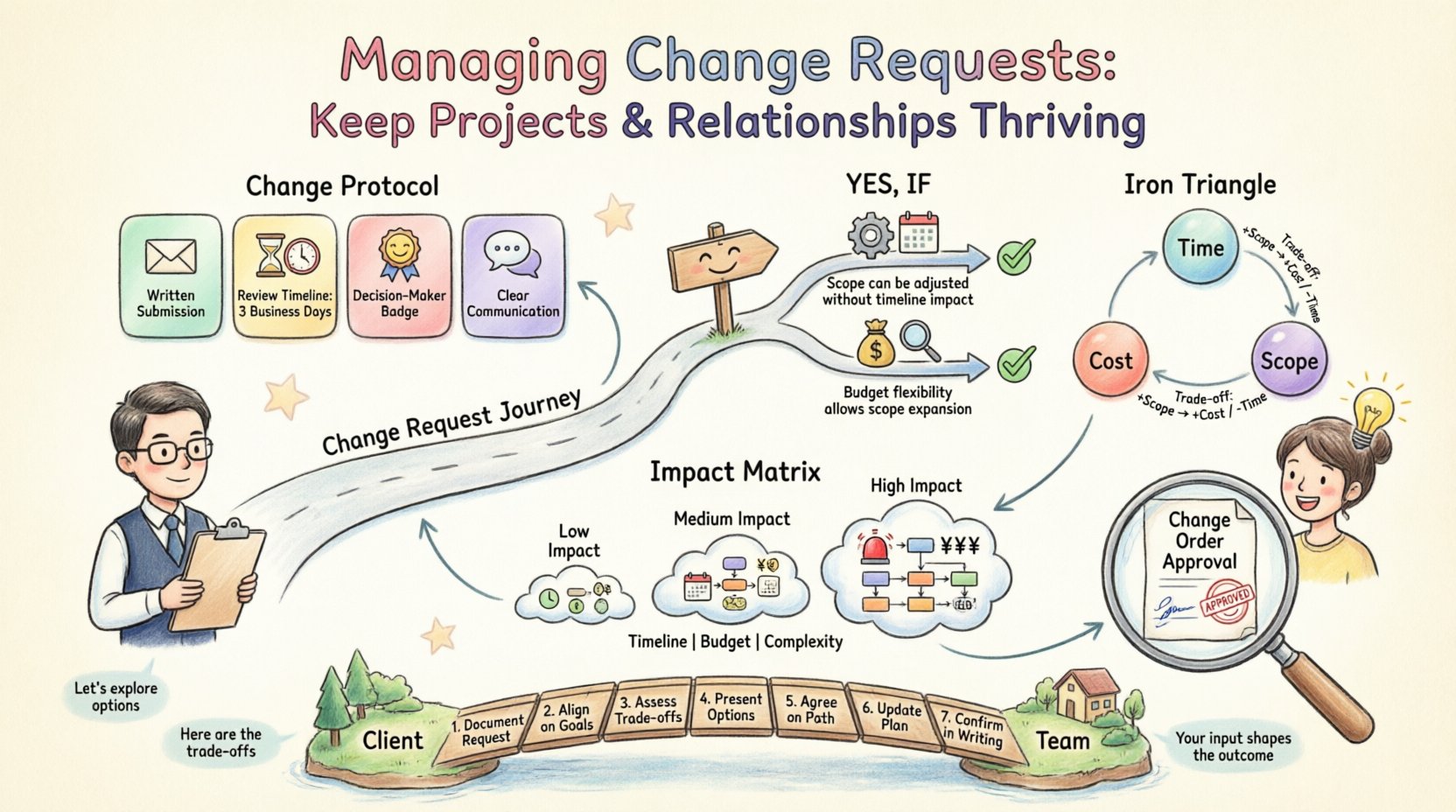
Key Components of the Protocol
- Submission Method: All changes must be submitted in writing. This creates a paper trail and forces the client to think about what they are asking.
- Review Timeline: Set a standard time for analysis. For example, “All change requests will be reviewed and presented within three business days.”
- Decision Maker: Clarify who has the authority to approve the change and who has the authority to approve the budget impact.
- Communication Channel: Specify how the decision will be communicated (e.g., official email, signed document, meeting).
Having this protocol in place removes the personal element. It is not you saying no; it is the process requiring a review. This protects the relationship because the rules were agreed upon before the work began.
The Art of the “No” (and How to Say It Better) 🗣️
Sometimes, the answer must be no. Perhaps the change is out of scope, or the timeline is immovable. However, delivering a hard no can damage rapport. The key is to offer alternatives rather than a flat rejection.
When a client asks for something you cannot provide immediately, use the “Yes, If” framework. You are not refusing the idea; you are negotiating the conditions under which the idea can be realized.
- Bad Response: “We cannot add that feature. It is not in the contract.”
- Result: Client feels blocked and undervalued.
- Good Response: “We can certainly explore adding that feature. If we include it, we will need to adjust the timeline by two weeks or reduce the scope of the reporting module. Which priority do you prefer?”
- Result: Client feels empowered and understands the trade-offs.
This approach shifts the conversation from a binary yes/no to a strategic discussion about priorities. It forces the client to participate in the decision-making process. They realize that resources are finite. This is a crucial lesson in project management.
Impact Analysis: Time, Cost, and Quality ⚖️
Once a request is formally submitted, you must analyze its impact. This is the technical core of change management. You cannot advise a client on the cost of a change without understanding the ripple effects. A small change in the design might require a significant change in the backend architecture.
Use a structured analysis to break down the request. Do not rely on gut feelings. Quantify the impact.
Factors to Evaluate
- Development Effort: How many hours or days will this take? Who on the team will be assigned?
- Dependencies: Does this change affect other modules? If the login screen changes, does the dashboard need to update?
- Testing Requirements: New features require new test cases. This adds time to the quality assurance phase.
- Risk: Does this change introduce technical debt? Is it a risky implementation that might fail?
- Cost: Based on the effort, what is the financial impact? This includes labor and any third-party costs.
Presenting this data to the client demonstrates professionalism. It shows that you have done the homework. It moves the decision from emotional to logical.
Change Request Impact Matrix
| Impact Area | Low Impact | Medium Impact | High Impact |
|---|---|---|---|
| Timeline | Zero delay | 1-3 Day delay | 1+ Week delay |
| Budget | Within contingency | Requires minor budget adjustment | Requires major budget approval |
| Complexity | Simple text or image change | Modification of existing logic | New architecture or integration |
| Client Action | Informal approval | Written confirmation | Formal Change Order |
This table helps standardize the response. If a change is High Impact, the client knows to expect a formal Change Order. If it is Low Impact, the process is streamlined. This clarity reduces anxiety on both sides.
Documentation and Sign-off 📝
Verbal agreements are the enemy of project control. Once the impact is analyzed and the client agrees to the trade-offs, you must document it. This is not about being bureaucratic; it is about protecting both parties.
A formal Change Order should include:
- Change Description: A clear statement of what is being added or removed.
- Reason: Why is this change being made? (e.g., Market shift, new regulation).
- Impact Summary: The specific changes to time, cost, and scope.
- Approval Signature: A digital or physical signature from the authorized client representative.
This document becomes part of the project baseline. If the project goes off track later, you can refer back to this document. It proves that the delay or cost overrun was agreed upon. This protects the project manager from accusations of poor performance.
Negotiation and Trade-offs 🔄
Often, the client wants the change but does not want to pay extra or wait longer. This is the negotiation phase. You must be firm on the reality of constraints but flexible on the solution.
Use the Iron Triangle concept. In project management, you have Time, Cost, and Scope. If you change one, at least one of the others must change. You can only keep two fixed.
- Fix Scope, Vary Time & Cost: “We can deliver exactly what you asked for originally, but we need more budget and time for the new feature.”
- Best for: Clients with a fixed deadline.
- Fix Time, Vary Scope & Cost: “We can meet the deadline, but we must reduce the scope of another area to make room for this new feature.”
- Best for: Clients with a fixed launch date.
- Fix Cost, Vary Time & Scope: “We can stay within the budget, but we will need to extend the timeline or remove the new feature.”
- Best for: Clients with a fixed budget.
Presenting these options gives the client control. It turns a conflict into a choice. This is a powerful psychological tool. The client feels they are driving the project, even though you are steering the constraints.
Common Pitfalls to Avoid 🚫
Even with a process, mistakes happen. Here are common errors that damage client relationships during change management.
- Scope Creep via “Small Favors”: Agreeing to small changes without documentation. “Sure, I can fix that button for you.” Over time, these small fixes add up to a month of work. Always document.
- Surprise Bills: Never present a bill for a change that was done verbally. The client should expect the cost before the work starts.
- Ignoring the Team: Do not promise a client you can do the work without checking with your team. If you overpromise, you burn out your staff and delay the project.
- Bad Timing: Do not present a major change request on a Friday afternoon. Give the team and the client time to think about it.
- Defensiveness: Do not argue that the original plan was better. The client’s needs have changed. Acknowledge their new insight.
Communication Scripts for Difficult Conversations 📞
Words matter. When discussing change, use language that emphasizes partnership. Avoid language that sounds like a barrier.
Scenario 1: The Client wants a change that breaks the deadline.
Instead of: “No, we can’t do that. The deadline is fixed.”
Try: “To ensure we maintain the launch date, we would need to prioritize this change over the original reporting feature. We can move the reporting to Phase 2. Does this work for your launch goals?”
Scenario 2: The Client asks for a change without a budget.
Instead of: “That will cost extra.”
Try: “We can certainly accommodate that request. Based on the analysis, this will require an additional investment of [Amount] to cover the development and testing hours. We have drafted a Change Order for your review. Would you like to proceed with this adjustment?”
Scenario 3: The Client keeps changing their mind.
Instead of: “You keep changing the requirements.”
Try: “We are noticing a pattern of shifting requirements. To protect the project timeline, I recommend we freeze the design for the next two weeks. This will allow us to focus on execution. We can review the changes after that period.”
Post-Implementation Review 🔄
Once the change is approved and implemented, the process is not over. You should review the impact. Did the change deliver the expected value? Did the cost match the estimate? This feedback loop helps refine your estimation skills for future requests.
- Verify Value: Did the client get what they wanted? If not, why?
- Verify Cost: Was the estimate accurate? If not, where did we miss?
- Verify Timeline: Did the change cause delays we didn’t predict?
Sharing this review with the client shows transparency. It proves that you are committed to accuracy. It also builds confidence that you can manage their future requests effectively.
Building Long-Term Trust Through Rigor 🔒
It might seem counterintuitive, but a rigorous change management process builds trust. Clients respect partners who protect their investment. If you say yes to everything, the client eventually realizes the project is drifting off course. They may lose confidence in your ability to deliver.
By managing changes formally, you demonstrate:
- Professionalism: You treat the project like a serious business engagement.
- Transparency: You show the client exactly what they are paying for.
- Accountability: You own the timeline and the budget.
This structure allows you to say “no” to bad ideas and “yes” to good ones, all while keeping the project on track. It transforms the client relationship from a transactional vendor model to a strategic partnership.
Final Considerations for Project Leaders 👨💼
Managing change is an ongoing practice. It requires discipline. You must be willing to enforce the process even when it is inconvenient. You must be willing to have difficult conversations. But the reward is a project that delivers value within the agreed constraints.
Remember that the client is on your side. They want the project to succeed. When you help them understand the implications of their decisions, you are helping them succeed. This shared goal is the foundation of a lasting relationship.
By following a structured approach, utilizing clear communication, and respecting the constraints of time and budget, you can navigate change requests without friction. The goal is not to avoid change, but to manage it with precision. This is the hallmark of a mature project management practice.