
Working as an independent contractor offers freedom, but it demands rigorous discipline. Handling several clients at once requires a robust system. This article explores how to maintain quality and sanity while scaling your workload. When you accept more than one commission, you transition from a solo operator to a small business owner. The stakes rise, and the margin for error shrinks. Success relies on structure, not just talent.
Many freelancers struggle with the transition from single-project focus to a multi-client environment. The mental load increases significantly. You must juggle deadlines, communication channels, and deliverables without dropping the ball. This guide provides a framework for organizing your professional life. It focuses on workflow, communication, and mental health.
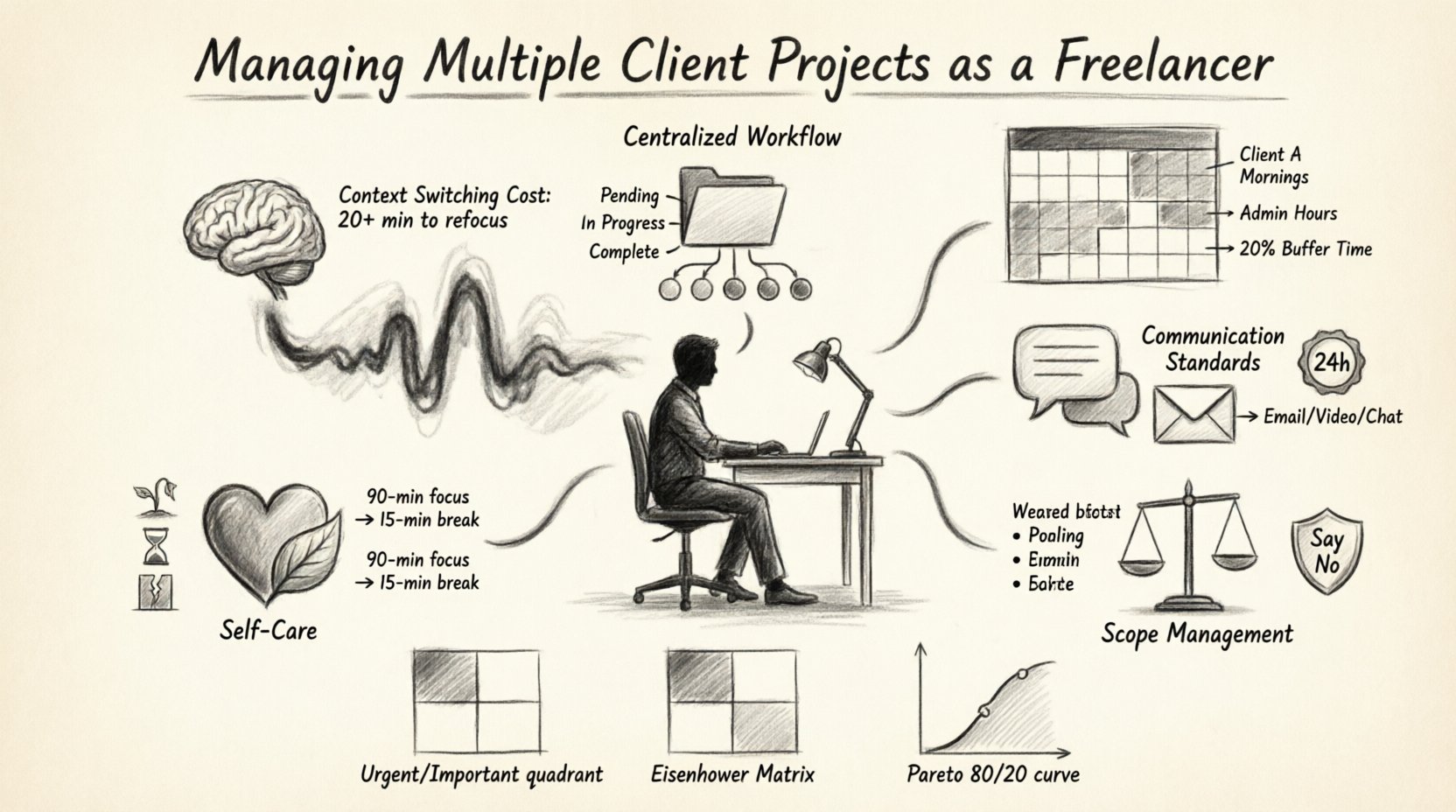
Understanding the Workflow Dynamics 🧠
Before implementing tools, you must understand the nature of your work. Context switching is a significant cost. Every time you move from one client’s task to another, your brain takes time to recalibrate. This friction reduces efficiency and increases the likelihood of errors.
- The Cost of Interruption: Research suggests it takes over 20 minutes to regain deep focus after a distraction.
- Cognitive Load: Keeping track of different requirements for different clients taxes your working memory.
- Emotional Bandwidth: Managing client expectations requires emotional energy that is finite.
To manage this, you need to segment your time and tasks. You cannot treat every client request with the same immediate urgency. Some projects require deep focus, while others need administrative attention.
Building a Centralized Workflow 📂
Reliability is your currency. Clients pay for consistency. If you lose track of a task, trust erodes. You need a single source of truth for all your active work. Relying on memory or scattered emails is a recipe for failure.
1. The Master Task List
Every project should have a dedicated section within your master tracking system. This allows you to see the big picture. You should list every action item, regardless of size. A simple “reply to email” counts as a task.
- Break down large projects into smaller, manageable milestones.
- Assign a due date to every single item.
- Mark the status as “Pending,” “In Progress,” or “Complete.”
2. Documenting Client Specifics
Each client has unique preferences. Some prefer long emails, others prefer quick messages. Some need detailed reports, others just want the final file. Create a profile for each client.
- Communication Style: Note how they like to receive updates.
- Brand Guidelines: Store their logos, fonts, and tone of voice documents in one place.
- Technical Specs: Keep file formats and hosting details handy.
Strategic Scheduling Techniques ⏰
Time management is not about filling every minute. It is about protecting the time needed for high-value work. You need a schedule that respects your energy levels and your client deadlines.
1. Time Blocking
Dedicate specific blocks of time to specific clients or types of work. This reduces the mental friction of switching contexts.
- Client A Mornings: Focus on deep work for your primary client.
- Client B Afternoons: Use this time for lighter tasks or secondary clients.
- Admin Hours: Set aside time for invoicing, emails, and scheduling.
2. Buffer Time
Things rarely go exactly according to plan. Clients may need revisions. Technical issues may arise. If you schedule 100% of your time, you have no room for error.
- Leave 20% of your week open for unexpected tasks.
- Buffer time prevents you from feeling rushed.
- It allows you to absorb delays without missing deadlines.
3. Prioritization Frameworks
Not all tasks are equal. Use a framework to decide what to do first. This helps you communicate realistic timelines to your clients.
| Framework | Focus | Best For |
|---|---|---|
| Urgent vs. Important | Separates tasks that need immediate attention from those that add long-term value. | General daily triage |
| Eisenhower Matrix | Categorizes tasks into four quadrants based on urgency and importance. | Weekly planning |
| Pareto Principle | Focuses on the 20% of tasks that yield 80% of results. | Efficiency optimization |
Communication Standards 📩
Clear communication prevents misunderstandings. It sets expectations early. When you manage multiple clients, silence can be misinterpreted as negligence. You must be proactive.
1. Setting Response Times
Do not feel pressured to reply instantly to every message. Define your working hours and stick to them.
- State your expected response time in your contract (e.g., within 24 hours).
- Use auto-responders if you are away.
- Batch your email checking to specific times of the day.
2. Regular Status Updates
Proactive updates build trust. Clients appreciate knowing the status of their work without having to chase you.
- Schedule a weekly check-in call or email.
- Highlight completed milestones.
- Flag any potential risks early.
3. Meeting Etiquette
Video calls can drain energy. Limit them to where they add value.
- Send an agenda before every meeting.
- Take notes during the call for accountability.
- Send a summary email immediately after.
| Channel | Best Use Case | Limitations |
|---|---|---|
| Formal updates, file transfers, detailed records. | Slow for urgent queries. | |
| Video Conferencing | Complex discussions, brainstorming, relationship building. | Time-consuming, energy intensive. |
| Instant Messaging | Quick questions, urgent alerts. | Can interrupt deep work if overused. |
Managing Scope and Expectations 📏
Scope creep is the silent killer of freelance profitability. It happens when a client asks for “just one more thing” without adjusting the timeline or budget. You must protect your boundaries.
1. Written Agreements
Never start work without a clear agreement. This document defines what you will deliver and what you will not.
- Specify the number of revisions included.
- Define what constitutes the “final” deliverable.
- Outline the payment schedule clearly.
2. Handling Change Requests
When a client asks for something outside the original scope, treat it as a new project.
- Assess the impact on time and cost.
- Provide a quote for the additional work.
- Get written approval before starting the extra task.
3. Saying No
Saying no is a vital skill. It protects your capacity for existing clients.
- Be polite but firm.
- Explain that taking on the new task would delay current commitments.
- Offer to refer them to another professional if you cannot help.
Financial Tracking Across Accounts 💰
Financial chaos often accompanies project chaos. When you have multiple income streams, tracking becomes harder. You need a system to monitor cash flow.
1. Separate Ledgers
Keep a dedicated spreadsheet or ledger for each client. Record every invoice sent and every payment received.
- Track the date of the invoice.
- Note the amount and the payment terms.
- Mark the status as “Unpaid” or “Paid”.
2. Tax Preparation
Freelancers are responsible for their own tax obligations. Mixing personal and business funds makes this difficult.
- Set aside a percentage of every payment for taxes.
- Save all receipts for business expenses.
- Review your financials monthly, not just at year-end.
3. Invoicing Cycles
Consistent invoicing improves cash flow. Do not wait until the end of the month to bill.
- Invoice upon completion of milestones.
- Use automated reminders for overdue payments.
- Make payment terms clear (e.g., Net 15, Net 30).
Self-Care and Sustainability 🌿
The most valuable asset you have is your health. If you burn out, you lose all your clients. Managing multiple projects is a marathon, not a sprint.
1. Recognizing Burnout
Signs of burnout include irritability, fatigue, and a lack of motivation. If you notice these signs, you need to adjust your workload.
- Take a full day off without checking work.
- Delegate non-essential tasks if possible.
- Consider pausing new client acquisition.
2. Structured Breaks
Work in intervals. Your brain needs rest to process information effectively.
- Take short breaks every hour.
- Step away from the screen during lunch.
- End your workday at a set time.
3. Continuous Learning
The market changes. Stay updated on industry trends and best practices.
- Read industry publications.
- Network with other freelancers.
- Invest in skills that increase your efficiency.
Final Thoughts on Professional Growth 📈
Handling multiple clients simultaneously is a skill that develops over time. It requires patience and iteration. You will make mistakes, and you will learn from them. The goal is not perfection, but consistency.
By implementing these strategies, you create a sustainable business model. You protect your time, your health, and your income. This allows you to focus on the work you enjoy most. Remember, the system serves you, not the other way around.
Start by implementing one change this week. Perhaps it is setting up a master task list or defining your response times. Small steps lead to significant improvements. Your career longevity depends on the foundations you build today.