
Building a sustainable business requires more than just a great product. It demands a clear understanding of how you connect with your audience and the pathways you use to deliver value. Within the framework of the Business Model Canvas, two critical building blocks dictate this interaction: Customer Relationships and Channels. These elements sit on the right side of the canvas, facing the market directly. They determine how customers discover, purchase, and remain loyal to your offering.
Many organizations struggle here. They might have a solid value proposition but fail to communicate it effectively or maintain the connection required for retention. This guide provides a detailed examination of how to map these components correctly. We will explore the specific types of relationships, the anatomy of distribution channels, and the strategic alignment needed to ensure your business model functions cohesively.
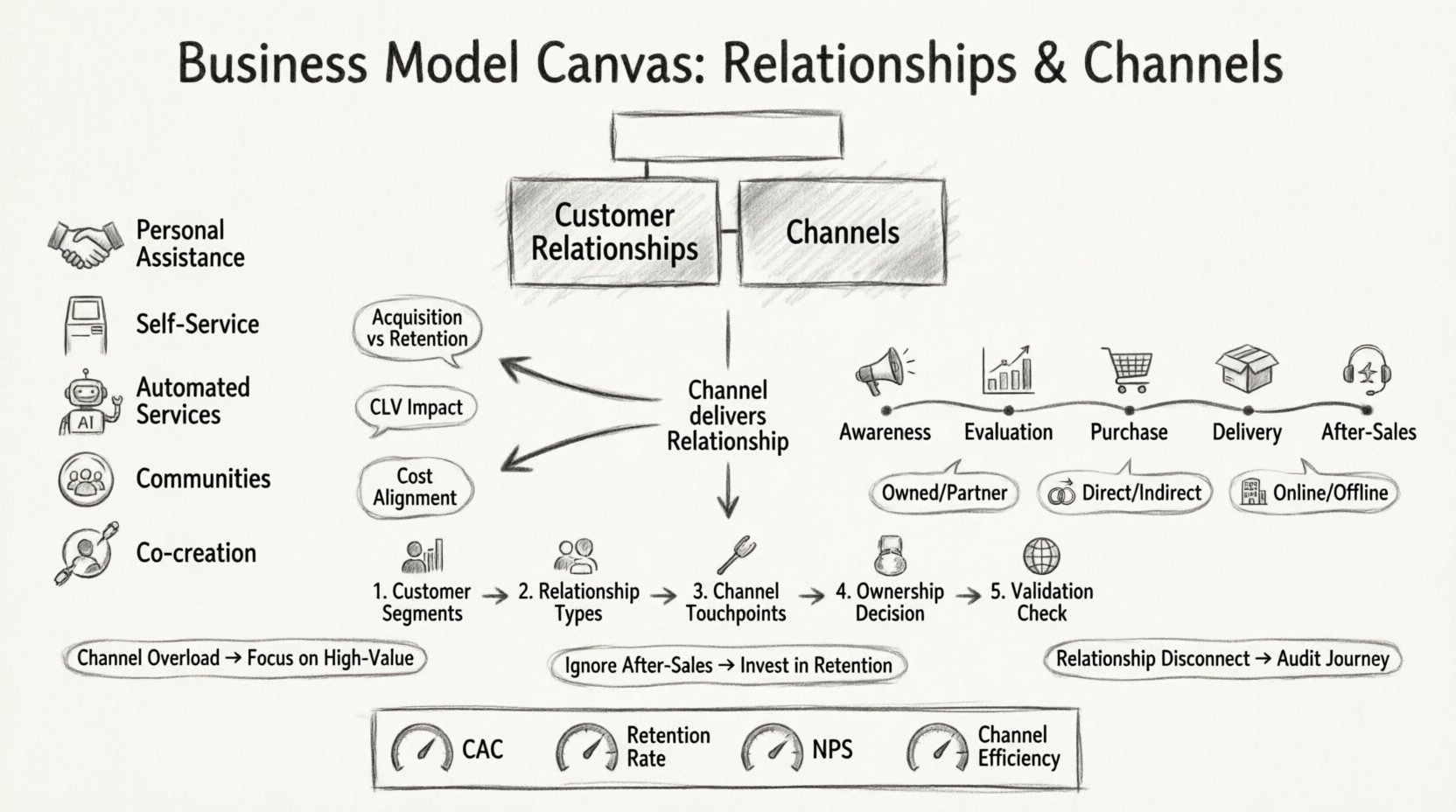
🤝 Understanding Customer Relationships
Customer relationships define the type of interaction a company establishes with specific customer segments. This block addresses the question: What relationship does each customer segment expect us to establish and maintain with them? These interactions can range from personal assistance to automated services. The nature of the relationship often correlates with the cost structure and the revenue model.
Identifying the correct relationship type is vital. If a segment expects a high-touch experience but receives a self-service bot, satisfaction will drop. Conversely, providing a concierge service for price-sensitive customers may erode margins unnecessarily.
🔑 Key Types of Customer Relationships
- Personal Assistance: This involves a human agent interacting with customers. It is common in B2B sales, luxury retail, and banking. The goal is to build trust and handle complex inquiries.
- Self-Service: No direct human contact. Customers solve their own problems using knowledge bases or intuitive interfaces. This scales well and reduces operational costs.
- Automated Services: This combines technology with customer needs. Examples include algorithms that recommend products or apps that manage accounts without human intervention. It offers convenience and speed.
- Communities: Creating a space for users to interact with each other. Social platforms and forums fall here. The business facilitates the connection rather than handling every query directly.
- Co-creation: Customers actively participate in designing the value proposition. This is prevalent in open-source software or crowdsourcing platforms. It increases loyalty and investment in the product.
💡 Strategic Considerations for Relationships
When defining these relationships, consider the following factors:
- Acquisition vs. Retention: Does the relationship focus on getting new users or keeping existing ones? Some models prioritize one over the other.
- Customer Lifetime Value (CLV): High CLV often justifies higher investment in personal relationships. Low CLV usually demands efficient, automated interactions.
- Cost Implications: Personal assistance is expensive. Automated services are cheaper to scale. The cost of the relationship must align with the revenue generated.
📢 Designing Distribution Channels
Channels are the touchpoints through which a company communicates with and reaches its customer segments to deliver a value proposition. They serve three main purposes: conveying information, facilitating purchase, and delivering the product. A robust channel strategy ensures that the value proposition reaches the intended audience efficiently.
🚪 The Five Stages of Customer Contact
Channels are not just about delivery; they span the entire customer journey. The journey typically breaks down into five distinct stages:
- Awareness: How do customers become aware of your offering? This involves marketing, advertising, and public relations.
- Evaluation: How do customers assess your value proposition against competitors? This might involve reviews, demos, or comparison tools.
- Purchase: How do customers buy the product? This includes the transaction mechanism, payment processing, and order placement.
- Delivery: How does the product or service get to the customer? This covers logistics, shipping, or digital access.
- After-Sales: How do you provide support post-purchase? This includes warranties, troubleshooting, and customer service.
🏢 Types of Channels
You can categorize channels based on ownership and accessibility. The choice here impacts cost, reach, and customer experience.
| Channel Type | Description | Examples |
|---|---|---|
| Owned Channels | Channels you control directly. You own the data and the experience. | Physical stores, company website, mobile app, sales team. |
| Partner Channels | Channels owned by third parties. You leverage their existing infrastructure. | Distributors, wholesalers, retail partners, affiliate networks. |
| Direct Channels | Communication and transaction happen directly between you and the customer. | In-house sales force, direct mail, email marketing. |
| Indirect Channels | Intermediaries handle the interaction. | Marketplaces, resellers, agents. |
| Online Channels | Digital platforms for discovery and transaction. | Social media, search engines, online marketplaces. |
| Offline Channels | Physical presence or traditional media. | Billboards, newspapers, brick-and-mortar locations. |
🔗 Aligning Relationships and Channels
The most common error in mapping the Business Model Canvas is treating Relationships and Channels as isolated blocks. They are deeply interconnected. The channel is often the vehicle through which the relationship is delivered. If you choose a self-service relationship model, your channels must support that autonomy.
🧩 How Channels Influence Relationships
- Personal Assistance Channels: If you use a dedicated sales team or a physical store, you facilitate a personal relationship. The channel enables the human touch.
- Automated Channels: If you rely on an app or a website, you enable automated or self-service relationships. The channel dictates the interaction style.
- Community Platforms: If your channel is a forum or social group, you facilitate community-based relationships. The channel brings the users together.
Consider the consistency required. If a customer expects personal help via a sales channel but encounters a bot during the purchase phase, the relationship breaks down. Alignment ensures a seamless experience from discovery to support.
🛠️ Step-by-Step Mapping Process
To effectively map these elements, follow a structured approach. This ensures no critical touchpoint is overlooked and that the strategy is grounded in reality.
📍 Step 1: Define Your Customer Segments
You cannot map relationships or channels without knowing who you are talking to. Different segments have different expectations. A business-to-business client may require a dedicated account manager, while a consumer segment might prefer a mobile app. List your segments clearly before proceeding.
📍 Step 2: Select Relationship Types per Segment
- Analyze the needs of each segment. Do they need guidance or independence?
- Assess the cost of maintaining these relationships against the revenue potential.
- Decide on the primary mode of interaction (e.g., dedicated support vs. chatbot).
- Document this in the Relationships block of your canvas.
📍 Step 3: Identify Channel Touchpoints
Map the customer journey for each segment. Where do they look for information? Where do they buy? Where do they get help?
- Awareness: Social media, search, word of mouth.
- Evaluation: Comparison sites, product demos, testimonials.
- Purchase: E-commerce cart, point of sale, contract signing.
- Delivery: Shipping, cloud access, physical handover.
- After-Sales: Help desk, warranty service, user forums.
📍 Step 4: Determine Ownership and Partnerships
For each touchpoint, decide if it is owned or partnered. Owning the channel provides control but requires investment. Partnering expands reach but reduces control over the customer experience. Balance these based on your resources and strategic goals.
📍 Step 5: Validate the Fit
Review the entire map. Does the channel support the relationship type? Is the cost sustainable? Is the experience consistent? This validation step prevents strategic drift.
⚠️ Common Pitfalls and Solutions
Even with a solid plan, execution often reveals gaps. Recognizing these pitfalls early can save significant resources.
❌ The Channel Overload
Many businesses attempt to be everywhere at once. They maintain a website, a physical store, social media, a marketplace, and a phone line. This dilutes focus and increases complexity.
- Solution: Focus on the channels that drive the most value. It is better to excel in one channel than to be mediocre in five.
❌ The Relationship Disconnect
This occurs when the delivery mechanism does not match the promise. For example, promising a premium experience but using a self-service portal without adequate guidance.
- Solution: Audit the customer journey. Ensure every interaction reinforces the relationship type defined in the strategy.
❌ Ignoring After-Sales
Businesses often focus heavily on acquisition channels and neglect the channels used for support. This leads to high churn rates.
- Solution: Treat after-sales channels as critical retention tools. Invest in knowledge bases and support teams to extend customer lifespan.
📈 Measuring Effectiveness
Once mapped, these blocks require monitoring. You need data to understand if your relationship and channel strategy is working. Here are key metrics to track.
- Customer Acquisition Cost (CAC): How much does it cost to reach a customer through your chosen channels?
- Retention Rate: How well does the relationship model keep customers coming back?
- Net Promoter Score (NPS): Measures customer satisfaction and loyalty, reflecting the quality of the relationship.
- Channel Efficiency: Which channels generate the highest conversion rates?
- Support Ticket Volume: High volume may indicate that self-service channels are failing or that the product needs improvement.
🔄 Continuous Optimization
The market changes. Customer expectations evolve. What works today may not work tomorrow. The mapping process is not a one-time activity. It requires regular review.
- Monitor Trends: Watch for shifts in how customers prefer to communicate or buy.
- Test New Channels: Experiment with new platforms to see if they offer better engagement.
- Refine Relationships: Adjust the level of service based on feedback and data.
By treating the Relationships and Channels blocks as dynamic components, you ensure your business model remains relevant. This agility allows you to adapt without losing your core value proposition.
🏁 Final Thoughts on Integration
Successfully mapping relationships and channels transforms abstract strategy into concrete action. It clarifies exactly how value flows from your organization to the customer and how value feedback returns. When these two blocks are aligned with the Value Proposition and Customer Segments, the entire canvas becomes a coherent system.
Remember that the goal is not complexity. The goal is clarity. A simple, well-executed channel strategy often outperforms a complex, disjointed one. Focus on the quality of the connection you provide and the efficiency of the path you offer. This balance drives sustainable growth and long-term viability in any market environment.