
In the fast-paced environment of modern project management, leaders often face a significant challenge: how to meet tight deadlines while simultaneously nurturing the growth of less experienced team members. This dual responsibility requires a delicate balance. You are tasked with ensuring the project moves forward efficiently, yet you must also invest time and energy into guiding those who are still learning the ropes. Ignoring either side can lead to burnout, missed targets, or stagnant team development.
This guide explores practical strategies for mentoring junior staff without compromising project delivery. By adopting structured approaches to delegation, communication, and time management, you can foster a culture where growth and results coexist harmoniously. We will break down the process into actionable steps, focusing on real-world application rather than theoretical concepts.
🧠 Understanding the Dual Responsibility
Effective leadership in this context involves managing two distinct streams of work. The first stream is the project itself: timelines, budgets, deliverables, and client satisfaction. The second stream is the human element: skill acquisition, confidence building, and career progression for junior employees.
Many managers struggle because they view these as competing priorities. Instead, consider them as interconnected. When juniors grow, the team becomes more resilient and capable of handling complex tasks. When the project succeeds, the team gains confidence and tangible proof of their contributions. However, this synergy does not happen by accident. It requires intentional planning.
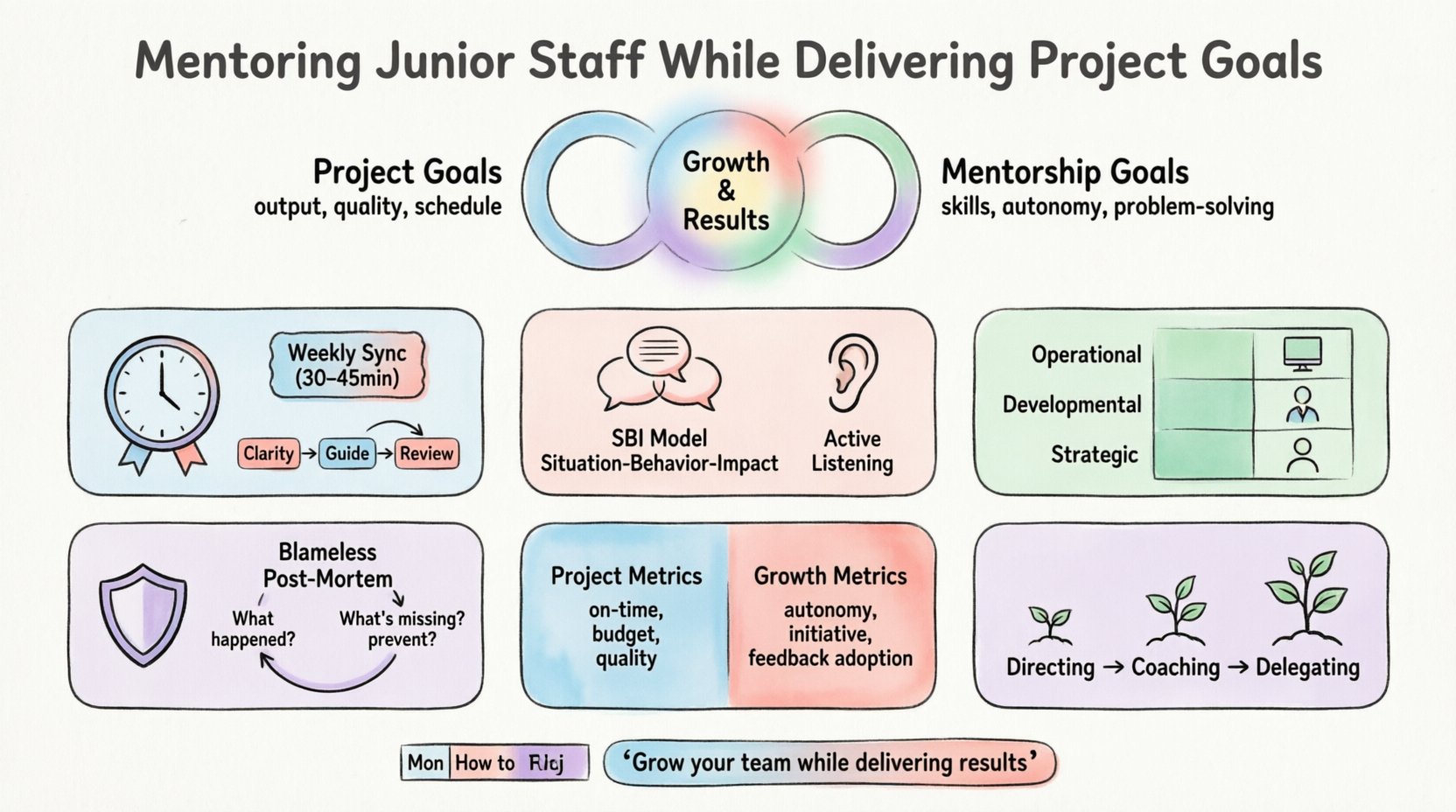
- Project Goals: Focus on output, quality, and schedule adherence.
- Mentorship Goals: Focus on skill acquisition, autonomy, and problem-solving abilities.
- The Intersection: Assigning tasks that challenge juniors but align with project needs.
Without a clear strategy, you may find yourself micromanaging to ensure deadlines are met, which stifles learning. Alternatively, you might give too much freedom, leading to errors that jeopardize the timeline. The key lies in finding the middle ground.
⏱️ Strategic Time Allocation
Time is your most finite resource. To mentor effectively, you must carve out specific moments for guidance without disrupting the workflow. Spontaneous advice is often reactive and can interrupt deep work. Scheduled sessions, however, provide focus and allow for deeper discussion.
1. The Weekly Sync
Establish a recurring meeting dedicated solely to mentorship. This is distinct from status updates. During status updates, you discuss what was done. During mentorship sessions, you discuss how it was done and how to improve.
- Frequency: Weekly, 30 to 45 minutes.
- Format: One-on-one, private, and distraction-free.
- Agenda: Review recent challenges, discuss learning goals, and provide feedback.
2. Timeboxing Guidance
When juniors approach you with questions, avoid diving into the solution immediately. Instead, allocate a specific time to solve it together. If the question is simple, answer it quickly. If it requires a deep dive, schedule a time to review it later. This prevents the mentor from becoming a bottleneck.
Use the following framework to structure these interactions:
- Clarify: Ask the junior to explain the problem back to you.
- Guide: Offer hints rather than answers.
- Review: Check the outcome together.
🗣️ Communication Frameworks
Communication is the vehicle through which mentorship travels. How you deliver feedback determines whether a junior staff member improves or becomes defensive. Constructive criticism must be specific, actionable, and timely.
1. The SBI Model
The Situation-Behavior-Impact model is a reliable tool for delivering feedback without ambiguity.
- Situation: Describe the specific context (e.g., “During yesterday’s sprint review…”).
- Behavior: Describe the observable action (e.g., “…you presented the data without validating the source…”).
- Impact: Describe the result of that action (e.g., “…this caused confusion among stakeholders regarding the timeline.”).
2. Active Listening
Listening is often undervalued in project management. When a junior staff member raises a concern, listen to understand, not to reply. This builds trust. Trust is essential for psychological safety, which allows team members to admit mistakes early before they become critical project risks.
Practices for active listening include:
- Maintaining eye contact during virtual or physical meetings.
- Paraphrasing what the speaker said to confirm understanding.
- Waiting three seconds after they finish speaking before responding.
🤝 Delegation Dynamics
Delegation is the primary mechanism for both project delivery and skill development. However, it is easy to confuse delegation with dumping work. Effective delegation involves handing over responsibility along with the authority to make decisions within defined boundaries.
1. Matching Tasks to Competence
Not every task is suitable for a junior. You must assess the complexity of the work against the current skill level of the employee. Use a matrix to categorize tasks.
| Task Type | Complexity | Mentorship Level | Example |
|---|---|---|---|
| Operational | Low | Monitor | Data entry, scheduling meetings |
| Developmental | Medium | Coach | Writing documentation, testing modules |
| Strategic | High | Delegate | Leading a small workstream, client presentation |
2. The Handoff Process
When assigning a task, follow a clear process to ensure clarity.
- Context: Explain why this task matters to the project.
- Expectations: Define what success looks like clearly.
- Resources: Point them to where they can find help.
- Checkpoints: Set specific times to review progress.
By doing this, you empower the junior to take ownership. If they succeed, they learn. If they struggle, you catch it early.
🛡️ Handling Mistakes Constructively
Mistakes are inevitable in project work. They are also the most valuable learning opportunities. How you respond to an error defines the team culture. If a mistake leads to public shaming, the team will hide errors. If it leads to a structured review, the team will improve.
1. The Blameless Post-Mortem
When a project goal is missed or a bug occurs, conduct a review focused on process, not people. Ask:
- What went wrong in the workflow?
- What information was missing?
- How can we prevent this next time?
This approach reduces fear. When juniors feel safe admitting they made a mistake, they can report it sooner, allowing you to mitigate damage to the project timeline.
2. Guided Problem Solving
Instead of fixing the mistake yourself, guide the junior through the fix. This reinforces the lesson. Walk them through the steps they should take to correct the issue and verify the solution.
Example dialogue:
Manager: “I noticed the integration failed. What do you think caused this?”
Junior: “I think it was the API version.”
Manager: “That is a strong hypothesis. How can we verify that?”
Junior: “I can check the logs.”
Manager: “Great. Let’s look at them together and see if we can find the specific error code.”
📊 Measuring Outcomes
To ensure both project goals and mentorship goals are being met, you need clear metrics. Relying on intuition is insufficient for long-term success.
1. Project Metrics
- On-Time Delivery: Are milestones being met?
- Budget Adherence: Are resources being used efficiently?
- Quality Standards: Is the output meeting the definition of done?
2. Growth Metrics
- Autonomy: Are they solving problems without constant intervention?
- Initiative: Are they proposing improvements to the process?
- Feedback Adoption: Are they implementing suggestions from previous reviews?
Track these metrics over a quarterly cycle. This allows you to adjust your approach if progress stalls.
🔄 Common Pitfalls to Avoid
Even experienced leaders stumble when balancing delivery and development. Recognizing these traps can save you from costly errors.
- The Hero Complex: Stepping in to do the work yourself when things get tough. This saves time now but robs the junior of the chance to learn.
- Overload: Assigning too much work to test their limits. This leads to burnout and errors.
- Inconsistency: Giving feedback one week and ignoring it the next. This creates confusion about expectations.
- Isolation: Not integrating the junior into the broader team network. Mentorship should extend beyond the immediate manager.
🌱 Building Long-Term Resilience
The ultimate aim is to create a team that does not rely on you. This requires shifting from a directive style to a supportive style over time.
Phase 1: Directing
At the beginning, provide clear instructions and close supervision. Ensure the junior understands the project goals and their specific role.
Phase 2: Coaching
As confidence grows, reduce the frequency of check-ins. Ask more questions and allow them to drive the conversation.
Phase 3: Delegating
Eventually, hand over ownership of entire modules or workstreams. Your role becomes one of removal of obstacles rather than assignment of tasks.
📅 Weekly Schedule Template
To help visualize how to fit this into a busy schedule, consider the following template.
| Day | Focus Area | Activity |
|---|---|---|
| Monday | Planning | Review project roadmap with the team. |
| Tuesday | Mentorship | One-on-one sessions with junior staff. |
| Wednesday | Execution | Deep work on critical project tasks. |
| Thursday | Review | Code reviews or document audits. |
| Friday | Retro | Team retrospective and weekly wrap-up. |
This structure ensures that mentorship is not an afterthought but a scheduled priority. It also prevents the week from becoming dominated solely by crisis management.
🤝 Fostering Peer Mentorship
As a manager, you cannot be present for every interaction. Encouraging peer-to-peer mentorship amplifies your impact. This distributes the load and builds a stronger team culture.
- Pairing: Assign a senior staff member to mentor a junior on specific tasks.
- Knowledge Sharing: Host internal workshops where juniors present what they learned.
- Open Channels: Create channels or forums where questions can be asked publicly.
When juniors learn from peers, they often feel more comfortable asking questions they might hesitate to ask a manager. This accelerates learning cycles.
🛠️ Tools for Organization
While we focus on methodology, organization tools play a role in keeping track of both project tasks and mentorship goals.
- Task Boards: Use Kanban boards to visualize progress and identify bottlenecks.
- Documentation: Maintain a shared knowledge base where solutions are recorded.
- Feedback Logs: Keep a private record of feedback given and received to track trends.
These tools help maintain visibility without constant meetings. They allow juniors to self-serve information when possible, freeing up your time for high-level guidance.
🧭 Navigating Project Crises
Crises are inevitable. When a project is at risk, the temptation is to tighten control and exclude juniors from decision-making. This is short-sighted.
Even in a crisis, involve the junior staff. Explain the situation clearly. Ask them to help brainstorm solutions. This maintains their confidence and demonstrates that their input is valued even under pressure.
After the crisis, conduct a specific review. Discuss what happened, what was learned, and how the team handled the stress. This turns a negative event into a bonding and learning experience.
🌟 Final Thoughts on Sustainable Leadership
Leading a team while delivering projects is a continuous balancing act. There is no perfect formula that works for every situation. You must adapt based on the specific needs of the project and the individual needs of the staff.
By prioritizing clear communication, structured delegation, and a supportive environment, you create a sustainable workflow. Your juniors grow into capable professionals, and the project succeeds. This cycle strengthens the organization as a whole.
Remember, the goal is not just to finish the project, but to finish it with a team that is stronger than when you started. This requires patience, consistency, and a genuine commitment to the growth of others.