
Designing a sustainable business requires more than just a great product. It demands a clear understanding of how value translates into financial viability. The Business Model Canvas (BMC) has become the standard framework for mapping out these strategies. Yet, despite its popularity, significant confusion persists regarding the Revenue Streams block. Many founders and strategists treat this section as a mere afterthought, assuming it will sort itself out once the product launches. This is a dangerous assumption.
Revenue generation is not a single event; it is a system. It involves pricing, customer behavior, delivery mechanisms, and cost structures. When these elements are misunderstood, the entire canvas collapses. This guide breaks down the most pervasive myths surrounding revenue models within the BMC context. We will explore the technical nuances of monetization, the psychology of pricing, and the structural integrity required for long-term growth.
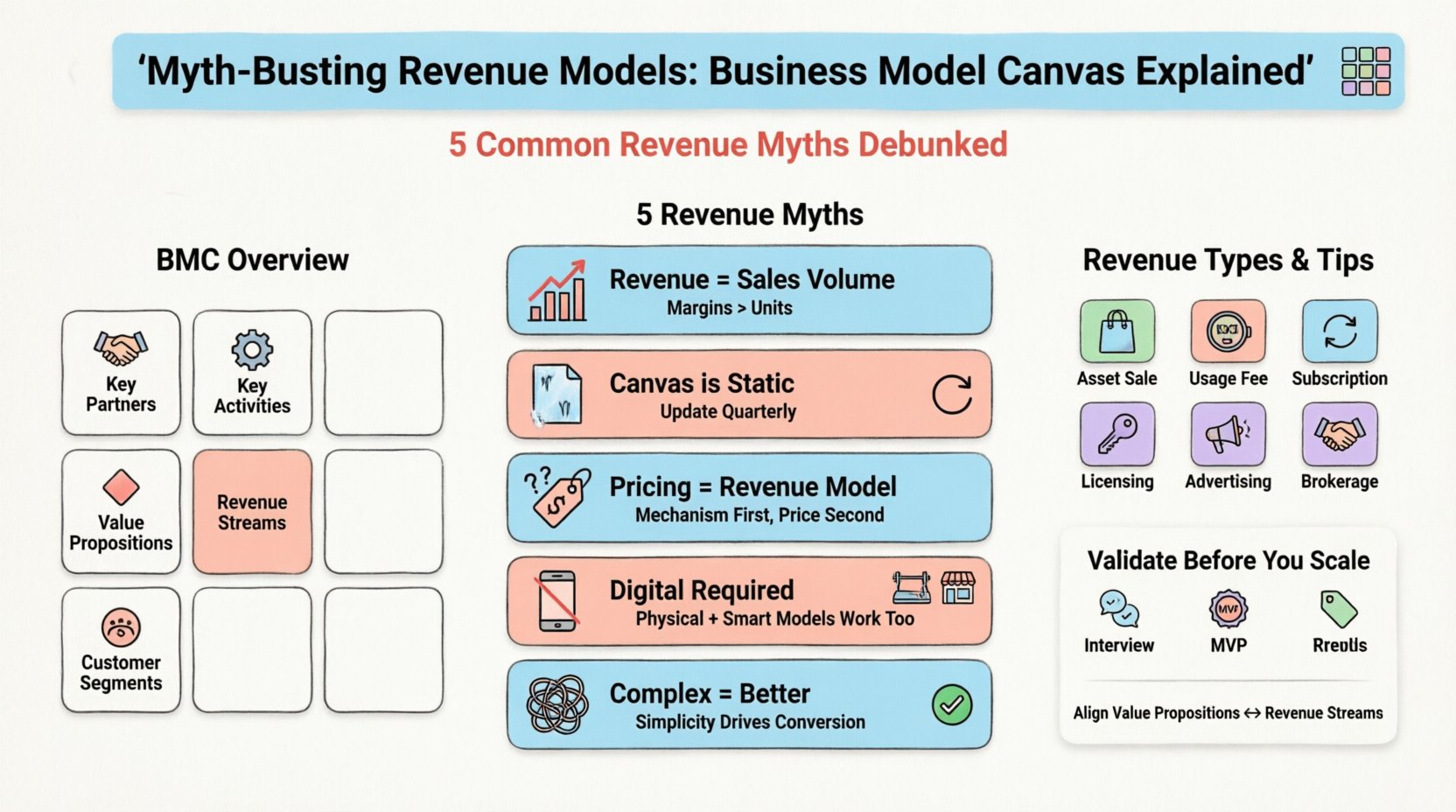
🧩 Understanding the Business Model Canvas Structure
Before dissecting the myths, we must establish a baseline understanding of the framework. Created by Alexander Osterwalder, the Business Model Canvas consists of nine building blocks. These blocks describe how an organization creates, delivers, and captures value. The nine blocks are:
- Key Partners: The network of suppliers and partners that make the model work.
- Key Activities: The most important things a company must do to operate successfully.
- Key Resources: The assets required to offer and deliver the proposed value.
- Value Propositions: The bundle of products and services that create value for a specific customer segment.
- Customer Relationships: The types of relationships a company establishes with specific customer segments.
- Channels: How a company communicates with and reaches its customer segments to deliver a value proposition.
- Customer Segments: The different groups of people or organizations an enterprise aims to reach and serve.
- Cost Structure: All costs incurred to operate a business model.
- Revenue Streams: The cash a company generates from each customer segment.
While all nine blocks are interconnected, the Revenue Streams block often receives insufficient attention. It is frequently conflated with pricing strategy or sales targets. In reality, it defines the economic engine of the organization. A misalignment here can lead to a situation where high traffic does not result in high profit, or where a profitable product cannot scale due to structural costs.
💰 The Revenue Stream Block: A Deep Dive
The Revenue Streams section answers one fundamental question: For what value are customers willing to pay? It is not enough to say “we sell widgets.” The model must specify the mechanism. Is it a one-time transaction? A subscription? A licensing fee? A commission? Each mechanism carries different implications for cash flow, valuation, and customer lifetime value (CLV).
When populating this block, consider the following technical distinctions:
- Asset Sale: Selling ownership of a physical product or digital asset.
- Usage Fee: Charging based on the extent of usage (e.g., data storage, API calls).
- Subscription Fees: Recurring payments for continuous access to a service.
- Lending/Renting/Leasing: Gaining a share of the value of the asset over time.
- Advertising Fees: Charging for space to display ads to an audience.
- Brokerage Fees: A commission earned by facilitating a transaction between two parties.
Understanding these categories is the first step in avoiding common pitfalls. Many organizations attempt to mix these models without clear boundaries, leading to customer confusion and operational inefficiency. Clarity in this block is paramount for investor confidence and internal alignment.
🚫 Myth 1: Revenue Equals Sales Volume
The most persistent myth is the belief that increasing the number of units sold automatically increases revenue health. While true in a vacuum, this ignores the cost of acquisition and the nature of the revenue stream. A business can grow its sales volume while simultaneously losing money.
This misconception stems from focusing on the top line (gross revenue) rather than the bottom line (net profit). In the context of the Business Model Canvas, this myth manifests when the Revenue Streams block is not balanced against the Cost Structure block.
- The Reality: Revenue is only valuable if it exceeds the Cost of Goods Sold (COGS) and Customer Acquisition Cost (CAC).
- The Risk: Focusing solely on volume often leads to discounting strategies that erode margins.
- The Fix: Map the unit economics. Calculate the contribution margin per unit. If the margin is negative, volume growth accelerates losses.
Consider a SaaS company that offers a free tier to drive volume. If the conversion rate to paid tiers is low, the revenue per user is negligible. Increasing the user base might look like success, but the revenue stream remains weak. The model needs to focus on conversion rates and average revenue per user (ARPU) rather than just total user count.
🚫 Myth 2: The Canvas is a Static Document
Many teams create the Business Model Canvas once during the ideation phase and file it away. They treat it as a snapshot rather than a living document. This assumption ignores the dynamic nature of markets and customer needs.
A revenue model that works today may be obsolete tomorrow due to regulatory changes, competitor actions, or shifts in consumer behavior. Treating the canvas as static leads to strategic drift.
- The Reality: The BMC should be reviewed and updated quarterly or whenever a major pivot occurs.
- The Risk: Sticking to a revenue model that no longer aligns with market demand leads to stagnation.
- The Fix: Implement a feedback loop. Use customer data to validate whether the current revenue assumptions hold true.
For example, a company might start with a transactional revenue model (pay per item). Over time, customers prefer predictability. The model should shift to a subscription basis to capture recurring value. Failing to update the canvas means missing this transition opportunity.
🚫 Myth 3: Pricing Strategy Defines the Revenue Model
There is a distinct difference between pricing strategy and the revenue model. Pricing is the tag on the product. The revenue model is the mechanism of exchange. Confusing the two leads to flawed financial planning.
You can have the same revenue model with different pricing strategies. For instance, a subscription model can be priced monthly, annually, or with a tiered structure. The model (recurring payment) remains the same, but the price changes.
- The Reality: The revenue model dictates the cash flow rhythm. Pricing dictates the volume and margin.
- The Risk: Changing prices without adjusting the underlying model can cause confusion. If you move from one-time sales to subscriptions, the accounting and reporting structure must change.
- The Fix: Define the mechanism first (e.g., licensing), then determine the price point (e.g., $50/month).
Another layer of complexity arises with dynamic pricing. Some models allow prices to fluctuate based on demand. While this is a pricing tactic, it relies on a revenue model capable of handling variable transactions. The Business Model Canvas must reflect the infrastructure required to support these transactions.
🚫 Myth 4: Digital Platforms Are Mandatory for Modern Models
In the tech era, there is a belief that a business model must be digital to be scalable. This excludes traditional industries from innovation. A revenue model does not require a website or an app to be effective.
Physical goods, services, and brick-and-mortar stores can utilize sophisticated revenue models. Think of a gym. It sells memberships (subscription), personal training sessions (usage fee), and merchandise (asset sale). It is entirely physical, yet the revenue model is complex and layered.
- The Reality: The channel of delivery does not dictate the revenue mechanism.
- The Risk: Ignoring digital integration might limit reach, but ignoring digital revenue models (like data monetization) might limit value capture.
- The Fix: Evaluate how technology can enhance the current revenue model, not replace it. Does data tracking improve retention? Does automation reduce costs?
A physical retail store can adopt a membership model for exclusive access. This shifts the revenue from transactional to recurring. The physical presence is the channel, but the revenue model is subscription-based. Both coexist.
🚫 Myth 5: Complex Models Are Better Models
There is a perception that a revenue model must be intricate to maximize value. Founders often add multiple revenue streams (ads, subscriptions, affiliate, licensing) hoping to capture every possible dollar. This creates operational bloat.
Complexity introduces friction. Customers do not understand the value if they have to navigate a maze of fees. Internal teams struggle to manage multiple billing systems and reporting lines.
- The Reality: Simplicity often drives higher conversion. A clear, single value proposition with a single payment mechanism is often more effective.
- The Risk: Fragmented revenue streams can dilute the brand and confuse the customer.
- The Fix: Prioritize the primary revenue stream. Add secondary streams only if they support the core value without creating friction.
Take the example of a software company. It might offer a free trial, a paid subscription, and an enterprise license. This is a layered approach, but it is clear. Adding a marketplace fee for third-party plugins might be too complex for the early stages. Focus on the core value exchange first.
📊 Misconception vs. Reality: A Comparative Table
To summarize the technical distinctions, the following table contrasts common misconceptions with the operational reality required for a robust Business Model Canvas.
| Misconception | Operational Reality |
|---|---|
| Revenue is just Sales Volume. | Revenue is Cash Flow minus Costs. Margins matter more than units. |
| The Canvas is a one-time document. | The Canvas is a dynamic tool requiring regular validation and updates. |
| Pricing Strategy = Revenue Model. | Pricing is a tactic within the model; the model defines the payment mechanism. |
| Digital is required for scalability. | Scalability depends on unit economics, not just the medium of delivery. |
| More revenue streams are always better. | Complexity adds friction. Focus on the primary value exchange first. |
| Customers pay for the product. | Customers pay for the outcome, access, or time saved. |
| Freemium guarantees conversion. | Freemium requires a clear path to value for paid tiers. |
| Revenue is recognized when a sale happens. | Revenue recognition follows accounting standards (e.g., over time for subscriptions). |
🔍 Validating Your Economic Assumptions
Once the myths are cleared, the focus must shift to validation. How do you know your revenue model works? Hypotheses in the Business Model Canvas are just guesses until tested. Validation requires data, not intuition.
Here is a framework for testing revenue assumptions:
- Customer Interviews: Ask potential users directly about their willingness to pay. Do not ask if they like the product; ask if they would buy it today.
- Concierge MVPs: Manually deliver the service before automating it. This helps understand the true cost of delivery and the value perceived by the customer.
- Smoke Tests: Create a landing page with pricing. Measure click-through rates to the checkout page, even if the product does not exist yet.
- Pre-sales: Sell the solution before it is built. This is the ultimate validation of the revenue model.
If a customer segment refuses to pay for the value proposition, the model is flawed. This is not a failure of the product, but a failure of the business model. The BMC allows you to pivot the revenue stream without abandoning the entire value proposition.
🔄 Integrating Value Propositions with Revenue
The Value Propositions block and the Revenue Streams block must be tightly aligned. If the value proposition is “convenience,” the revenue model should reflect that (e.g., subscription for access). If the value proposition is “status,” the revenue model might involve premium pricing or exclusive access fees.
Misalignment here creates cognitive dissonance for the customer. Imagine a luxury brand offering a “discounted” revenue model. The price signals value. If the revenue mechanism is too transactional, it undermines the perceived worth of the brand.
Consider the following alignment strategies:
- Access vs. Ownership: If you sell access (SaaS), the revenue is recurring. If you sell ownership (Software License), the revenue is one-time.
- Outcome vs. Effort: If you charge for results (performance marketing), the risk is on you. If you charge for effort (hourly consulting), the risk is on the client.
- Volume vs. Margin: Low price/high volume requires a different cost structure than high price/low volume.
The BMC helps visualize this alignment. If the Value Proposition is “Speed,” the Channels must support speed, and the Revenue model must not penalize speed (e.g., long contracts).
⚠️ Common Pitfalls in BMC Design
Beyond the myths, there are structural pitfalls that plague Business Model Canvas design. These often lead to financial instability.
- Ignoring Hidden Costs: The Cost Structure block often misses indirect costs like customer support or payment processing fees. These eat into revenue.
- Overestimating Conversion: Assuming 10% of free users will pay without evidence. This inflates the revenue projections.
- Neglecting Churn: A subscription model looks great on paper until churn rates are factored in. High churn kills LTV.
- One-Size-Fits-All Pricing: Treating all customer segments the same. Enterprise clients often need different pricing structures than SMB clients.
Addressing these pitfalls requires a rigorous review of the Cost Structure and Revenue Streams blocks. They are not independent; they are two sides of the same coin. Profitability exists in the gap between them.
📈 Scaling the Revenue Model
Once validated, the goal is scaling. Scaling a revenue model is different from scaling sales. Sales scaling involves more people. Revenue scaling involves increasing the efficiency of the economic engine.
Key levers for scaling include:
- Increasing Average Order Value (AOV): Upselling and cross-selling within the same customer base.
- Reducing Churn: Improving retention increases the lifetime value of each customer.
- Optimizing CAC: Improving marketing efficiency lowers the cost to acquire new revenue.
- Automating Delivery: Reducing marginal costs per unit allows for higher margins at scale.
When scaling, revisit the Business Model Canvas. Does the current Cost Structure support the new volume? Does the Revenue Stream block need adjustment to handle higher transaction volumes? Often, the model that worked for 100 customers breaks at 10,000.
🏁 Final Thoughts on Revenue Strategy
The Business Model Canvas is a powerful tool, but only if used correctly. The Revenue Streams block is not a line item; it is the heart of the financial engine. By debunking the myths surrounding sales volume, static planning, pricing confusion, digital dependency, and complexity, you build a stronger foundation.
Success comes from clarity. Clear value, clear pricing, and clear mechanisms. Regularly challenge your assumptions. Validate your economic models. Ensure that the revenue you capture aligns with the value you deliver. This disciplined approach separates sustainable businesses from fleeting ventures.
Remember, the goal is not just to make money. It is to create a system that generates value consistently over time. The Business Model Canvas provides the map, but the revenue model provides the fuel. Ensure both are optimized for the journey ahead.