
Software systems are rarely static. They evolve, expand, and adapt to changing business requirements over months and years. However, this evolution often comes with a hidden cost known as technical debt. While often associated with quick fixes or missed deadlines, technical debt frequently originates from the foundational architecture of the codebase itself. In object-oriented programming, the class is the primary building block. Consequently, the logic embedded within class design directly influences the longevity and maintainability of the entire system.
When developers ignore the structural integrity of their classes, they accumulate interest on that debt. Every subsequent feature becomes harder to add, every bug fix carries a higher risk of regression, and the velocity of the team slows to a crawl. This guide explores the mechanics of proper class design and how adhering to specific architectural principles can mitigate this debt before it becomes unmanageable.
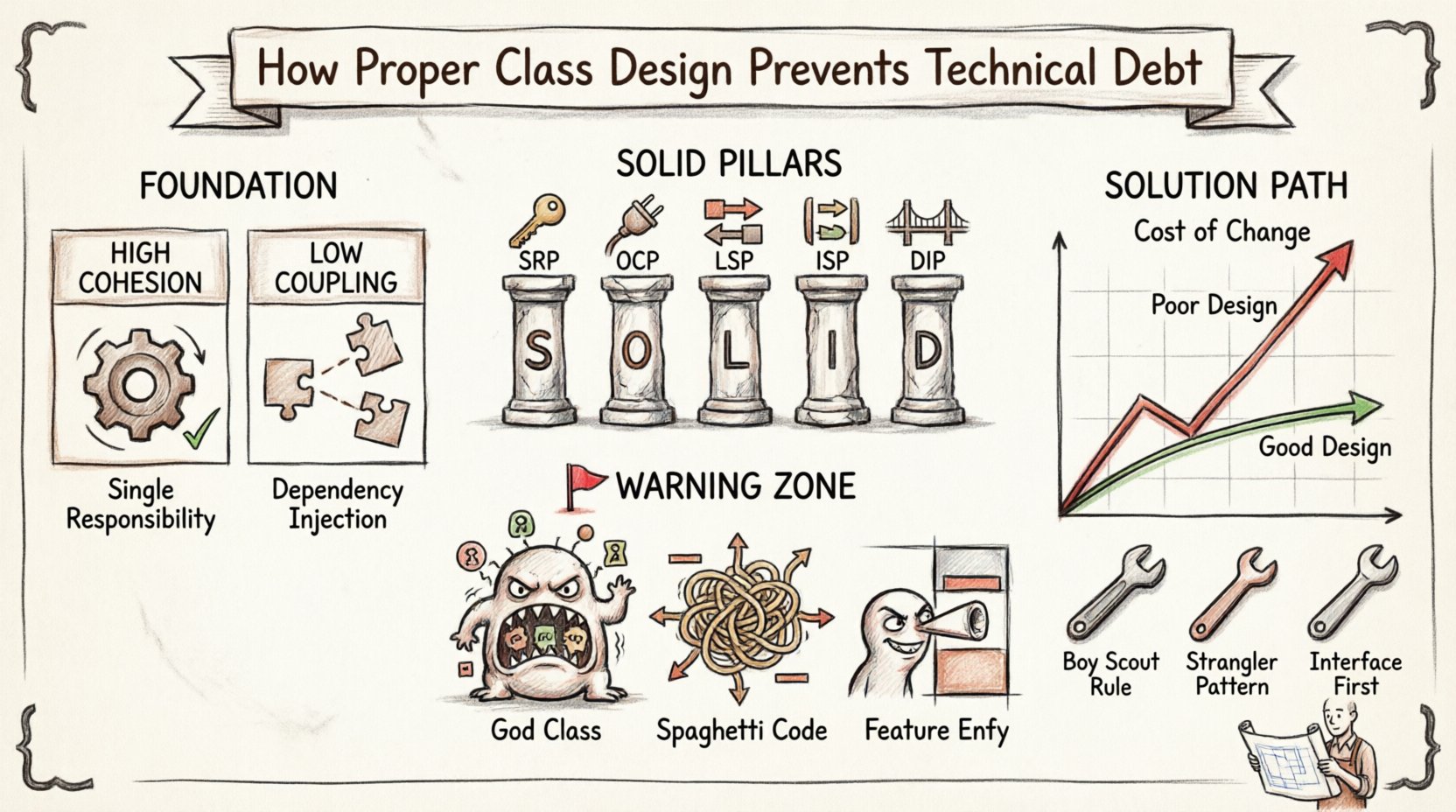
🏗️ Understanding the Foundation: Cohesion and Coupling
The two most critical metrics for evaluating the health of a class are cohesion and coupling. These concepts form the backbone of stable software architecture. Ignoring them is akin to building a skyscraper without a foundation; the structure might stand for a while, but the stress of wind (changing requirements) will eventually cause collapse.
High Cohesion: The Single Responsibility
Cohesion refers to how closely related the responsibilities of a single class are. A class with high cohesion performs one specific task and does it well. This is often synonymous with the Single Responsibility Principle. When a class handles multiple unrelated concerns, it becomes fragile.
- Strong Cohesion: A class dedicated to calculating tax rates based on location and currency.
- Weak Cohesion: A class that calculates tax, processes the payment, sends the email receipt, and logs the database transaction.
When a class is too broad, a change in one requirement forces a modification in the entire class. This increases the surface area for bugs. By separating these concerns into distinct classes, the impact of change is localized. If the email service changes, the tax calculator remains untouched.
Low Coupling: Reducing Dependencies
Coupling measures the degree of interdependence between software modules. Low coupling means that a change in one module requires minimal or no changes in another. High coupling creates a web of dependencies where fixing one issue breaks another.
Consider the relationship between classes. If Class A instantiates Class B directly inside a method, Class A is tightly coupled to Class B. If Class B changes its constructor signature, Class A must be updated. This creates a ripple effect.
- Tight Coupling: Direct instantiation, reliance on concrete implementations, shared mutable state.
- Loose Coupling: Dependency injection, reliance on interfaces, immutable data transfer.
Reducing coupling is not just about code cleanliness; it is about organizational agility. It allows different teams to work on different modules without stepping on each other’s toes.
📐 The SOLID Principles as Debt Prevention
The SOLID principles provide a roadmap for class design that naturally resists technical debt. These are not just theoretical guidelines but practical rules that dictate how classes should interact and behave.
1. Single Responsibility Principle (SRP)
A class should have only one reason to change. If you can think of two distinct reasons why a class might need to be modified, it likely violates SRP. This principle forces developers to decompose complex problems into smaller, manageable units.
2. Open/Closed Principle (OCP)
Software entities should be open for extension but closed for modification. This allows new functionality to be added without altering existing code. This is crucial for long-term projects where the core logic should remain stable even as features grow.
- Violation: Adding a new
if/elseblock every time a new payment method is supported. - Solution: Using an interface for payment methods where new implementations are added as new classes.
3. Liskov Substitution Principle (LSP)
Objects of a superclass should be replaceable with objects of its subclasses without breaking the application. This ensures that inheritance is used correctly. If a subclass changes the behavior of a parent class in an unexpected way, it introduces subtle bugs that are difficult to trace.
4. Interface Segregation Principle (ISP)
Clients should not be forced to depend on interfaces they do not use. Large, monolithic interfaces are a source of debt. They force implementations to carry methods they cannot use, leading to throw new NotImplementedException() or empty methods.
5. Dependency Inversion Principle (DIP)
High-level modules should not depend on low-level modules. Both should depend on abstractions. This decouples the business logic from the infrastructure details. It allows the infrastructure to change (e.g., switching databases or APIs) without rewriting the business rules.
📊 Visualizing the Structure: The Role of Class Diagrams
A class diagram is not merely a documentation artifact; it is a blueprint for the system’s logic. In long-term projects, the code often drifts away from the design. This drift is a primary indicator of technical debt.
Maintaining accurate class diagrams helps teams visualize the complexity of the system. It highlights circular dependencies and deep inheritance trees that are prone to failure.
Key Elements to Monitor in Diagrams
| Visual Element | What It Indicates | Debt Risk |
|---|---|---|
| Circular Dependency | Class A depends on Class B, which depends on Class A. | High. Causes compilation issues and logical loops. |
| Deep Inheritance Tree | Classes nested 5 or more levels deep. | Medium. Hard to predict behavior of child classes. |
| God Class | One class with excessive lines of code and methods. | High. Single point of failure and change bottleneck. |
| Spaghetti Connections | Unorganized cross-module links. | High. Unmaintainable and confusing structure. |
Regularly reviewing these diagrams against the actual code ensures that the design intent matches reality. If the diagram shows a clean hierarchy but the code is a mess, the team needs to address the discrepancy immediately.
🚫 Recognizing Anti-Patterns Early
Certain design patterns become traps when misused. Identifying these anti-patterns early can save thousands of hours of refactoring later.
1. The God Class
This is a class that knows too much and does too much. It acts as a global controller for the system. While it might seem convenient initially, it becomes a bottleneck. No one dares to touch it because the risk of breaking something is too high. The solution is to break it down into smaller, focused classes.
2. The Anemic Domain Model
This occurs when classes contain only getters and setters, with no business logic. All the logic is pushed into service classes. This violates the principle of Encapsulation and makes the domain model useless for understanding the business rules. Logic should reside where the data resides.
3. Spaghetti Code
This refers to code with tangled control flow, often resulting from excessive use of goto (in older languages) or deeply nested if/else statements in modern logic. It makes the flow of execution impossible to follow. Proper class design dictates that logic should be encapsulated in methods with clear inputs and outputs.
4. Feature Envy
This happens when a method in Class A accesses too many attributes of Class B. It suggests that the method should belong to Class B instead. This promotes better cohesion and reduces the knowledge required by Class A.
📉 The Cost of Change Over Time
One of the most compelling arguments for proper class design is the economic cost of change. In the early stages of a project, the cost of change is low. A developer can move a method from one class to another with minimal effort.
However, as the system matures, this cost grows exponentially. Poor design creates a scenario where the cost of change becomes prohibitive. This leads to “feature stagnation,” where new business requirements cannot be met because the codebase is too rigid.
Factors Influencing Change Cost
- Testability: Well-designed classes are easier to unit test. Poorly designed classes are hard to isolate, leading to a lack of confidence in refactoring.
- Readability: Clear class boundaries make it easier for new developers to onboard. Ambiguous structures require more time to understand.
- Debuggability: When a bug occurs, a well-structured system allows for faster root cause analysis. A tangled system requires tracing through multiple layers of dependencies.
Investing time in class design is an investment in future velocity. It is the difference between a system that can adapt to the market and one that becomes obsolete.
🛠️ Refactoring Strategies for Legacy Code
What happens when a project is already suffering from technical debt? The answer is not to rewrite the whole system, but to refactor strategically.
1. The Boy Scout Rule
Leave the code cleaner than you found it. Every time you touch a file to add a feature or fix a bug, improve the structure slightly. Extract a method, rename a variable, or move a class to a better location. Small, continuous improvements prevent large-scale debt accumulation.
2. Strangler Fig Pattern
This involves gradually replacing legacy functionality with new, well-designed components. You do not stop the old system; you build the new system around it and slowly migrate traffic. This allows for class-by-class migration without a risky big-bang release.
3. Interface Implementation
Start by defining the interfaces for the new design. Implement the old code behind these interfaces. This allows you to decouple the system incrementally. Over time, you can swap out the old implementations for new ones without changing the calling code.
🤝 Team Dynamics and Design Governance
Code is written by teams, not individuals. Therefore, class design must be a collaborative effort. Relying on a single “architect” to approve every class leads to bottlenecks and resentment.
Pair Programming
Pair programming is an effective way to ensure design quality. Two minds reviewing the structure of a class in real-time can catch coupling issues and cohesion problems before they are committed. It acts as a continuous code review process.
Design Reviews
Before implementing complex logic, a brief design review can save significant time. This is not about micromanaging, but about ensuring alignment with the system’s architectural goals. It is a discussion about why a class is structured a certain way, not just how it is written.
Documentation
While code is the best documentation, comments are still necessary for explaining the why behind a class structure. A class diagram serves as a high-level map, while inline comments explain specific decisions. This context is vital for future maintainers who were not present during the original design.
🔮 Sustaining Architectural Health
The goal is not a perfect design on day one. It is a design that is resilient to change. Software architecture is a living discipline. The rules of class design must be revisited as the system grows.
Teams should regularly audit their codebase for signs of debt. Metrics such as cyclomatic complexity, coupling score, and lines of code per class can provide objective data on the health of the system. When these metrics spike, it is time to pause feature development and focus on refactoring.
By treating class design as a critical component of project success, teams can ensure that their software remains a valuable asset rather than a liability. The logic hidden within a class definition is the logic that dictates the future of the project. Proper attention to this logic ensures that the system survives the test of time.