
In the landscape of project management, ambiguity is the silent killer of timelines and budgets. One of the most common sources of friction between teams and stakeholders is the lack of clarity regarding what constitutes a finished product. When expectations are vague, the likelihood of rework, dissatisfaction, and scope creep increases exponentially. This guide outlines a robust approach to defining deliverables with precision, ensuring every party understands exactly what is expected, when it is due, and how it will be measured. We will explore the mechanics of clear specification, the importance of acceptance criteria, and the strategic communication required to prevent misunderstandings before they arise.
What Exactly Is a Deliverable? 🔍
A deliverable is a tangible or intangible good or service produced as a result of a project that is intended to be delivered to a customer. It is not merely a task completed; it is a verified outcome. In many professional environments, this distinction is blurred, leading to situations where a team believes a job is done, but the client perceives a gap in quality or functionality.
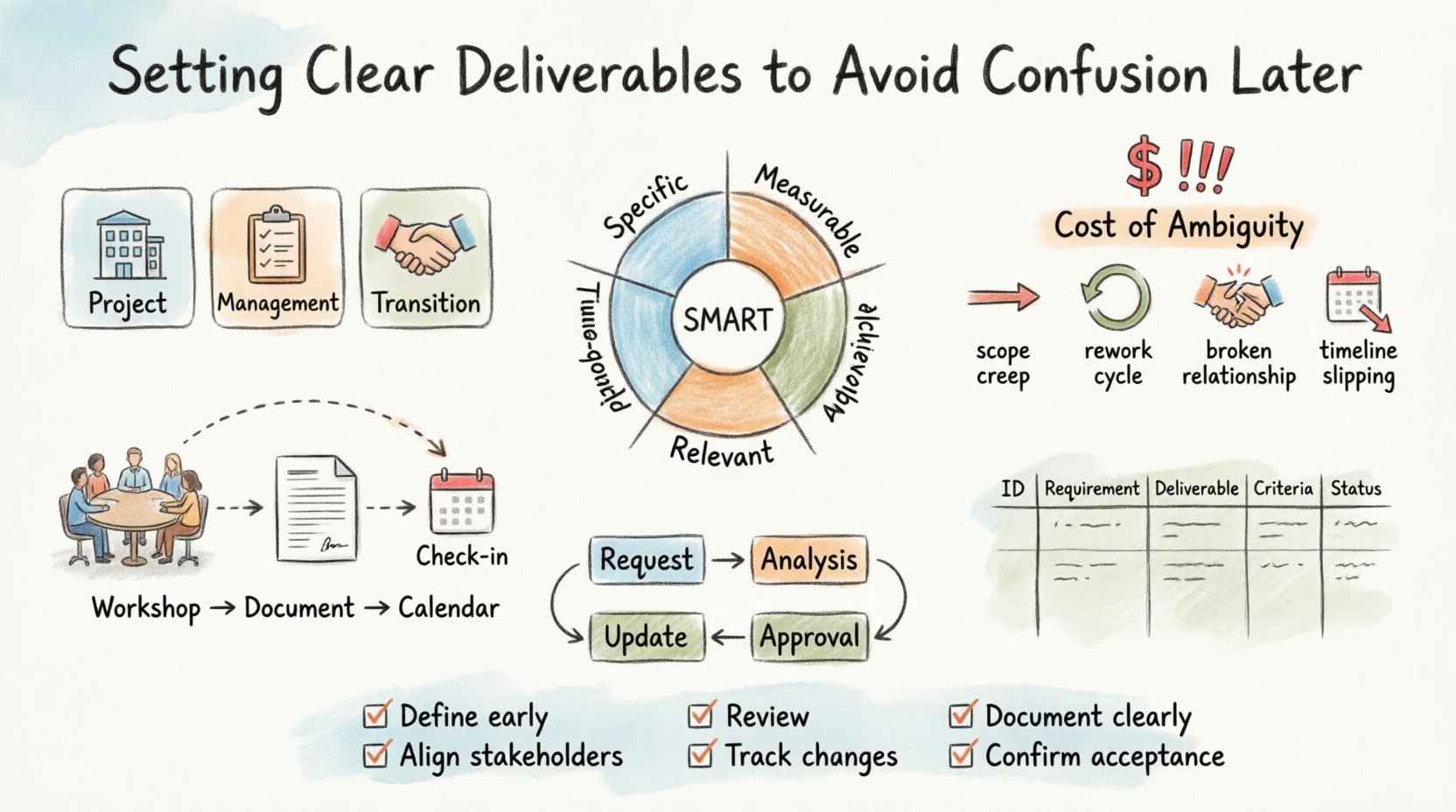
To establish clarity, we must categorize deliverables into specific types:
- Project Deliverables: These are the final outputs required to complete the project. Examples include a completed software application, a constructed building, or a final marketing report.
- Management Deliverables: These support the execution of the project but are not the final product. Examples include status reports, risk logs, and meeting minutes.
- Transition Deliverables: These ensure the handover of the final product. Examples include training manuals, warranty documents, and support agreements.
Understanding these categories helps in organizing the project scope. When a stakeholder asks for a “project,” they often mean the final output. However, the project manager must account for the management and transition artifacts to ensure the final handover is smooth.
The Cost of Ambiguity 💸
Ambiguity in deliverables is not a minor inconvenience; it is a significant financial and reputational risk. When terms are open to interpretation, the following issues typically emerge:
- Scope Creep: Without defined boundaries, stakeholders may add requirements mid-stream, assuming those additions were part of the original agreement.
- Unnecessary Rework: If the definition of “done” is not shared, work may be completed only to be rejected and repeated, wasting resources.
- Strained Relationships: Frequent disputes over quality or completeness erode trust between the service provider and the client.
- Timeline Slippage: Unclear requirements lead to back-and-forth clarification loops that extend the project duration.
By investing time upfront to define deliverables, organizations save considerable time and money in the execution and closure phases. The cost of definition is far lower than the cost of correction.
The Framework for Defining Deliverables 🛠️
To move from vague ideas to concrete specifications, a structured framework is necessary. This process involves breaking down the project into manageable units and defining the success metrics for each unit. The following steps provide a logical flow for this process.
1. Identify Stakeholder Needs
Before writing a single requirement, understand who will use the deliverable and why. Different stakeholders have different priorities. A developer might prioritize code efficiency, while a marketing manager might prioritize speed to market. Conduct interviews or workshops to gather these inputs. Document the primary pain points the project aims to solve.
2. Apply the SMART Criteria
Every deliverable should be defined using the SMART framework to ensure it is actionable:
- Specific: What exactly is being produced? Avoid generic terms like “improve” or “update.” Use precise language.
- Measurable: How will we know it is complete? Define quantitative metrics where possible.
- Achievable: Is the deliverable realistic given the resources and time available?
- Relevant: Does this deliverable contribute to the overall project goal?
- Time-bound: When must the deliverable be finished?
3. Define Acceptance Criteria
Acceptance criteria are the conditions that a software product or service must satisfy to be accepted by a user, customer, or other entity. These are the pass/fail tests for a deliverable. For example, a deliverable might be a “login page.” The acceptance criteria might include: “The page must load in under two seconds,” “The password field must require a minimum of eight characters,” and “The system must reject invalid credentials with a specific error message.”
Without these criteria, a stakeholder might accept a login page that looks good visually but fails functionally under load. Writing these criteria down removes the subjectivity from the approval process.
4. Determine the Format of Delivery
How will the deliverable be presented? This includes the file format, the medium of transmission, and the physical location if applicable. If the deliverable is a document, specify the format (e.g., PDF, editable Word doc). If it is code, specify the repository or deployment environment. This prevents technical friction during the handover.
Communication Strategies for Alignment 🗣️
Even the best-defined deliverables can fail if communication is poor. Once the specifications are written, they must be communicated effectively to all relevant parties. This involves more than just sending an email; it requires a collaborative review process.
1. The Review Workshop
Hold a session where the deliverable definitions are presented to the stakeholders. Walk through each item, explaining the acceptance criteria and the expected timeline. Encourage questions and challenge assumptions. If a stakeholder hesitates or seems confused about a definition, pause to clarify immediately. This is the moment to catch misunderstandings.
2. Written Confirmation
Verbal agreement is not enough in complex projects. Follow up the workshop with a written summary. This document serves as the baseline for the project. It should be signed off by key decision-makers. This creates a formal record of what was agreed upon. If disputes arise later, this document is the reference point.
3. Regular Check-ins
Deliverables are not static. Requirements may evolve. Schedule regular checkpoints to review progress against the deliverable definitions. These meetings allow for early detection of drift. If the team is building something that no longer matches the original definition, it can be corrected before it is too late.
Documentation and Tracking 📝
Documentation acts as the single source of truth. It ensures that everyone is working from the same information. While the specific tools used may vary, the principles of documentation remain constant. The goal is to create a trail that links every deliverable to a requirement.
1. The Requirements Traceability Matrix
A traceability matrix is a document that links requirements to their corresponding deliverables. It ensures that every requirement has a deliverable associated with it, and every deliverable can be traced back to a requirement. This prevents “orphan” work that does not contribute to the project goals.
Consider a simplified version of such a matrix:
| ID | Requirement | Deliverable | Acceptance Criteria | Status |
|---|---|---|---|---|
| REQ-001 | User Authentication | Login Module | Must support 2FA | In Progress |
| REQ-002 | Data Export | Report Generator | Must export to CSV | Not Started |
| REQ-003 | Performance | Load Testing Report | Must handle 10k users | Not Started |
This table provides immediate visibility into the project status. It highlights gaps where a requirement exists but no deliverable is planned, or where a deliverable lacks defined criteria.
2. Version Control
Deliverable definitions change. A version control system for documents ensures that the team always knows which version of the requirements is current. Maintain a log of changes that includes the date, the author, and the reason for the change. This accountability prevents confusion about which rules apply at any given time.
Managing Scope Creep and Changes 🔄
Despite best efforts, changes will happen. New regulations may emerge, market conditions may shift, or stakeholders may realize new needs. The key is to manage these changes without undermining the original agreement. This is where the concept of “Change Control” becomes vital.
1. Formal Change Requests
Do not accept verbal requests for changes. Require a formal request that details the change, the impact on the timeline, and the impact on the budget. This forces the stakeholder to consider the cost of the change. Often, the friction of the process encourages stakeholders to think twice before adding unnecessary features.
2. Impact Analysis
Before approving a change, analyze its impact on existing deliverables. Does this new requirement conflict with an existing one? Does it require additional resources? Document this analysis. Present it to the decision-makers along with the recommendation. This data-driven approach builds confidence in the management of the project.
3. Update the Baseline
Once a change is approved, update the baseline documentation. This includes the requirements matrix, the acceptance criteria, and the project schedule. If the baseline is not updated, the team will be working off old information. Ensure that the updated baseline is communicated to the entire team.
Psychological Safety and Deliverable Quality 🧠
Clear deliverables are not just about avoiding arguments; they are about enabling high-quality work. When the team knows exactly what is expected, they can focus on execution rather than guessing. This psychological safety allows for creativity and problem-solving within the defined boundaries.
Conversely, if the team feels that the goalposts are constantly moving, they may disengage. They may adopt a defensive posture, doing only what is explicitly stated to avoid blame. This “just enough” mentality can lead to low-quality outputs. By setting clear, stable deliverables, the team feels empowered to build the best possible solution within the agreed scope.
Post-Project Review and Feedback 🔄
Once a deliverable is accepted, the process does not end. A post-project review helps refine the definition of deliverables for future work. This feedback loop is essential for continuous improvement.
- Identify Gaps: Were there any deliverables that were missed? Were there any that were over-delivered?
- Refine Criteria: Were the acceptance criteria too strict or too loose? Adjust them for the next project.
- Process Audit: Did the communication flow work? Were the workshops effective?
This retrospective data informs the project management methodology. Over time, the organization becomes better at estimating effort and defining scope, leading to more predictable outcomes.
Checklist for Deliverable Clarity ✅
To ensure you have covered all bases before signing off on a project plan, use the following checklist. This serves as a final gatekeeper for ambiguity.
- Is the deliverable described in plain language? Avoid jargon that the client may not understand.
- Are the acceptance criteria binary? It should be clear if the item passes or fails.
- Is the format specified? File types, media, and physical specs should be listed.
- Is the timeline realistic? Are there dependencies between deliverables?
- Is the owner assigned? Who is responsible for creating this deliverable?
- Is the approver identified? Who has the authority to sign off on this deliverable?
- Is the cost included? Are there any additional costs associated with this deliverable?
- Has it been reviewed by all stakeholders? Ensure no key decision-maker was left out of the definition process.
Final Thoughts on Precision 🔮
The discipline of setting clear deliverables is a fundamental competency for any project manager. It transforms a chaotic set of requests into a structured plan of action. By focusing on specificity, measurable criteria, and robust communication, teams can navigate complex projects with confidence. The goal is not to restrict creativity, but to provide a safe container within which innovation can thrive. When everyone agrees on the destination and the map, the journey becomes significantly more efficient.
Remember that clarity is a gift to your team and your client. It reduces stress, minimizes waste, and builds trust. Invest the time in the definition phase, and the execution phase will thank you for it. The difference between a successful project and a failed one often lies in the precision of the initial deliverable definitions.