
Pricing your services as a freelance project management consultant is one of the most critical decisions you will make in your career. It directly impacts your income, client perception, and long-term sustainability. Too low, and you risk undervaluing your expertise and burning out. Too high, and you might struggle to secure consistent work. Finding the right balance requires a strategic approach grounded in market data, value assessment, and clear communication.
This guide explores practical methods for setting rates, choosing billing models, and negotiating contracts without relying on guesswork. We will cover the nuances of hourly versus fixed pricing, how to calculate your true overhead, and strategies to handle scope changes effectively. By the end, you will have a framework to price your services with confidence and authority.
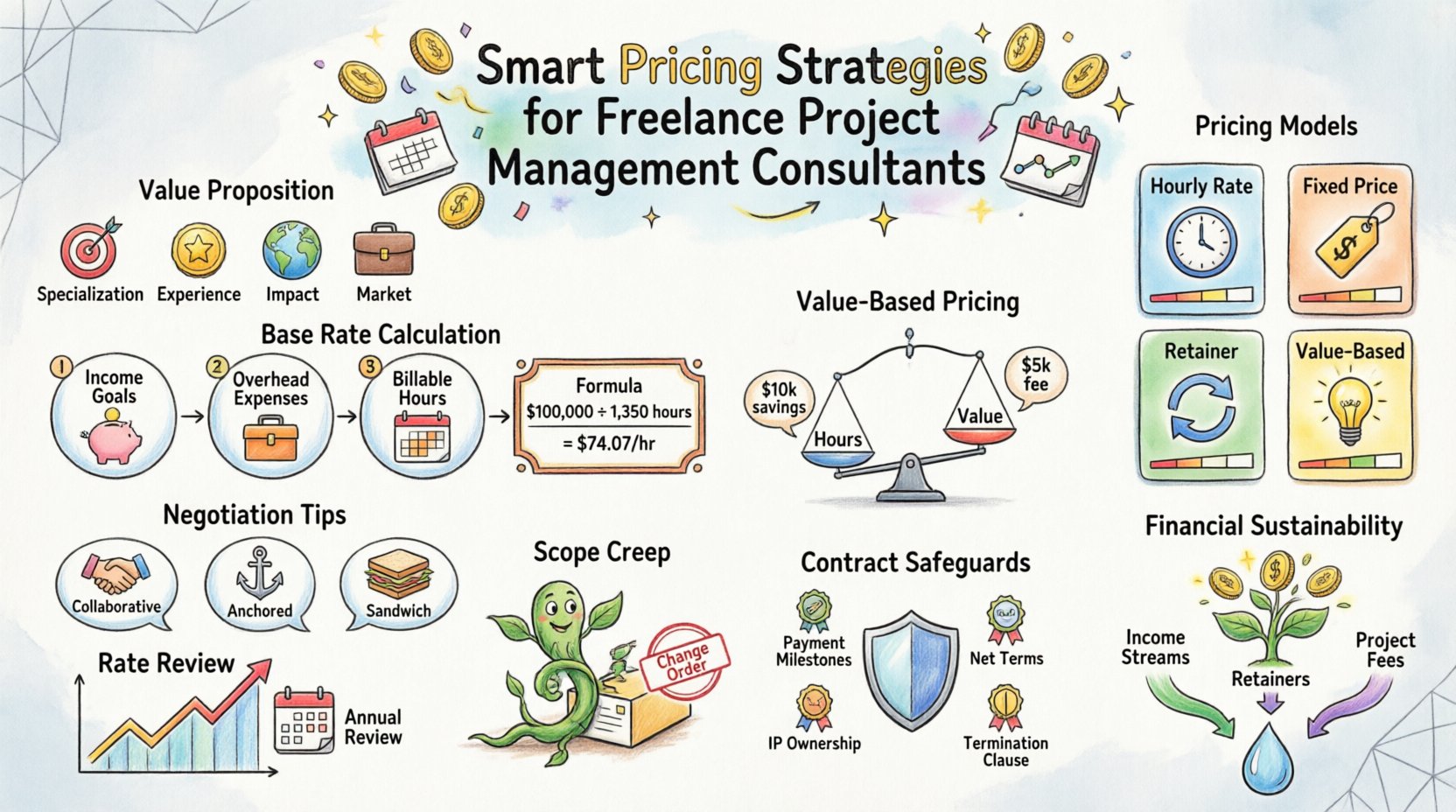
Understanding Your Value Proposition 🎯
Before discussing numbers, you must define what you offer. Clients do not pay for time; they pay for outcomes. As a project management consultant, your value lies in risk mitigation, efficiency improvements, and successful delivery. You are not just tracking tasks; you are ensuring that resources are optimized and goals are met.
When setting your rates, consider these factors:
- Specialization: Do you focus on Agile methodologies, construction management, or software development? Niche expertise often commands higher fees.
- Experience Level: Years in the field and a proven track record of delivering complex projects justify premium rates.
- Business Impact: Can you demonstrate how your work saves money or generates revenue? Quantifying this impact strengthens your pricing position.
- Geographic Market: Rates vary significantly by region. Remote work allows you to tap into global markets, but you should still align with local economic standards.
Common Pricing Models Compared 📊
Selecting the right billing model is essential for cash flow management and client alignment. Each model carries different risks and rewards. Below is a breakdown of the most common structures used by independent consultants.
| Model | Description | Best For | Risk Level |
|---|---|---|---|
| Hourly Rate | Charging for every hour worked on the project. | Unclear scope, ongoing support, exploratory phases. | Low (Client pays for time) |
| Fixed Price | A set fee for the entire project scope. | Well-defined requirements, short-term deliverables. | High (Consultant absorbs overrun risk) |
| Retainer | A recurring fee for a set block of time or availability. | Long-term partnerships, continuous advisory roles. | Medium (Stable income, but commitment required) |
| Value-Based | Fee tied to the financial value delivered to the client. | High-impact strategic initiatives, cost-saving projects. | Medium-High (Requires trust and clear metrics) |
While the table provides a quick overview, the decision often depends on the specific engagement. For example, if a client is unsure about the project duration, an hourly rate protects your time. Conversely, if the scope is rigid, a fixed price can be more attractive to the client.
Calculating Your Base Rate 🧮
Many consultants set rates based on what competitors charge rather than their own financial needs. This approach can lead to underpricing. To determine a sustainable rate, you must calculate your break-even point and desired income.
Step 1: Determine Annual Income Goals
Start with the net amount you need to take home. Include taxes, health insurance, retirement contributions, and personal savings. For instance, if you need $80,000 net annually, you must earn significantly more before taxes.
Step 2: Account for Overhead Expenses
Freelance work incurs business costs that employees do not face. These include software subscriptions, hardware, home office utilities, professional development, and marketing. Calculate these monthly and multiply by 12. Add this to your income goal.
Step 3: Calculate Billable Hours
You cannot bill for 40 hours every week. Time is lost to administration, marketing, invoicing, and unpaid gaps between projects. A realistic billable utilization rate is often between 60% and 70%.
- Total Hours: 2,080 hours in a year (40 hours x 52 weeks).
- Billable Hours: If you aim for 65% utilization, that is approximately 1,350 billable hours.
Step 4: The Formula
Combine your total annual cost (income + expenses) and divide by your billable hours.
Example:
Total Annual Need: $100,000
Billable Hours: 1,350
Hourly Rate: $74.07
This number is your floor. It is the minimum you should charge to sustain your business. From here, you can adjust upward based on market demand and specialization.
Shifting to Value-Based Pricing 💡
Hourly billing caps your earnings at the number of hours you work. Value-based pricing decouples time from money. Instead of charging for the hours spent managing a project, you charge based on the value the project brings to the organization.
This approach is powerful for consultants who can quantify their impact. Consider a scenario where a client is losing $10,000 per month due to supply chain delays. If you can reduce delays by half within three months, you save them $15,000. Charging $5,000 for this intervention is a no-brainer for the client, even if it took you only 20 hours.
To implement this model:
- Identify Key Metrics: Discuss with the client what success looks like. Is it speed to market? Cost reduction? Compliance adherence?
- Set Baselines: Establish the current state before you begin work.
- Define Outcomes: Clearly state the expected results in the contract.
- Align Fees: Propose a fee that represents a fraction of the expected value, typically 10% to 30% of the projected savings or revenue.
While this requires confidence and a strong understanding of the client’s business, it is often the most lucrative path for senior consultants.
Negotiating Rates with Clients 🤝
Negotiation is a standard part of the consulting lifecycle. It is not about winning an argument but finding a mutually beneficial agreement. Here are strategies to handle price discussions effectively.
Anchoring
Present your rate first. If you wait for the client to name a number, you are reacting rather than leading. By stating a confident, well-researched figure, you set the anchor point for the negotiation.
Justification
Never state a price without context. Always pair the number with the value proposition. “My rate is $150 per hour because this approach reduces your risk of project failure by 40%.” This shifts the conversation from cost to investment.
The Sandwich Method
If a client pushes back on price, acknowledge their concern, restate the value, and offer a compromise. “I understand the budget is tight. Given the critical nature of the deliverables, I can adjust the scope to fit the budget, but the core advisory services need to remain intact.”
Know Your Walk-Away Point
Be prepared to decline a project if the rate is below your floor. Accepting low-paying work often leads to resentment and burnout. It is better to turn down a client than to work at a loss.
Managing Scope Creep and Change Orders ⚠️
Scope creep is the silent killer of profitability. It happens when small, uncharged requests accumulate until the project becomes unprofitable. This is common in fixed-price engagements.
Define Scope Clearly
Start with a detailed Statement of Work (SOW). List exactly what is included and, just as importantly, what is excluded. Use bullet points for clarity.
- Inclusions: Weekly status meetings, risk register updates, stakeholder reporting.
- Exclusions: Marketing copywriting, software development, training sessions beyond the kickoff.
Implement Change Orders
If a client requests work outside the agreed scope, do not do it for free. Issue a change order. This document outlines the additional work, the cost, and the timeline impact. It must be signed before work begins.
This process protects you and sets professional boundaries. It also helps clients understand that every feature or task has a cost. Over time, they will become more precise about their requirements.
Contractual Safeguards and Payment Terms 📝
A verbal agreement is not enough. You need a contract that protects your financial interests and defines the relationship.
Payment Milestones
For larger projects, avoid waiting until the end for payment. Break the project into phases and tie payments to deliverables. For example:
- 30% upon contract signing.
- 40% upon completion of the planning phase.
- 30% upon final delivery and sign-off.
Net Terms
Specify when payment is due. Standard terms are Net 15 or Net 30. Avoid Net 60 unless necessary. Late payment clauses should be included to discourage delays. For example, “Invoices unpaid after 30 days will incur a 1.5% monthly interest fee.”
Intellectual Property
Clarify who owns the work product. Typically, the client owns the final deliverables upon full payment. However, you should retain the right to use your methodologies and templates for future work. This prevents clients from claiming ownership of your proprietary tools.
Termination Clauses
Life happens. Clients may cancel projects. Ensure your contract allows for termination with notice. Crucially, include a clause for compensation of work completed up to the termination date. “In the event of termination, the client agrees to pay for all hours worked and non-cancelable expenses incurred.”
Reviewing and Updating Rates 📈
Pricing is not static. Your rates should evolve as your skills grow and the market changes. Set a calendar reminder to review your pricing annually.
Factors for Adjustment
- Increased Demand: If you are fully booked, it is a signal to raise rates.
- Inflation: Costs for goods and services rise over time. Adjust your rates to maintain purchasing power.
- New Certifications: Gaining a new credential or mastering a new methodology adds value.
- Client Mix: If you are working with larger enterprises, their budgets may support higher rates than small businesses.
Communicating Increases
When raising rates, communicate the change clearly to existing clients. For new clients, simply state the new rate. For existing clients, provide advance notice. “Our rates will increase effective next quarter. We value our partnership and will ensure the transition is smooth.” Offer to lock in the current rate for a specific period if appropriate.
Financial Sustainability and Long-Term Growth 🌱
Pricing is only one part of financial health. You must also manage cash flow. Clients may pay late, so you need reserves to cover your own expenses during slow periods.
Emergency Fund
Aim to save three to six months of operating expenses. This fund allows you to weather economic downturns without panic-selling your services at a discount.
Diversify Income Streams
Don’t rely on a single client. Mix project work with retainer clients and occasional training sessions. This diversification stabilizes your income and gives you leverage in negotiations.
Track Your Metrics
Monitor your effective hourly rate. If you are working more hours but earning less per hour, something is wrong. It could be scope creep or an inefficient workflow. Regularly review your invoices to ensure you are billing for all time spent.
Final Thoughts on Pricing Confidence 🚀
Setting prices as a freelance project management consultant is a blend of art and science. It requires a deep understanding of your own value, the market conditions, and the needs of your clients. By avoiding underpricing and focusing on the outcomes you deliver, you build a sustainable business.
Remember that pricing is a conversation. It is an opportunity to demonstrate your professionalism and commitment to quality. When you charge what you are worth, you attract clients who respect your expertise. This alignment leads to better working relationships and more successful project outcomes.
Take the time to calculate your numbers, define your models, and draft clear contracts. With a solid foundation, you can focus on what you do best: managing projects and delivering results. Your financial stability is the bedrock of your consulting practice, so treat it with the same rigor as any other project you manage.