
Are you tired of chasing symptoms instead of solving the real problem? If your team is consistently missing project delivery deadlines, you’re not alone. The frustration of recurring delays can be a major productivity drain. But what if you could quickly and confidently identify the true root cause of this issue, rather than just applying temporary fixes? The AI-Powered 5 Whys Root Cause Analysis Tool from Visual Paradigm makes this possible. This powerful, step-by-step application guides you through a structured analysis, using the proven 5 Whys methodology to dig deep and find the fundamental reason behind the problem. The tool’s AI feature can even generate a complete analysis from a simple problem description, saving you hours of brainstorming. In this guide, we’ll walk through a real-world example of how the tool works, from the initial problem input to the final, professional report, showing you how to transform a chaotic problem into a clear, actionable plan.
Quick Summary: Key Takeaways
-
Problem-Solving Made Simple: The 5 Whys tool provides a structured, guided workflow to move from a vague problem to a clear root cause.
-
AI-Powered Efficiency: The AI generator can create a comprehensive analysis draft in seconds, saving significant time on the initial brainstorming phase.
-
Structured, Professional Output: The tool organizes your findings into a clean, professional report that is easy to share with your team and stakeholders.
-
Focus on Real Solutions: By identifying the root cause, you can develop solutions that prevent the problem from recurring, leading to long-term improvements.
-
Complete Data Control: Your analysis data is saved locally on your computer, ensuring your sensitive business information remains private and secure.
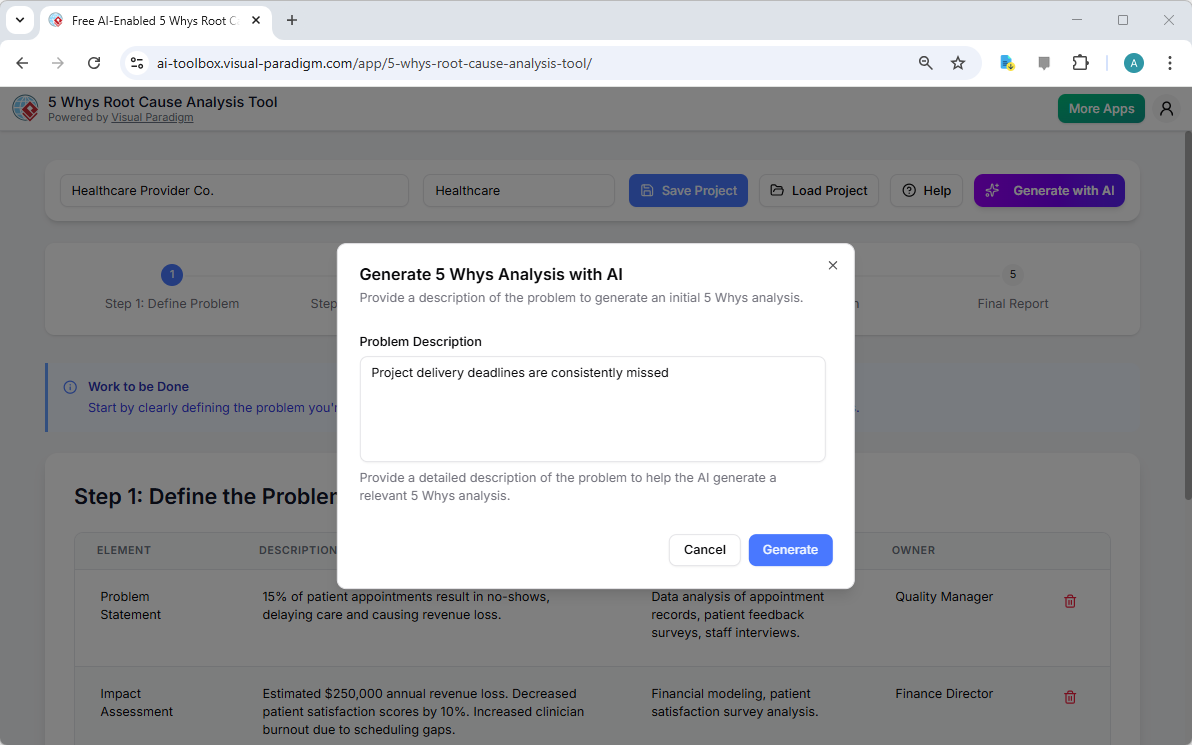
Let’s see how this process unfolds in practice. The journey begins with a simple, clear problem statement. Image 1 shows the initial screen of the AI-Powered 5 Whys Root Cause Analysis Tool. The user has entered a problem description: “Project delivery deadlines are consistently missed.” This is the crucial first step. The tool is designed to be intuitive, with a clear prompt to “Provide a description of the problem to generate an initial 5 Whys analysis.” The AI then takes this starting point and begins to build a structured analysis, which is a significant advantage over manual methods that often get stuck at the definition stage.
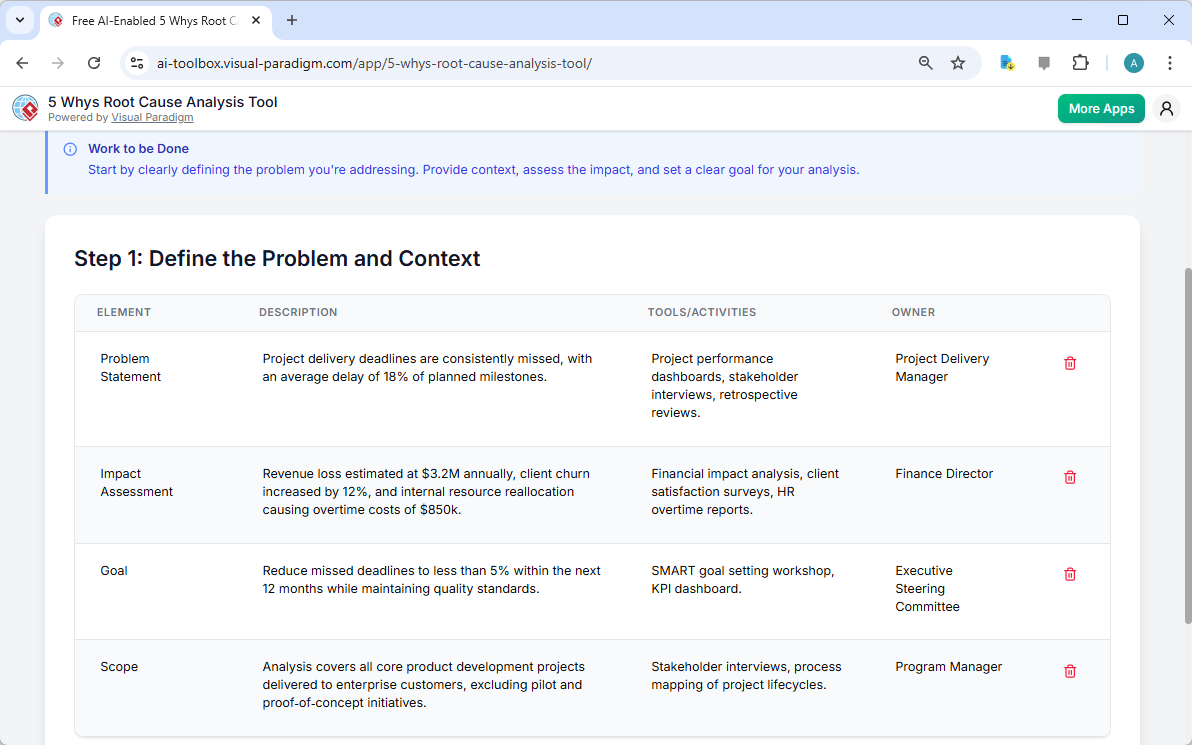
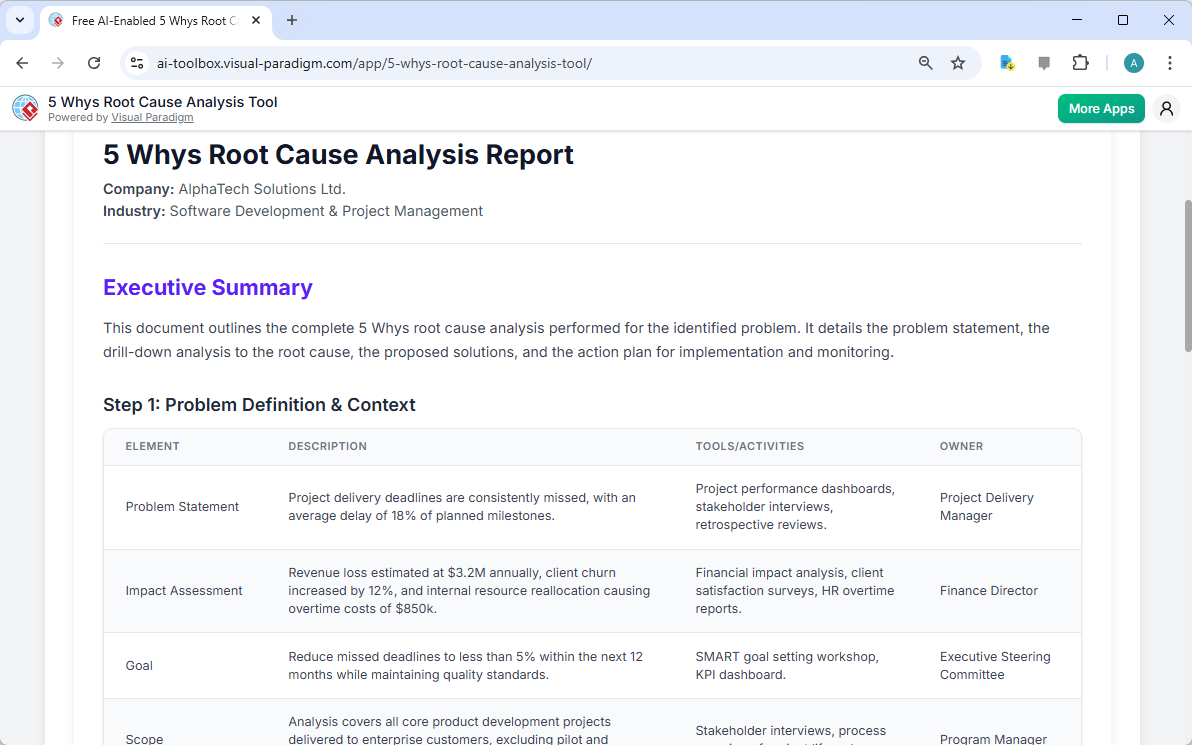
Once the AI has processed the initial input, it moves to Step 1: Define the Problem and Context, as shown in Image 2. This step is critical for setting the stage. The tool provides a dynamic table with predefined columns: “Element,” “Description,” “Tools/Activities,” and “Owner.” The AI has already populated this table with a detailed problem statement, an impact assessment that quantifies the financial loss, a clear goal for improvement, and a defined scope. This structured approach forces you to think about the problem’s full context, including its financial impact and the specific stakeholders involved. It’s a powerful way to ensure that the analysis is not just focused on the symptom, but on the entire business impact.
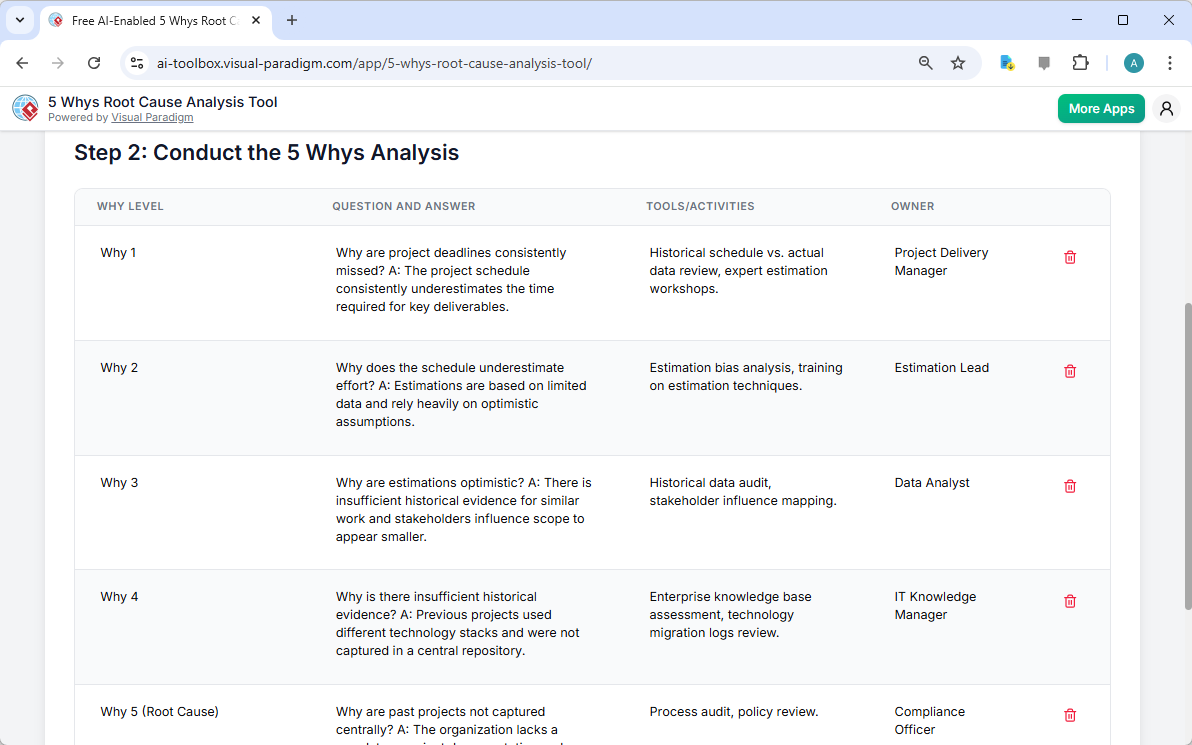
With the problem clearly defined, the analysis progresses to Step 2: Conduct the 5 Whys Analysis, as seen in Image 3. Here, the tool guides you through a series of “Why?” questions, each one drilling deeper into the cause-and-effect chain. The AI has generated a sequence of five questions, each with a corresponding answer, leading from the initial symptom (“Why are project deadlines consistently missed?”) to the root cause (“Why are past projects not captured centrally?”). The table is dynamic, allowing you to add or remove rows as needed, which is essential for complex problems that might require more than five iterations. This step is where the true power of the 5 Whys technique is realized, moving you beyond surface-level excuses to the fundamental systemic issues.
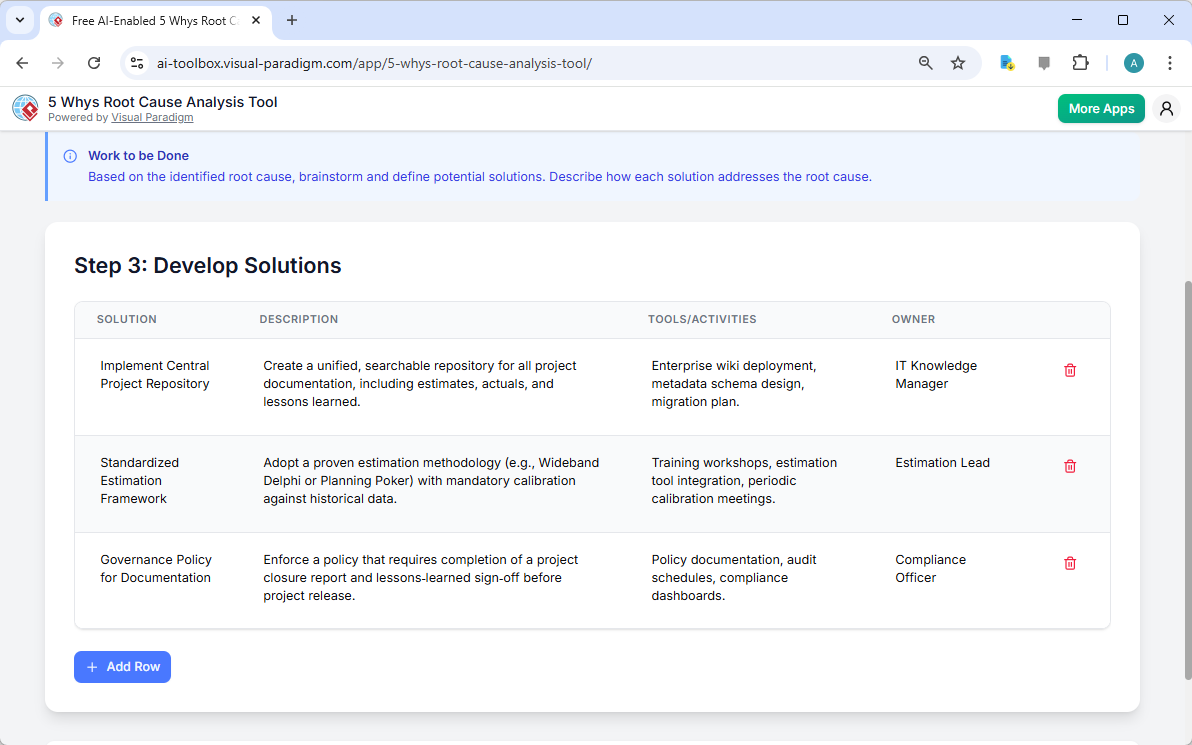
After identifying the root cause, the focus shifts to solutions. Step 3: Develop Solutions, shown in Image 4, is where you brainstorm and define potential fixes. The AI suggests solutions like “Implement Central Project Repository” and “Standardized Estimation Framework.” The table structure allows you to not only list the solution but also describe it, assign the necessary tools and activities, and designate an owner. This ensures that every proposed solution is actionable and has clear accountability, which is often missing in ad-hoc problem-solving sessions.
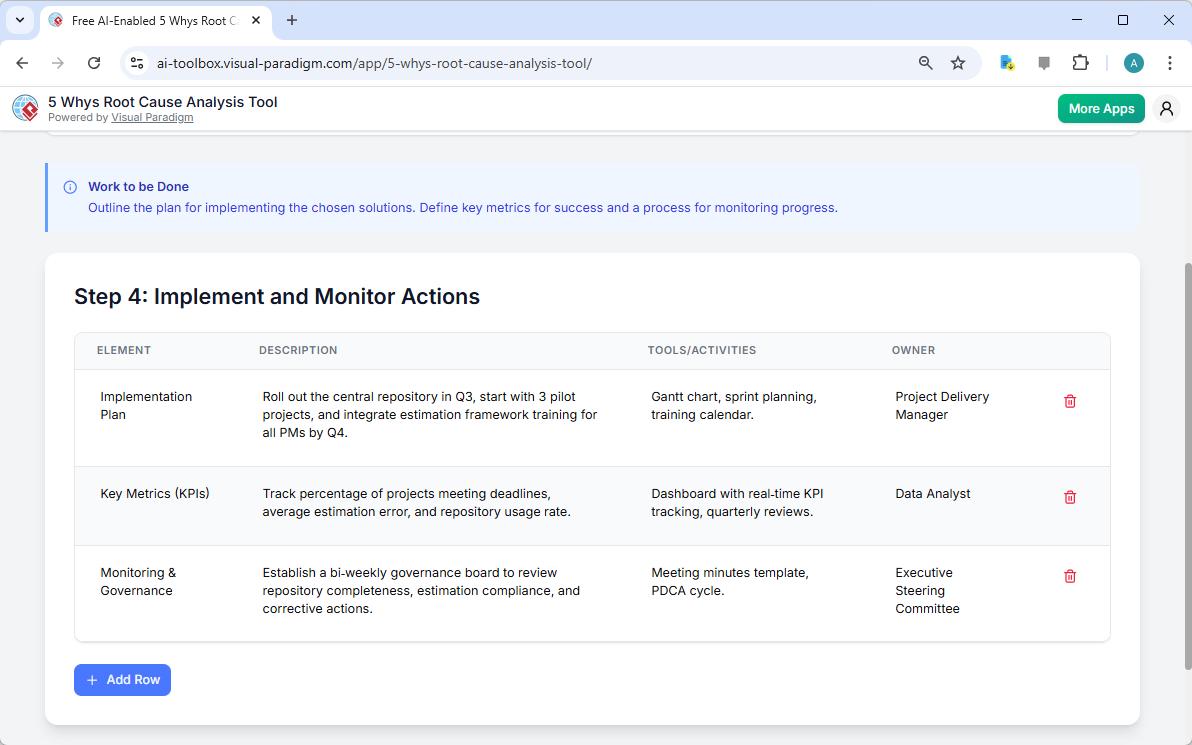
Finally, the analysis moves to implementation. Step 4: Implement and Monitor Actions, depicted in Image 5, is where the plan is solidified. The tool helps you create a detailed implementation plan, define key performance indicators (KPIs) to track success, and establish a monitoring process. For example, the plan might involve rolling out the central repository in the third quarter, with KPIs to track the percentage of projects meeting deadlines. This step ensures that the solutions are not just ideas but are embedded into the organization’s processes with clear metrics for success.
The journey culminates in a comprehensive, professional report. Image 6 shows the final output, a “5 Whys Root Cause Analysis Report.” This report is a polished, single document that consolidates all the information from the previous steps: the problem statement, the impact assessment, the detailed 5 Whys analysis, the proposed solutions, and the implementation plan. It’s a powerful tool for communication, providing a clear, shared understanding for your entire team and management. The report is ready to be printed or saved as a PDF, making it easy to share and archive.
By using the AI-Powered 5 Whys Root Cause Analysis Tool, you can transform a frustrating, recurring problem into a structured, solvable challenge. The tool’s guided workflow, combined with AI assistance, makes the process faster, more thorough, and more effective. It helps you move from reactive firefighting to proactive problem-solving, ensuring that your team can deliver on time and improve overall performance. Ready to find the true root cause of your problems? Try the 5 Whys Root Cause Analysis Tool now and start building a more resilient and efficient organization.
Related Links
The 5 Whys technique is an iterative interrogative method used to explore the cause-and-effect relationships underlying a particular problem. In project management and quality control, it is frequently combined with fishbone (Ishikawa) diagrams to perform comprehensive root cause analysis, allowing teams to move beyond surface-level symptoms to identify the actual source of an issue,. Modern platforms now offer AI-powered generators that can automate the creation of these diagrams from text descriptions, instantly uncovering root causes and organizing them into structured visual models,.
-
Fishbone Diagram and 5 Whys – Enhancing Root Cause Analysis: A specialized guide on integrating the 5 Whys technique with fishbone diagrams to improve problem-solving accuracy.
-
AI-Powered Fishbone Diagram Generator – Uncover Root Causes in Seconds: This tool leverages artificial intelligence to automate the identification of root causes and build structured diagrams instantly.
-
Unraveling Complex Issues: The Power of Cause and Effect Analysis: An article explaining how structured analysis enables teams to solve difficult business and operational problems.
-
Fishbone Analysis: Ishikawa Diagram Concepts and AI-Powered Tools: A detailed exploration of key analysis concepts and how generative AI enhances traditional root cause methodologies.
-
Free Online Fishbone Diagram Tool – Collaborative Problem Solving: A browser-based platform for creating professional diagrams to visually map cause-and-effect without software installation.
-
Practical Guide to Creating Cause and Effect Diagrams: A step-by-step tutorial for building effective diagrams to support systematic root cause analysis.
-
Cause and Effect Analysis Toolkit – Best Practices and Templates: A comprehensive resource providing templates and best practices for conducting in-depth problem analysis.
-
Step-by-Step Guide to Creating a Fishbone Diagram: A hands-on guide for identifying root causes within processes, projects, or complex systems.
-
Cause and Effect Diagram Gallery – Real-World Examples: A curated collection of diagrams showing how root causes are identified across engineering and quality management.
-
Fishbone (Ishikawa) Diagram Template – Ready-to-Use Resources: Access customizable templates to quickly visualize causal relationships and streamline the analysis process.