
One of the most common reasons tech startups fail is not a lack of innovation, but a lack of clarity regarding how money flows through the organization. Founders often build products based on assumptions rather than validated data. This leads to a situation where development continues, but revenue remains elusive. The Business Model Canvas (BMC) offers a structured framework to visualize, design, and pivot your venture without relying on guesswork. This guide walks through every component of the canvas, with a specific focus on validating revenue streams for technology companies.
Understanding the Business Model Canvas 🧩
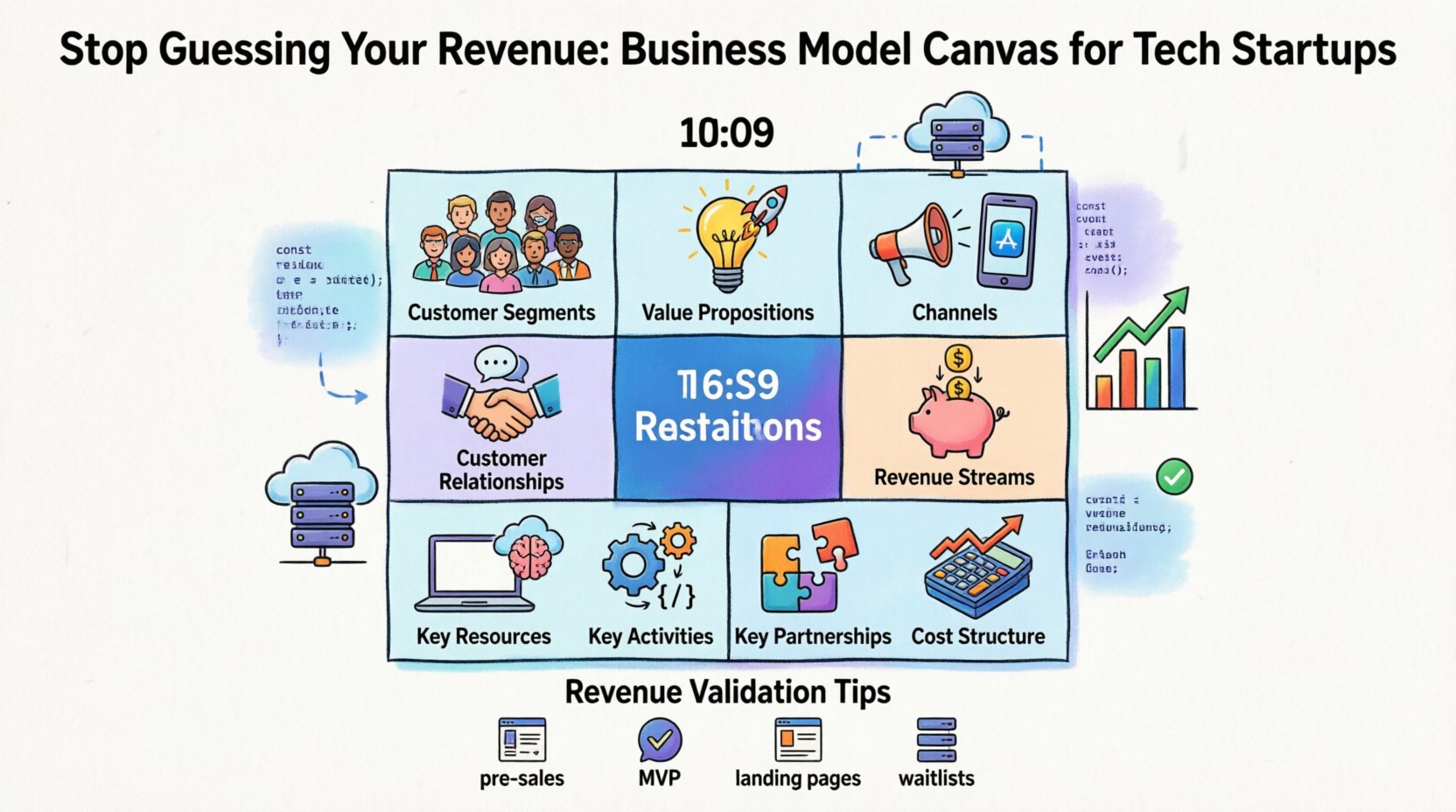
The Business Model Canvas is a strategic management template used for developing new or documenting existing business models. It is a visual chart with elements describing a firm’s or product’s value proposition, infrastructure, customers, and finances. Unlike traditional business plans, which can be dozens of pages long, the BMC condenses the essence of the business into nine building blocks.
- Visual Clarity: It allows teams to see the big picture at a glance.
- Flexibility: It is designed to be updated as hypotheses are tested and proven.
- Focus: It forces you to prioritize the most critical aspects of the operation.
For tech startups, where agility is paramount, this tool is essential. It shifts the conversation from “What are we building?” to “How does this create value and capture it?”.
The 9 Building Blocks Explained 🔍
To stop guessing, you must understand the interplay between the nine components. Each block influences the others. Changing one often requires adjusting the rest. Here is a detailed breakdown tailored for technology ventures.
1. Customer Segments 👥
Who are you creating value for? Every business exists to serve a specific group of people or organizations. In the tech sector, this is often segmented by behavior, demographics, or technical needs.
- Mass Market: No segmentation, serving everyone (e.g., social media apps).
- Niche Market: Serving a specific group with specialized needs (e.g., dental practice management software).
- Segmented: Distinct groups with different requirements (e.g., free users vs. enterprise users).
- Multi-sided Platforms: Serving two or more interdependent groups (e.g., drivers and riders).
Key Question: Who is willing to pay for the solution you are building?
2. Value Propositions 🎯
This block describes the bundle of products and services that create value for a specific customer segment. It solves a customer problem or satisfies a need.
- Newness: Offering something that didn’t exist before.
- Performance: Better speed, accuracy, or efficiency.
- Customization: Tailoring the product to individual needs.
- Design: Aesthetics and user experience that stand out.
- Price: Making the solution more affordable than alternatives.
- Cost Reduction: Helping the customer save money.
- Risk Reduction: Lowering the risk for the customer.
- Convenience/Usability: Making the product easier to use.
For tech startups, the value proposition is often tied to automation, data insights, or connectivity. Be specific. “Better software” is not a value proposition. “Reduce data entry time by 80%” is.
3. Channels 📢
How does a startup reach its customer segments? Channels are the touchpoints where customers interact with the company. They are critical for awareness, evaluation, purchase, delivery, and after-sales support.
- Owned Channels: Your website, mobile app, or direct sales team.
- Partner Channels: App stores, marketplaces, or third-party integrators.
- Physical Stores: If applicable for hardware startups.
- Online Search: SEO and paid advertising.
In the digital space, the channel is often the product itself (the app), but the marketing channel (ads, content) is where the acquisition happens.
4. Customer Relationships 🤝
What type of relationship does each customer segment expect? This defines how you interact with customers throughout their journey.
- Personal Assistance: Human support via chat or phone.
- Automated Services: Self-service interfaces and AI bots.
- Self-Service: Customers navigate the product without help.
- Communities: Building user forums or groups.
- Co-creation: Involving users in the development process.
Tech startups often struggle here. Is the product simple enough for self-service, or does it require onboarding calls? This decision impacts your Cost Structure significantly.
5. Revenue Streams 💸
This is the core of the prompt: how do you make money? Revenue streams represent the cash a company generates from each customer segment. It is where you validate your assumptions.
- Asset Sale: Selling the right of ownership of a physical or digital good.
- Usage Fee: Charging for every time the product is used.
- Subscription Fees: Recurring revenue for continued access.
- Lending/Renting/Leasing: Giving temporary right to use an asset.
- Licensing: Charging for the right to use intellectual property.
- Brokerage Fees: Facilitating a transaction between two parties.
- Advertising: Charging for space to display ads.
Validation Tip: Don’t just pick a model. Test price elasticity. If you charge too little, you leave money on the table. If too much, you lose volume. The goal is to find the sweet spot where the perceived value matches the cost.
6. Key Resources 🛠️
What assets do you need to make your business model work? These are the physical, intellectual, human, or financial resources required.
- Physical: Buildings, machines, vehicles.
- Intellectual: Brands, patents, copyrights, databases.
- Human: The team members, engineers, sales staff.
- Financial: Cash, lines of credit, equity.
For software startups, intellectual property and human talent are usually the most critical resources.
7. Key Activities 🏃
What strategic things must the company do to operate successfully? These are the most important actions a company must take to make its business model work.
- Production: Designing, making, and delivering a product in large quantities or of high quality.
- Problem Solving: Creating new solutions to individual customer problems.
- Platform/Network: Maintaining the platform and ensuring the network functions.
In a tech context, development, maintenance, and sales are typically the primary activities.
8. Key Partnerships 🤝
The network of suppliers and partners that make the business model work. Companies form partnerships to optimize efficiency, reduce risk, or acquire resources.
- Strategic Alliances: Non-competitors partnering.
- Coopetition: Strategic partnerships between competitors.
- JVs: Joint ventures to develop new businesses.
- Buyer-Supplier Relationships: Ensuring reliable supply.
Tech startups often rely on infrastructure partners (cloud providers) and integration partners (APIs) to deliver value without building everything from scratch.
9. Cost Structure 💳
What are the most important costs inherent in the business model? Every business model has costs.
- Fixed Costs: Salaries, rent, infrastructure (stable regardless of output).
- Variable Costs: Costs that vary with production volume (e.g., server costs per user).
- Economies of Scale: Costs decrease as volume increases.
- Economies of Scope: Costs decrease as the range of products increases.
Understanding the balance between fixed and variable costs is vital for cash flow management.
Focusing on Revenue Validation for Tech 🧪
Once the canvas is filled, the next step is validation. This is where you stop guessing. You must test the assumptions behind your Revenue Streams block.
- Pre-Sales: Can you get a commitment before the code is written?
- Concierge MVP: Manually deliver the service to test willingness to pay.
- Landing Pages: Test different pricing tiers on a landing page to measure click-through rates.
- Waitlists: Gauge interest levels before launch.
Many founders avoid talking about money too early. This is a mistake. If customers are not willing to pay, the value proposition is likely flawed. Revenue validation is not just about setting a price; it is about confirming that the problem you solve is painful enough for them to open their wallets.
Tech Startup Specifics ⚙️
Technology startups have unique characteristics that influence the canvas. Unlike traditional businesses, tech ventures often have high initial development costs and low marginal costs of replication.
SaaS Dynamics
- Recurring Revenue: Subscription models provide predictability.
- Churn: The rate at which customers stop subscribing is a critical metric.
- LTV: Lifetime Value of a customer must exceed Customer Acquisition Cost (CAC).
Marketplace Dynamics
- Network Effects: The product becomes more valuable as more people use it.
- Two-Sided Revenue: You might charge the buyer, the seller, or both.
- Liquidity: Ensuring there are enough buyers and sellers to match.
API & Infrastructure
- Usage-Based Pricing: Charge per API call or data processed.
- Developer Experience: Documentation and support are key value props.
Common Pitfalls to Avoid ⚠️
Even with the canvas, founders can go astray. Here are common errors observed in the tech sector.
- Ignoring Cost Structure: Focusing only on revenue while ignoring the burn rate.
- Too Many Segments: Trying to serve everyone dilutes the value proposition.
- Assuming Channels are Free: Organic growth is not guaranteed; paid channels cost money.
- Neglecting Customer Relationships: High churn destroys recurring revenue models.
- Confusing Activity with Value: Writing code is an activity; solving the problem is the value.
Practical Checklist ✅
Use this table to audit your current Business Model Canvas before seeking funding or scaling.
| Block | Key Question | Validation Method |
|---|---|---|
| Customer Segments | Who actually has the problem? | Customer Interviews |
| Value Propositions | Why choose us over alternatives? | Competitor Analysis |
| Revenue Streams | Are they willing to pay? | Pricing Tests / Pre-orders |
| Channels | Where do they look for solutions? | Channel Traffic Analysis |
| Cost Structure | Can we sustain operations? | Financial Projections |
This checklist ensures that every assumption is backed by evidence. It moves the startup from intuition to data-driven decision-making.
Iterating the Model 🔄
The Business Model Canvas is not a static document. It is a living artifact. As you gather data, you will find that your initial assumptions were incorrect. This is not failure; it is learning.
- Pivot: Change the value proposition or the customer segment based on feedback.
- Persevere: Double down on the elements that are working.
- Refine: Adjust pricing or channels based on conversion metrics.
Regularly revisit the canvas. A quarterly review helps keep the team aligned on the current strategy. It prevents “feature creep” and keeps the focus on the core business model.
Final Thoughts on Financial Clarity 📉
Clarity regarding revenue is the foundation of sustainability. By using the Business Model Canvas, founders can map out the entire ecosystem of their startup. It highlights dependencies, reveals hidden costs, and clarifies how value is captured. When you stop guessing and start validating, you increase the probability of long-term success.
Remember that the canvas is a tool for communication as much as strategy. Use it to align your team, investors, and partners. When everyone understands how the machine works, execution becomes smoother. Focus on the connections between the blocks. For instance, if you choose a high-touch customer relationship, your Key Activities and Cost Structure must support that. If you choose a low-cost model, your Value Proposition must reflect efficiency.
Start filling out the canvas today. Do not wait for the perfect product. Start with the hypothesis, test it, and refine it. The market will tell you the truth if you ask the right questions.