
In the digital landscape, the difference between a visitor and a customer often lies in the quality of interaction at specific moments. These moments are known as strategic touchpoints. They are the critical intersections where your brand meets customer expectations. When mapped correctly within a customer journey, these interactions drive measurable results.
Many organizations focus solely on the end transaction. However, sustainable growth requires attention to the entire ecosystem of engagement. By analyzing and optimizing these strategic touchpoints, businesses can reduce friction and increase the likelihood of conversion. This guide explores how to identify, optimize, and measure these interactions effectively.
🔍 What Are Strategic Touchpoints?
A touchpoint is any interaction a potential client has with your brand. It is not just the website or the app. It encompasses email communications, social media posts, customer support calls, and even physical packaging. A strategic touchpoint is one that has been deliberately designed to move the user closer to a specific goal.
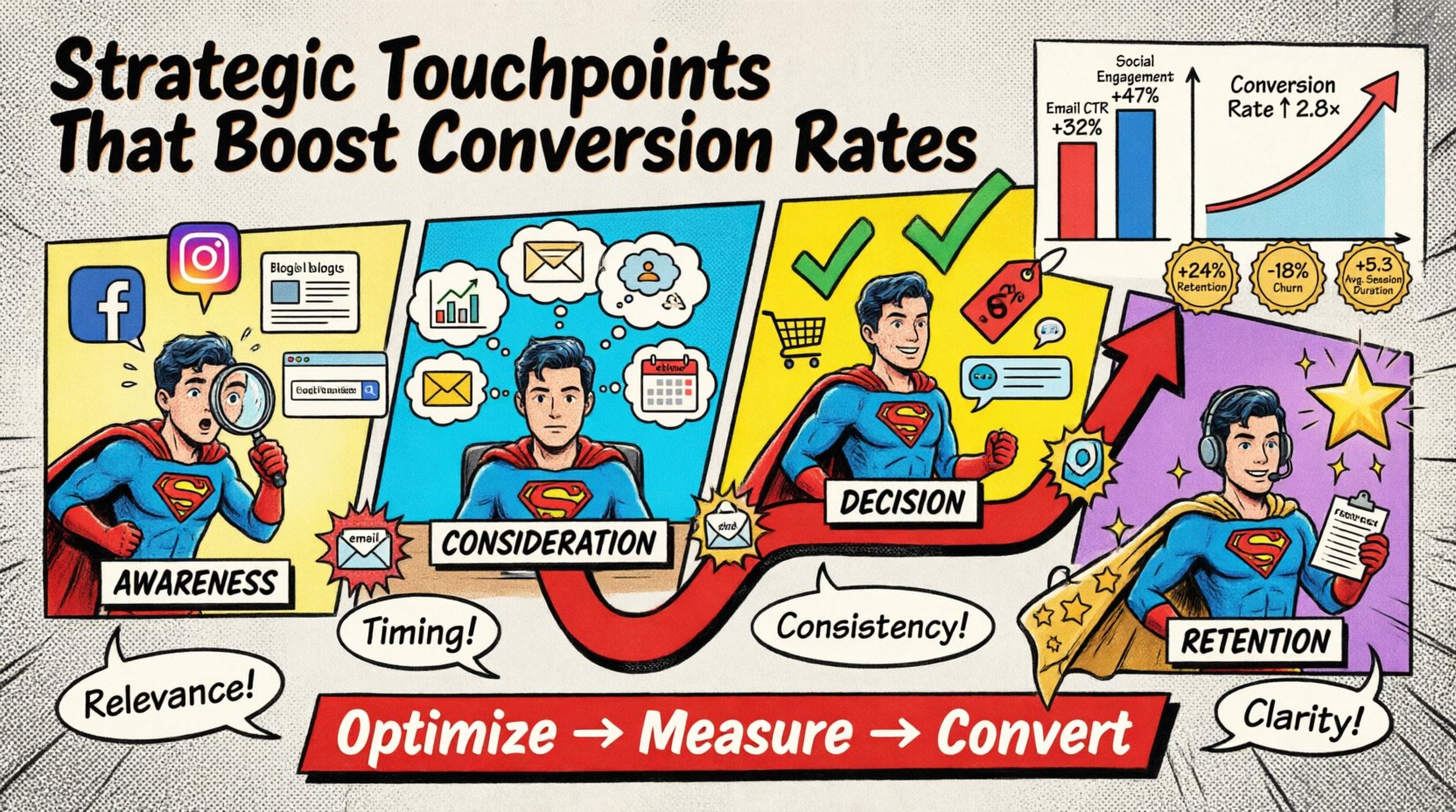
Not all touchpoints carry the same weight. Some are passive, while others are active. The goal is to identify which interactions influence decision-making the most. Here are the core characteristics of high-impact touchpoints:
Relevance: The content must match the user’s current intent.
Timing: The message must arrive when the need is highest.
Consistency: The tone and message should remain uniform across channels.
Clarity: The call to action must be unambiguous.
🗺️ Mapping the Customer Journey Stages
To optimize conversion, you must understand where the user stands in their lifecycle. The journey is typically divided into distinct phases. Each phase requires a different approach to engagement.
Below is a breakdown of the standard stages and the associated touchpoints that drive movement between them.
Stage | User Mindset | Key Touchpoints | Primary Goal |
|---|---|---|---|
Awareness | Identifying a problem or need | Social Media, Blog Posts, Search Ads | Attract Attention |
Consideration | Evaluating solutions | Comparison Guides, Webinars, Email Drip | Educate & Build Trust |
Decision | Ready to purchase | Pricing Pages, Free Trials, Live Chat | Reduce Friction |
Retention | Post-purchase experience | Onboarding, Support Tickets, Loyalty Programs | Ensure Success |
📈 Awareness Stage Optimization
The journey begins before a user visits your site. Awareness is about visibility. If your potential customers cannot find you, conversion is impossible. However, simply being visible is not enough. The message must resonate.
Here are strategies to optimize the top of the funnel:
Search Engine Visibility: Ensure your content answers the questions users are asking. Focus on intent rather than just keywords.
Social Engagement: Use platforms where your audience spends time. Do not force a presence where it does not fit naturally.
Content Marketing: Publish educational material that solves problems without asking for a sale immediately. This builds authority.
When optimizing for awareness, avoid aggressive sales language. The objective is to establish credibility. A user who trusts you is more likely to convert later. Measure success through traffic volume, time on page, and social shares.
🤔 Consideration Stage Optimization
Once a user is aware of your brand, they enter the consideration phase. They are comparing you against competitors. This is the most critical period for nurturing. You must provide evidence that you are the better choice.
Key actions during this phase include:
Detailed Landing Pages: Create pages dedicated to specific solutions. Avoid generic home pages for paid traffic.
Case Studies: Show real-world examples of success. Social proof is a powerful driver of confidence.
Email Nurturing: Send a sequence of messages that provide value over time. Do not ask for a commitment until the user is ready.
Interactive Tools: Use calculators or assessments that help the user understand their specific situation.
Friction in this stage often comes from information overload. Keep your messaging clear. Use bullet points and short paragraphs to make scanning easy. If a user cannot find the information they need quickly, they will leave.
🛒 Decision Stage Optimization
This is where the transaction happens. The user has decided they want your solution, but they may hesitate due to cost, risk, or confusion. The goal here is to remove barriers to entry.
Optimization tactics include:
Transparent Pricing: Hide costs and create suspicion. Be clear about what is included in the price.
Guarantees: Offer risk-reversal mechanisms such as money-back guarantees or free trials.
Live Support: Have human assistance available for final questions. A chat window can resolve doubts instantly.
Checkout Flow: Minimize the number of steps required to complete a purchase. Auto-fill fields where possible.
Analyze your drop-off rates at this stage. If many users abandon their carts, investigate the cause. Is the shipping cost too high? Is the form too long? Is there a lack of payment options? Each data point offers a clue for improvement.
🔄 Retention & Advocacy
Conversion does not end with the first sale. A retained customer is often more valuable than a new one. Post-purchase touchpoints are essential for turning a buyer into an advocate.
Focus on these areas:
Onboarding: Guide the user on how to get the most value from your product immediately.
Feedback Loops: Ask for reviews and testimonials. This provides data for your marketing and validates the purchase for others.
Re-engagement: Reach out with updates or new features that solve existing problems.
Loyalty Incentives: Reward repeat business with exclusive access or discounts.
Retention strategies rely on consistency. If the experience degrades after the sale, trust erodes. Maintain the same level of quality and support that was promised during the decision phase.
📊 Data-Driven Analysis Methods
You cannot optimize what you do not measure. Relying on intuition leads to guesswork. Use data to inform your decisions regarding touchpoints.
1. Qualitative Research
Understand the why behind the behavior. Methods include:
Customer interviews
Usability testing sessions
Feedback forms placed on key pages
Heatmaps showing where users click and scroll
2. Quantitative Analysis
Understand the what and how much. Metrics to track include:
Conversion rates per touchpoint
Exit rates on specific pages
Average session duration
Customer Lifetime Value (CLV)
Return on Ad Spend (ROAS)
Combine these data sources to form a complete picture. High traffic with low conversion indicates a messaging issue. Low traffic with high conversion indicates a visibility issue.
⚠️ Common Friction Points
Even with a solid strategy, issues can arise. Identifying common friction points helps you avoid pitfalls.
Slow Load Times: Users expect instant access. Delays lead to abandonment.
Complex Navigation: If users cannot find the path to conversion, they will leave.
Inconsistent Messaging: If the ad says one thing and the landing page says another, trust is broken.
Mobile Unfriendliness: A significant portion of traffic comes from mobile devices. The experience must work on small screens.
Hidden Fees: Unexpected costs at checkout are a leading cause of cart abandonment.
📏 Measuring Impact
How do you know your optimizations are working? You need to define clear Key Performance Indicators (KPIs) for each stage.
For the Awareness stage, track impressions and click-through rates. For Consideration, track time on page and content downloads. For Decision, track conversion rate and average order value. For Retention, track churn rate and repeat purchase rate.
Regular reporting allows you to spot trends. If a specific email subject line drives more opens, replicate that style. If a specific landing page underperforms, test a new layout. Continuous iteration is key to long-term success.
🎯 Conclusion
Boosting conversion rates is not about a single magic button. It is about the cumulative effect of well-crafted interactions. By mapping your customer journey and optimizing strategic touchpoints, you create a seamless path to purchase.
Focus on relevance, timing, and consistency. Use data to guide your changes. Remove friction wherever it appears. When you treat every interaction as an opportunity to build trust, conversion rates naturally improve over time.
Start by auditing your current touchpoints. Identify the gaps. Implement changes incrementally. Monitor the results. With patience and precision, you can build a system that consistently converts visitors into loyal customers.