
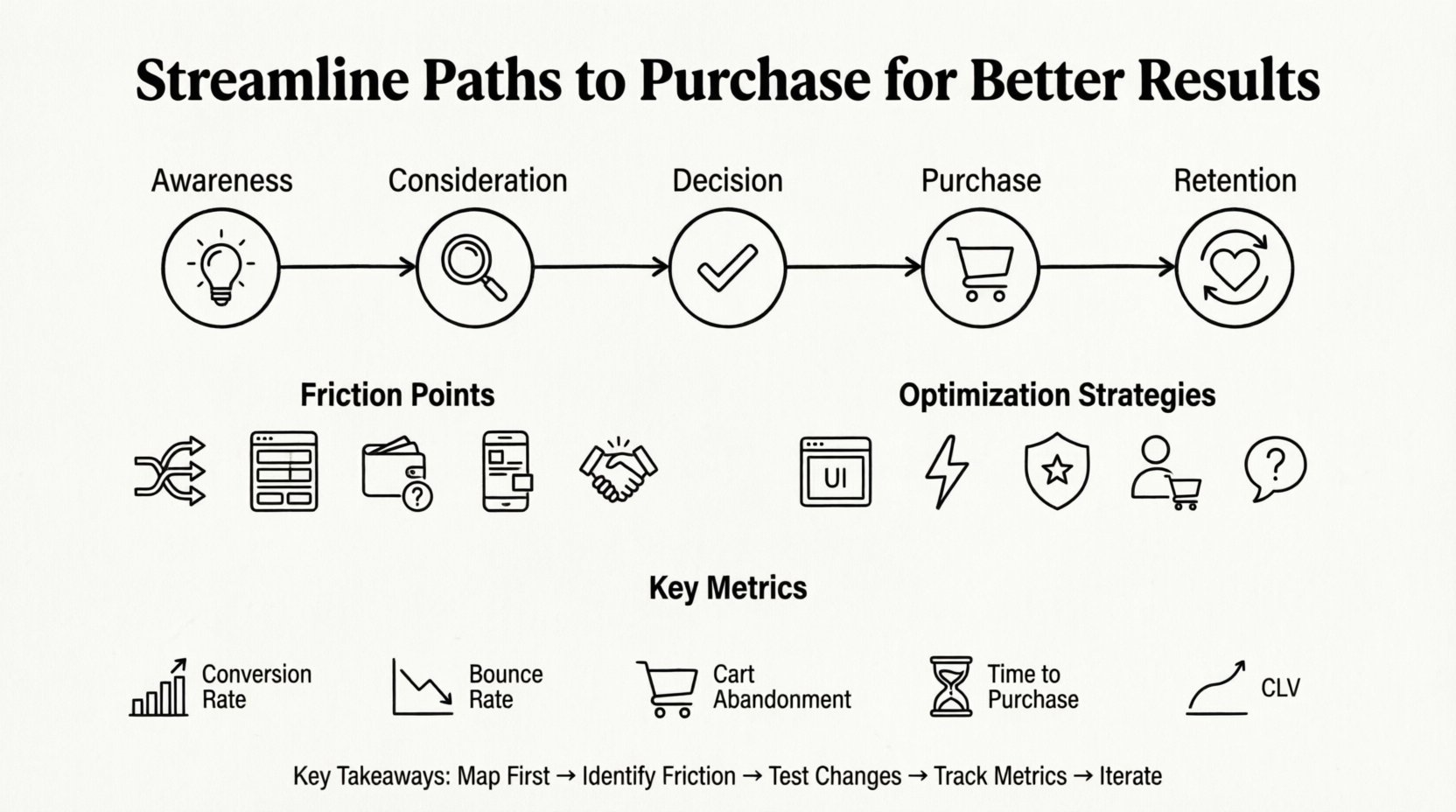
The journey a customer takes before completing a transaction is rarely a straight line. It is a complex sequence of interactions, decisions, and emotional responses. When businesses fail to map these interactions clearly, they risk introducing friction that halts progress. Streamlining the path to purchase is not merely about design aesthetics; it is about aligning operational efficiency with customer psychology. This guide explores how to optimize these pathways to achieve tangible improvements in conversion and retention without relying on external hype.
Understanding the Customer Purchase Path 🧭
A purchase path encompasses every touchpoint a potential buyer encounters from initial awareness to final payment and beyond. It includes digital interactions, physical experiences, and interpersonal communications. Mapping this path requires a deep understanding of how information flows and where decision-making occurs. The goal is to ensure that the customer moves smoothly from interest to action.
- Awareness: The customer identifies a need or problem.
- Consideration: The customer evaluates options and solutions.
- Decision: The customer selects a specific product or service.
- Purchase: The transaction is completed.
- Retention: The customer uses the product and considers future engagement.
Each stage presents unique opportunities and challenges. A delay in the consideration phase often stems from a lack of trust or insufficient information. A drop-off in the decision phase usually indicates technical barriers or pricing confusion. Recognizing these patterns allows for targeted improvements.
Identifying Friction Points 🛑
Friction is the primary obstacle to a streamlined purchase path. It manifests as anything that slows down the user or causes hesitation. Friction can be technical, such as slow loading times, or psychological, such as uncertainty about security. Identifying these points requires data analysis and direct feedback.
Common friction points include:
- Complex Navigation: If a user cannot find the checkout button within seconds, they may leave.
- Excessive Form Fields: Every additional input increases cognitive load.
- Hidden Costs: Unexpected fees at the final step are a major cause of cart abandonment.
- Mobile Incompatibility: A site that functions poorly on smartphones alienates a significant portion of the audience.
- Lack of Trust Signals: Absence of reviews, secure payment icons, or clear contact information reduces confidence.
Understanding the nature of the friction is crucial. A technical issue can be fixed with code, but a psychological barrier requires content strategy and design adjustments. The following table outlines specific friction types and their typical impacts.
| Friction Type | Typical Symptom | Impact on Path |
|---|---|---|
| Technical | Page load time > 3 seconds | Immediate bounce or high exit rate |
| Informational | Missing product specifications | Increased support inquiries, lower conversion |
| Psychological | Unclear return policy | Cart abandonment at checkout |
| Process | Forced account creation | High drop-off before payment |
Mapping the Journey Effectively 📝
Accurate mapping is the foundation of any optimization strategy. It requires aggregating data from multiple sources to create a holistic view of the user experience. Relying on assumptions leads to incorrect conclusions. Instead, use quantitative data to validate hypotheses.
The mapping process involves several critical steps:
- Data Collection: Gather analytics on traffic sources, page views, and time spent on site.
- Persona Alignment: Ensure the mapped journey matches the specific needs and behaviors of your target audience segments.
- Touchpoint Analysis: Identify every channel the customer uses, including social media, email, direct visits, and physical stores.
- Emotional State Tracking: Note where frustration or satisfaction peaks during the interaction.
- Gap Identification: Find discrepancies between the intended path and the actual behavior.
When creating the map, visualize the flow as a linear process but acknowledge the reality of non-linear behavior. Customers may jump from consideration to purchase without reading a blog post. They may return to the consideration stage after adding an item to the cart. The map must accommodate these loops.
Strategies for Optimization 🚀
Once the map is complete and friction points are identified, the focus shifts to optimization. This involves making specific changes to reduce barriers and guide the user toward completion. Optimization is an iterative process, not a one-time fix.
Reducing Cognitive Load
Users make decisions based on mental energy. If the path requires too much thinking, they will stop. Simplify the interface. Use clear headings and concise text. Avoid jargon. When presenting options, limit the choices to prevent analysis paralysis. A clear hierarchy helps users understand the next step without confusion.
Improving Speed and Performance
Speed is a conversion factor. Slow pages lead to frustration. Optimize images, minimize code, and use efficient hosting. Ensure that the site responds instantly to user input. Every second of delay can result in a significant percentage of lost conversions. Mobile users are particularly sensitive to latency.
Enhancing Trust and Credibility
Trust is the currency of online transactions. Display security badges prominently near payment fields. Show customer testimonials and case studies. Provide transparent contact information. If a user doubts the legitimacy of the business, they will not proceed. Social proof acts as a signal of safety.
Streamlining the Checkout Process
The checkout is the most critical moment. It should be as short as possible. Offer guest checkout options to avoid forced registration. Auto-fill information where possible. Allow multiple payment methods to accommodate user preference. Show progress indicators so users know how many steps remain.
Providing Contextual Support
Users often have questions at specific points in the journey. Live chat or contextual help text can resolve these questions instantly. If a user hesitates on a pricing page, a tooltip explaining the value proposition can clarify the cost. Support should be available exactly when the user needs it.
Measuring Performance and Success 📊
Optimization efforts must be measured to determine their effectiveness. Relying on vanity metrics like page views is insufficient. Focus on metrics that directly correlate with the purchase path.
- Conversion Rate: The percentage of visitors who complete the desired action.
- Bounce Rate: The percentage of visitors who leave after viewing only one page.
- Cart Abandonment Rate: The percentage of users who add items to the cart but do not complete the purchase.
- Time to Purchase: The average duration from first visit to completed transaction.
- Customer Lifetime Value (CLV): The total revenue expected from a single customer account.
Tracking these metrics over time reveals trends. A sudden drop in conversion rate may indicate a broken link or a pricing error. A gradual improvement suggests that recent changes are effective. Regular reporting ensures that the path remains optimized as the business evolves.
Common Pitfalls to Avoid ⚠️
Even with a solid strategy, mistakes can occur. Awareness of common pitfalls helps in avoiding them.
- Assuming One Size Fits All: Different customer segments may have different needs. A path optimized for a novice buyer may confuse an expert.
- Ignoring Mobile Users: A significant portion of traffic comes from mobile devices. If the experience is poor on smartphones, revenue is lost.
- Neglecting Post-Purchase: The path does not end at payment. Onboarding and support are part of the journey and influence future purchases.
- Focusing on Tactics Over Strategy: Tweaking buttons is less effective than redesigning the overall flow. Understand the “why” behind the behavior.
- Over-Reliance on Automation: While automation helps, personal touchpoints often build stronger relationships.
Long-Term Maintenance and Iteration 🔁
A purchase path is not static. Market conditions change, competitor offerings evolve, and customer expectations shift. What works today may not work tomorrow. Continuous improvement is necessary to maintain results.
Implement a feedback loop. Collect data regularly. Conduct A/B testing to validate changes. Engage with customer support teams to hear direct complaints. Update the journey map at least quarterly to reflect new behaviors. This proactive approach ensures that the path to purchase remains efficient and relevant.
Investing in the customer journey yields compounding returns. A smoother path reduces the cost of acquisition because more visitors convert. It also increases satisfaction, leading to higher retention rates. The focus should always be on removing obstacles rather than adding features. Simplicity drives efficiency.
Key Takeaways for Implementation 📌
- Map First: Do not optimize until you understand the current flow.
- Identify Friction: Look for drop-off points in the data.
- Test Changes: Validate improvements with controlled experiments.
- Track Metrics: Use conversion and retention data to measure success.
- Iterate Continuously: Treat the path as a living system.
By applying these principles, businesses can create a seamless experience that respects the customer’s time and intelligence. The result is a robust purchase path that supports sustainable growth without relying on aggressive sales tactics. The focus remains on facilitating the user’s natural decision-making process.