
Founders often begin their journey with a strong vision, sketching out a plan on a whiteboard or a digital document. This document, the Business Model Canvas (BMC), is meant to be a blueprint for success. However, as reality sets in, many entrepreneurs find that their canvas looks less like a roadmap and more like a puzzle with missing pieces. 🧩 When the pieces do not fit, it is not necessarily a failure of creativity, but a signal to revisit the underlying assumptions.
A broken Business Model Canvas usually indicates a disconnect between what you believe you are offering and what the market actually demands. This guide provides a systematic approach to diagnosing the structural integrity of your business model, validating your hypotheses, and making necessary adjustments. We will move beyond theory into practical troubleshooting steps that ensure your strategy aligns with market realities.
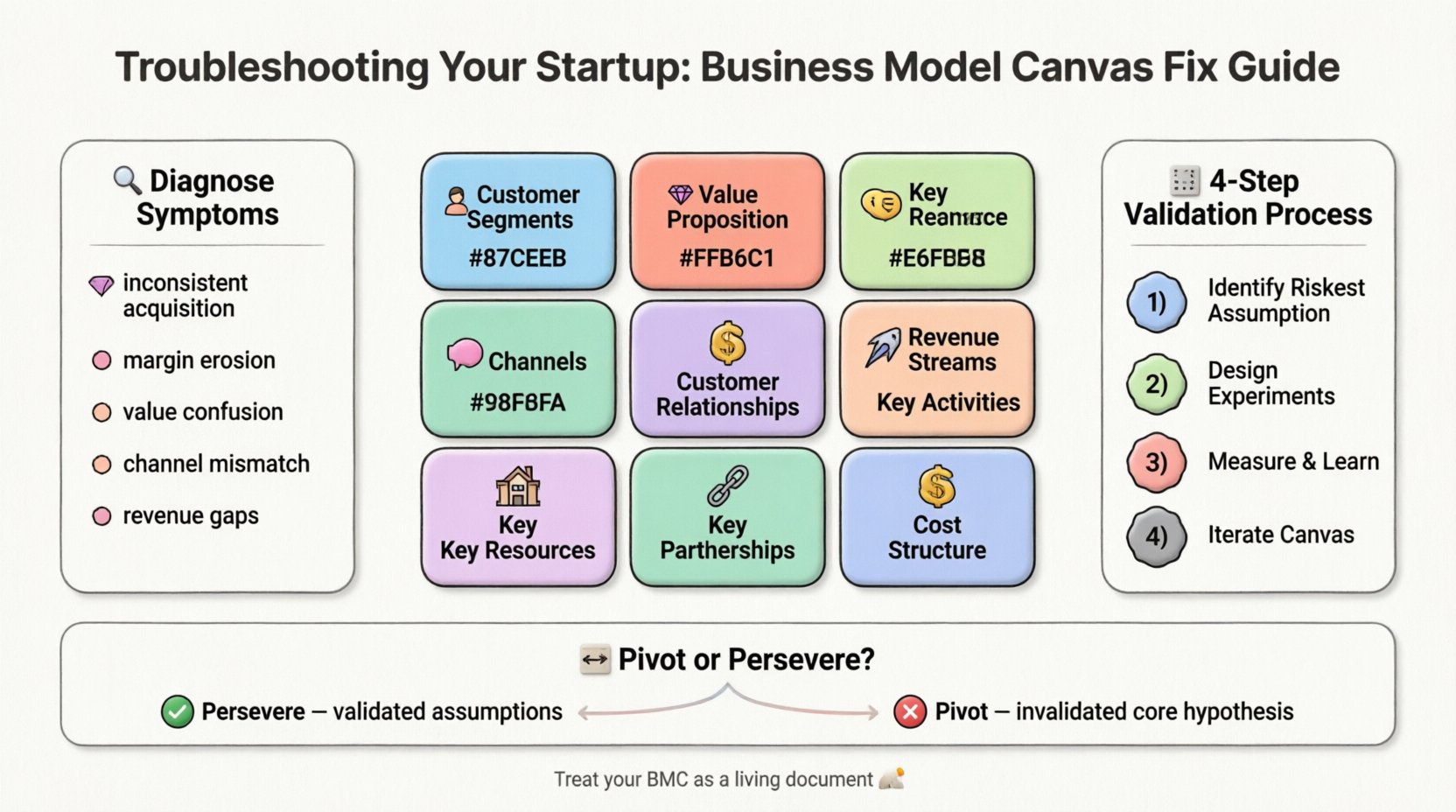
🔍 Diagnosing the Problem: Why Does It Feel Broken?
Before applying fixes, you must identify the root cause. A “broken” canvas typically manifests in one of three ways: lack of traction, financial instability, or internal misalignment. Here are the common symptoms you might observe:
- Inconsistent Customer Acquisition: You know who you want, but you cannot find them or convince them to buy.
- Margin Erosion: Revenue streams exist, but the cost to acquire and serve customers is eating all the profit.
- Value Proposition Confusion: Customers do not understand the problem you are solving, or they do not care about the solution.
- Channel Mismatch: You are marketing on platforms where your audience is not active.
- Revenue Model Gaps: The pricing strategy does not match the perceived value delivered to the client.
When these symptoms appear, the canvas is not static; it is a hypothesis that needs testing. Treat every block of the canvas as a claim that requires evidence. If the evidence contradicts the claim, you must adjust the claim.
🧱 Deep Dive: Troubleshooting Each Building Block
The Business Model Canvas consists of nine building blocks. To fix a broken model, you must examine each component individually. Below is a detailed breakdown of common issues and actionable fixes for each section.
1. Customer Segments 👥
This block defines who you are creating value for. A common error is trying to serve everyone. If your growth has stalled, your segment definition might be too broad.
- The Issue: You are targeting a demographic that is either too small to sustain growth or too large to reach effectively.
- The Fix: Narrow your focus. Create specific personas based on behavior rather than just demographics. Conduct interviews to verify if these specific people actually have the pain point you are addressing.
- Action: List your current segments. Rank them by potential value. Select the top three and test your offer against them exclusively.
2. Value Proposition 💎
This is the core reason customers choose you over competitors. If this is broken, everything else fails because the product is not needed.
- The Issue: The benefit is unclear, or it addresses a “nice-to-have” rather than a “must-have.”
- The Fix: Refine the language. Instead of describing features, describe outcomes. Ask customers to describe the problem in their own words, then map your solution to that specific language.
- Action: Write your value proposition down. If a stranger cannot explain it back to you in one sentence, it is too complex.
3. Channels 📢
How does your product reach your customer? This covers both communication and distribution.
- The Issue: High customer acquisition costs (CAC) relative to the lifetime value (LTV) of the customer.
- The Fix: Audit your current channels. Are you spending time on social media platforms where your users are not present? Shift resources to organic channels where trust is higher.
- Action: Map the customer journey. Identify where the drop-off occurs. Is it awareness, consideration, or purchase? Focus troubleshooting on that specific friction point.
4. Customer Relationships 🤝
How do you interact with customers to acquire, retain, and grow them? This includes support, self-service, or personal assistance.
- The Issue: High churn rates despite good acquisition. Customers leave as soon as the initial novelty wears off.
- The Fix: Implement feedback loops. Establish regular check-ins or automated follow-ups that provide value without asking for money.
- Action: Analyze support tickets. What are customers asking about most? This indicates where the product experience is failing or where education is needed.
5. Revenue Streams 💰
How does the business earn money? This includes asset sales, usage fees, subscription fees, or advertising.
- The Issue: Pricing is too low to cover costs, or too high to gain adoption. The model relies on volume that is not achievable.
- The Fix: Test different pricing models. A subscription might work better than a one-time fee, or vice versa. Use A/B testing on pricing pages to gauge willingness to pay.
- Action: Calculate the break-even point. If your current pricing does not allow you to reach this point within a reasonable timeframe, the math is broken.
6. Key Resources 🏗️
What assets do you need to make the model work? This includes physical, intellectual, human, and financial assets.
- The Issue: You are over-investing in resources that do not drive value. For example, hiring staff before validating the need for their roles.
- The Fix: Adopt a lean approach. Outsource non-core functions until demand justifies in-house hiring. Prioritize resources that directly impact the Value Proposition.
- Action: List all resources currently in use. For each, ask: “If we removed this, would the product fail?” If the answer is no, consider divesting.
7. Key Activities 🚀
What things must the company do to make the business model work?
- The Issue: Teams are busy but not productive. Activities are focused on internal processes rather than customer outcomes.
- The Fix: Align daily tasks with strategic goals. Eliminate activities that do not contribute to revenue or validation.
- Action: Review weekly meetings and task lists. Categorize them as “Growth,” “Maintenance,” or “Admin.” Cut the “Admin” and “Maintenance” categories where possible.
8. Key Partnerships 🤝
Who are your key suppliers and partners? What key resources are you acquiring from partners?
- The Issue: Partnerships are not delivering the promised value. Reliance on a single partner creates risk.
- The Fix: Diversify the partner network. Ensure contracts are clear regarding deliverables and timelines.
- Action: Review partner performance metrics. If a partner is underperforming, renegotiate terms or find alternatives.
9. Cost Structure 💸
All costs incurred to operate the business model.
- The Issue: Fixed costs are too high for the current revenue base. Burn rate is unsustainable.
- The Fix: Shift from fixed to variable costs where possible. Lease equipment instead of buying. Use pay-per-use cloud services.
- Action: Conduct a full expense audit. Identify any cost that exceeds 5% of revenue and evaluate if it can be reduced.
📊 Common BMC Pitfalls and Fixes
Visualizing the relationship between issues and solutions can help speed up the troubleshooting process. Use the table below as a quick reference guide.
| Problem Symptom | Likely BMC Block | Immediate Action |
|---|---|---|
| High traffic but no sales | Value Proposition or Revenue Streams | Conduct user interviews to understand objections. |
| High sales but low retention | Customer Relationships or Value Proposition | Implement onboarding sequences and gather churn feedback. |
| Running out of cash quickly | Cost Structure or Key Resources | Reduce overhead and renegotiate vendor contracts. |
| Cannot find customers | Channels or Customer Segments | Pivot target audience or change marketing channels. |
| Competitors undercut pricing | Value Proposition or Revenue Streams | Differentiate on service or quality, not price. |
| Operations are too slow | Key Activities or Key Resources | Automate processes or hire specialized talent. |
🧪 The Validation Process: Testing Your Assumptions
A canvas is only as good as the data supporting it. You cannot fix what you do not measure. The process of validation is about proving or disproving the hypotheses embedded in each block.
Step 1: Define the Riskiest Assumption
Not all parts of the canvas are equally uncertain. Identify the one block that, if proven false, would destroy the business. This is usually the Value Proposition or the Customer Segment. Focus your energy there first.
Step 2: Design Experiments
Create small, low-cost experiments to test these assumptions. Do not build the full product. Do not launch a full marketing campaign. Instead, use:
- Concierge Tests: Manually perform the service to see if customers value the outcome.
- Wizard of Oz: Fake the backend functionality to test if users will interact with the interface.
- Landing Pages: Test demand for specific features before building them.
- Presales: Attempt to sell the product before it is ready to gauge willingness to pay.
Step 3: Measure and Learn
Collect data from these experiments. Look for behavioral signals, not just verbal feedback. People say they want things, but they buy what they need. Track conversion rates, time spent on pages, and actual sign-ups.
Step 4: Iterate the Canvas
Update the canvas based on the data. If a segment was wrong, erase it and write in the new one. If the revenue model failed, cross it out and try a subscription. Treat the canvas as a living document that evolves with your understanding of the market.
🔄 Pivot or Persevere: Making the Strategic Decision
After troubleshooting, you will likely reach a decision point. You must determine whether to continue on the current path or make a significant change. This is often the hardest part of the startup journey.
Signs You Should Pivot
- Customer feedback consistently indicates they do not understand the core value.
- Acquisition costs are significantly higher than the lifetime value of a customer.
- Competitors have captured the market with a similar but better solution.
- You have exhausted your resources without finding product-market fit.
Signs You Should Persevere
- Customers are complaining about specific features, not the core value.
- Growth is slow but steady, with increasing retention rates.
- Feedback indicates the timing is wrong, not the product.
- Unit economics improve as volume increases.
📝 Final Thoughts on Business Model Resilience
Building a business is an exercise in managing uncertainty. The Business Model Canvas is a tool to manage that uncertainty, not a guarantee of success. When it looks broken, it is simply telling you that your knowledge of the market is incomplete.
By systematically diagnosing each block, validating assumptions through real-world testing, and being willing to change direction based on data, you can repair the model. The goal is not to create a perfect plan on day one, but to build a resilient system that adapts to reality. Keep the canvas updated, keep the team aligned, and keep the focus on solving actual problems for real people.
Remember that every successful company started with a flawed model that was iterated upon. Your current state is just part of the process. Stay disciplined, remain curious, and let the data guide your next move. 🚀
🔎 Frequently Asked Questions
- How often should I update my Business Model Canvas?
Update it quarterly or whenever you have significant new data. It is a living document, not a one-time exercise. - Can I use the same canvas for different products?
Yes, but ensure the Value Proposition and Customer Segments are specific to each product offering. - What if my team disagrees on the canvas?
Use data to resolve the disagreement. Run an experiment to see which hypothesis is correct. - Is a broken canvas a sign to quit?
No. It is a sign to learn. Most startups pivot at least once before finding their fit.