
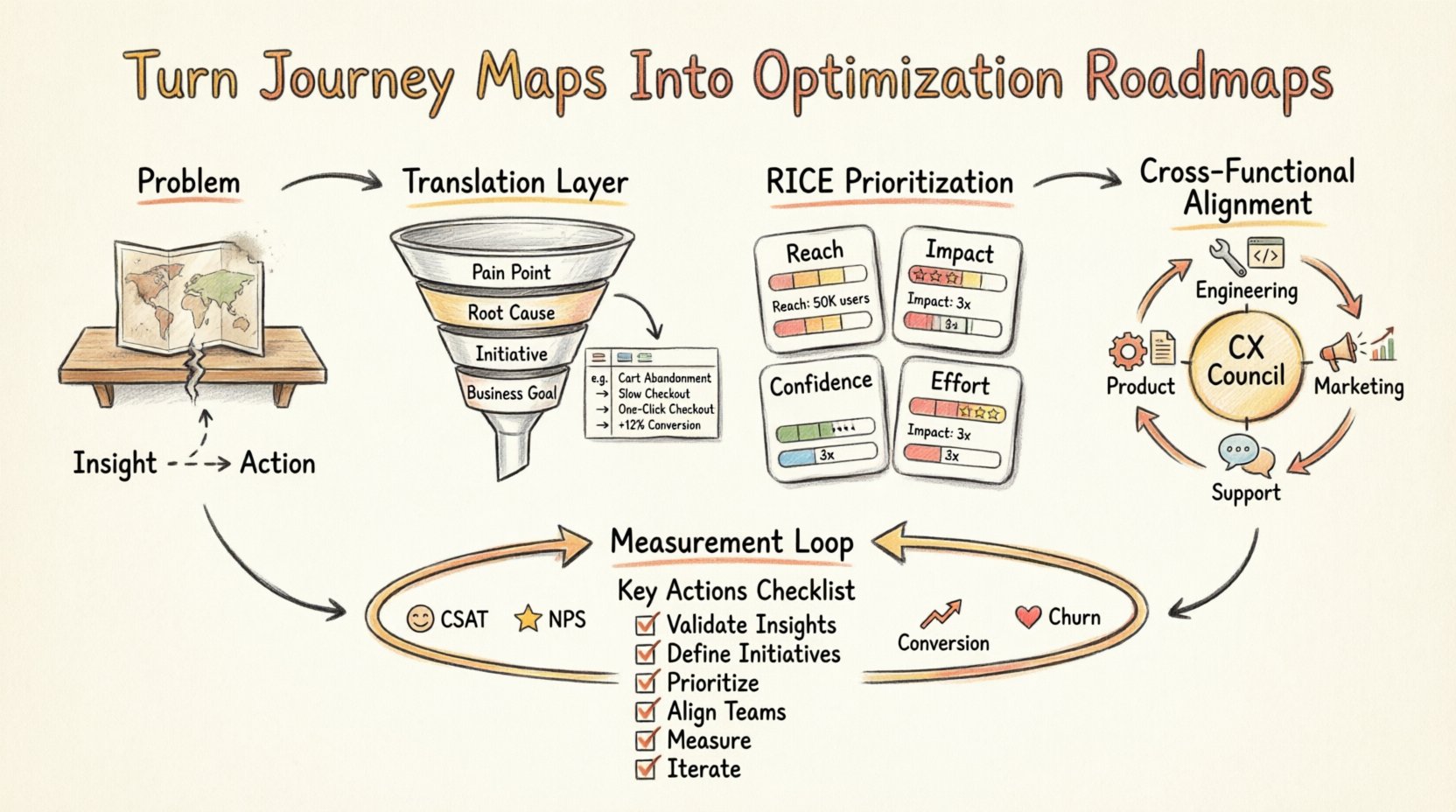
Many organizations invest significant time and resources into creating detailed customer journey maps. These visual artifacts illustrate the touchpoints, emotions, and actions of a user as they interact with a brand. However, a common frustration exists: the map sits on a shelf or in a shared drive, gathering digital dust while the underlying business problems remain unsolved. This is the gap between insight and action. To truly leverage customer experience (CX) strategy, a static map must evolve into a dynamic optimization roadmap.
This transition requires a shift in mindset. A journey map is a diagnostic tool; a roadmap is a plan for execution. Moving from visualization to implementation involves rigorous prioritization, cross-functional alignment, and a commitment to measurable outcomes. The following guide details the process of converting customer journey insights into a structured plan for improvement.
🛑 Why Journey Maps Often Fail to Drive Change
Before establishing a roadmap, it is essential to understand why existing maps stall. A journey map is essentially a snapshot of a current state. Without a mechanism to drive change, it serves only as documentation rather than a catalyst. Several factors contribute to this stagnation:
- Lack of Ownership: Maps are often created by a single team (e.g., Marketing or Design) without clear accountability for fixing the issues identified.
- Insufficient Data Granularity: High-level maps show the “what” but miss the “why” behind the friction.
- No Clear Success Metrics: If you cannot measure the impact of a change, you cannot justify the investment.
- Disconnected Stakeholders: The teams responsible for fixing the pain points (Engineering, Operations, Support) are often not involved in the mapping process.
When a map is treated as a deliverable rather than a foundation, it loses value. The goal is to transform these insights into a backlog of initiatives that directly impact the business bottom line and customer satisfaction.
🔄 The Translation Layer: From Insight to Initiative
The core of the optimization roadmap lies in the translation layer. This is the process of taking a specific pain point identified on the map and converting it into a tangible work item. This requires a structured approach to ensure nothing gets lost in translation.
1. Identify the Root Cause
A map might show a customer abandoning a cart at the checkout stage. This is a symptom. The root cause could be:
- A confusing form field.
- A lack of preferred payment methods.
- Unexpected shipping costs revealed too late.
- Security concerns or lack of trust signals.
Before assigning work, teams must validate the root cause through data analysis or direct customer interviews. Assumptions lead to wasted effort.
2. Define the Initiative Scope
Once the root cause is understood, the initiative must be scoped. Is this a quick fix (e.g., changing a label) or a structural change (e.g., integrating a new payment gateway)? The roadmap must accommodate both types of work.
- Quick Wins: High impact, low effort changes that can be implemented rapidly to build momentum.
- Strategic Projects: High impact, high effort changes that require significant resources and time.
- Maintenance Tasks: Ongoing work required to keep the journey frictionless.
3. Link to Business Goals
Every initiative on the roadmap must tie back to a broader business objective. If the business goal is revenue growth, a journey optimization initiative should aim to increase conversion rates. If the goal is retention, the initiative should focus on reducing churn or improving onboarding.
| Map Insight | Root Cause | Initiative | Business Goal |
|---|---|---|---|
| High drop-off at sign-up | Too many required fields | Simplify registration form | Increase User Acquisition |
| Low NPS in Support | Long wait times | Implement AI chatbot triage | Improve CSAT Scores |
| Cart Abandonment | Hidden shipping costs | Display costs earlier | Boost Conversion Rate |
📊 Prioritization: The RICE Framework for CX
With a list of potential initiatives, you cannot execute all of them simultaneously. You need a prioritization framework to decide what moves to the top of the roadmap. One effective method is adapting the RICE scoring model (Reach, Impact, Confidence, Effort) specifically for customer experience.
1. Reach
How many customers will this initiative affect? If you are fixing a bug that affects only 1% of users, the reach is low. If you are optimizing the homepage, the reach is high. Quantify this by customer volume or revenue impact.
2. Impact
How much will this improve the experience or the metric? Impact can be measured in terms of conversion lift, time saved, or sentiment improvement. Use a scale (e.g., Low, Medium, High, Massive) to assign values.
3. Confidence
How sure are you about your estimates? If you have data backing the assumption, confidence is high. If you are guessing based on a single interview, confidence is low. Lower confidence scores should require more discovery work before full implementation.
4. Effort
How much time and resources are required? This includes design, development, testing, and rollout. Lower effort scores are better. A high-effort project must demonstrate a commensurate high impact to justify the cost.
By calculating a score for each initiative, you create an objective basis for ordering the roadmap. This removes bias and ensures resources are allocated to the highest value work.
🤝 Cross-Functional Alignment
A journey optimization roadmap rarely lives within a single department. It requires the collaboration of Product, Engineering, Marketing, Sales, and Support. Without alignment, initiatives stall due to resource contention or conflicting priorities.
Establishing a CX Council
Form a cross-functional council that meets regularly to review the roadmap. This group acts as the gatekeepers for what gets built. Their responsibilities include:
- Reviewing new insights from the journey map.
- Validating prioritization scores.
- Ensuring resource availability.
- Resolving conflicts between departments.
Communication Channels
Transparency is key. The roadmap should be visible to all stakeholders. Regular updates should be shared that explain:
- What was built in the last cycle.
- What is currently in progress.
- What is planned for the next quarter.
- How customer feedback is influencing the plan.
This prevents surprises and builds trust. When Engineering understands how their work improves the customer journey, they are more likely to prioritize it.
📈 Measurement & Feedback Loops
A roadmap is not a static document; it is a living plan. It requires continuous measurement and feedback to ensure it remains relevant. You must define how success is measured before the work begins.
Defining Key Performance Indicators (KPIs)
Every initiative needs a metric to track progress. Common CX metrics include:
- Customer Satisfaction Score (CSAT): Immediate reaction to a specific interaction.
- Net Promoter Score (NPS): Long-term loyalty and recommendation likelihood.
- Customer Effort Score (CES): How easy it was for the customer to solve their problem.
- Conversion Rate: The percentage of users completing a desired action.
- Churn Rate: The percentage of customers who stop using the service.
Post-Implementation Review
After an initiative is launched, conduct a post-implementation review. Compare the actual results against the projected impact. Did the simplified sign-up form increase registrations by the predicted 10%? If not, why?
This feedback loop is critical. It validates the accuracy of your initial assumptions and informs future prioritization. If a type of initiative consistently underperforms, you may need to adjust your strategy or resource allocation.
Continuous Data Collection
Journey maps are not one-time exercises. Data collection must be continuous to keep the map accurate. Use analytics tools, surveys, and support logs to gather real-time data. This ensures the roadmap is responding to current realities rather than outdated assumptions.
⚠️ Common Pitfalls to Avoid
Even with a solid framework, organizations often stumble during execution. Being aware of these pitfalls can help you navigate the process more effectively.
1. Optimizing for the Wrong Journey
Not all journeys are equal. Focusing on a low-value journey (e.g., a one-time download) might yield better results than optimizing a high-value journey (e.g., the purchase flow). Ensure you are prioritizing journeys that align with business value.
2. Ignoring Internal Friction
Customer journeys are often hindered by internal processes. A customer might face a long wait time because the support team lacks access to the right tools. Optimization must address internal bottlenecks, not just external customer-facing elements.
3. Overloading the Roadmap
Trying to fix everything at once leads to failure. A roadmap should be focused. Limit the number of major initiatives in a single quarter to ensure adequate focus and resources are dedicated to each.
4. Neglecting the “Happy Path”
Most teams focus solely on fixing broken parts. However, the “happy path” (the ideal flow) also needs optimization. Removing friction from a smooth journey can still increase conversion and delight.
5. Failing to Close the Loop
Just because you fixed a pain point does not mean the customer knows. Communicate changes to customers where appropriate. If you improved the checkout process, a subtle message confirming a faster experience can reinforce the positive change.
🚀 Building a Culture of Continuous Improvement
The ultimate goal of turning journey maps into optimization roadmaps is to build a culture where customer experience is a continuous cycle, not a project. This requires leadership commitment and a willingness to adapt.
When teams see that their work directly improves the customer journey and drives business results, engagement increases. The roadmap becomes a shared vision rather than a top-down mandate.
Steps to Institutionalize the Process
- Embed CX in OKRs: Include customer experience goals in departmental objectives.
- Regular Training: Ensure all employees understand the journey map and their role in it.
- Customer Voice Integration: Make customer feedback a standard agenda item in team meetings.
- Iterate the Map: Update the journey map quarterly to reflect new processes and customer behaviors.
By treating the roadmap as a living document, you ensure that your organization remains responsive to customer needs. The journey map provides the map, but the roadmap provides the vehicle to get there.
🔑 Summary of Key Actions
To successfully transition from mapping to optimization, follow these core actions:
- Validate Insights: Ensure pain points are backed by data, not just anecdotes.
- Define Initiatives: Translate problems into specific, actionable work items.
- Prioritize Rigorously: Use scoring models to rank initiatives by impact and effort.
- Align Teams: Ensure all departments agree on the plan and resource allocation.
- Measure Outcomes: Track KPIs to verify the effectiveness of changes.
- Iterate: Update the map and roadmap regularly based on new data.
This structured approach ensures that the effort invested in customer journey mapping delivers tangible returns. It bridges the gap between understanding the customer and serving them better.
📅 The Path Forward
Creating a customer journey optimization roadmap is not a destination; it is a discipline. It requires ongoing attention, data analysis, and cross-functional cooperation. By following the steps outlined above, organizations can move beyond static documentation and into a phase of active improvement.
The journey of the customer is complex and ever-changing. Your strategy must be flexible enough to adapt to those changes. By treating the roadmap as a dynamic tool, you position your organization to deliver consistent value and build lasting loyalty. The map shows the way, but the roadmap gets you there.