
In the dynamic landscape of software development, the backlog serves as the single source of truth for work. It is not merely a list of tasks but a living artifact that guides the team toward delivering value. Effective backlog management ensures that every sprint is grounded in clarity, priority, and feasibility. Without a structured approach to organizing and refining user stories, teams risk slogging through ambiguity, missing deadlines, or delivering features that do not meet stakeholder needs.
This guide explores the mechanics of maintaining a healthy product backlog. We will examine how to structure stories, apply prioritization frameworks, and prepare work for sprint planning. By focusing on discipline and continuous refinement, teams can transform their backlog from a chaotic to-do list into a strategic roadmap.
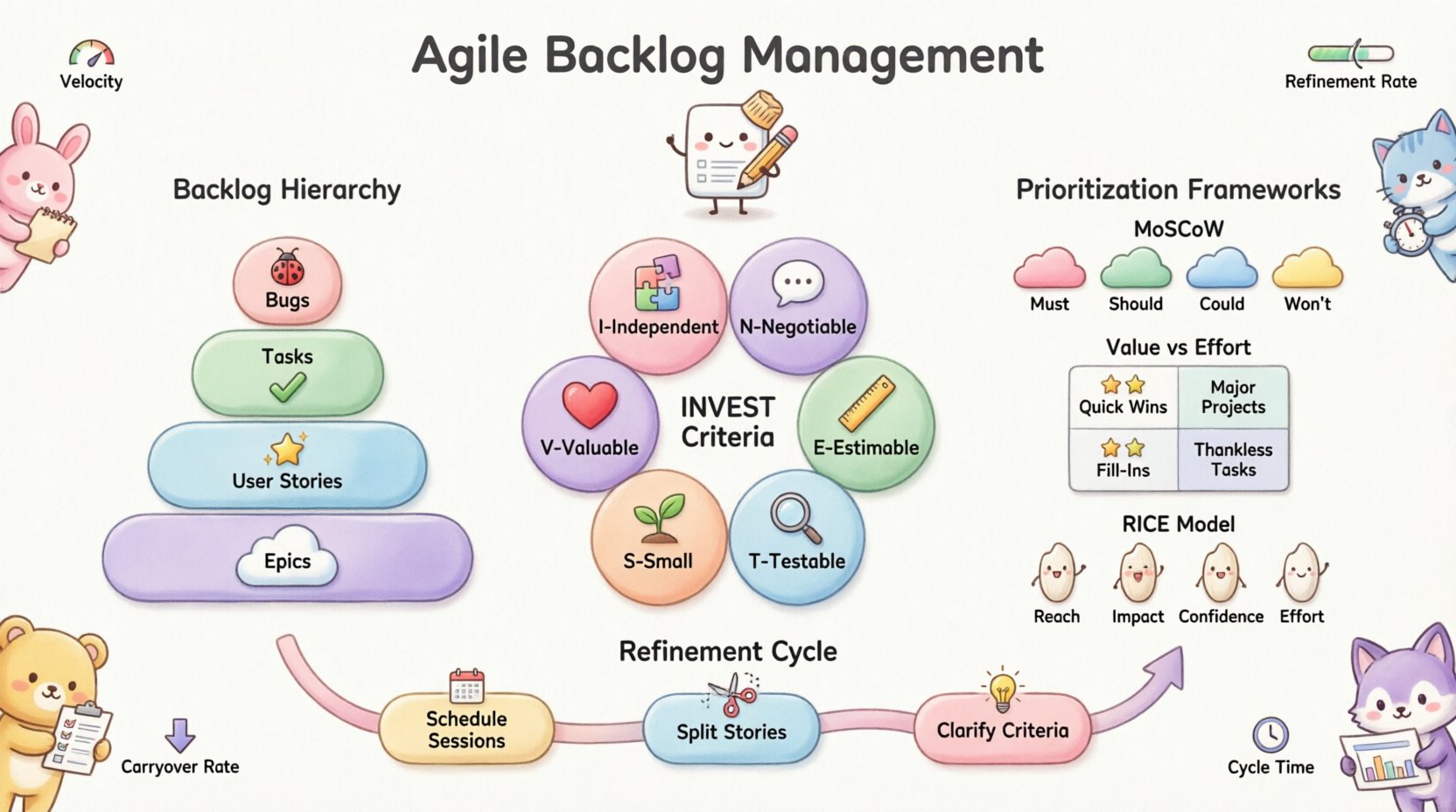
🏗️ Understanding Backlog Structure and Hierarchy
Before diving into refinement, it is essential to understand the hierarchy of work items. A well-organized backlog typically follows a tiered structure that allows for high-level planning and detailed execution.
- Epics: Large bodies of work that can be broken down into smaller stories. Epics often span multiple sprints and represent major features or initiatives.
- User Stories: The core unit of value. These describe functionality from the perspective of the end user.
- Tasks: Technical steps required to complete a story. These are often created during sprint planning.
- Bugs: Defects identified in the current state of the product that need fixing.
Organizing these items correctly prevents confusion. For example, a story should never be too large to fit within a single sprint. If a story is too big, it is likely an epic in disguise and needs splitting. This structure allows product owners to plan far ahead with epics while the development team focuses on specific stories for the immediate future.
🔍 The INVEST Criteria for Quality Stories
Not all user stories are created equal. To ensure stories are actionable, they should adhere to the INVEST criteria. This acronym stands for Independent, Negotiable, Valuable, Estimable, Small, and Testable. Each letter represents a quality check that the backlog owner and team should perform during refinement.
| Letter | Meaning | Why It Matters |
|---|---|---|
| I | Independent | Stories should ideally not depend on other stories. Dependencies create bottlenecks and reduce flexibility in scheduling. |
| N | Negotiable | Details should be flexible. The team discusses how to implement the solution, not just what the solution is. |
| V | Valuable | Every story must deliver value to a user or stakeholder. If it does not, it should be removed. |
| E | Estimable | The team must have enough information to estimate the effort required to complete the work. |
| S | Small | Stories should be small enough to be completed within a sprint. Large stories are hard to test and manage. |
| T | Testable | There must be clear conditions of acceptance to verify the story is done. |
Applying these criteria acts as a filter. When a story is written, it should pass through this filter before entering the refinement queue. If a story fails the “Small” or “Testable” check, it requires further decomposition or clarification.
🔄 The Backlog Refinement Process
Refinement, often called grooming, is the practice of reviewing, updating, and organizing the backlog. This is not a one-time event but a continuous activity. Regular refinement sessions keep the backlog healthy and ready for upcoming sprints.
1. Scheduling Refinement Sessions
Teams should dedicate specific time for this work. A common pattern is to hold a refinement session midway through a sprint. This ensures that stories for the next sprint are prepared while the current sprint is still active. During these sessions, the product owner presents the high-priority items, and the team asks questions to uncover hidden complexity.
2. Splitting Large Stories
One of the most common tasks in refinement is splitting. If a story describes a complex feature, break it down into smaller, independent pieces. For example, instead of building a complete “Checkout Process,” split it into “Add Item to Cart,” “Enter Shipping Details,” and “Process Payment.” This allows for incremental delivery and earlier feedback.
3. Clarifying Acceptance Criteria
A story without acceptance criteria is a promise of ambiguity. Acceptance criteria define the boundaries of the work. They answer the question: “When is this story considered complete?”
- Example: “As a user, I want to reset my password.”
- Criterion 1: The user receives an email link within 5 minutes.
- Criterion 2: The link expires after 24 hours.
- Criterion 3: The new password must meet complexity requirements.
Writing these criteria collaboratively ensures that developers, testers, and the product owner share the same vision.
⚖️ Prioritization Frameworks
Once the backlog is refined, the product owner must decide what comes next. Prioritization is the art of ordering work based on value, cost, and risk. There are several frameworks to assist in this decision-making process.
MoSCoW Method
This framework categorizes items into four buckets:
- Must Have: Non-negotiable requirements for the release.
- Should Have: Important but not vital for the immediate launch.
- Could Have: Desirable features that add value if time permits.
- Won’t Have: Agreed-upon items to exclude for the current cycle.
Value vs. Effort Matrix
Plotting items on a grid helps visualize trade-offs. The X-axis represents effort (time, resources), and the Y-axis represents value (revenue, user satisfaction).
- Quick Wins: High Value, Low Effort. Prioritize these first.
- Major Projects: High Value, High Effort. These require significant planning.
- Fill-Ins: Low Value, Low Effort. Do these when capacity allows.
- Thankless Tasks: Low Value, High Effort. Avoid or reconsider these.
RICE Scoring
For data-driven teams, RICE scoring provides a numerical value to each story. The formula multiplies four factors:
- Reach: How many users will this affect?
- Impact: How much will it move the needle for each user?
- Confidence: How sure are we about the estimates?
- Effort: How much time will it take?
By calculating a score, teams can objectively compare disparate items, such as a new feature versus a technical debt reduction task.
📅 Preparing for Sprint Planning
The goal of backlog management is to feed the sprint planning meeting with ready work. Sprint planning is where the team commits to a set of stories for the upcoming iteration. Preparation here determines the success of the sprint.
1. Estimating Effort
Teams use various methods to estimate effort, such as Planning Poker or T-shirt sizes. The goal is not precision but relative comparison. If Story A takes twice as long as Story B, that relationship is more important than knowing exactly how many hours Story A will take. Estimation helps the team understand their capacity.
2. Assessing Capacity
Capacity planning accounts for reality. Developers will not work 100% of the sprint time. They have meetings, support requests, and administrative duties. Teams must subtract these overheads to determine available hours. Overcommitting is a common cause of sprint failure.
3. Selecting the Right Mix
A healthy sprint often contains a mix of story types. Relying solely on new features creates risk. Including technical tasks or bug fixes ensures the product remains stable. The team should select stories that balance business value with system health.
🚧 Common Pitfalls in Backlog Management
Even experienced teams face challenges. Recognizing these pitfalls early can save significant time and frustration.
- Gold Plating: Developers adding features not requested in the story. This wastes time and introduces bugs.
- Vague Descriptions: Stories that rely on assumptions rather than facts. This leads to rework.
- Scope Creep: Adding new requirements mid-sprint without adjusting the commitment. This disrupts flow.
- Ignoring Technical Debt: Focusing only on new features until the codebase becomes unmaintainable.
- Static Backlogs: Treating the backlog as a finished document rather than a living plan that changes with market conditions.
📊 Measuring Backlog Health
To improve backlog management, teams need metrics. These metrics provide insight into the flow of work and the quality of the backlog itself.
| Metric | Definition | Goal |
|---|---|---|
| Velocity | The amount of work completed per sprint. | Stability over time to predict future capacity. |
| Refinement Rate | Percentage of stories ready for sprint. | Ensure enough stories are prepared for the next 1-2 sprints. |
| Cycle Time | Time from start to finish for a story. | Reduce time to deliver value. |
| Carryover Rate | Percentage of stories not finished in sprint. | Keep this low to maintain commitment reliability. |
Tracking these metrics helps identify bottlenecks. For instance, if the refinement rate is low, it means the team is waiting on clarification during sprint planning, which wastes time. If carryover is high, the team may be overcommitting or stories are too complex.
🛠️ Tools and Techniques for Organization
While specific software names are not the focus, the functional capabilities of a system matter. A good tool should support the following features:
- Drag-and-Drop Ordering: To easily adjust priority without complex queries.
- Linking and Dependencies: To show relationships between stories and epics.
- Search and Filtering: To find specific items quickly by tag, status, or assignee.
- Collaboration Features: Comments and @mentions allow the team to discuss details within the item.
- Export Capabilities: To move data between systems or create reports.
The tool is secondary to the process. A complex tool used poorly will yield poor results. A simple tool used with discipline will produce a high-quality backlog.
🤝 Collaboration and Communication
Backlog management is not a solo activity. It requires constant communication between the product owner, developers, and testers.
The Product Owner owns the “What” and “Why.” They ensure the backlog aligns with business goals and user needs.
The Development Team owns the “How.” They provide estimates, technical insights, and feasibility checks during refinement.
Quality Assurance ensures that the acceptance criteria are testable and that the stories meet quality standards before they are accepted.
When these roles collaborate early, surprises are minimized. Developers can ask about edge cases during refinement, and testers can clarify validation steps before the sprint begins.
🌱 Continuous Improvement
Backlog management evolves. As the team matures, the definition of “ready” may change. Perhaps stories need more technical spikes, or perhaps acceptance criteria need to be more detailed. Regular retrospectives should include a discussion on backlog health. Ask questions like: “Were we blocked by unclear stories?” or “Did we have too many dependencies?”
Adapting the process based on feedback ensures the backlog remains a useful asset rather than a bureaucratic burden. The ultimate goal is to create a flow of value that is predictable, transparent, and aligned with stakeholder expectations.
By implementing these practices, teams can navigate the complexities of Agile development with confidence. A well-managed backlog is the foundation of a successful sprint and a sustainable product.