
Accurate effort prediction is the backbone of reliable delivery. When teams estimate user stories effectively, they build trust with stakeholders and create sustainable workflows. However, guessing the time required for a feature is notoriously difficult. Uncertainty is inherent in software development, yet teams must still commit to timelines. This guide explores the mechanics behind reliable estimation, moving beyond simple guesswork into data-driven decision-making.
Estimation is not about predicting the future with certainty. It is about understanding the relative size of work and the risks involved. By adopting specific techniques and focusing on team dynamics, you can improve the quality of your predictions over time. The goal is not perfection, but continuous improvement in how work is understood and planned.
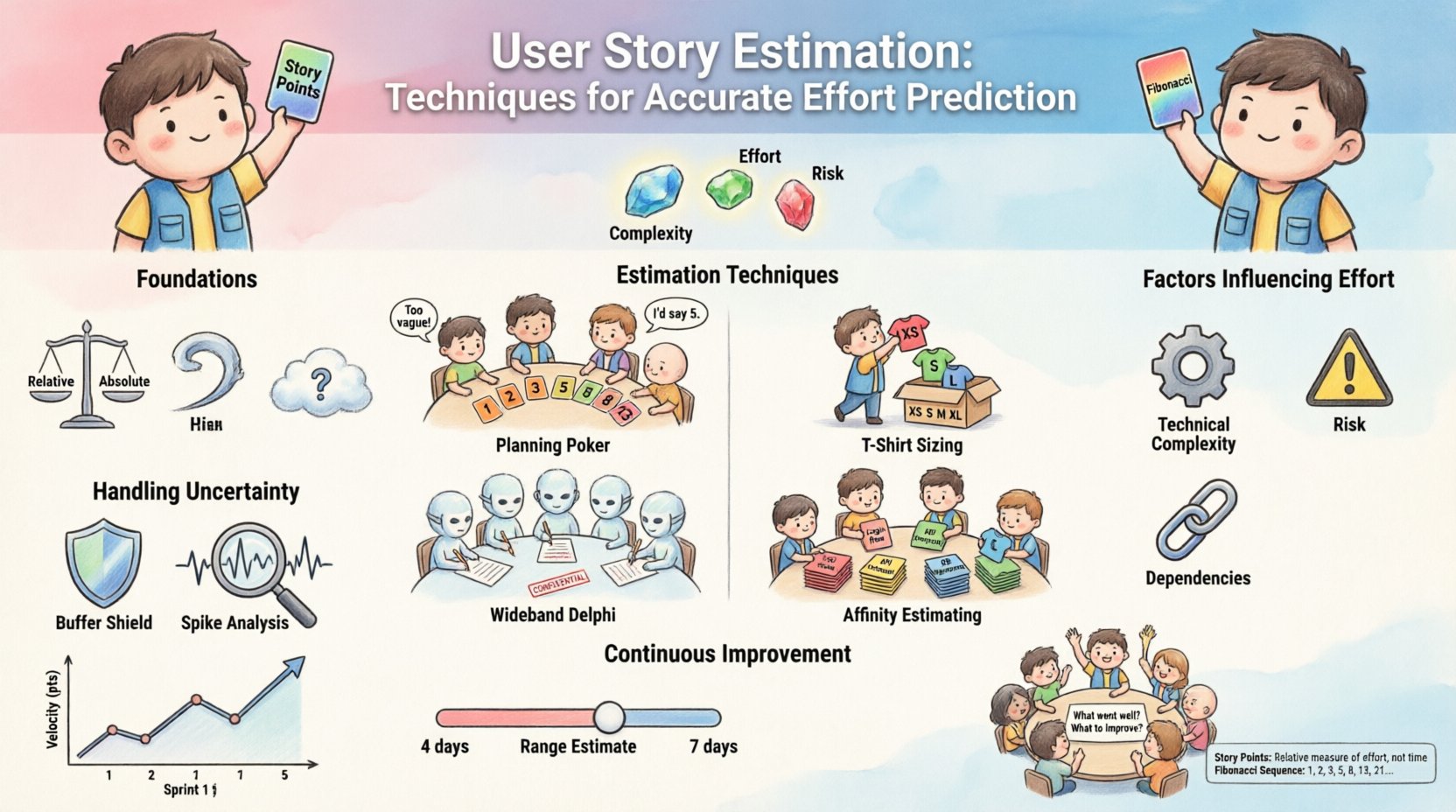
🧠 The Foundations of Estimation
Before diving into specific techniques, it is crucial to understand what estimation actually represents. In many contexts, teams confuse estimation with commitment. A good estimate provides a range or a probability, not a hard deadline.
- Relative vs. Absolute: Absolute estimates (hours or days) often feel precise but are usually inaccurate. Relative estimates (story points) compare work to a baseline, which is often more reliable.
- Complexity, Effort, and Risk: A complete estimate considers three dimensions. Complexity is how hard the code is to write. Effort is the time required. Risk is the likelihood of something going wrong.
- Uncertainty: The more unknown factors exist in a story, the wider the range of the estimate should be.
🛠 Common Estimation Techniques
Various methods exist to help teams arrive at a consensus on effort. Each technique has strengths depending on the team size, the maturity of the project, and the available data.
1. Planning Poker
Planning Poker is perhaps the most recognized method for collaborative estimation. It combines individual calculation with group discussion to reach a consensus.
- The Process: The team reviews the story card. Each member selects a card from a deck representing a number (often following the Fibonacci sequence: 1, 2, 3, 5, 8, 13, etc.). Everyone reveals their card simultaneously.
- Discussion: If numbers vary widely, the highest and lowest estimators explain their reasoning. This reveals hidden assumptions about complexity or requirements.
- Re-voting: The team votes again after the discussion. The goal is convergence, not necessarily unanimity.
The Fibonacci sequence is used to reflect the increasing uncertainty of larger numbers. Guessing the difference between 21 and 22 hours is less reliable than guessing the difference between 1 and 2 points.
2. T-Shirt Sizing
For high-level planning or early discovery phases, T-Shirt Sizing offers a quick way to categorize effort without getting bogged down in specific numbers.
- Sizes: Stories are classified as XS, S, M, L, XL, or XXL.
- Mapping: These sizes are later mapped to story points (e.g., M = 3 points, L = 8 points).
- Use Case: This works well for backlog refinement sessions where hundreds of items need initial sorting.
3. Wideband Delphi
This technique focuses on minimizing bias by using anonymity and iteration. It is similar to Planning Poker but often conducted without face-to-face pressure.
- Step 1: The facilitator presents the story.
- Step 2: Team members write estimates privately on paper.
- Step 3: Estimates are collected and reviewed.
- Step 4: The group discusses outliers and revises estimates.
4. Affinity Estimating
Affinity Estimating is ideal for breaking down large backlogs quickly. It relies on grouping similar items rather than estimating them individually.
- Grouping: Team members place stories into piles based on perceived size.
- Ordering: The piles are ordered from smallest to largest.
- Assigning Values: The smallest pile is assigned a base value, and others are scaled relative to it.
📋 Comparison of Techniques
Choosing the right method depends on the context. The table below outlines the best use cases for each technique.
| Technique | Best For | Pros | Cons |
|---|---|---|---|
| Planning Poker | Sprint Planning | Builds consensus; reveals hidden risks | Time-consuming for large backlogs |
| T-Shirt Sizing | Backlog Refinement | Fast; simple for stakeholders | Less precise; requires mapping later |
| Wideband Delphi | Complex Projects | Reduces groupthink; anonymous | Requires multiple rounds; slower |
| Affinity Estimating | Large Scale Planning | Quickly sorts many items | Lower accuracy for individual items |
📉 Factors Influencing Effort
Estimates are rarely just about coding time. Several external and internal factors influence the actual effort required. Ignoring these leads to missed deadlines.
Technical Complexity
Not all features are created equal. Some require deep architectural changes, while others are simple UI tweaks.
- New vs. Existing Code: Modifying legacy systems often takes longer than building new features due to lack of documentation or hidden dependencies.
- Integration: Connecting to third-party APIs or external systems introduces latency and potential failure points.
Risk and Uncertainty
Every story carries a degree of risk. High risk stories should have larger buffers or be broken down further.
- Learning Curve: If the team is unfamiliar with a technology, effort increases significantly.
- Unknown Unknowns: Requirements that are not fully understood should be treated as spikes or research tasks first.
Dependencies
Work rarely exists in a vacuum. Dependencies on other teams, infrastructure, or data availability can stall progress.
- External Dependencies: Waiting on another team to complete a service.
- Internal Dependencies: Waiting for a specific component to be ready before starting.
🧩 Handling Uncertainty and Risk
Even with perfect data, uncertainty remains. Teams must manage this through buffers and risk analysis rather than padding estimates arbitrarily.
- Contingency Buffers: Add time to the project plan for known risks, but avoid inflating individual story estimates.
- Spikes: When uncertainty is too high, create a time-boxed research task (a spike) to gather information before estimating the feature.
- Range Estimates: Instead of saying “5 days”, say “4 to 7 days”. This communicates confidence levels.
🤝 Team Dynamics and Collaboration
Estimation is a social activity. The way a team interacts during planning affects the accuracy of the output.
Avoiding Anchoring Bias
Anchoring occurs when the first number mentioned influences the rest of the group. To prevent this:
- Use silent voting methods like Planning Poker.
- Encourage junior members to speak up before senior members.
- Focus on the story details, not the numbers initially.
Building Consensus
Consensus does not mean everyone agrees perfectly. It means everyone understands the scope and accepts the effort level.
- Disagreement is Good: If everyone agrees too quickly, the team may not be thinking critically about the story.
- Resolving Outliers: If one person estimates 1 and another estimates 13, discuss why. The outlier often sees something the group missed.
📈 Continuous Improvement
Estimation accuracy improves with data. Teams should track their actual performance against estimates to calibrate future predictions.
Tracking Velocity
Velocity is the amount of work a team completes in a sprint. It helps in forecasting future capacity.
- Stable Velocity: A consistent velocity indicates stable estimation practices.
- Fluctuations: Significant drops in velocity signal process issues, scope creep, or burnout.
Retrospectives on Estimates
Use retrospective meetings to discuss estimation accuracy without assigning blame.
- Why did we miss? Did we miss a dependency? Was the story too large?
- Adjustment: If a story type is consistently underestimated, adjust the sizing guidelines.
📝 Best Practices for Refinement
Preparation is key to accurate estimation. The refinement process ensures stories are ready to be estimated.
- Clear Acceptance Criteria: Stories without clear criteria are impossible to estimate accurately.
- Split Large Stories: If a story takes more than a sprint, split it into smaller, independent stories.
- Definition of Ready: Establish a checklist that a story must meet before it enters the planning phase.
🔄 When to Re-estimate
Estimates are not set in stone. They should evolve as the story evolves.
- New Information: If requirements change during development, re-evaluate the effort.
- Technical Debt: If unexpected code issues arise, the remaining work needs a fresh estimate.
- Team Composition: If a team member leaves or joins, velocity and capacity may change.
🎯 Final Thoughts on Prediction
Accuracy in effort prediction is a journey, not a destination. By combining structured techniques with honest team discussions, organizations can deliver value consistently. Focus on understanding the work rather than just hitting numbers. The data will follow the process.
Remember that the purpose of estimation is planning, not policing. Use these insights to manage expectations and support your team. With practice, the art of prediction becomes a science of informed decision-making.