
In the landscape of software delivery, the gap between an idea and a deployed feature is where most projects face friction. User story validation serves as the critical checkpoint that ensures what is built matches what was intended. Without a rigorous validation process, teams risk investing time and resources into features that do not solve the actual problem. This guide explores the mechanics of securing stakeholder sign-off before implementation begins, focusing on clarity, alignment, and risk reduction.
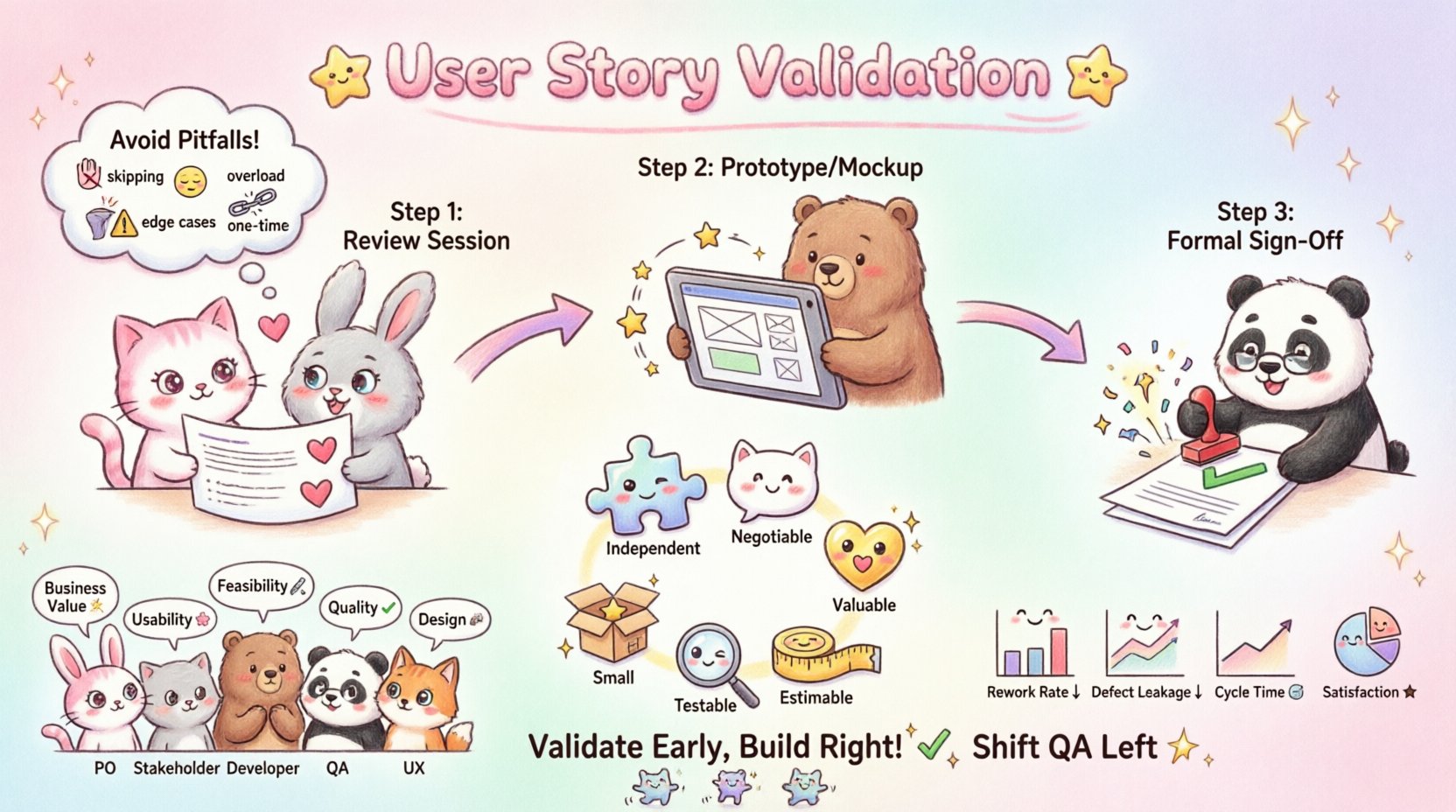
Understanding User Story Validation 🧐
Validation is often confused with testing, yet they occupy distinct roles in the development lifecycle. Testing verifies that the code functions correctly. Validation confirms that the solution delivers value to the user and meets business needs. Getting sign-off before implementation is a proactive strategy. It shifts quality assurance to the left, preventing defects from being built into the system in the first place.
When we speak of validation in this context, we refer to the agreement among the product owner, business stakeholders, and development team that a user story is ready to be worked on and that the acceptance criteria are understood by all parties. This agreement minimizes ambiguity and reduces the likelihood of rework during the later stages of delivery.
- Verification: Did we build the product right? (Technical correctness)
- Validation: Did we build the right product? (Business value and user need)
Securing sign-off is not merely a bureaucratic step. It is a communication milestone. It represents a shared understanding of the scope and expectations. When a stakeholder signs off, they are acknowledging that they have reviewed the proposed solution and agree that it satisfies the requirements as documented.
Preparing the Foundation: Acceptance Criteria 📝
Validation cannot happen in a vacuum. It relies on the quality of the input. The primary input is the user story itself, specifically the acceptance criteria. These criteria define the boundaries of the story and the conditions under which it is considered complete. If the criteria are vague, validation becomes subjective and prone to disagreement.
To prepare for effective validation, the team must ensure the story adheres to the INVEST model:
- Independent: The story can be developed and tested without dependencies on other stories.
- Negotiable: The details are open for discussion until a shared understanding is reached.
- Valuable: It delivers value to the user or the business.
- Estimable: The team can estimate the effort required to complete it.
- Small: It can be completed within a single sprint or iteration.
- Testable: There must be a clear way to verify if the story is done.
Acceptance criteria should be written clearly, avoiding technical jargon where possible. They should describe the behavior of the system from the user’s perspective. Using the Given-When-Then format helps structure these criteria logically.
- Given: The initial context or state.
- When: The action or event that occurs.
- Then: The expected outcome or result.
This structure forces precision. It removes ambiguity about what happens when a user performs a specific action. It provides a concrete basis for validation.
The Validation Workflow 🔄
Securing sign-off requires a structured workflow. Ad-hoc approvals lead to forgotten requirements and scope creep. A defined process ensures that every story passes through specific gates before development starts.
Step 1: The Review Session
The first step is a formal review of the user story. This involves the product owner, the development team, and any relevant business stakeholders. During this session, the story is read aloud, and the acceptance criteria are discussed. The goal is to identify gaps in logic or missing edge cases.
Key activities during this review include:
- Reading the story description to ensure clarity.
- Walking through the acceptance criteria line by line.
- Identifying potential technical constraints or dependencies.
- Confirming that the story fits the current sprint capacity.
Step 2: The Prototype or Mockup
For complex interactions or UI-heavy features, text alone is insufficient. Visual aids bridge the gap between abstract requirements and concrete expectations. Wireframes, mockups, or interactive prototypes allow stakeholders to see the proposed solution.
Visual validation helps catch issues that text descriptions often miss, such as:
- Navigation flows that are confusing.
- Missing feedback mechanisms for user actions.
- Accessibility concerns that were overlooked in the text.
- Layout issues on different screen sizes.
When stakeholders interact with a prototype, they can provide immediate feedback. This reduces the chance of misunderstanding the final deliverable.
Step 3: Formal Sign-Off
Once the review and visual validation are complete, a formal sign-off is requested. This does not need to be a physical signature, but it must be a recorded acknowledgment. This could be a comment in the tracking system, a specific status change, or a formal email confirmation.
The sign-off document or record should include:
- The specific version of the requirements being approved.
- The date of approval.
- The names of the approvers.
- Any conditions or notes attached to the approval.
Recording this approval creates an audit trail. If requirements change later, it is clear what was originally agreed upon.
Roles and Responsibilities in Validation 👥
Validation is a collaborative effort. Different roles bring different perspectives to the table. Understanding who is responsible for what ensures that all angles are covered.
| Role | Responsibility in Validation | Focus Area |
|---|---|---|
| Product Owner | Defines the vision and prioritizes the story. | Business Value and ROI |
| Business Stakeholders | Represent the end-users and operational needs. | Usability and Workflow |
| Developers | Assess technical feasibility and complexity. | Implementation Constraints |
| QA Engineers | Define testability and edge cases. | Quality and Verification |
| UX Designers | Ensure the experience is intuitive and accessible. | Design and Interaction |
When all these roles participate in the validation process, the risk of blind spots decreases. The Product Owner ensures the right problem is being solved. The Stakeholders ensure the solution works in their environment. The Developers ensure it is buildable. The QA Engineers ensure it is testable.
Managing Stakeholder Expectations 🤝
One of the biggest challenges in validation is managing expectations. Stakeholders often have high hopes that exceed the resources available. Or, they may have a vision that conflicts with technical realities. Communication is the tool used to align these expectations.
During the validation process, be prepared to say no or to propose alternatives. If a requirement is out of scope, flag it immediately. Do not wait until implementation has started to raise concerns. Early rejection of invalid requirements saves significant time.
Strategies for effective expectation management include:
- Transparency: Share the current velocity and capacity constraints openly.
- Trade-offs: If a feature cannot be delivered fully, offer a phased approach.
- Education: Explain technical constraints in business terms.
- Documentation: Ensure all agreements are written down to prevent memory errors.
Building trust is essential. When stakeholders trust that the team is honest about limitations, they are more likely to provide realistic feedback during validation.
Resolving Ambiguity and Conflict ⚔️
Disagreements during validation are normal. Different stakeholders may interpret the same requirement differently. When conflicts arise, the goal is not to win an argument but to find the path that delivers the most value.
Common sources of ambiguity include:
- Undefined terms (e.g., “fast,” “secure,” “user-friendly”).
- Conflicting requirements between different departments.
- Unclear priority levels between features.
To resolve these conflicts, refer back to the business goals. Which option aligns best with the strategic objectives? If the goal is unclear, escalate the decision to the Product Owner or a higher-level executive.
Use data to support your arguments. If a stakeholder requests a feature that slows down the system, show metrics on performance impact. If another stakeholder argues for a different workflow, present user research data. Facts reduce emotional tension and focus the discussion on outcomes.
Documentation and Evidence 📂
Validation produces evidence. This evidence is not just for compliance; it is for knowledge retention. Teams change, stakeholders leave, and projects span years. Documentation preserves the context of decisions.
Key documents to maintain include:
- User Story Cards: The original request with attached criteria.
- Meeting Notes: Records of validation sessions, including decisions made.
- Approval Logs: Who approved what and when.
- Change Requests: Records of any changes made after the initial sign-off.
When changes occur after sign-off, a formal change request process should be triggered. This ensures that the impact on scope, time, and cost is evaluated before the change is implemented. It prevents scope creep from undermining the validation effort.
Measuring Validation Success 📊
To improve the validation process, you must measure it. Metrics provide insight into where the process is working and where it is breaking down. Tracking these metrics helps identify bottlenecks and areas for improvement.
| Metric | Definition | Why It Matters |
|---|---|---|
| Requirement Rework Rate | Percentage of stories requiring changes after sign-off. | Indicates quality of initial validation. |
| Defect Leakage | Bugs found in production that should have been caught in validation. | Shows gaps in acceptance criteria. |
| Sign-Off Cycle Time | Time taken to get approval after submission. | Measures efficiency of the validation process. |
| Stakeholder Satisfaction | Feedback score from stakeholders on the final product. | Confirms business value alignment. |
If the rework rate is high, it suggests that the acceptance criteria were not clear enough. If the cycle time is long, the review process may be too cumbersome. Adjust the process based on these signals.
Common Pitfalls to Avoid ❌
Even experienced teams fall into traps during validation. Being aware of these common pitfalls helps you navigate the process more smoothly.
| Pitfall | Consequence | Solution |
|---|---|---|
| Skipping Validation | Building the wrong feature. | Make validation a mandatory gate. |
| Assuming Silence is Approval | Unnoticed requirements. | Require explicit confirmation. |
| Overloading Stories | Too complex to validate effectively. | Split stories into smaller, testable units. |
| Ignoring Edge Cases | System fails under specific conditions. | Include negative testing in criteria. |
| One-Time Sign-Off | Changes go unnoticed. | Re-validate after significant changes. |
By anticipating these issues, you can put safeguards in place. A mandatory gate prevents skipping. Explicit confirmation prevents assumptions. Splitting stories prevents overload.
Final Considerations 🌟
Validation is a continuous practice, not a one-time event. As the product evolves, so do the requirements. The sign-off process must be flexible enough to accommodate changes while maintaining control.
The ultimate goal is to deliver value efficiently. By validating stories before implementation, teams reduce waste, improve quality, and increase stakeholder confidence. The effort invested in getting sign-off pays for itself many times over in reduced rework and happier customers.
Start by reviewing your current process. Identify where the friction points are. Is it unclear criteria? Is it slow approvals? Is it missing stakeholders? Address one area at a time. Incremental improvements lead to a robust validation framework.
Remember that validation is about people as much as it is about processes. Foster a culture where questions are encouraged and ambiguity is resolved openly. When the team feels safe to challenge assumptions, the validation process becomes stronger.
Implement these steps consistently. Over time, the habit of validation will become second nature. Your team will deliver features that are right the first time, saving time and resources for future innovation.