Comprehensive Tutorial on Integrating BPMN and UML in Visual Paradigm
Introduction Visual Paradigm is a versatile modeling tool that integrates BPMN (Business Process Model and Notation) and UML (Unified Modeling Language) into a single platform. This integration streamlines the design and development process, enabling efficient collaboration between business analysts and software developers. By combining BPMN’s process-oriented focus with UML’s system-oriented perspective, organizations can achieve a […]
Continue ReadingComprehensive Guide to Integrating TOGAF with ArchiMate, UML, and BPMN in Visual Paradigm
Introduction Visual Paradigm is a powerful tool for enterprise architecture (EA) that integrates multiple modeling standards, including TOGAF, ArchiMate, UML, and BPMN. This integration provides a structured and visually comprehensive approach to architecture development, enabling organizations to align their business and IT strategies effectively. This guide explores how Visual Paradigm enhances EA through these integrations, […]
Continue ReadingComprehensive Guide to TOGAF ADM Guide-Through Process for Enterprise Architecture (EA) Project Development
Introduction The TOGAF (The Open Group Architecture Framework) Architecture Development Method (ADM) is a comprehensive approach to developing and managing enterprise architecture (EA). Visual Paradigm enhances this methodology with its Guide-Through Process, providing a structured roadmap for architects to navigate the complexities of EA project development. This guide outlines the key components and steps involved […]
Continue ReadingComprehensive Guide to Using ArchiMate with TOGAF in Visual Paradigm
Introduction Visual Paradigm is a versatile modeling tool that supports various frameworks, including ArchiMate and TOGAF (The Open Group Architecture Framework). This guide will walk you through the process of integrating ArchiMate with TOGAF using Visual Paradigm to create comprehensive enterprise architecture models. Understanding ArchiMate and TOGAF ArchiMate is a modeling language designed to represent […]
Continue Reading🚀 Unleash Your Creativity with Visual Paradigm Online’s Free Use Case Diagram Tool!
Visual Paradigm Online (VP Online) is a powerful, versatile platform designed for creating a wide range of diagrams and models. Whether you’re a professional, student, or hobbyist, VP Online offers tools to enhance your productivity and creativity. This guide will walk you through the key features and functionalities of the platform, helping you get started […]
Continue ReadingComprehensive Guide to UML Interaction Overview Diagrams
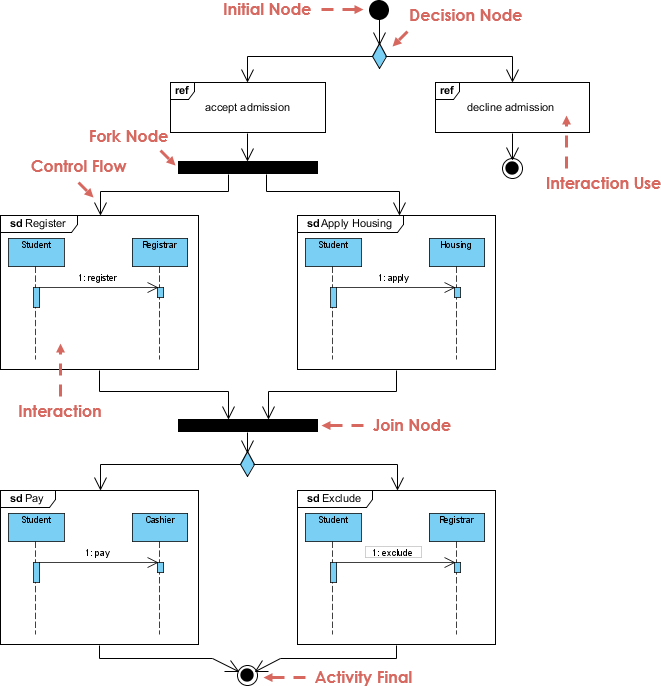
Introduction Interaction Overview Diagrams (IODs) are a type of Unified Modeling Language (UML) diagram that provide a high-level view of an interaction model. They focus on the flow of control between interactions or interaction uses, offering a simplified view of complex interactions within a system. This guide will cover the purpose, structure, elements, use cases, […]
Continue ReadingComprehensive Guide to Visual Paradigm
Introduction In the dynamic landscape of enterprise architecture and software development, effective modeling and collaboration are crucial for aligning business strategies with IT capabilities. Visual Paradigm emerges as a leading all-in-one visual modeling platform, designed to support a wide array of modeling languages and frameworks, including UML (Unified Modeling Language) and BPMN (Business Process Model […]
Continue ReadingComprehensive Guide to Visual Paradigm for Business Process Modeling
Introduction Visual Paradigm is a powerful software tool designed to streamline business process modeling through intuitive and professional diagram creation. It supports various modeling notations, including BPMN (Business Process Model and Notation), UML (Unified Modeling Language), and ERD (Entity Relationship Diagram). This guide will focus on the BPMN capabilities of Visual Paradigm, providing a detailed […]
Continue ReadingGuide to Using UML Composite Structure Diagrams
What is a UML Composite Structure Diagram? A UML Composite Structure Diagram (CSD) is a type of diagram used in Unified Modeling Language (UML) to represent the internal structure of a classifier, showing how it is composed of smaller parts and how these parts interact with each other. It provides a detailed view of the […]
Continue ReadingComprehensive Guide to UML Composite Structure Diagrams
Introduction UML Composite Structure Diagrams (CSDs) provide a detailed view of the internal structure of a class and the interactions between its parts at runtime. Unlike class diagrams, which show static relationships, CSDs highlight how different parts of a class collaborate during execution. This guide will cover the key concepts, components, and practical applications of […]
Continue Reading