
Creating a business plan is often mistaken for predicting the future. The Business Model Canvas (BMC) is a strategic management template designed for developing new business models or documenting existing ones. However, many entrepreneurs find themselves staring at a completed canvas, confident in their strategy, only to watch their venture struggle when launched. A static diagram does not guarantee market fit. The canvas is a hypothesis, not a guarantee.
When a business model fails, it is rarely due to a single error. It is usually a misalignment between your assumptions and market reality. This guide serves as a troubleshooting manual. It moves beyond the basic construction of the nine building blocks to analyze why they break and provides a systematic approach to debugging your strategy. We will look at the anatomy of failure, diagnostic frameworks, and the rigorous validation required to turn a hypothesis into a sustainable operation.
Understanding the Anatomy of Failure 📉
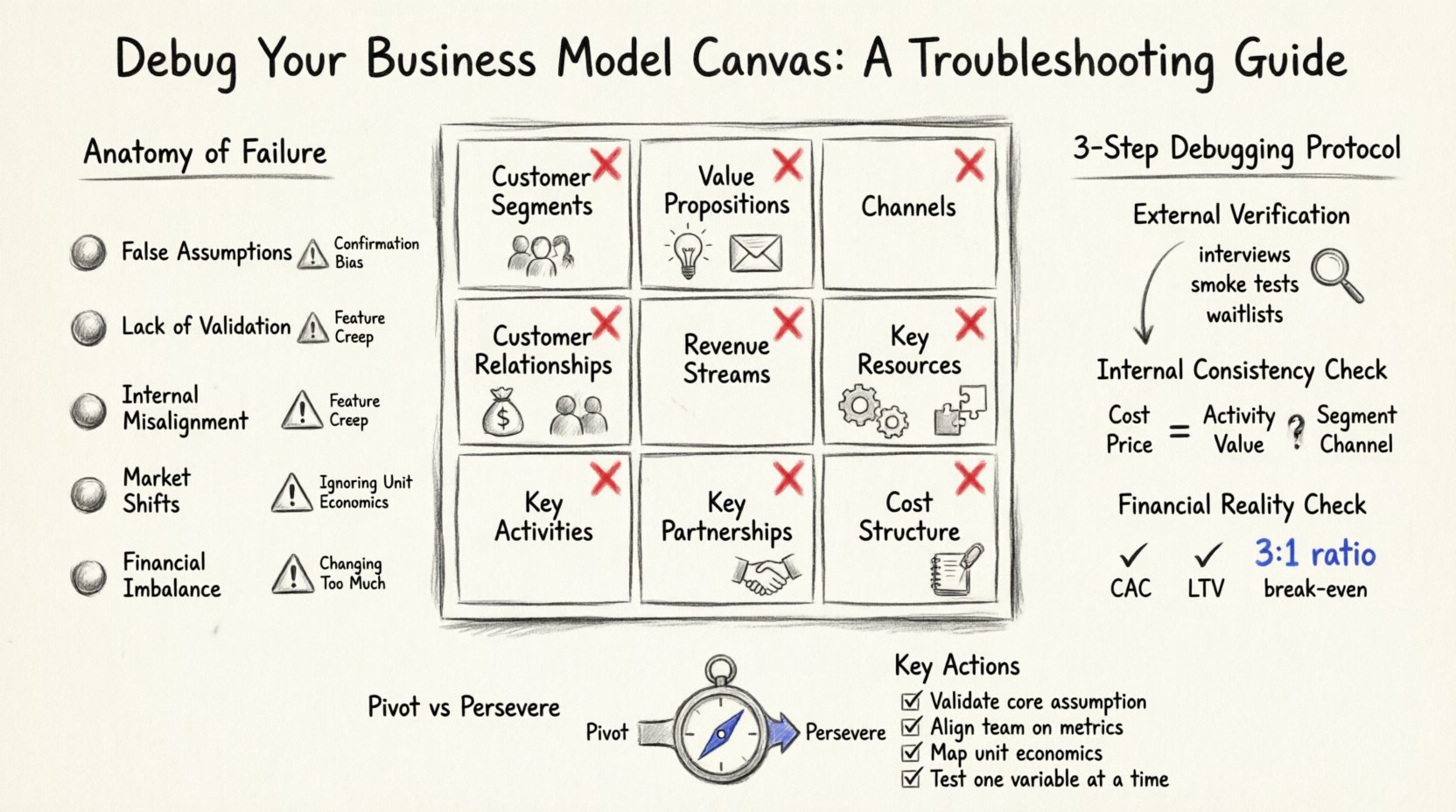
The BMC consists of nine building blocks: Customer Segments, Value Propositions, Channels, Customer Relationships, Revenue Streams, Key Resources, Key Activities, Key Partnerships, and Cost Structure. Failure often stems from treating these blocks as isolated silos rather than an interconnected system. A change in one block affects the others. If you optimize your Key Activities without validating the Value Proposition, you are simply building something efficiently that no one wants.
Here are the primary reasons the canvas fails to translate into revenue:
- False Assumptions: You believe you know the customer better than the customer knows themselves.
- Lack of Validation: You build the product before testing the demand.
- Internal Misalignment: The team understands the canvas differently, leading to execution drift.
- Market Shifts: External factors change faster than your model adapts.
- Financial Imbalance: Costs exceed the value customers are willing to pay.
Detailed Block Analysis: Where Things Break Down 🔍
To debug your model, you must examine each block for weaknesses. Below is a deep dive into the specific failure modes associated with each component.
1. Customer Segments ❌
The most common error here is trying to serve everyone. A segment that is too broad dilutes your message. If your canvas lists “Small Business Owners” as a segment, that is too vague. You need to define the specific demographic, psychographic, and behavioral traits. Failure occurs when the segment does not have a problem severe enough to pay for your solution.
- Debugging Question: Can I describe my top 10 customers without using general terms?
- Debugging Question: Are they actively seeking a solution right now?
2. Value Propositions 💎
This block defines the bundle of products and services that create value. It fails when the value is “nice to have” rather than “must have.” It also fails when the value proposition does not align with the customer segment’s specific needs. For example, offering high-end customization to a price-sensitive segment is a misalignment.
- Debugging Question: Does this solve a critical pain point?
- Debugging Question: Is the benefit quantifiable?
3. Channels 📢
Channels are how you reach your customer segments. A failure here means your customers are not where you are selling. You might have a great product, but if your distribution channel is inaccessible or untrusted, sales will not happen. Many businesses assume digital channels will work for a demographic that prefers in-person interaction.
- Debugging Question: Are customers finding you organically or are you paying for every lead?
- Debugging Question: Is the friction to purchase too high?
4. Customer Relationships 🤝
This block describes the types of relationships a company establishes. It fails when the relationship model is too costly to maintain relative to the customer lifetime value. If you rely on high-touch personal support for a low-margin product, the model is unsustainable.
- Debugging Question: Can this relationship scale without linear cost increases?
- Debugging Question: Does the relationship type match customer expectations?
5. Revenue Streams 💰
Revenue streams represent the cash a company generates from each customer segment. Failure often occurs due to poor pricing strategy. If you price below cost, you lose money. If you price above value, you lose customers. It also fails when the revenue model does not match the customer’s payment preferences (e.g., subscription vs. one-time purchase).
- Debugging Question: Does the revenue cover the cost of acquisition?
- Debugging Question: Is the pricing model predictable?
6. Key Resources 🏗️
These are the assets required to make a business model work. Failure happens when resources are over-invested in areas that do not drive value. You might spend heavily on office space when your team is distributed, or invest in proprietary technology that is easily commoditized.
- Debugging Question: Is this resource a competitive advantage or a commodity?
- Debugging Question: Do we own this, or are we dependent on a third party?
7. Key Activities 🔄
The most important actions a company must take to operate successfully. This block fails when activities are misaligned with the value proposition. If you sell speed, but your key activity is manual customization, you cannot scale.
- Debugging Question: Do these activities directly deliver the value proposition?
- Debugging Question: Are we optimizing for efficiency or effectiveness?
8. Key Partnerships 🤝
The network of suppliers and partners that make the business model work. Failure occurs when partnerships create dependency risks or when partners do not share the same strategic goals. Relying on a single supplier for a critical component is a major vulnerability.
- Debugging Question: Do we have a backup plan if this partner fails?
- Debugging Question: Does this partnership lower costs or increase value?
9. Cost Structure 💸
The costs incurred to operate a business model. This fails when costs are hidden or underestimated. Fixed costs that are too high can kill a business during slow periods. Variable costs that are too high erode margins.
- Debugging Question: Are we aware of all operational costs?
- Debugging Question: Is the cost structure fixed or variable relative to revenue?
Diagnostics: Symptom vs. Cause Analysis 🔬
When a business struggles, the symptoms are often visible (low sales, high churn), but the root cause lies within the canvas. The table below helps map symptoms to the specific building blocks and the likely root causes.
| Symptom | Primary Block Affected | Potential Root Cause | Immediate Action |
|---|---|---|---|
| Low Traffic | Channels | Wrong audience targeting or poor channel selection | Re-evaluate channel mix and SEO strategy |
| High Traffic, Low Sales | Value Proposition | Offer does not match intent or price | Conduct A/B testing on landing pages |
| High Churn | Customer Relationships | Onboarding is poor or product does not solve the problem | Interview churned customers immediately |
| High Acquisition Cost | Revenue Streams / Channels | Customer Lifetime Value is too low | Optimize pricing or focus on retention |
| Operational Delays | Key Activities | Process bottlenecks or resource constraints | Audit workflows and automate manual tasks |
| Burn Rate Exceeds Revenue | Cost Structure | Overhead is too high for current scale | Reduce fixed costs and renegotiate contracts |
The Debugging Protocol: Step-by-Step Fixing 🛠️
Once you have identified the weak blocks, you must execute a debugging protocol. This process replaces assumptions with data. It requires moving from speculation to verification.
Step 1: External Verification 📢
The canvas is an internal document. It must be tested externally. Stop building and start asking. Do not ask friends and family; they are biased. Go to your potential customers.
- Conduct Interviews: Ask open-ended questions about their current workflows and pain points. Do not pitch your solution yet.
- Smoke Tests: Create a landing page describing the value proposition. Run ads to measure click-through rates. If no one clicks, the value proposition is unclear.
- Waitlists: Measure interest by seeing how many people sign up for early access without a product.
Step 2: Internal Consistency Check 🔄
Even if the market says yes, the business must say yes. The blocks must fit together logically. This is often called “The Fit Test.”
- Cost vs. Price: Does the Cost Structure allow for the Revenue Streams at the desired margin?
- Activity vs. Value: Do your Key Activities actually deliver the Value Proposition? If you promise speed, can your activities support speed?
- Segment vs. Channel: Can your chosen Channels actually reach the defined Customer Segments?
Step 3: Financial Reality Check 📊
Many models fail because the math does not work. You need to build a unit economics model. This is not just a spreadsheet; it is a stress test.
- Calculate CAC: Customer Acquisition Cost. How much does it cost to get one paying customer?
- Calculate LTV: Lifetime Value. How much revenue does one customer generate over their life?
- The Ratio: A healthy business usually requires an LTV to CAC ratio of at least 3:1. If it is 1:1, you are losing money on every sale.
- Break-Even Analysis: How many units must you sell to cover fixed costs? Is this number realistic?
Common Pitfalls in Iteration 🚧
Debugging is not a one-time event. It is a continuous cycle. However, during the iteration process, you risk falling into traps that prevent progress.
Pitfall 1: The Confirmation Bias Trap
This occurs when you only look for data that supports your current hypothesis. If you believe your product is great, you ask questions that lead to a “yes.” You must actively seek disconfirmation. Ask, “Why would this fail?” and “What would make you not buy this?”
Pitfall 2: Feature Creep
Adding features to solve specific customer complaints often dilutes the core Value Proposition. If your canvas focuses on speed, adding complexity slows you down. Stick to the core value defined in the model.
Pitfall 3: Ignoring the Unit Economics
Some founders focus on top-line revenue growth while ignoring the cost of acquiring that revenue. You can have a million dollars in revenue and still go bankrupt if the margins are negative. Always prioritize profitability over vanity metrics.
Pitfall 4: Changing Too Much Too Soon
When you debug, you must isolate variables. If you change the Value Proposition, the Price, and the Channel all at once, you will not know which change caused the result. Change one block at a time and measure the impact.
Validation Techniques for Specific Blocks 🔎
Here are specific validation techniques for the most critical blocks of your canvas.
Validating the Value Proposition
Use the “Mom Test” method. Ask about their life, not your idea. If they say, “That sounds great,” it means nothing. If they say, “I tried to solve that last year but it took too long,” that is data. Look for evidence of behavior, not just words.
Validating the Revenue Model
Pre-sell the product. Ask for payment before the product exists. If they hesitate at the price, the value is not there. If they pay, the value is validated. Do not rely on “intent to buy” surveys; rely on actual currency exchange.
Validating the Channels
Run small experiments. Spend a small budget on a specific channel (e.g., Google Ads, LinkedIn, Cold Email). Measure the conversion rate. If the cost per lead is higher than the profit per customer, the channel is invalid for your current model.
When to Pivot vs. Persevere 🧭
After debugging, you will face a decision. Do you keep going with the current model, or do you change direction? This decision relies on the data collected.
- Persevere: If the Value Proposition is validated, but the Channels are inefficient. You keep the model but optimize the distribution.
- Pivot: If the Customer Segment is wrong. You might have a great product, but you are selling to the wrong people. Change the segment, keep the product.
- Persevere: If the Pricing is too low. You have demand, but you are leaving money on the table. Increase price.
- Pivot: If the Cost Structure is unsustainable. The business is not profitable at any scale. Change the delivery mechanism to reduce costs.
Finalizing the Iteration Cycle 🔄
The Business Model Canvas is not a document to be filed away. It is a living document. It should be updated every quarter or whenever a significant market shift occurs. The debugging process ensures that your business model remains aligned with reality.
By systematically analyzing each block, validating assumptions, and monitoring financial health, you reduce the risk of failure. The goal is not to predict the future perfectly, but to build a model that is resilient enough to adapt when the future changes. A debugged canvas is a canvas that survives.
Remember, the canvas is a tool for thinking, not a substitute for action. The most accurate canvas is the one that has been tested in the real world. Start debugging today. Identify the weakest block in your current model, run a validation experiment, and adjust. This cycle is the engine of sustainable growth.
Summary of Key Actions ✅
- Review all nine blocks for internal consistency.
- Conduct customer interviews to verify segments.
- Calculate unit economics (CAC vs. LTV).
- Run small-scale channel tests before full investment.
- Isolate variables when making changes to the model.
- Update the canvas regularly based on data.
Failure is data. Use it to refine your model. The difference between a failed startup and a successful one is often the speed and accuracy of their debugging process. Apply these troubleshooting techniques to your business model to ensure long-term viability.