
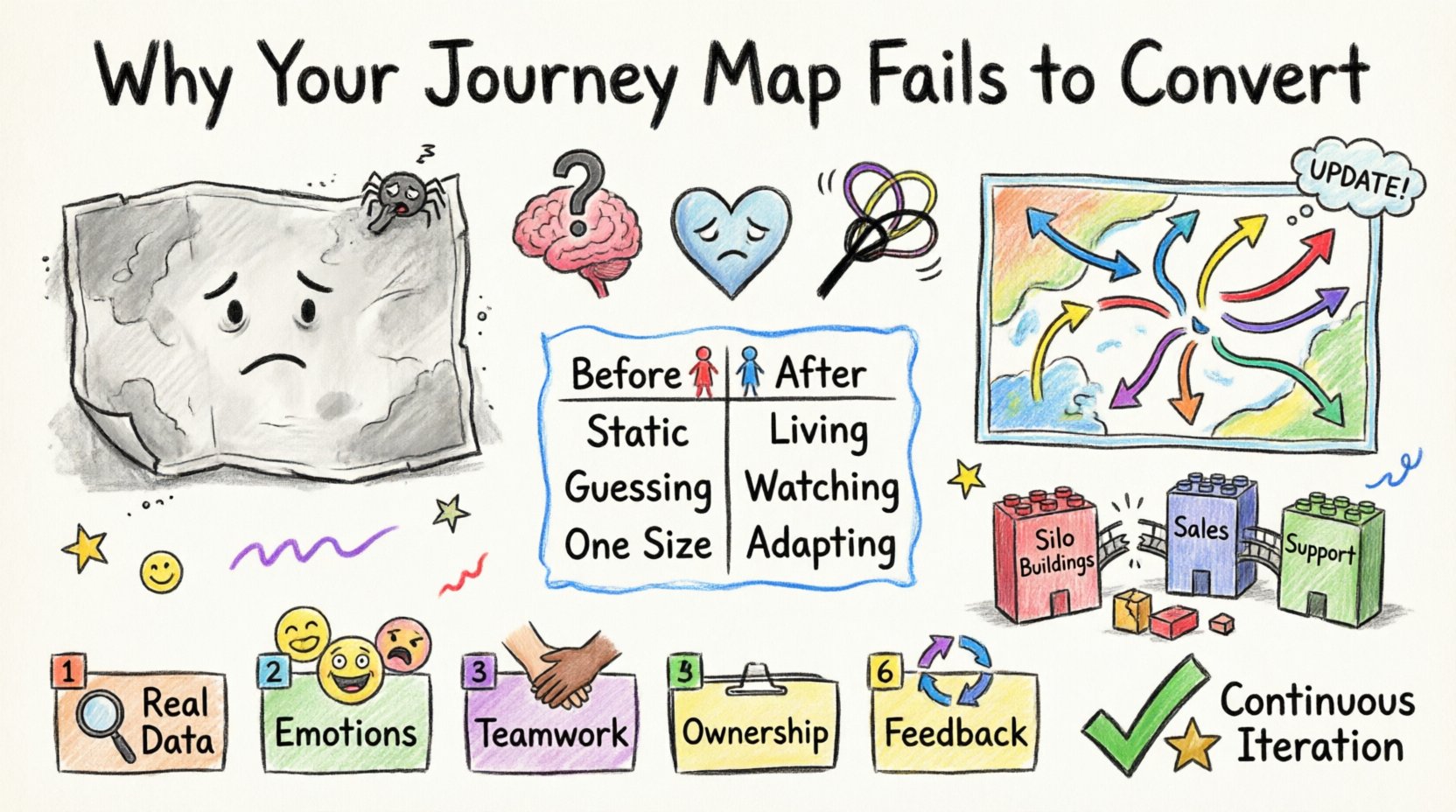
Creating a visual representation of the customer experience is a common initiative for modern businesses. Many teams invest significant time and resources into drawing out every touchpoint, from the first ad click to post-purchase support. However, a significant number of these documents end up gathering digital dust. They become static artifacts rather than living strategies that drive action. The gap between a theoretical map and actual conversion is often caused by fundamental structural errors in how the journey is defined, measured, and owned.
If your customer journey map is not influencing business outcomes, it is time to audit the underlying assumptions. This guide examines the specific reasons why journey mapping initiatives stall and provides actionable steps to realign your strategy with customer reality. We will move beyond the surface level to address data integrity, emotional context, and organizational alignment.
📉 The Problem: Static vs. Dynamic Thinking
Most journey maps are created as one-off projects. A workshop is held, diagrams are drawn, and the output is presented to leadership. Once the meeting ends, the map is archived. This approach treats the customer journey as a fixed path, which is rarely the case in the real world. Customers interact with brands across multiple devices, channels, and timeframes. Their behavior shifts based on market conditions, personal needs, and competitive offers.
When a map is static, it cannot account for:
- Seasonal fluctuations in customer intent
- New product launches or service changes
- Shifts in channel preference (e.g., moving from desktop to mobile)
- Emerging customer pain points not identified during the initial research
A map that does not evolve becomes obsolete quickly. It reflects a snapshot of the past rather than a tool for the future. To improve conversion, the map must be treated as a hypothesis that requires constant testing and validation.
🧩 Common Pitfalls That Kill Conversion
There are specific patterns that consistently lead to failure in journey mapping. Identifying these patterns is the first step toward correction. Below are the most frequent structural issues found in underperforming journey maps.
1. Relying on Internal Assumptions
One of the most damaging errors is building the map based on how the team thinks customers behave, rather than how they actually behave. This often happens when the research phase is skipped or relies solely on internal data.
Internal Data Blindspots:
- CRM data often shows what happened, not why it happened.
- Support tickets highlight issues, but not the proactive steps taken by the customer.
- Sales teams often assume the path to purchase is linear, which contradicts research.
Without direct customer input, such as interviews or behavioral analytics, the map is merely an internal opinion piece. This leads to strategies that solve problems customers do not have while ignoring those they actually face.
2. Ignoring the Emotional Arc
A journey map is not just a list of steps; it is a narrative of feelings. Customers make decisions based on emotion, logic, and trust. If a map focuses only on the functional steps (e.g., “Clicked Ad” -> “Filled Form”), it misses the psychological weight of those actions.
For example, a customer filling out a long registration form may feel frustration. If the map does not capture this friction, the team might optimize the form for speed without realizing the user needs reassurance or clarity. Emotional mapping requires asking specific questions about the customer state at each touchpoint.
3. The Linear Fallacy
Many maps depict a straight line from awareness to purchase. In reality, customer journeys are messy loops. A user might:
- Research a product, leave, and return weeks later.
- Visit a competitor, then come back to your site.
- Contact support before they even decide to buy.
- Share the product link with a friend who becomes the actual buyer.
Forcing a complex, non-linear experience into a linear diagram creates false expectations for the team. It suggests that if you optimize Step A, Step B will automatically follow. This is rarely true.
📊 Static vs. Dynamic Journey Maps: A Comparison
Understanding the difference between a static artifact and a dynamic tool is crucial for improvement. The following table highlights the key distinctions.
| Feature | Static Map (Ineffective) | Dynamic Map (Effective) |
|---|---|---|
| Creation Frequency | One-time workshop output | Regularly updated based on data |
| Data Source | Internal opinions and assumptions | Customer interviews, analytics, feedback |
| Focus | Process flow and steps | Customer emotions and pain points |
| Ownership | Marketing department only | Shared across all customer-facing teams |
| Usage | Presented once in a meeting | Referenced daily in decision-making |
| KPI Alignment | Generic brand awareness metrics | Specific conversion and retention goals |
🏢 Organizational Silos and Fragmentation
Even a perfectly designed map can fail if the organization cannot execute it. This is often the case when different departments own different parts of the journey without communication.
1. Channel Fragmentation
Marketing might run a campaign on social media that promises a specific offer. However, the sales team is unaware of this offer, and the support team is not prepared to handle inquiries about it. When a customer moves from one channel to another, the experience breaks. The map fails to account for the handoffs between teams.
Key Questions to Ask:
- Does the sales team know what the marketing team promised?
- Is the website content consistent with the email campaigns?
- Do support agents have access to the same history as the sales team?
2. Lack of Clear Ownership
When a map is created, who is responsible for its maintenance? If no one is assigned this role, the map becomes outdated as soon as a process changes. Conversion optimization requires agility. If a team member leaves or a strategy shifts, the map must reflect that immediately.
Assigning a “Journey Owner” or a cross-functional committee ensures that the map remains relevant. This person is responsible for gathering feedback, updating the visual representation, and ensuring that the insights are acted upon.
📏 Measurement and KPI Misalignment
A common reason for failure is measuring the wrong things. Teams often focus on vanity metrics like page views or session duration. While these indicate traffic, they do not indicate conversion or satisfaction.
1. Vanity vs. Value Metrics
High traffic does not equal high conversion. If a journey map is optimized for clicks, the team might create aggressive pop-ups that drive users away. Instead, focus on metrics that reflect the customer’s intent.
- Completion Rate: What percentage of users finish the specific step?
- Drop-off Rate: Where are users abandoning the process?
- Time to Value: How quickly does the customer achieve their goal?
- Customer Effort Score: How difficult was the journey for them?
2. Ignoring Negative Feedback
It is easy to highlight the smooth parts of a journey. It is harder to address the friction. Conversion drops often happen in the “dark zones” where customers struggle but do not complain. You must actively look for negative feedback signals, such as repeated form errors or high abandonment at checkout.
If your map does not explicitly track these negative signals, you will never know where the revenue is leaking.
🛠 How to Fix Your Journey Map
Once you have identified the failure points, you can begin the process of correction. This is not a one-time fix but a cycle of continuous improvement.
Step 1: Validate with Real Data
Stop relying on assumptions. Gather data from actual users. Use surveys, heatmaps, and session recordings to see where users actually go. Compare this data against your current map. Highlight the discrepancies. These discrepancies are your opportunities for improvement.
Step 2: Map the Emotions
Add an emotional layer to your existing map. For every step, ask: “How did the customer feel here?” Use a scale of frustration to delight. Identify the peaks of frustration. These are the priority areas for optimization. Reducing frustration is often more effective than increasing delight in the short term.
Step 3: Break Down Silos
Bring representatives from all relevant departments into the review process. Marketing, Sales, Product, and Support must all agree on the journey. If there is a conflict in the map, it usually means there is a conflict in the process. Resolve the process conflict first, then update the map.
Step 4: Define Clear Ownership
Assign a specific owner to the journey map. This person ensures that the map is updated when processes change. They also ensure that the insights from the map are communicated to the teams responsible for execution.
Step 5: Implement Feedback Loops
Create a system where the map informs the product or service roadmap. If the map shows a bottleneck at Step 4, the product team should prioritize fixing that specific step. This closes the loop between strategy and execution.
🔄 Continuous Iteration is Key
Customer behavior is not static. It evolves with technology, culture, and competition. A journey map that worked last year may not work today. This is why the concept of iteration is vital.
Regularly schedule reviews of the journey map. Quarterly reviews are common. During these reviews, ask:
- Has our customer base changed?
- Have we launched new features that alter the path?
- Are our conversion rates improving or declining?
- Do we have new data points that contradict our current map?
If the answer to any of these is yes, the map needs to change. Do not be afraid to scrap sections of the map that no longer reflect reality. A map is a tool, not a monument. Its value lies in its utility, not its permanence.
🎯 Final Thoughts on Journey Mapping Success
The failure of a journey map is rarely about the visual design. It is about the foundation of data, the alignment of the organization, and the commitment to continuous improvement. When teams treat the map as a strategic asset rather than a deliverable, conversion rates tend to follow.
Focus on the customer, not the process. Build empathy into the data. Align your teams. And keep the map alive. By doing so, you transform a static diagram into a dynamic engine for growth.
Remember that the goal is not to create a perfect map. The goal is to create a map that helps you make better decisions. If the map is not helping you decide, it is not serving its purpose. Revisit the assumptions, gather the data, and start the cycle again.