
When an experienced employee leaves an organization, the impact can extend far beyond the vacancy they create. They may take with them years of practical experience, knowledge of internal processes, familiarity with customers, an understanding of past decisions, and awareness of problems that are not documented anywhere.
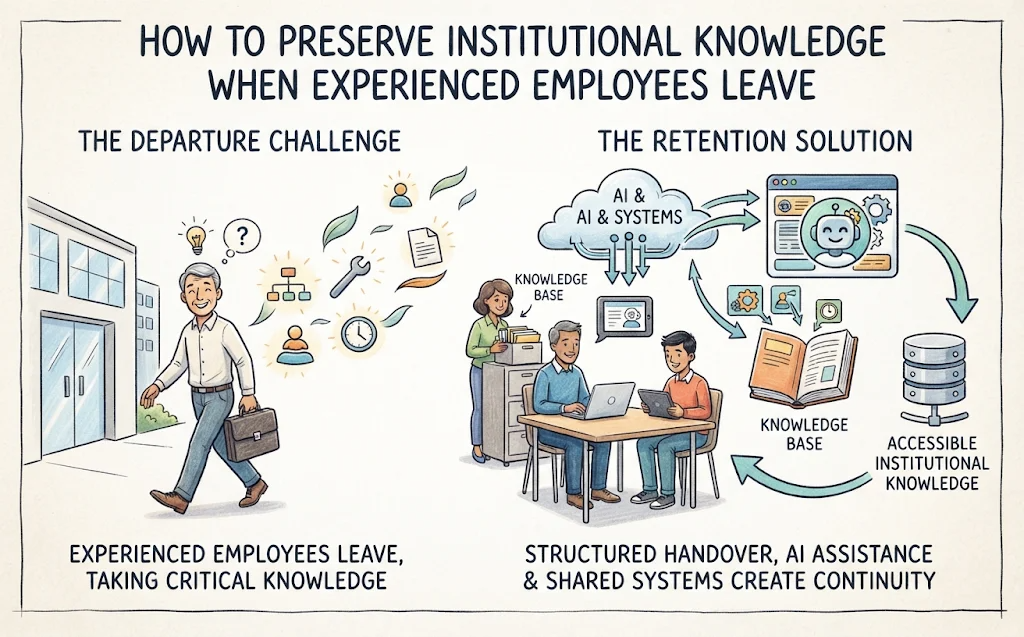
Some of this knowledge can be transferred through a handover document or a few meetings. Much of it, however, is accumulated gradually through everyday work. It may exist in personal notes, email conversations, project discussions, informal procedures, and the employee’s understanding of how things really get done.
This is the challenge of institutional knowledge retention. Businesses need ways to preserve important knowledge before it disappears, organize it so others can use it, and make it accessible long after the original knowledge holder has moved on.
Here are practical ways organizations can approach this challenge, including how AI can help turn scattered information into a more accessible source of organizational knowledge.
What Is Institutional Knowledge?
Institutional knowledge is the collective knowledge an organization develops through its people, experiences, activities, and history. It includes formal information, such as policies and procedures, as well as practical insights that employees acquire while doing their jobs.
Examples include:
- Knowledge of how internal processes are performed in practice.
- Lessons learned from previous projects and business decisions.
- Understanding of customer expectations and working relationships.
- Technical knowledge about systems, products, and infrastructure.
- Awareness of recurring problems and how they have been resolved.
- Knowledge of organizational history and the reasons behind established practices.
- Practical shortcuts, exceptions, and workarounds developed through experience.
Some institutional knowledge is documented and formally maintained. Other knowledge is informal and may be known only to a few employees.
Both types matter. A procedure document may explain the official process, for example, but an experienced employee may also know which steps commonly cause delays, which exceptions require special attention, and whom to contact when something goes wrong.
Why Does Knowledge Disappear When Experienced Employees Leave?
Employee departures are a normal part of business. People retire, change jobs, move to other departments, or pursue different opportunities. The problem is not that employees leave. It is that organizations often depend on knowledge that has never been properly captured or shared.
1. Important knowledge exists only in people’s minds
Employees develop expertise through repeated experience. They learn how to handle unusual situations, recognize warning signs, and make decisions based on context that is difficult to express in a formal procedure.
When this knowledge remains undocumented, it can be difficult for another employee to reproduce the same judgment or approach.
2. Handover documents cover tasks, not the full context
A typical employee handover may list current responsibilities, outstanding tasks, important contacts, and upcoming deadlines. This is useful, but it rarely captures the full history behind a role or project.
For example, a handover might say that a particular supplier should be used. It may not explain why that supplier was selected, which alternatives were considered, or what problems occurred with previous suppliers.
3. Knowledge is scattered across different systems
Employees often store information wherever it is convenient at the time: shared folders, email, spreadsheets, project management tools, meeting notes, and personal documents.
Even when useful information has been recorded, it may be difficult for colleagues to discover it. A new employee may not know which folder to search, which document is authoritative, or who originally made a particular decision.
4. Organizations rely on informal communication
In many teams, experienced employees become the people everyone approaches for answers. Colleagues ask them about procedures, technical issues, customer history, and exceptions because they know where the information is or how to handle the situation.
This informal knowledge network can work well while those employees remain available. However, it can create a dependency on individuals rather than on an accessible organizational knowledge base.
How to Preserve Institutional Knowledge Before Employees Leave
Knowledge retention should not begin only when an employee submits a resignation. Organizations can reduce knowledge loss by making knowledge sharing part of normal business operations.
1. Identify employees who hold critical knowledge
Start by identifying roles and individuals whose experience is particularly important to business continuity. This does not mean that only senior employees hold valuable knowledge. A long-serving administrator, technical specialist, customer service representative, or project coordinator may understand processes that few others know.
Useful questions include:
- Which tasks depend heavily on one person’s experience?
- Who understands systems or processes that are not fully documented?
- Which employees are frequently approached for advice?
- Which customer or project relationships rely on individual knowledge?
- What would become difficult if a particular employee were unavailable tomorrow?
This exercise helps identify knowledge-retention risks before they become urgent.
2. Document processes and practical procedures
Encourage employees to document how important work is performed. The objective is not to create lengthy manuals for every activity. It is to capture enough practical information for another qualified employee to understand and carry out the work.
Useful documentation may include:
- Step-by-step procedures for recurring tasks.
- Checklists for activities that require several stages.
- Instructions for using internal systems and tools.
- Common problems and recommended troubleshooting steps.
- Important exceptions and situations that require escalation.
Whenever possible, documentation should include real examples. A short explanation of how a process works in a typical situation, along with examples of unusual cases, can be more useful than a long description of abstract rules.
3. Record the reasons behind important decisions
Organizations often preserve the final outcome of a decision but lose the reasoning that led to it. This can create problems when a new team member needs to revisit the decision or determine whether it is still appropriate.
Consider recording:
- The problem or opportunity that prompted the decision.
- The options that were considered.
- The main reasons for choosing a particular approach.
- Important constraints, assumptions, and risks.
- The people involved and the date of the decision.
- Conditions that might justify reviewing the decision later.
This creates a more useful record than simply noting what was agreed. It helps future employees understand the context and avoid repeating earlier discussions unnecessarily.
4. Conduct structured knowledge-transfer sessions
Direct conversations remain one of the most effective ways to transfer practical experience. A structured knowledge-transfer session gives an experienced employee time to explain important responsibilities, demonstrate processes, and answer questions from colleagues.
Instead of relying on one general handover meeting, consider several focused sessions covering areas such as:
- Daily and recurring responsibilities.
- Important systems, tools, and workflows.
- Key customers, suppliers, and stakeholders.
- Ongoing projects and unresolved issues.
- Common exceptions and difficult situations.
- Lessons learned from previous work.
With the employee’s agreement and appropriate organizational policies, sessions can also be recorded or transcribed. These records can then be reviewed, organized, and converted into useful knowledge resources.
5. Encourage knowledge sharing throughout the employee lifecycle
It is risky to treat knowledge transfer as an activity that happens only during resignation or retirement. By that stage, there may be limited time to capture everything that matters.
Instead, encourage employees to contribute to shared knowledge resources as part of their regular work. Project teams can maintain decision logs, departments can review procedures periodically, and specialists can document recurring solutions to common problems.
New employees can also contribute by asking questions that reveal unclear procedures or missing documentation. Their questions often highlight knowledge that experienced colleagues take for granted.
Why a Knowledge Repository Is Not Enough
Creating a central repository is an important step, but simply collecting documents does not guarantee that organizational knowledge will remain useful.
A repository can become another collection of files that employees struggle to navigate. Information may be duplicated, outdated, poorly labeled, or difficult to locate. Employees may not know which document contains the answer they need.
For a knowledge repository to support long-term retention, organizations should consider three practical requirements:
- Organization: Information should be grouped and labeled in ways that reflect how employees search for and use it.
- Maintenance: Important content should have clear ownership and be reviewed when processes or circumstances change.
- Accessibility: Employees should be able to find relevant information without already knowing where it is stored.
The last requirement is particularly important. Preserving knowledge is only part of the challenge. Making that knowledge usable by other people is what gives it continuing value.
How AI Can Help Preserve and Reuse Institutional Knowledge
AI introduces another way to manage organizational knowledge. Rather than requiring employees to locate and read every relevant document manually, an AI assistant can help retrieve information from selected knowledge sources and answer questions in natural language.
This can be particularly useful when information comes from different employees, projects, and periods of time.
Make scattered knowledge easier to access
An AI-powered knowledge assistant can help employees search across connected documents, notes, and reference materials. Instead of remembering a filename or folder location, an employee can ask a question about a process, project, or previous decision.
For example:
- What did the previous project manager recommend when this issue occurred?
- Which documents describe the procedure for handling this type of request?
- What were the main lessons learned from the last implementation?
- Which meeting notes contain the discussion about this customer requirement?
When the relevant information is available and properly indexed, the assistant can retrieve related material and use it as context for its response.
Connect information from different records
Knowledge is often spread across several documents. A project decision may appear in meeting notes, a requirement may be recorded in a specification, and the final implementation may be described in a technical report.
AI can help employees explore connections between these records by answering questions that involve multiple sources. This can make it easier to understand how a project developed and why certain decisions were made.
Identify gaps and inconsistencies
AI can also assist with reviewing collections of documents to highlight possible contradictions, missing explanations, or outdated information.
For example, an organization might ask an AI assistant to compare two versions of a procedure or identify different explanations of the same project requirement. The findings can help knowledge owners decide which records need review.
These results should be treated as review suggestions rather than definitive conclusions. AI may miss context or interpret similar information as contradictory when the documents refer to different circumstances.
Turn unstructured notes into reusable documentation
Employees may record useful knowledge in informal notes, meeting summaries, or rough explanations. AI can help transform this material into more structured outputs, such as procedure drafts, project summaries, FAQs, and knowledge articles.
A knowledgeable employee should review the resulting content to confirm that important details have not been lost or misunderstood. Once approved, the material can become part of the organization’s shared knowledge resources.
Building a Continuous Knowledge-Retention Process
Preserving institutional knowledge is not a one-time project. It requires a repeatable process that connects knowledge creation, documentation, review, and reuse.
A practical approach can follow these steps:
- Identify critical knowledge. Determine which processes, decisions, relationships, and specialist skills would be difficult to replace.
- Capture knowledge regularly. Use documentation, meeting records, interviews, demonstrations, and project reviews to collect important information.
- Organize the material. Store information in shared resources with sensible categories, labels, and ownership.
- Make knowledge discoverable. Provide effective search and, where appropriate, AI-powered question answering across selected sources.
- Review and update content. Assign responsibility for checking important procedures and reference material when circumstances change.
- Encourage reuse. Make it normal for employees to consult and contribute to shared knowledge rather than relying exclusively on individual colleagues.
Organizations can begin with one department or a critical business process and expand the approach as they learn what works. The aim is to create a sustainable knowledge-sharing habit rather than an administrative burden.
Putting AI-Powered Knowledge Management into Practice
For organizations that want to make accumulated knowledge easier to preserve, search, and reuse, Visual Paradigm’s Private AI solution for enterprise knowledge brings together knowledge management tools, an AI assistant, documentation capabilities, and implementation services.
The solution includes NotesKeep for collecting and organizing corporate notes and documents, along with tailored AI prompts for repeatable knowledge-related tasks. Its AI Chatbot allows employees to ask questions using selected knowledge sources, helping them retrieve information and explore connections across organizational records.
OpenDocs provides a space for creating and organizing documentation, while the diagramming tools help teams turn written knowledge into visual representations of processes, systems, and structures.
Visual Paradigm also provides deployment setup, live online team training, and ongoing technical support. Organizations can explore self-hosted infrastructure or connect the tools to a cloud AI provider using their own account and endpoint credentials, depending on their requirements.
The broader objective is to help organizations move beyond simply storing documents. By making knowledge easier to capture, find, understand, and reuse, businesses can reduce their dependence on individual knowledge holders and build a stronger foundation for continuity.
Frequently Asked Questions
What is the difference between institutional knowledge and documented knowledge?
Documented knowledge is information that has been formally recorded, such as procedures, manuals, and reports. Institutional knowledge is broader. It includes documented information as well as practical experience, historical context, informal practices, and lessons learned by employees.
Why is institutional knowledge important when employees leave?
Experienced employees may understand processes, systems, customers, and past decisions that are not fully documented. If this knowledge is not transferred, the organization may face delays, repeated mistakes, reduced efficiency, or difficulty maintaining business continuity.
How can a business capture knowledge before an employee retires?
Start by identifying the employee’s critical responsibilities and areas of expertise. Conduct structured knowledge-transfer sessions, document important procedures and decisions, record practical examples, and involve colleagues who will take over the work. Begin well before the employee’s departure whenever possible.
Can AI preserve knowledge from employees who have left?
AI can help organize, retrieve, summarize, and analyze knowledge that has already been captured in documents, notes, recordings, and other approved sources. It cannot reliably recover information that was never recorded or made available to the system.
Does an AI knowledge management system replace a traditional knowledge base?
No. A well-organized knowledge base remains important because it provides the underlying information. AI can make that information easier to discover and explore through natural-language questions, but it does not eliminate the need for accurate documentation, ownership, and maintenance.
How often should institutional knowledge be reviewed?
Review frequency depends on the type of information. Frequently changing procedures may need regular checks, while historical project records may simply need to remain accurately archived and searchable. Each important knowledge resource should have a clear owner and a review process appropriate to its purpose.