
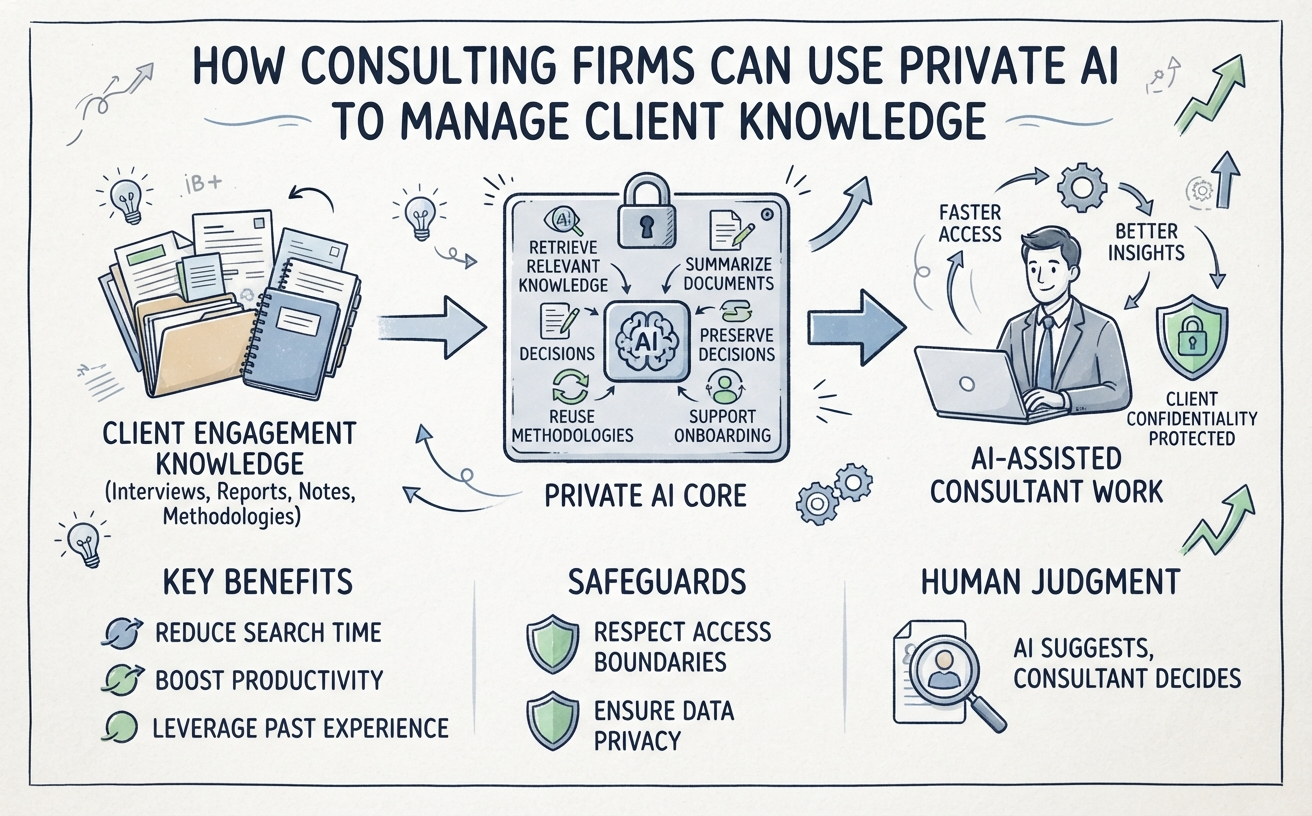
Every consulting engagement produces knowledge. Consultants review documents, conduct interviews, analyze business operations, develop recommendations, prepare presentations and record decisions. Over time, a consulting firm can accumulate an enormous amount of valuable experience.
Yet much of that knowledge is difficult to reuse. Previous project documents may be stored in different folders, important insights may exist only in meeting notes, and experienced consultants may remember useful approaches that have never been properly documented.
This creates a knowledge management challenge. Consultants need to find relevant information quickly, but they must also protect client confidentiality and avoid mixing information from unrelated engagements.
Private AI for consulting firms offers a way to address some of these challenges. By connecting AI tools to carefully selected organizational knowledge, firms can make relevant information easier to retrieve, summarize and apply in their work.
Why Client Knowledge Is Difficult to Manage
Consulting knowledge is created in many forms and across many different engagements. A single project might produce:
- Client interview notes and workshop records.
- Business requirements and process documentation.
- Research findings and market analysis.
- Project plans, status reports and decision logs.
- Presentations, proposals and final recommendations.
- Technical diagrams, operating models and specifications.
- Lessons learned and reusable methodologies.
These materials are not always stored in one place. Some may reside in document repositories, others in collaboration tools, project folders or individual working files.
Even when documents are centrally stored, finding the right information can be difficult. A consultant may know that the firm previously completed a similar engagement but not know which team handled it, what the project was called or where its deliverables are located.
Several problems commonly arise:
Knowledge is scattered across projects
Different teams may use different folder structures, naming conventions and documentation practices. This makes it harder to search across the firm’s collective experience.
Important context is missing
A final presentation may contain recommendations without fully explaining the interviews, assumptions or discussions that led to them. Without the supporting context, another consultant may struggle to understand why a decision was made.
Expertise remains with individuals
Experienced consultants often develop valuable knowledge about industries, clients, methodologies and recurring business problems. When that knowledge is not documented, it can be difficult for other team members to benefit from it.
Previous work is recreated unnecessarily
Consultants may spend time rebuilding research, templates or analyses that already exist somewhere within the organization. This is not necessarily because the firm lacks the knowledge, but because employees cannot find it when they need it.
What Private AI Can Bring to Consulting Knowledge Management
A private AI environment can help a consulting firm make selected internal knowledge more accessible through natural-language interaction.
Instead of relying entirely on folder navigation and keyword searches, a consultant could ask questions in ordinary language, such as:
- Have we previously worked on a similar business process improvement project?
- What were the main challenges identified in our earlier engagement?
- Which project documents describe the client’s requirements?
- What lessons did the team record after completing the project?
- Do we have an existing methodology or template for this type of analysis?
Depending on the solution’s knowledge sources, permissions and retrieval configuration, AI can help identify relevant material and summarize information from selected documents.
This does not mean the AI should replace consultants’ professional judgment. Rather, it can reduce the time spent locating and reviewing information, allowing consultants to focus more attention on analysis, client discussions and recommendations.
Seven Practical Ways Consulting Firms Can Use Private AI
1. Retrieve Relevant Knowledge from Previous Engagements
When a new client presents a familiar challenge, consultants may want to understand how the firm has approached similar situations in the past.
For example, a consultant working on a business process improvement engagement might ask:
Find previous projects involving order processing improvements. Summarize the main operational problems identified and the types of recommendations made.
An AI assistant connected to appropriate project records could help locate relevant documents and produce an initial summary for further review.
This can help consultants discover useful experience that might otherwise remain hidden in old project folders. It can also help new team members understand how the firm has approached comparable problems.
2. Summarize Large Collections of Client Documents
Consulting engagements can involve extensive documentation. A team may receive business reports, process descriptions, policy documents, meeting records and technical specifications before it has a complete understanding of the client’s situation.
AI can help consultants review these materials more efficiently by preparing summaries, extracting key points and organizing information around specific questions.
For example, a consultant could ask an AI assistant to summarize a collection of project documents according to:
- Business objectives and project scope.
- Stakeholder requirements.
- Existing operational problems.
- Known constraints and assumptions.
- Outstanding questions and decisions.
The resulting summary can serve as a starting point for analysis. Consultants should still check important details against the original documents, especially when preparing client-facing recommendations.
3. Preserve Engagement History and Decisions
Client engagements often involve many discussions and changes in direction. A decision made during a workshop may influence later requirements, project scope or recommendations.
If those decisions are not recorded clearly, team members may struggle to reconstruct the reasoning behind the current project direction.
By organizing meeting notes, decision records and project documentation in a searchable knowledge environment, a firm can make historical context easier to retrieve.
Consultants might ask:
Summarize the major decisions recorded during this engagement. For each decision, identify the available supporting notes and any unresolved issues.
This can be particularly useful when team members change, projects run over extended periods or a new consultant needs to understand the engagement’s history.
4. Identify Conflicting or Outdated Information
Client documentation is not always consistent. Different departments may describe the same process in different ways, and documents created at different times may contain conflicting requirements or assumptions.
AI can assist with comparing selected documents and highlighting potential inconsistencies for human investigation.
For example, a consultant could ask:
Compare these process descriptions and identify differences in the approval steps, responsible roles and stated processing times.
The assistant may help identify passages that appear inconsistent or refer to different versions of a process. Consultants can then verify whether the differences represent genuine conflicts, changes over time or simply different levels of detail.
This can support discovery and review activities, but AI-generated findings should not be treated as definitive evidence without checking the source material.
5. Reuse Methodologies, Templates and Best Practices
Consulting firms often develop reusable approaches for common business challenges. These may include assessment frameworks, workshop templates, interview questions, process modeling conventions and report structures.
Over time, such resources can become scattered across teams and projects.
A well-organized knowledge repository can make these materials easier to discover. An AI assistant can help consultants locate a relevant template, understand how it is used and identify supporting examples from previous work.
For instance, a consultant preparing a business analysis workshop might ask:
Find our existing workshop materials for stakeholder requirement gathering and summarize the recommended preparation steps.
By making reusable knowledge easier to find, firms can reduce duplicated effort and encourage more consistent working practices without preventing consultants from adapting their approach to individual clients.
6. Support Consultant Onboarding and Knowledge Transfer
New consultants need to learn more than the firm’s formal policies. They also need to understand its methodologies, terminology, industry experience and practical ways of working.
A searchable knowledge environment can help new team members find relevant internal guidance and learn from documented project experience.
Instead of asking colleagues to locate every resource manually, a new consultant might ask questions such as:
- What methodology does the firm use for process analysis?
- Where can I find examples of completed assessment reports?
- What should I prepare before conducting a stakeholder interview?
- Which internal guidelines apply when preparing a client deliverable?
This can make organizational knowledge more accessible and reduce the burden on senior consultants who would otherwise need to answer the same introductory questions repeatedly.
7. Turn Project Knowledge into Structured Deliverables
Consultants frequently need to transform unstructured information into clear business and technical deliverables.
For example, a collection of workshop notes and requirements may need to become a structured specification. A written description of an operational process may need to become a process diagram. A project review may need to become a formal report.
AI-assisted tools can help with the initial transformation of information into structured content.
Depending on the tools available, consultants may use AI to help:
- Draft project summaries and business reports.
- Organize requirements into structured specifications.
- Generate process descriptions and workflow diagrams.
- Prepare system documentation and technical models.
- Turn analysis findings into presentation-ready material.
Consultants remain responsible for validating the content, correcting errors and ensuring that deliverables reflect the client’s actual requirements.
Client Confidentiality: An Essential Consideration
Consulting firms often work with multiple clients, each with its own confidentiality requirements and contractual obligations. A knowledge management strategy must account for these boundaries from the beginning.
Making information searchable is valuable only when the right people can access the right information for the right purpose.
Before connecting client documents to an AI environment, firms should consider the following safeguards and practices.
Separate client information appropriately
Documents belonging to different clients should be organized and access-controlled according to the firm’s contractual and operational requirements. A consultant working on one engagement should not automatically gain access to another client’s confidential records.
Define who can access each knowledge source
Permissions should reflect project membership, responsibilities and information sensitivity. The firm should understand whether the AI retrieval process respects the same access boundaries as the underlying knowledge repository.
Review what information can be reused
Not all client material is suitable for reuse across engagements. A firm should distinguish between confidential client-specific information and reusable internal knowledge, such as approved methodologies, generic templates or lessons that have been appropriately anonymized and cleared for reuse.
Understand the AI deployment and data flows
Firms should examine where information is processed, which AI providers or services are involved, how data is retained and what contractual protections apply. Private AI can be deployed in different ways, including on premises, on dedicated cloud infrastructure or through an organization-managed cloud AI endpoint.
The appropriate arrangement depends on the firm’s confidentiality obligations, technical requirements and risk assessment. The term “private AI” alone should not be treated as proof that all client information is protected.
Keep human review in the process
AI-generated summaries, comparisons and recommendations should be reviewed before being used in client deliverables or important decisions. Consultants need to verify source material, assess context and apply professional judgment.
Building a Practical AI-Powered Knowledge Environment
A consulting firm does not need to make every document available to AI at once. A focused implementation can begin with a defined knowledge collection and a small number of useful workflows.
Step 1: Identify a specific knowledge problem
Start with a recurring difficulty. For example, consultants may struggle to find previous engagement examples, locate approved methodologies or understand the history of a project.
Choosing a clear problem makes it easier to determine which information sources and AI capabilities are actually needed.
Step 2: Select suitable knowledge sources
Identify the documents and records that can support the selected use case. These might include approved internal methodologies, reusable templates, project summaries or a specific collection of engagement records for which the necessary access and reuse permissions have been established.
Do not assume that every document should be included. The quality, relevance, ownership and permitted use of information matter more than the size of the repository.
Step 3: Organize information and access permissions
Review the selected material for duplication, outdated versions and unclear ownership. Establish appropriate access controls before enabling AI retrieval.
For a consulting firm, this may involve separating general internal knowledge from client-specific project information and applying additional restrictions to sensitive engagement records.
Step 4: Introduce AI-assisted retrieval
Connect the selected knowledge sources to an AI assistant or knowledge application that can retrieve relevant information in response to natural-language questions.
Test it with realistic questions from consultants. Check whether it finds the right material, handles incomplete information appropriately and respects the intended permissions.
Step 5: Expand into practical workflows
Once the initial use case is working reliably enough for its intended purpose, consider other workflows such as document summarization, engagement handovers, requirements analysis and report preparation.
Expansion should be guided by demonstrated value and appropriate controls, rather than simply connecting more information or adding more AI features.
Step 6: Maintain the knowledge environment
Assign responsibility for reviewing and updating the knowledge sources. Establish procedures for archiving old material, correcting inaccurate information and adjusting access when project responsibilities change.
A knowledge environment becomes less useful when employees cannot distinguish current guidance from outdated records. Ongoing maintenance is therefore an essential part of the implementation.
Measuring the Value of Private AI in a Consulting Firm
Consulting firms should evaluate AI in terms of improvements to actual work, not simply the number of questions employees ask an AI assistant.
Potential measures include:
- Information retrieval time: How long does it take consultants to locate relevant internal knowledge?
- Knowledge reuse: Are teams making better use of approved methodologies, templates and previous work?
- Onboarding efficiency: Can new consultants find internal guidance and understand established practices more easily?
- Document review effort: Does AI-assisted summarization help teams review large collections of material more efficiently?
- Knowledge continuity: Can teams preserve and retrieve important project decisions when personnel change?
- Deliverable preparation: Does AI reduce repetitive preparation work while maintaining appropriate quality checks?
Establish a baseline before introducing AI, then compare results after employees have had sufficient time to adopt the new workflows. Also gather qualitative feedback: consultants may identify benefits or problems that simple usage statistics do not reveal.
How Visual Paradigm Supports Private AI for Enterprise Knowledge
For consulting firms exploring an AI-powered knowledge environment, the technology needs to support more than conversational question answering. Consultants may need to collect and organize knowledge, retrieve information, analyze requirements and turn findings into structured documents or diagrams.
Visual Paradigm’s Private AI for Enterprise Knowledge solution brings together several capabilities that can support this type of work:
- NotesKeep: A knowledge management environment for organizing notes and documents as a shared source of organizational information.
- AI Chatbot: Natural-language interaction with selected knowledge sources, helping users ask questions and explore information.
- OpenDocs: Tools for creating and organizing documentation and reports.
- Diagram editing tools: Capabilities for developing structured visual models, such as business processes and technical diagrams.
- Implementation and support services: Assistance with software and AI endpoint setup, team training and ongoing technical advisory.
Depending on the firm’s requirements, the AI environment can use self-hosted infrastructure or connect to a cloud AI provider through an organization-managed account and endpoint. The appropriate arrangement should be evaluated against the firm’s client confidentiality obligations, infrastructure capabilities and operational requirements.
For a consulting organization, the potential benefit is a more connected way to manage internal knowledge and use it in everyday professional work—from finding relevant information to preparing structured deliverables.
Final Thoughts
Consulting firms invest considerable effort in developing expertise through client engagements. However, that experience becomes a lasting organizational asset only when it can be preserved, organized and made accessible to the people who need it.
Private AI can help bridge the gap between accumulated knowledge and practical use. It can assist consultants in finding previous work, reviewing documents, understanding project history, discovering reusable methodologies and preparing structured deliverables.
The most important starting point is not the AI model itself. It is a clear knowledge management strategy that respects client confidentiality, establishes appropriate access boundaries and identifies useful workflows.
With those foundations in place, AI can help consulting firms make better use of their collective experience while allowing consultants to concentrate on the judgment, problem-solving and client relationships that define their profession.
Frequently Asked Questions
What is private AI for consulting firms?
Private AI for consulting firms refers to an AI environment configured to support the firm’s business needs and its handling of organizational knowledge. It can help consultants retrieve and analyze selected internal information while allowing the firm to choose an appropriate deployment and data-handling arrangement.
How can AI help consulting firms manage client knowledge?
AI can help consultants search selected documents, summarize project records, retrieve previous engagement insights, compare information and prepare structured content. The usefulness of these capabilities depends on the quality of the knowledge sources, permissions and system configuration.
Can consulting firms use AI across multiple client projects?
Potentially, but access boundaries must be carefully designed. Client-specific information should only be available to authorized users and used in accordance with applicable contracts and confidentiality requirements. Firms should also distinguish client-confidential material from internal knowledge that is approved for reuse.
Can private AI help preserve consulting expertise?
Yes. By making documented methodologies, project summaries, lessons learned and other approved internal resources easier to retrieve, AI can help employees benefit from knowledge accumulated by colleagues and previous teams. It cannot preserve undocumented expertise automatically, so knowledge capture and maintenance remain important.
Does private AI require an on-premises server?
No. Depending on the solution, private AI may use on-premises infrastructure, dedicated cloud infrastructure or a cloud AI provider accessed through an organization-managed account and endpoint. Firms should evaluate the data flows, contractual requirements, security controls and costs of each approach.