
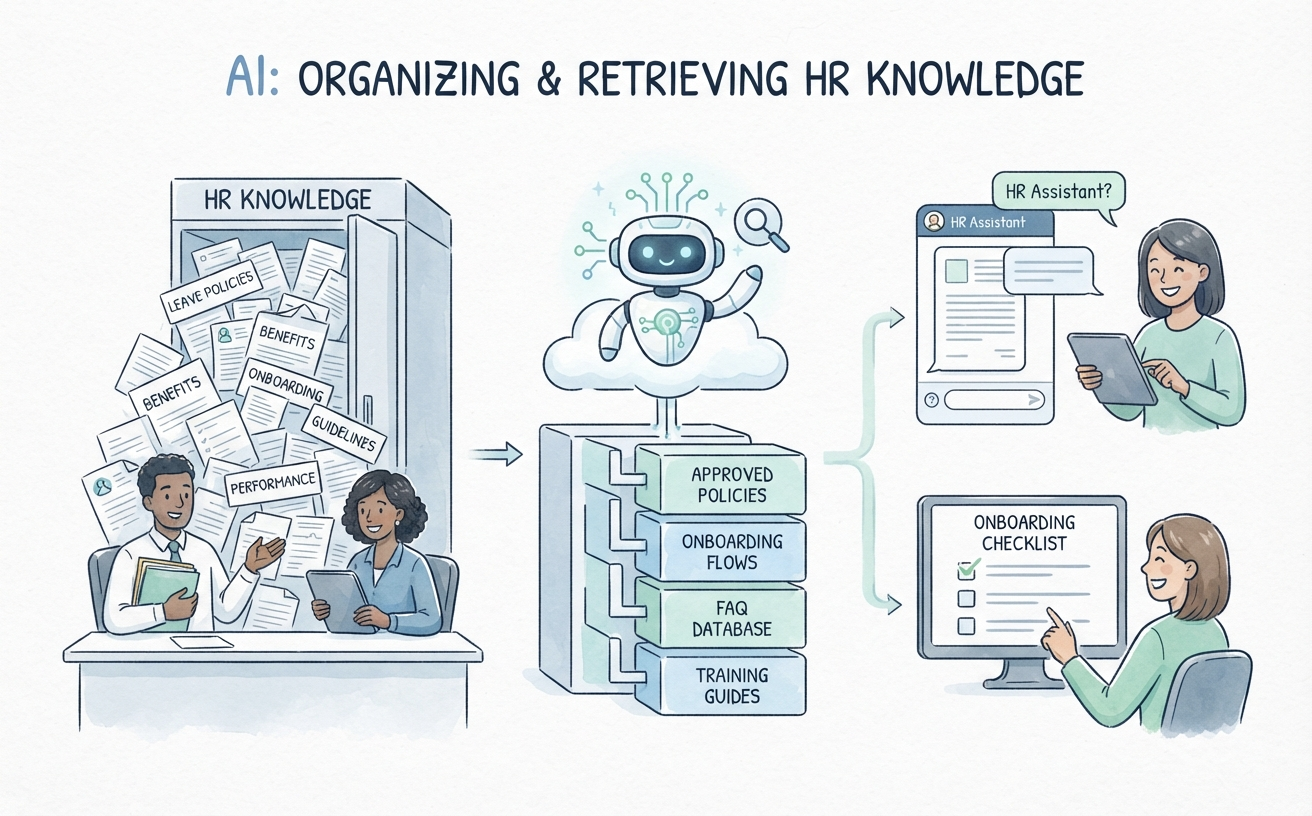
Human resources teams handle a constant flow of information. Employees ask about leave policies, benefits, onboarding procedures, training opportunities, performance processes and workplace guidelines. HR professionals must also maintain policy documents, recruitment materials, internal communications and records of decisions made over time.
As an organization grows, this information can become difficult to manage. Policies may be stored in different folders, older documents may remain in circulation, and employees may repeatedly contact HR to ask questions that have already been answered elsewhere.
AI can help HR teams make organizational knowledge easier to organize, search and use. When connected to approved company information, an AI-powered knowledge assistant can help employees find relevant guidance, support HR professionals with recurring enquiries and preserve knowledge that might otherwise remain scattered across documents and individual experience.
Why HR Knowledge Can Be Difficult to Manage
HR information is not limited to a single employee handbook or policy document. It is distributed across many sources and changes as the organization evolves.
Common challenges include:
- Information scattered across systems: Employee handbooks, policy documents, onboarding materials, training guides and internal announcements may be stored in different locations.
- Repeated employee questions: HR teams spend time answering recurring questions about leave, benefits, expenses, working arrangements and internal procedures.
- Outdated information: Employees may find an older policy or procedure and mistake it for the current version.
- Knowledge concentrated in individuals: Experienced HR professionals often understand the background behind policies and processes, but that knowledge may not be documented adequately.
- Complex information: Some HR policies contain exceptions, conditions and different procedures for different employee groups or locations.
- Confidentiality requirements: HR information includes sensitive personal and employment records that must not be exposed to people without appropriate authorization.
Simply storing more documents does not solve these problems. Employees need a practical way to find the right information, understand it in context and know when they should contact HR for assistance.
How AI Can Support HR Knowledge Management
An AI-powered knowledge assistant can work with approved HR documents and other selected company information to help users find and understand relevant content through natural-language questions.
Instead of searching through multiple folders or guessing which document contains an answer, an employee could ask a question in everyday language. The AI assistant can retrieve relevant information from connected sources and formulate a response based on the available material.
Here are several practical ways HR teams can use this approach.
1. Make HR Policies and Employee Guidelines Easier to Find
Employees may not know the exact name of a policy or where it is stored. They are more likely to ask questions such as:
- How many days of annual leave can I carry over?
- What is the process for requesting parental leave?
- Where can I find the company’s remote-working guidelines?
- What documents do I need to submit for an expense claim?
An AI assistant connected to approved HR knowledge sources can help retrieve the relevant policy or procedure without requiring employees to know its exact title.
This can make existing information more accessible and reduce the time employees spend looking for answers. It also gives HR teams an opportunity to make better use of the documentation they have already created.
2. Improve Employee Onboarding and New-Hire Support
New employees often have many questions during their first few weeks. They need to understand company policies, workplace procedures, available resources, reporting arrangements and administrative requirements.
HR teams can organize onboarding materials in a knowledge repository and connect them to an AI assistant. New employees can then ask questions as they work through the onboarding process.
For example, an employee might ask:
- What should I prepare before my first day?
- How do I request access to internal systems?
- Where can I find the staff handbook?
- What training is required during my first month?
The assistant can help direct employees to relevant guidance and explain documented procedures. This does not replace personal support from HR or managers, but it can make routine information easier to access at the moment it is needed.
3. Reduce Repetitive Questions Handled by HR
Many HR enquiries concern information that is already documented. Employees may contact the HR team repeatedly about benefits, leave entitlements, reimbursement procedures, training arrangements or internal application processes.
An AI knowledge assistant can handle some of these routine information requests by retrieving answers from approved documentation.
This may help HR teams:
- Reduce time spent locating and repeating standard information.
- Give employees access to guidance without waiting for an individual HR representative.
- Direct employees to the relevant policy, form or procedure.
- Identify topics that generate frequent questions and may need clearer documentation.
Not every question should be answered automatically. Personal employment matters, disputes, unusual circumstances and questions requiring professional judgment should be directed to an appropriate HR representative.
4. Preserve HR Knowledge and Historical Decisions
HR professionals develop valuable organizational knowledge through years of experience. They learn why certain procedures exist, how policies have evolved, what challenges have occurred during previous initiatives and how particular processes are handled in practice.
When experienced employees leave or change roles, some of this knowledge can be lost if it has not been documented.
HR teams can use a knowledge repository to preserve:
- Process documentation and internal operating procedures.
- Frequently asked questions and approved responses.
- Lessons learned from onboarding and employee-development initiatives.
- Documentation explaining changes to policies and processes.
- Knowledge-transfer notes prepared by departing team members.
AI can then help HR professionals retrieve and explore this material. For example, a new HR team member could ask how a particular internal process has changed over time or locate documentation about a previous training initiative.
The goal is not to replace experienced HR professionals with an AI system. It is to make useful organizational knowledge less dependent on individual memory.
5. Support Training and Employee Development
Organizations often maintain a substantial amount of information about internal training, professional development, competency frameworks and learning opportunities.
When this information is organized in accessible knowledge sources, employees and managers can use an AI assistant to explore available resources.
For example, employees might ask where to find training materials for a particular role, while managers might look for documented guidance on development planning or internal learning procedures.
HR professionals can also use AI to summarize training materials, prepare draft learning guides or identify related documents that should be reviewed together. Any resulting guidance should still be checked against approved company policies and learning requirements.
6. Identify Gaps and Inconsistencies in HR Documentation
HR documentation can become inconsistent as policies change and different departments create their own supporting materials.
For example, an employee handbook may describe one leave-request procedure while an older onboarding guide still refers to a previous process. A benefits document may also contain information that no longer matches the current policy.
AI can help HR professionals compare documents, summarize differences and identify information that may need review.
It can also help reveal gaps in the knowledge base. If employees repeatedly ask questions that are not clearly addressed by existing documentation, HR teams can use those enquiries as signals that additional guidance may be needed.
AI-generated findings should be treated as review suggestions, not authoritative decisions. HR professionals remain responsible for confirming which policy is current and approving any changes.
Important Consideration: Protecting Confidential HR Information
HR knowledge management requires particular care because not all HR information should be accessible to all employees.
There is an important difference between general organizational guidance and personal employment records.
Examples of general HR knowledge include:
- Employee handbooks and company-wide policies.
- Standard onboarding instructions.
- General benefits information.
- Training guides and learning resources.
- Approved procedures for leave requests and expense claims.
By contrast, information such as performance reviews, salary details, disciplinary records, medical information, individual employment cases and personal employee files requires much stricter access controls.
Organizations should not place all HR documents into one unrestricted AI knowledge source. A responsible implementation should consider:
- Access permissions: Users should only be able to retrieve information they are authorized to access.
- Knowledge-source separation: General employee guidance should be separated from restricted HR and personnel records where appropriate.
- Data handling: Organizations should understand how documents, prompts and responses are processed, stored and retained by the chosen AI infrastructure and service providers.
- Governance: HR teams should define which information can be connected to AI, who can manage it and how it should be reviewed.
- Human oversight: Sensitive employment matters and decisions affecting individuals should remain subject to appropriate human review.
A private or controlled AI environment can be part of an organization’s approach to managing corporate information, but the deployment model alone does not guarantee confidentiality. Effective protection depends on the complete architecture, permissions, infrastructure, configuration and operating practices.
Building an AI-Powered HR Knowledge Environment
Organizations interested in using AI for HR knowledge management should begin with a clearly defined scope rather than trying to connect every document at once.
Step 1: Identify the Most Useful HR Knowledge
Start with information that employees frequently need, such as the staff handbook, onboarding instructions, leave policies, benefits information and standard administrative procedures.
Prioritize documents that are approved, maintained and suitable for the intended audience.
Step 2: Organize and Review Existing Documents
Before connecting documents to an AI assistant, review their accuracy, ownership and version status. Remove or clearly archive outdated materials, identify duplicate documents and establish which source should be treated as authoritative.
Good information management is essential. AI cannot reliably resolve every ambiguity in poorly maintained documentation.
Step 3: Define Access Rules
Decide which information is available to all employees, which is restricted to HR staff and which requires more specific authorization.
Test the access model with realistic user scenarios. It is important to verify not only whether an authorized user can retrieve the right information, but also whether an unauthorized user is prevented from accessing restricted content.
Step 4: Connect an AI Assistant to Approved Knowledge Sources
Choose an AI solution that can retrieve information from the selected HR knowledge sources and respond to natural-language questions.
Where possible, responses should help users identify the documents or policies behind the answer. This makes it easier to verify information, especially when policies contain exceptions or conditions.
Step 5: Test with Realistic HR Questions
Test the system using common employee enquiries, onboarding questions and more complicated scenarios involving policy conditions.
Check whether the assistant retrieves the correct documents, handles missing information appropriately, distinguishes between current and outdated material, and directs users to HR when a question requires human judgment.
Step 6: Maintain and Improve the Knowledge Base
HR policies and procedures change. Assign responsibility for reviewing documents, updating knowledge sources and removing obsolete information.
Regularly review the questions employees ask and the responses they receive. These interactions can reveal documentation gaps, unclear policies and opportunities to improve the employee experience.
How Visual Paradigm Supports Private AI for Corporate Knowledge
Organizations exploring AI for HR knowledge management may benefit from an environment that combines document management, knowledge retrieval and tools for creating structured business documentation.
Visual Paradigm’s Private AI for Enterprise Knowledge brings together several capabilities that can support this approach:
- NotesKeep: Provides a place to organize corporate notes and documents, helping teams maintain a structured knowledge collection.
- AI Chatbot: Allows users to ask natural-language questions about selected corporate knowledge sources and explore the information they contain.
- Tailored AI Prompts: Helps teams establish reusable prompts and workflows for recurring tasks, such as summarizing documents or preparing structured information.
- OpenDocs: Supports the creation and organization of documentation and reports that can form part of an organization’s knowledge resources.
- Diagram Editing Tools: Help teams create visual representations of processes, responsibilities and workflows, making complex procedures easier to communicate.
The offering also includes implementation services, AI endpoint and infrastructure setup options, team training and ongoing technical support. Depending on organizational requirements, deployment can use self-hosted AI infrastructure or connect to a cloud AI provider through the organization’s own account and endpoint credentials.
For HR teams, these capabilities can provide a foundation for organizing approved knowledge, making internal information easier to explore and developing repeatable documentation workflows. As with any HR technology initiative, access controls and the treatment of sensitive employee information should be designed carefully before deployment.
Conclusion
HR teams manage knowledge that affects nearly every stage of the employee experience, from recruitment and onboarding to training, development and everyday workplace procedures.
When this knowledge is scattered across documents or concentrated in the experience of a few individuals, employees may struggle to find reliable answers and HR professionals may spend too much time handling repetitive enquiries.
AI can help make approved HR information easier to retrieve, support employee self-service, preserve organizational knowledge and identify documentation that needs attention. The greatest value comes when AI is introduced alongside sound knowledge management practices, clear access permissions and human oversight.
Rather than treating AI as a replacement for HR expertise, organizations can use it to make that expertise and the information behind it more accessible, consistent and reusable.
Explore Visual Paradigm’s Private AI for Enterprise Knowledge to learn how an integrated knowledge environment can help organizations put their corporate information to better use.