
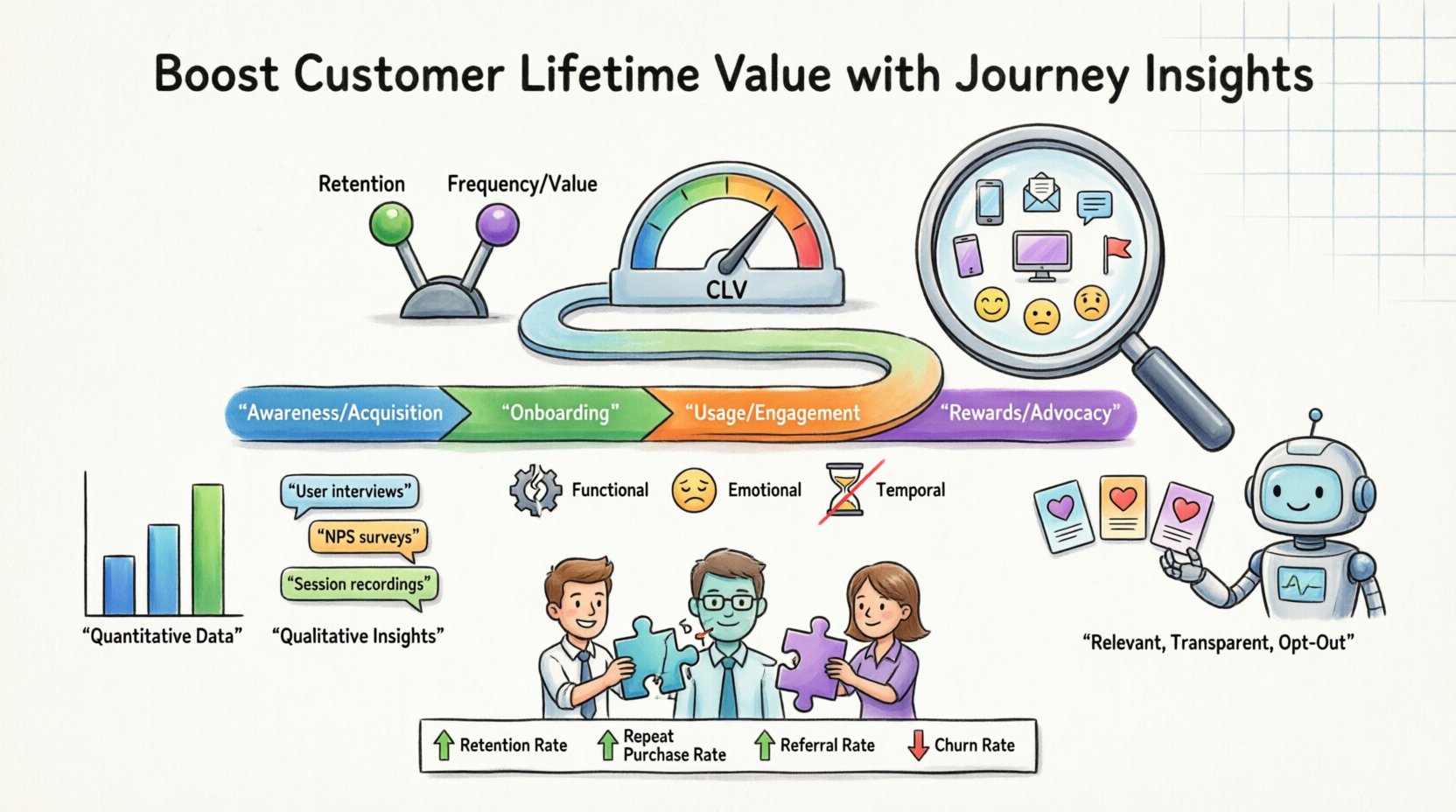
In the modern business landscape, customer acquisition costs continue to climb. While acquiring new users remains essential, the true engine of sustainable growth lies in maximizing the value of the customers you already have. This metric is known as Customer Lifetime Value (CLV). To increase CLV effectively, businesses must move beyond transactional thinking and adopt a holistic view of the customer experience. The key lies in understanding the nuances of the customer journey. By leveraging journey insights, organizations can identify opportunities to deepen relationships, increase retention, and drive higher spend over time.
This guide explores how to systematically improve lifetime value through deep journey insights. We will examine the connection between experience and revenue, discuss methods for gathering actionable data, and outline strategies for optimizing touchpoints without relying on specific vendor solutions.
🧠 Understanding the Core Metrics
Customer Lifetime Value represents the total net profit a company can expect to earn from a customer over the entire duration of their relationship. It is not merely a calculation of past purchases; it is a projection of future behavior based on historical data and current engagement patterns. Many organizations focus heavily on the acquisition phase, often neglecting the post-purchase experience. This oversight leads to a “leaky bucket” scenario where new revenue is constantly needed to replace churned accounts.
Improving CLV involves two primary levers:
- Increasing Retention: Keeping the customer active for a longer period.
- Increasing Frequency or Value: Encouraging more frequent purchases or higher-value transactions per interaction.
Journey insights provide the roadmap for pulling these levers. By understanding where customers succeed and where they struggle, you can make informed decisions that directly impact these metrics.
🗺️ The Anatomy of Journey Insights
Journey insights are the data points and qualitative feedback that reveal how a customer interacts with your brand across various channels and stages. Unlike standard analytics, which often focus on what happened, journey insights explain why it happened. They capture the emotional and functional context of the interaction.
Effective journey mapping requires looking beyond the linear path. Customers do not always follow a straight line from awareness to purchase. They may loop back, skip steps, or engage with multiple departments simultaneously. To gain true insights, you must analyze:
- Touchpoints: Every instance of contact, including website visits, support tickets, emails, and physical interactions.
- Channels: The medium used for the interaction, such as mobile app, desktop browser, or phone.
- Emotions: The sentiment expressed during the interaction, often found in feedback forms or support logs.
- Goals: What the customer was trying to achieve at that specific moment.
When these elements are synthesized, they create a narrative of the customer experience. This narrative highlights the friction points that drive churn and the moments of delight that drive loyalty.
📊 Mapping Stages to Value Drivers
Different stages of the customer lifecycle require different strategies to influence Lifetime Value. A strategy that works during the onboarding phase may not be effective during the renewal phase. Below is a breakdown of how journey insights apply to specific stages to drive value.
| Journey Stage | Primary Goal | Journey Insight Opportunity | LTV Impact |
|---|---|---|---|
| Awareness & Acquisition | Qualification | Understand which channels bring high-value prospects. | Reduces acquisition cost per high-LTV customer. |
| Onboarding | Activation | Identify steps where users drop off or feel confused. | Increases time-to-value and early retention. |
| Usage & Engagement | Habit Formation | Discover which features drive regular usage. | Encourages habit and reduces churn risk. |
| Rewards & Advocacy | Referral | Pinpoint moments of extreme satisfaction. | Generates organic growth and lowers CAC. |
By aligning your insights with these specific goals, you ensure that every optimization effort contributes directly to the bottom line.
🔍 Sourcing Data Without Tools
Gathering journey insights does not require expensive proprietary platforms. You can build a robust understanding of your customers using existing data sources and direct engagement. The focus should be on the quality of the data rather than the volume.
Quantitative Data
Look at the data you already have. Standard web analytics can reveal drop-off points in a funnel. CRM records can show purchase frequency and average order value. However, to understand the journey, you need to stitch these records together.
- Support Logs: Analyze recurring issues. If customers contact support frequently in the first week, your onboarding journey is likely flawed.
- Transaction History: Look for patterns in spend. Do customers who buy Product A also buy Product B within 30 days?
- Session Recordings: If available, watch how users navigate your digital interface. Where do they hesitate or click repeatedly?
Qualitative Data
Numbers tell you what is happening; people tell you why. Qualitative research fills in the gaps.
- Customer Interviews: Conduct one-on-one sessions with users who have high LTV and those who have churned. Ask about their decision-making process.
- Surveys: Deploy Net Promoter Score (NPS) or Customer Satisfaction (CSAT) surveys at key journey milestones.
- Focus Groups: Bring together small groups to discuss their experience with the brand.
🛑 Identifying and Removing Friction
Friction is the enemy of Lifetime Value. Every obstacle a customer encounters increases the likelihood of churn. Journey insights help you locate these obstacles. Friction often appears in three forms: functional, emotional, and temporal.
- Functional Friction: The system does not work as expected. Broken links, slow load times, or confusing forms fall into this category.
- Emotional Friction: The customer feels undervalued or frustrated. This often happens when communication is impersonal or when problems are not resolved quickly.
- Temporal Friction: The process takes too long. Waiting for a response or a delivery can cause a customer to seek alternatives.
Once identified, these friction points must be addressed systematically. For example, if journey data shows a spike in support contacts during the setup process, the documentation or the interface may need simplification. Removing friction is not just about fixing bugs; it is about respecting the customer’s time and effort.
👤 Personalization Without Creepiness
Personalization is a powerful tool for increasing LTV. When a customer feels understood, they are more likely to remain loyal. However, personalization based on journey insights must be handled with care to avoid being intrusive.
Use insights to deliver value, not just ads. If a customer frequently purchases a specific type of product, offer a reminder or a related accessory, not a generic discount. Timing is also critical. Sending an email during a moment of high engagement is more effective than sending it during a period of inactivity.
Key principles for ethical personalization include:
- Relevance: Ensure the content matches the customer’s current stage and needs.
- Transparency: Be clear about how data is being used.
- Opt-Out: Always provide easy ways for customers to pause communication.
📈 Measuring the ROI of Insights
To justify the effort of mapping and analyzing journeys, you must measure the impact on Lifetime Value. This requires establishing a baseline before implementing changes and tracking progress over time.
Consider the following metrics to gauge success:
- Retention Rate: Are customers staying longer after journey improvements?
- Churn Rate: Has the rate of customers leaving decreased?
- Repeat Purchase Rate: Are customers buying again more frequently?
- Referral Rate: Are satisfied customers recommending the brand to others?
It is important to segment these metrics by cohort. Look at how the journey changes affected specific groups of customers. This allows you to isolate the impact of specific interventions.
🤝 Organizational Alignment
Customer journey insights are not solely the responsibility of the marketing department. To truly improve LTV, the entire organization must be aligned around the customer experience. Silos often create fragmented journeys where the sales promise does not match the product delivery.
Share insights across teams:
- Product Teams: Need to know which features drive engagement.
- Support Teams: Need to know common pain points to improve resolution.
- Marketing Teams: Need to know the sentiment to refine messaging.
Regular cross-functional meetings can ensure that journey insights are translated into action across the business. This shared understanding ensures that every department contributes to a cohesive customer experience.
🔄 Evolving the Map Over Time
A customer journey map is not a static document. It is a living artifact that must evolve as the business and the market change. Customer expectations shift, new technologies emerge, and competitors introduce new offerings. A map that was accurate last year may be obsolete today.
Commit to regular updates. Schedule quarterly reviews of your journey data. Ask questions like:
- Have new channels emerged that we need to track?
- Have customer behaviors changed in response to external factors?
- Are there new pain points that have appeared?
Continuous iteration ensures that your strategies remain relevant and effective. It also signals to your team that customer experience is a priority that requires ongoing attention.
🔑 Key Takeaways for LTV Growth
Improving Lifetime Value is a strategic imperative that goes beyond simple upselling. It requires a deep understanding of the customer experience. By focusing on journey insights, you can create a more empathetic and efficient path for your users.
The core steps to success include:
- Define CLV clearly: Understand the metrics that matter to your specific business model.
- Collect diverse data: Combine quantitative analytics with qualitative feedback.
- Identify friction: Systematically remove obstacles that hinder progress.
- Align teams: Ensure the entire organization works toward a unified customer experience.
- Measure impact: Track retention and revenue changes resulting from insights.
When you treat the customer journey as a critical asset, you unlock sustainable growth. The focus shifts from short-term transactions to long-term relationships. This shift builds resilience and creates a foundation for lasting success in a competitive market.