
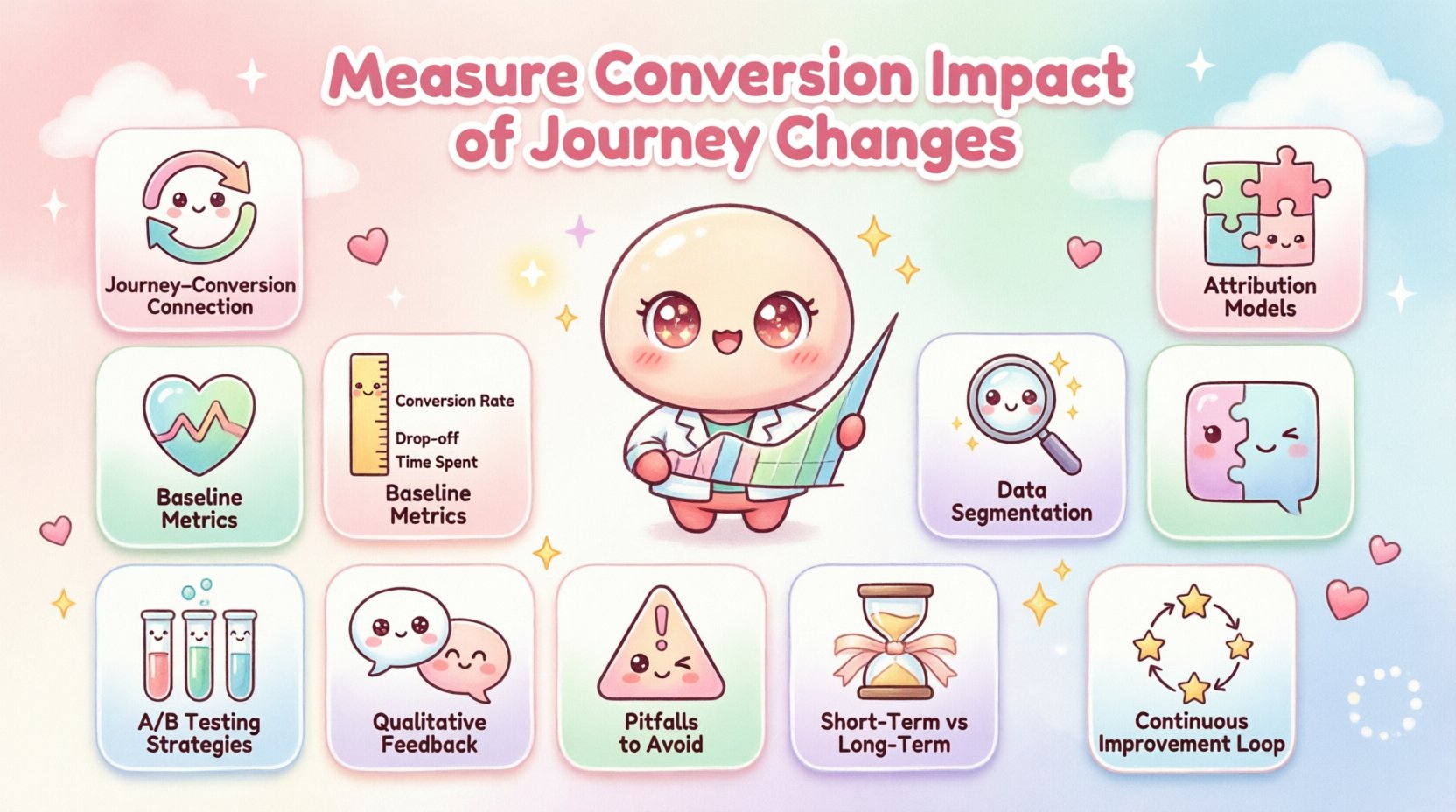
Customer journey mapping is a strategic exercise that visualizes the path a user takes to achieve a goal. However, the value of a map lies not in its creation, but in the actions taken after analyzing it. When teams modify touchpoints, streamline processes, or alter messaging within a journey, the immediate question becomes: did this change improve the outcome? To answer this, one must rigorously measure the conversion impact of journey changes. Without precise measurement, optimization efforts are based on assumptions rather than evidence.
This guide provides a structured approach to quantifying how adjustments to a customer journey influence conversion metrics. It covers the foundational metrics, testing methodologies, attribution logic, and the integration of qualitative feedback. By following these steps, organizations can ensure that every modification contributes positively to business objectives.
Understanding the Connection Between Journey and Conversion 🔄
Conversion is not a singular event; it is the culmination of interactions across multiple channels and touchpoints. A journey change might involve simplifying a checkout form, changing the order of steps in an onboarding flow, or altering the content on a landing page. The impact of these changes ripples through the data, affecting how users behave and ultimately whether they complete the desired action.
Measuring this impact requires a clear definition of what constitutes a conversion within the specific context. Is it a purchase? A sign-up? A demo request? Once defined, the relationship between the journey structure and the conversion event must be isolated. This involves distinguishing between correlation and causation. Just because a conversion rate rises after a change does not automatically mean the change caused the rise, though it is the primary hypothesis.
Key Considerations for Measurement:
Consistency of Definition: Ensure the conversion goal remains constant throughout the testing period.
Control Groups: Establish a baseline group that does not experience the change to compare against the experimental group.
Statistical Significance: Gather enough data to ensure the results are not due to random variance.
Contextual Factors: Account for external variables like seasonality, marketing campaigns, or economic shifts.
Establishing a Robust Baseline 📉
Before implementing any journey modification, it is critical to document the current performance. This baseline serves as the reference point for all future comparisons. Without a historical record, it is impossible to determine the delta created by the new strategy.
Collecting Historical Data
Review data from a period that represents typical user behavior. Avoid selecting a period with anomalies, such as a major holiday sale or a system outage. The goal is to understand the natural performance of the journey under normal conditions.
Baseline Metrics to Record:
Overall Conversion Rate: The percentage of users who complete the goal out of the total who started the journey.
Drop-off Rates: The percentage of users who leave at each specific step.
Average Time Spent: How long users take to move from entry to exit or completion.
Device and Channel Breakdown: Performance differences across mobile, desktop, or referral sources.
Revenue Per Visitor: If applicable, the monetary value generated per user entering the journey.
Core Metrics for Journey Analysis 📏
Different journey changes affect different metrics. A change to the visual design might impact click-through rates, while a change to the form length might impact completion rates. It is essential to track a balanced scorecard of metrics to get a holistic view of the impact.
The following table outlines primary metrics and what they indicate regarding journey health.
Metric | Definition | What It Indicates | Impact Sensitivity |
|---|---|---|---|
Conversion Rate | % of users completing the goal | Overall effectiveness of the journey | High |
Funnel Drop-off | % of users leaving at a step | Friction points or confusion | Medium |
Time on Page/Step | Duration spent at a specific point | Engagement level or hesitation | Medium |
Bounce Rate | % of users leaving immediately | Relevance of entry point | High |
Return Rate | % of users coming back | Retention and satisfaction | Low |
Task Success Rate | % of tasks completed correctly | Usability and clarity | High |
Methodologies for Attribution 🧩
Attribution is the process of assigning credit to specific touchpoints for a conversion. When a journey changes, the attribution model used to analyze the data becomes crucial. A poorly chosen model can mask the true impact of a modification.
1. Last-Touch Attribution
This model assigns 100% of the credit to the final interaction before conversion. It is simple to implement but often undervalues earlier touchpoints in the journey. If a change is made to a middle step, last-touch attribution might not show an impact because the final click remains the same.
2. First-Touch Attribution
This model credits the initial interaction. It is useful for understanding acquisition channels but ignores the optimization of the middle of the funnel. It can be misleading if the journey change occurs at the end of the path.
3. Multi-Touch Attribution
This approach distributes credit across multiple touchpoints. Linear attribution gives equal credit to all steps. Time-decay gives more credit to interactions closer to the conversion. Position-based attribution gives more weight to the first and last interactions. For measuring journey changes, multi-touch models often provide a more accurate picture of how specific steps contribute to the final outcome.
4. Incrementality Testing
The most rigorous method is incrementality testing. This involves comparing a group exposed to the new journey against a control group exposed to the old journey. By isolating the variable, you measure the true lift attributable to the change, excluding external factors.
Segmenting the Data for Precision 🔍
Averaging data across all users can hide significant insights. Different segments may react differently to journey changes. A modification that helps mobile users might frustrate desktop users. To measure impact accurately, data must be segmented.
Demographic and Behavioral Segments
New vs. Returning Users: New users may need more guidance, while returning users prefer speed.
Traffic Source: Users from paid ads may have different expectations than organic search users.
Geographic Location: Regional preferences can influence how a journey is perceived.
Device Type: Mobile users often have different interaction patterns than desktop users.
High-Value vs. Low-Value Segments
Not all conversions are equal. If a journey change increases the volume of conversions but decreases the average order value, the net impact might be negative. Segmenting by customer lifetime value or purchase history helps ensure that the journey optimization aligns with business profitability.
Testing Strategies and Execution 🧪
Implementation of journey changes should be supported by a structured testing framework. This minimizes risk and provides clear data on performance.
A/B Testing
Split traffic between the original journey (Control) and the modified journey (Variant). Ensure that the split is random to avoid bias. Run the test until statistical significance is reached. Do not stop early based on initial trends, as variance can be high in the beginning.
Multivariate Testing
If multiple elements within a journey are being tested simultaneously, multivariate testing allows you to see how combinations of changes perform. This is useful for understanding interactions between different parts of the journey, such as how a headline change affects button clicks.
Canary Releases
For larger journeys, release the change to a small percentage of users first. Monitor for errors or significant drops in performance. If the metrics look healthy, gradually increase the rollout percentage. This protects the majority of users from a potentially harmful change.
Qualitative Data Integration 🗣️
Quantitative data tells you what is happening, but qualitative data explains why. Numbers can show that drop-off increased at step three, but they cannot explain that users found the instructions confusing or the form too long.
Methods for Gathering Qualitative Insights
User Surveys: Deploy short pop-up surveys after the journey to ask about the experience.
Session Recordings: Watch recordings to see where users hesitate, rage-click, or scroll excessively.
Usability Testing: Observe users performing tasks in a controlled environment to identify friction points.
Customer Support Logs: Review tickets related to the journey to find common complaints or confusion.
Combining qualitative feedback with conversion metrics provides a complete narrative. If a journey change improves conversion rates but increases support tickets, the net value might be neutral. Understanding the user sentiment helps refine the journey further.
Common Pitfalls in Measurement ⚠️
Even with a solid plan, errors can occur during the measurement process. Being aware of these common pitfalls helps maintain data integrity.
1. Ignoring Seasonality
Conversions naturally fluctuate based on time of year, day of week, or time of day. Comparing a test run during a holiday period against a baseline from a quiet week will yield skewed results. Always compare like-with-like time periods.
2. Short Testing Windows
Running a test for only a few days can miss weekly patterns. A B2B journey might perform differently on Mondays than Fridays. Ensure the test runs for a full business cycle to capture representative data.
3. Data Latency
Attribution data often takes time to process. Relying on real-time dashboards can lead to premature decisions. Wait for data to stabilize before drawing conclusions.
4. P-Hacking
Looking at data repeatedly and stopping only when a significant result appears is a statistical error. Define the sample size and duration before starting the test and stick to the plan.
5. Overlooking Technical Errors
Sometimes a drop in conversion is due to a broken link, a slow loading page, or a bug in the tracking code rather than the journey design itself. Regular technical audits are necessary to rule out these issues.
Long-Term vs. Short-Term Impact ⏳
Some journey changes may boost immediate conversions but harm long-term retention. For example, making a sign-up process easier might increase the number of users, but if those users do not find value quickly, churn will rise. Conversely, a rigorous onboarding process might lower initial conversion but increase lifetime value.
Cohort Analysis
To understand long-term impact, use cohort analysis. Group users by the date they entered the journey and track their behavior over time. This reveals whether the change affected user quality, not just initial volume.
Long-Term Metrics to Monitor:
Retention Rate: Do users return after the initial conversion?
Churn Rate: Do users leave the platform sooner?
Customer Lifetime Value (CLV): Does the total revenue per user change?
Referral Rate: Are users more likely to recommend the service?
Reporting and Stakeholder Communication 📢
Once the data is collected and analyzed, the findings must be communicated effectively. Technical reports are often insufficient for decision-makers who need to understand the business implications.
Structuring the Report
Executive Summary: Briefly state the hypothesis, the change made, and the final outcome.
Key Findings: Highlight the most significant metric movements.
Visualizations: Use charts to show trends over time and comparisons between control and variant.
Qualitative Quotes: Include user feedback to humanize the data.
Recommendations: Propose next steps based on the evidence.
Handling Negative Results
Not every change will be successful. In fact, a negative result is valuable data. It indicates a boundary for what works. Communicate negative results transparently to prevent future waste. Documenting failed experiments builds an organizational knowledge base that helps avoid repeating mistakes.
Continuous Improvement Loop 🔄
Measurement is not a one-time event. It is part of a continuous cycle of improvement. The journey is dynamic, and user behavior evolves over time. What works today may not work next year.
Steps for the Loop
Measure: Collect data on current performance.
Analyze: Identify areas of friction or opportunity.
Hypothesize: Propose a change based on the analysis.
Test: Run an experiment to validate the hypothesis.
Implement: Roll out the winning variation.
Monitor: Track performance post-implementation to ensure stability.
By institutionalizing this loop, organizations can maintain a data-driven culture where decisions are grounded in evidence rather than intuition. This approach ensures that the customer journey remains optimized for the highest possible conversion rates over time.
Final Thoughts on Journey Optimization 🎯
Measuring the conversion impact of journey changes is a complex but necessary discipline. It requires a blend of quantitative rigor and qualitative empathy. By establishing clear baselines, selecting appropriate metrics, and utilizing robust testing methods, teams can confidently navigate the complexities of customer experience.
The goal is not merely to increase a number, but to understand the user better. Every data point represents a human interaction. When these interactions are measured and optimized correctly, the result is a journey that is more efficient, more satisfying, and more profitable for all parties involved.
Start with a clear definition of success. Gather the necessary data. Test your assumptions. Listen to the feedback. And always remain open to the possibility that the data will tell a story you did not expect. This is the essence of effective journey measurement.