
Every project manager knows the feeling. You have a solid plan, a clear budget, and a deadline. Then, a stakeholder suggests a small tweak. Another requests a feature addition. Before you know it, the original deliverables have shifted, and the budget is bleeding. This phenomenon is known as scope creep, and it is one of the leading causes of project failure.
Scope creep does not happen overnight. It is a gradual accumulation of uncontrolled changes and continuous growth in a project’s scope. Without strict boundaries, these small additions add up to significant costs, missed deadlines, and team burnout. The goal is not to say “no” to every request, but to manage the flow of change so that it aligns with financial realities.
This guide provides a comprehensive framework for identifying, preventing, and managing scope creep. We will explore the mechanics of budget overruns, the psychology behind change requests, and the structural controls necessary to keep your project on track. By implementing these strategies, you protect your resources and ensure delivery success.
🧐 Understanding Scope Creep: Definition and Origins
To stop scope creep, you must first understand what it is. It is distinct from a formal change order. A formal change order is a documented request that has been reviewed, approved, and priced. Scope creep is the accumulation of work that happens outside of this process.
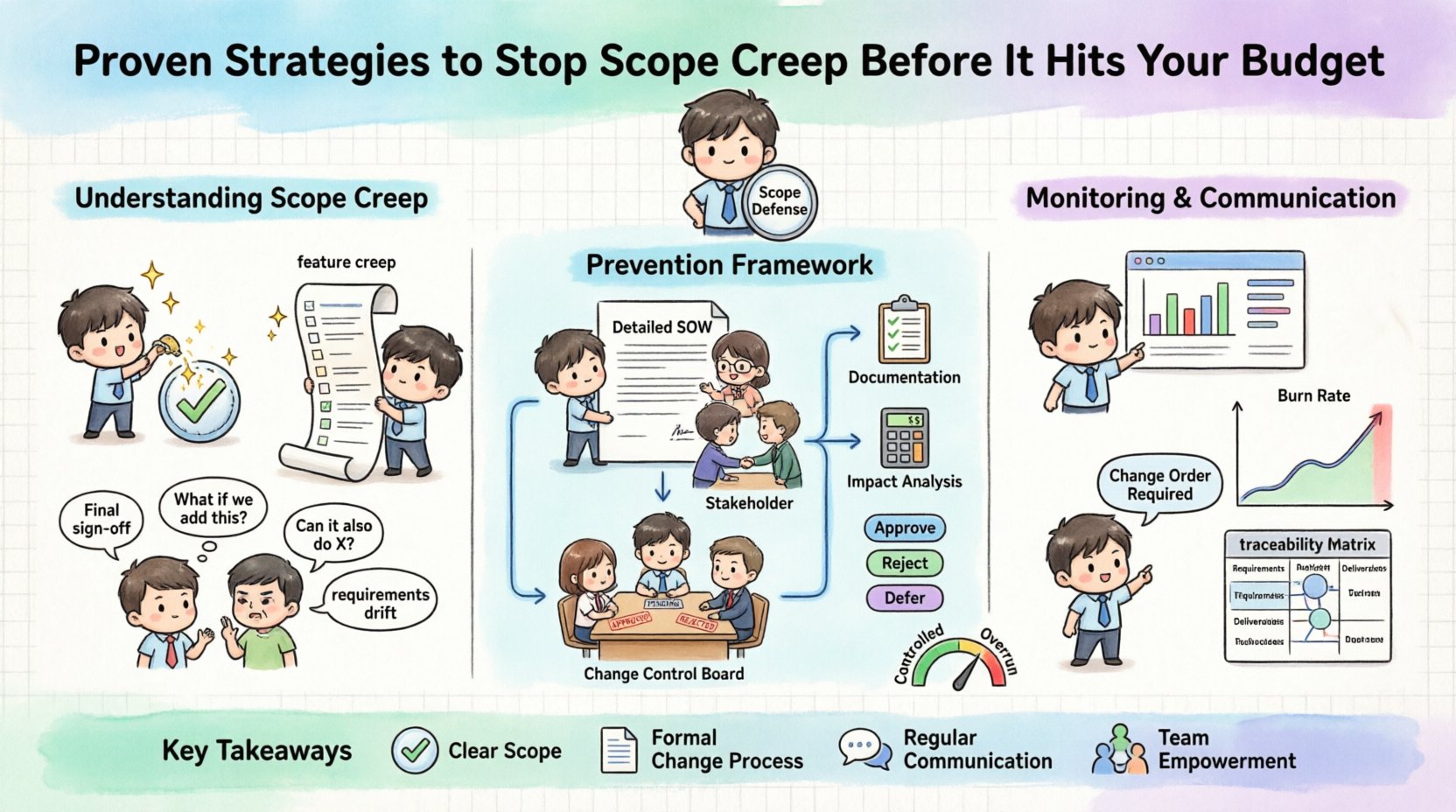
- Gold Plating: The team adds extra features the client did not ask for, believing it adds value.
- Feature Creep: The gradual addition of new features during development without adjusting the timeline or budget.
- Requirements Drift: Stakeholders change their minds about what they want as the project progresses.
These behaviors often stem from good intentions. Stakeholders want the best outcome, and team members want to deliver excellence. However, without a gatekeeping mechanism, good intentions lead to budget exhaustion.
💸 The Financial Impact of Uncontrolled Changes
Scope creep is primarily a financial issue disguised as a technical one. When requirements expand, costs rise. This impact is often underestimated until it is too late.
Direct Costs
Every additional hour of labor, every new piece of hardware, and every extra license fee adds to the bottom line. If a project was budgeted for 100 hours and 120 are now required, the direct cost increase is 20%. If the hourly rate is high, this can wipe out profit margins entirely.
Indirect Costs
Beyond labor, there are hidden costs. These include:
- Management Overhead: More time spent coordinating, meeting, and tracking changes.
- Opportunity Cost: Resources tied up in an over-scoped project cannot be deployed to new revenue-generating work.
- Quality Risk: Rushing to accommodate new scope often leads to technical debt or bugs, increasing post-launch maintenance costs.
🛡️ Pre-Project Defense: Planning and Definition
The strongest defense against scope creep is built before the first line of code is written or the first brick is laid. Prevention starts with clarity.
1. Detailed Statement of Work (SOW)
A vague SOW invites ambiguity. Your project definition document must be exhaustive. It should explicitly list what is included and, crucially, what is excluded.
- Deliverables: List every tangible output required.
- Assumptions: Document the conditions under which the project is being delivered.
- Constraints: Clearly state limitations regarding technology, timeline, or budget.
2. Stakeholder Expectation Alignment
Before signing off, review the requirements with every key stakeholder. Ensure they understand that a change later will cost more. This sets a psychological baseline that change has a price tag.
3. The Change Control Board (CCB)
Establish a governance structure before work begins. A Change Control Board is a group of key decision-makers who review, approve, or reject change requests. Their role is to weigh the impact of a change against the available budget and timeline.
| Phase | Activity | Owner |
|---|---|---|
| Initiation | Define Scope and Budget | Project Manager |
| Planning | Establish Change Process | PM + Sponsors |
| Execution | Monitor Variances | Team Leads |
| Monitoring | Approve/Reject Changes | CCB |
🔄 The Change Management Process
When a change request comes in, it must go through a formal workflow. Ad-hoc requests are the enemy of budget control. Every request, no matter how small, should trigger the following steps.
Step 1: Documentation
Never accept verbal requests. Require a written description of what the stakeholder wants to add. This forces them to think about the request seriously and provides a record for future reference.
Step 2: Impact Analysis
Before discussing approval, you must calculate the impact. This analysis should cover:
- Cost: How many additional hours are needed?
- Time: Does this delay the launch date?
- Resources: Do we have the staff to handle this?
- Risk: Does this introduce new technical risks?
Step 3: Decision Making
Present the impact analysis to the CCB. They have three options:
- Approve: The change is accepted, and the budget/timeline is adjusted.
- Reject: The change is denied to protect the original scope.
- Defer: The change is accepted but pushed to a future phase or release.
🗣️ Communication Protocols with Stakeholders
Technical controls are useless without effective communication. You must manage the relationship between the project team and the stakeholders.
1. Regular Status Reporting
Schedule consistent meetings to report progress. When stakeholders see the project moving forward, they are less likely to introduce surprise requests. Transparency builds trust.
2. The Power of “No”
Learning to say no is a critical skill. It is not about being unhelpful; it is about being responsible. Use phrases like:
- “We can do that, but it will require a change order.”
- “This is outside the current agreement. We can discuss adding it to phase two.”
- “To include this, we would need to delay the launch by two weeks.”
3. Managing the “Happy Path”
Stakeholders often imagine the perfect scenario without considering edge cases. Your job is to show them the reality. Explain why a specific feature might be complex and how it affects the overall system. Educate them on the trade-offs.
📊 Monitoring and Tracking
You cannot manage what you do not measure. Continuous monitoring is essential to catch scope creep early.
Earned Value Management (EVM)
While technical, EVM is a powerful tool for tracking performance. It compares the work planned, the work completed, and the actual cost. If the Planned Value differs significantly from the Actual Cost, it signals a deviation that needs investigation.
Burn Rate Analysis
Track how quickly your budget is being spent. If the burn rate accelerates without a corresponding increase in deliverables, scope creep may be occurring. Investigate the tasks causing the spend.
Requirement Traceability Matrix
Maintain a document that links every requirement to a specific deliverable. If a task appears that is not linked to a requirement, it is likely unauthorized scope. Review this matrix weekly.
📜 Contractual Protections
If you are working on a fixed-price contract, the financial risk falls entirely on the service provider. You need legal safeguards.
1. Clear Acceptance Criteria
Define exactly what constitutes “done.” This prevents stakeholders from claiming the work is incomplete to justify more work.
2. Change Order Clauses
Ensure the contract states that any work outside the original scope requires a signed change order and additional payment. This legal backing reinforces the process.
3. Termination for Convenience
Include clauses that allow either party to stop the project with notice. This protects you if the scope expands beyond what is financially viable.
🤝 Team Culture and Psychology
Scope creep often happens because the team wants to please the client. You must cultivate a culture of discipline.
1. Empower the Team
Encourage team members to push back on unauthorized requests. If a developer receives an email from a stakeholder asking for a change, they should route it to the Project Manager. Do not allow direct communication to bypass the process.
2. Celebrate Adherence to Scope
Recognize the team when they successfully deliver within the agreed boundaries. Reinforce that sticking to the plan is a sign of professionalism, not rigidity.
3. Avoid Heroics
Do not reward team members who work overtime to accommodate extra work without compensation. This sets a precedent that extra work is expected for free.
🚧 Common Pitfalls to Avoid
Even with a plan, mistakes happen. Here are common errors that lead to budget overruns.
- Ignoring Small Requests: “It’s just a small fix.” Small fixes add up to a large project.
- Informal Approvals: Getting a verbal “yes” from a sponsor without a paper trail.
- Weak Requirements: Starting with “we will figure it out as we go” is a recipe for disaster.
- Failing to Update the Plan: If you approve a change, you must update the project schedule and budget immediately. Failing to do so makes the variance invisible.
🔄 Recovery Strategies
If scope creep has already happened, you can still recover. It requires honesty and corrective action.
1. Stop the Bleeding
Freeze all new work immediately. Acknowledge the current state of the project. Do not accept new requests until the existing variance is addressed.
2. Re-baseline the Project
Work with stakeholders to re-define the scope. This might mean removing features that were planned originally to accommodate the new ones. Cut the low-value items to save the high-value ones.
3. Negotiate Resources
If the budget is exhausted, negotiate for additional funding. Be prepared to show the data: “To achieve these additional features, we need $X more.”
🔍 Frequently Asked Questions
What is the difference between a change and scope creep?
A change is a formal, documented, and approved modification to the project plan. Scope creep is informal, undocumented, and unapproved growth in the project scope.
How do I handle a stakeholder who insists a small change is free?
Politely explain that while the change is small, it impacts the schedule and resources. Offer to add it to the next phase or require a formal change order that adjusts the timeline.
Can agile methodologies prevent scope creep?
Agile allows for flexibility, but it still requires a backlog and sprint planning. Without prioritization and time-boxing, agile projects can suffer from feature creep. The key is discipline in sprint boundaries.
What if the budget is already over?
Immediate communication is required. Inform stakeholders of the variance and propose options: reduce scope, increase budget, or extend the timeline.
🔚 Summary
Protecting your budget from scope creep requires a combination of rigorous planning, clear communication, and strict governance. It is not about being difficult; it is about ensuring the project delivers value within the agreed constraints.
By defining scope clearly, enforcing a change control process, and maintaining open lines of communication, you can navigate the complexities of project management. The strategies outlined here provide a roadmap for maintaining control. When you manage change effectively, you protect your team, your budget, and your reputation.
Remember, the goal is delivery, not perfection. Delivering a project on time and on budget is often more valuable than delivering a perfect project that is late and over cost. Stay vigilant, document everything, and keep the focus on the original objectives.