
Mastering Business Architecture: A Step-by-Step Guide to the Motivation and Strategy Layers in ArchiMate
Architecting complex systems requires more than just drawing boxes and lines; it requires telling a story of why a system is being built and how it delivers value. In enterprise architecture, specifically using the ArchiMate framework, this narrative is structured into distinct layers. Today, we will dive deep into the relationship between the Motivation Layer and the Strategy Layer.
This tutorial will walk you through a practical scenario: Automating Order Processing. By the end of this article, you will understand how to trace a business driver from a high-level strategic goal down to a specific technical capability.
Understanding the Core Layers
Before we look at the specific diagram, let’s define the two critical areas we are exploring:
- The Motivation Layer (The “Why”): This layer deals with the forces that drive the enterprise. It captures the stakeholders, their concerns, the specific goals they want to achieve, and the requirements necessary to get there. It answers the question: “What problem are we solving?”
- The Strategy Layer (The “What” & “How”): This layer translates the motivation into concrete plans. It defines the capabilities the organization needs to build or acquire and the specific courses of action (projects or initiatives) required to realize those capabilities.
Case Study: Reducing Order-Processing Costs
Let’s visualize how these layers interact using a standard Enterprise Architecture model. Imagine a Chief Operations Officer (COO) looking at the company’s current state and identifying a significant problem.
1. The Motivation Layer: Identifying the Problem
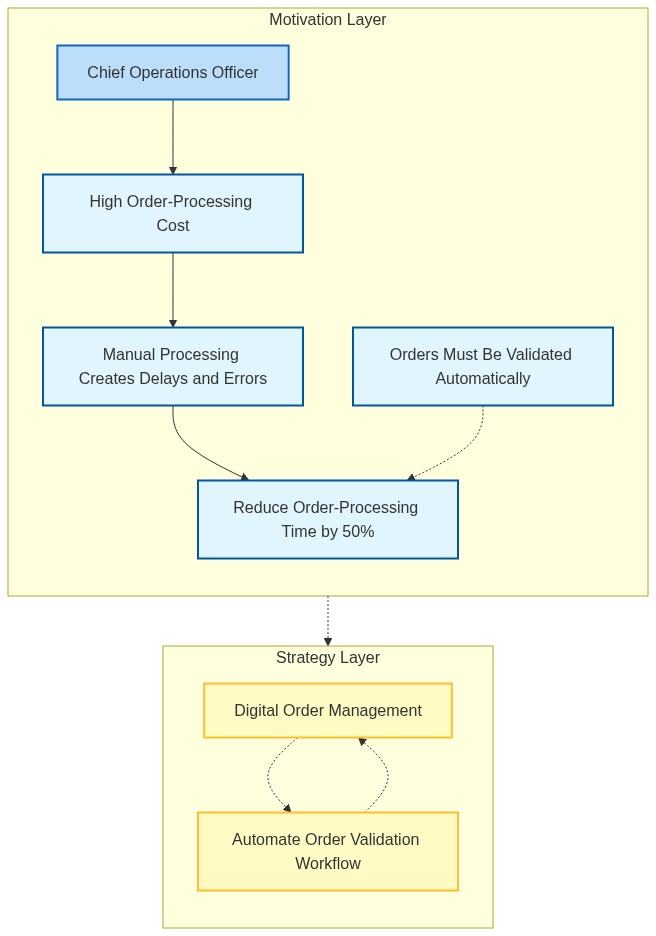
The journey begins at the top of the Motivation Layer with the Stakeholder. In our scenario, the Chief Operations Officer is the key driver.
- Driver (The Problem): The COO is concerned about High Order-Processing Costs. This is an internal force (an “Antecedent”) that creates tension within the organization.
- Assessment (The Analysis): To understand the root cause, the organization assesses the current situation. They determine that Manual Processing Creates Delays and Errors. This is a structural weakness in the current state.
- Goal (The Target): Motivated by the high costs and the assessment of manual errors, the organization sets a clear Goal: Reduce Order-Processing Time by 50%.
- Requirement (The Constraint): To achieve this goal, a specific Requirement is established: Orders Must Be Validated Automatically. This requirement acts as a bridge, connecting the “Why” to the “How.”
2. The Strategy Layer: Defining the Solution
Once the requirements are clear, the architecture moves to the Strategy Layer to define the structural changes needed.
- Capability (The Capacity): To satisfy the requirement for automatic validation, the organization needs a new Capability: Digital Order Management. A capability represents a stable ability of the enterprise to perform an activity.
- Course of Action (The Initiative): Finally, to activate this capability, the organization defines a specific Course of Action: Automate Order Validation Workflow. This is the project or initiative that will be executed.
Visualizing the Architecture
The following diagram illustrates the logical flow from the human concern down to the technical implementation. Notice the distinct visual separation between the Motivation Layer (bottom) and the Strategy Layer (top).
graph TD
    %% Styling
    classDef motivation fill:#e1f5fe,stroke:#01579b,stroke-width:2px;
    classDef strategy fill:#fff9c4,stroke:#fbc02d,stroke-width:2px;
    classDef stakeholder fill:#bbdefb,stroke:#1565c0,stroke-width:2px;

    %% Motivation Layer
    subgraph Motivation["Motivation Layer"]
        direction TB
        Stakeholder[Chief Operations Officer]:::stakeholder
        Driver[High Order-Processing Cost]:::motivation
        Assessment[Manual Processing Creates Delays and Errors]:::motivation
        Goal[Reduce Order-Processing Time by 50%]:::motivation
        Requirement[Orders Must Be Validated Automatically]:::motivation
    end

    %% Strategy Layer
    subgraph Strategy["Strategy Layer"]
        direction TB
        Capability[Digital Order Management]:::strategy
        CourseOfAction[Automate Order Validation Workflow]:::strategy
    end

    %% Relationships
    Stakeholder --> Driver
    Driver --> Assessment
    Assessment --> Goal
    Requirement -.-> Goal
    Requirement -.-> Capability
    Capability -.-> CourseOfAction
    CourseOfAction -.-> Capability

    %% Layout Hints (Visual only)
    style Motivation fill:none,stroke:#333,stroke-dasharray: 5 5
    style Strategy fill:none,stroke:#333,stroke-dasharray: 5 5
Figure 1: Logical flow of the Order Processing Architecture Model
Key Takeaways for Architects
When designing your own architecture models, remember these three critical insights based on this example:
- Traceability is Key: Notice how the
Requirement(Orders Must Be Validated) connects directly to theCapability(Digital Order Management). This ensures that every piece of software or process you build has a direct lineage to a business requirement. - Capabilities vs. Actions: A common confusion is between Courses of Action and Capabilities.
- Courses of Action are temporary or specific projects (e.g., “Automate Workflow”).
- Capabilities are the enduring abilities the organization gains (e.g., “Digital Order Management”).
- Business Value Drives Design: The entire diagram starts with “High Order-Processing Cost.” If you cannot trace a technical component back to a “Driver” or “Goal” in the Motivation Layer, that component may be unnecessary technical debt.
By mastering the link between the Motivation and Strategy layers, you ensure that your architecture is not just a technical drawing, but a strategic roadmap for business success.