
Nobel Prize Workflow in Visual Paradigm: BPMN for Complex Processes
In the world of business process modeling, few scenarios are as intricate and compliance-heavy as the annual Nobel Prize nomination process. This workflow involves strict deadlines, high-stakes decision-making, and a complex interplay between different entities like the Nobel Committee and the University. In this tutorial, we will break down the architecture of this process as modeled in Visual Paradigm, focusing on how to handle complex logic, role-based responsibilities, and state transitions.
Understanding the Architecture: Swimlanes and Context
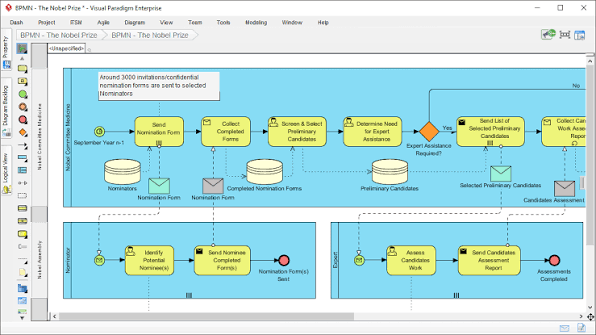
The diagram provided illustrates a sophisticated process flow split into two distinct swimlanes. In BPMN (Business Process Model and Notation), swimlanes are used to organize activities and show which role or department is responsible for each step. This separation is crucial for “Gap Analysis” and “Matrix Transformation,” as it allows stakeholders to instantly visualize where the “As-Is” state differs from the “To-Be” state.
1. The “Nobel Committee Members” Lane
The top swimlane represents the administrative and strategic oversight phase. It begins with the Send Nomination Form event, a crucial trigger where the committee initiates the cycle. This step is pivotal because it sets the context for the entire operation, aiming to distribute around 3,000 confidential forms to selected nominations.
The flow then moves through a sequential logic:
- Collect Completed Forms: Gathering the raw data.
- Screen & Select Preliminary Candidates: The filtering phase where the pool is reduced.
- Determine Need for Expert Assistance: This introduces a decision point (the diamond shape), showing that the process is not linear but conditional.
2. The “Nominee” Lane
The bottom swimlane represents the individual actors responding to the committee’s actions. This lane highlights the “To-Be” state of the nominee’s journey:
- Identify Potential Nominee(s): The individual’s initial research phase.
- Send Nominee Completed Form(s): The submission of their data back to the system.
- Access Candidates Assessment Report: The final review stage.
Technical Deep Dive: Data Objects and Event Handling
Visual Paradigm excels in bridging the gap between process modeling and data management. Look closely at the interaction between the processes and the Data Objects (represented by the cylinder and envelope icons).
Notice the Nomination Form and Completed Nomination Forms. These are not just static icons; they represent the flow of information. In a real-world implementation using Visual Paradigm’s VPasCode or simulation tools, you would define the schema for these data objects to ensure that the “Nomination Form” sent by the committee matches the structure required by the “Nominee.”
The diagram also utilizes Start Events (Green circles) and End Events (Red circles) to clearly mark the lifecycle of the process. The “Nominee” lane ends with an Assessments Completed event, signaling the successful closure of that specific sub-process.
Handling Logic: The Gateway Decision
One of the most critical features in this model is the Exclusive Gateway (the orange diamond) located in the Committee lane. This symbol represents a decision point where the process path diverges based on a condition.
The condition here is: “Expert Assistance Required?”
- Yes Path: If the committee requires help, the flow moves to “Send List of Selected Preliminary Candidates” and “Collect Call Work, Assess & Vote.”
- No Path: The diagram implies a continuation or a bypass to the next logical step if assistance is not needed (though the specific “No” path is not explicitly drawn, standard BPMN rules dictate a default flow).
This logic is the heart of the “Matrix Transformation” capability. By mapping this decision gate, the tool can automatically generate a RACI matrix, identifying exactly which roles are Responsible (doing the work) and Accountable (owning the decision) at the moment of the “Expert Assistance” check.
Conclusion
This diagram serves as a perfect example of how Visual Paradigm handles complex enterprise scenarios. By combining clear visual hierarchy with strict BPMN standards, it transforms a chaotic set of rules into a manageable, analytical workflow. Whether you are analyzing the “As-Is” inefficiencies or planning the “To-Be” optimization, the ability to separate concerns by lane and map data objects is indispensable.